
Blogs

Blog title place here
We understand that every federal employee's situation is unique. Our solutions are designed to fit your specific needs.

Blog title place here
We understand that every federal employee's situation is unique. Our solutions are designed to fit your specific needs.

Blog title place here
We understand that every federal employee's situation is unique. Our solutions are designed to fit your specific needs.
How Much Will My FERS Refund Be? a Practical Estimator
If you were hired before 2013, your FERS contribution rate is 0.8% of basic pay. If you were hired in 2013, it's 3.1%, and if you were hired after 2013, it's 4.4%, with interest added on top of your own contributions when OPM calculates the refund.
That's why the fastest estimate for how much will my FERS refund be starts with your basic pay, the right contribution rate, and your years of service, then gets refined with interest and pay-period detail. A perfect number on day one isn't always necessary; a defensible ballpark while waiting on paperwork and gathering records is what's often needed.
A lot of federal employees ask the wrong question first. They try to compare the refund to their final salary, when the refund is a reconstruction of payroll deductions plus Treasury interest, and that difference changes the whole estimate process. If you're staring at an old LES stack, a separation notice, and a vague memory of switching agencies halfway through your career, that's normal.
The clean way to think about it is simple. Your refund is your own money plus interest, not the government's match, and the main challenge is proving the numbers when your payroll history is incomplete or split across offices. That's where the estimate either becomes reliable or starts drifting.
Understanding the FERS Refund
Someone separates from federal service, checks the paperwork, and wants one number right away. That is understandable, but a FERS refund is not a payout based on final salary or a severance formula. It is the return of your own retirement contributions plus accrued interest, which is why the estimate depends on what came out of each paycheck instead of one simple multiplier.
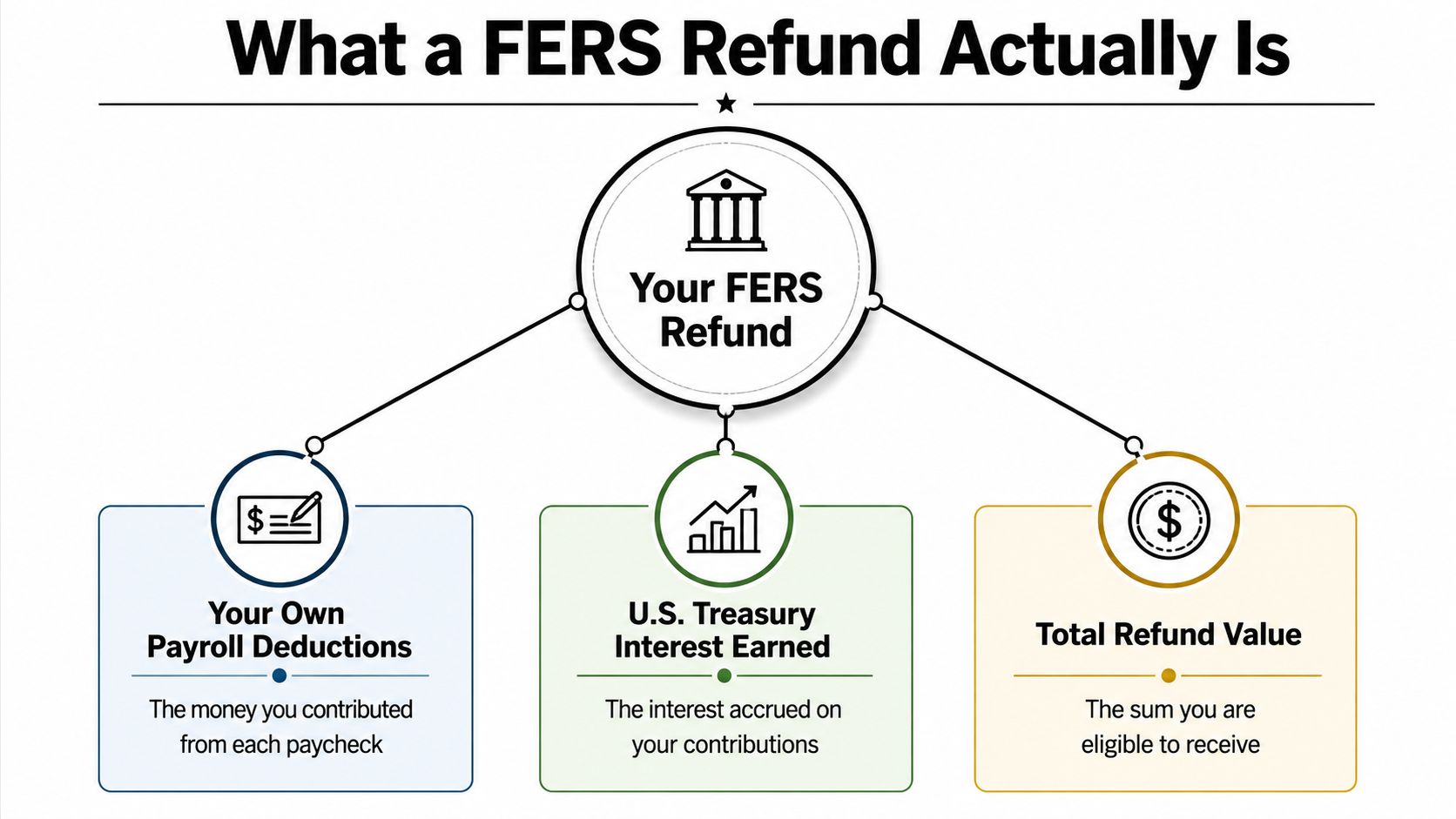
What's in the refund
The refund starts with employee contributions only. For most employees, that means 0.8%, 3.1%, or 4.4% of basic pay, depending on hire date, with interest credited to those deductions over time. The key point is that the refund is built from payroll history, not from separation pay or a guessed lump sum.
Practical rule: if a dollar never came out of your paycheck as a FERS deduction, it does not belong in the refund.
That means the refund does not include the government's automatic or matching contributions. It also does not include your TSP balance, Social Security credits, or any benefit that lives outside the retirement deductions bucket. Those are separate systems, and they stay separate when OPM computes the refund.
Why the distinction matters
Federal employees often compare the refund to a future annuity because the same service time can support retirement income later. OPM's basic FERS annuity formula is generally 1% of the high-3 average salary times years of service, rising to 1.1% only for employees retiring at age 62 or later with 20 or more years of service. That is why the refund question is really a tradeoff between cash now and a pension stream later.
A former employee with a high-3 salary of $80,000 and 5 years of FERS service would be looking at about $4,000 per year under the standard 1% formula, before any special reductions or enhancements. That annuity comparison is what makes people pause before cashing out.
Documents and Pay Items You Need to Pull
An accurate estimate starts with records, not intuition. If the payroll history is incomplete, the refund estimate can drift fast, especially if you changed agencies, had a break in service, or moved through years where your salary changed often. The goal is to rebuild the contribution trail well enough that the refund number reflects actual deductions, not a rough guess.
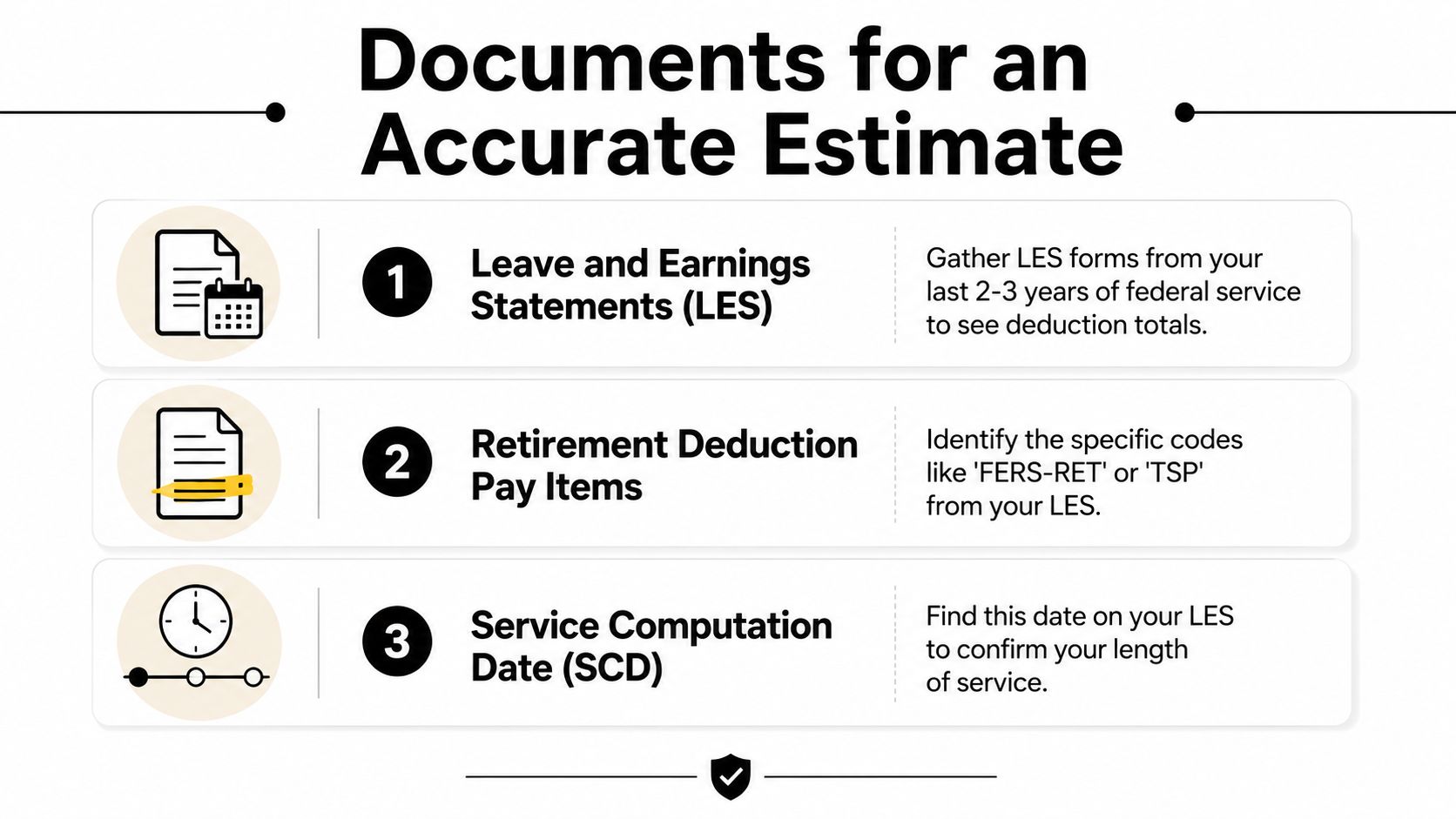
Start with the records that anchor the estimate
Your first stop should be Leave and Earnings Statements (LES). Those show the deduction pattern over time, which is the only way to see whether the contribution base changed when your pay changed. If you can gather LES forms from your last several years of service, you'll usually spot the deduction code and the salary base that fed the refund calculation.
Your SF-50s matter because they verify appointment type, service breaks, and agency changes. The form also helps confirm the service dates that determine whether a period belongs in the refund history. For a deeper look at why this personnel form matters so much, see the SF-50 guide at what is a SF-50 form and why it matters for federal employees.
W-2s can help when LES records are missing, but they're not a perfect substitute because taxable wages aren't the same thing as FERS-covered basic pay. If you had multiple agencies, a long break in service, or old records that moved to archives, W-2s are often better for confirming timing than for reconstructing the refund itself.
Know which pay items count
Only basic pay drives the FERS deduction. That usually includes regular pay and other covered pay items that feed retirement deductions, while items like awards, bonuses, and lump-sum annual leave payments generally don't build the refund in the same way. If your pay changed because of locality, shift work, or other covered adjustments, those records matter because they change the contribution base.
Missing one year of LES data can distort the estimate more than people expect, especially if that year contained a promotion or an agency transfer.
Before you estimate, pull together the records that prove pay, deductions, and service dates. If you want the number to be close, you need the trail, not just the ending salary.
The Calculation Formula With a Worked Example
A good FERS refund estimate starts as a reconstruction, not a shortcut. If your payroll history is complete, the math is straightforward. If your records are scattered across agencies, grades, or old pay systems, the estimate depends on how well you can rebuild each period of basic pay, the deduction rate that applied, and the interest credited later.
FERS contribution rates by hire cohort
| Hire Date Cohort | Employee Contribution Rate | Notes |
|---|---|---|
| First hired before 2013 | 0.8% | Lower contribution rate for most employees in this group |
| First hired in 2013 | 3.1% | Mid-range contribution rate for most employees in this group |
| First hired after 2013 | 4.4% | Core benchmark for many newer employees |
That table gives you the starting point. If you know your basic pay and your hire cohort, a rough estimate can begin with basic pay × contribution rate × years of service, then be adjusted for interest and any pay changes. The problem is that a single annual average can miss the true refund when your file includes promotions, grade changes, part-time service, leave without pay, or a transfer between agencies that used different payroll systems. For a fuller breakdown of how the pieces fit together, use the FERS refund calculation guide.
For a quick comparison or planning exercise, some people use a simple calculator to organize the moving parts. The AI savings calculator is useful when you want to test how different pay assumptions change the estimate before you rebuild the full history.
Worked example
Take a hypothetical employee with a high-3 salary of $80,000 and 5 years of FERS service. Using the common 4.4% contribution rate, the rough principal total is about $17,600 before interest. That is basic pay × rate × years, and it is a reasonable first pass when pay was steady and the record is clean.
That number can still be off if the employee had promotions, unpaid leave, or service at a different agency with different pay cycles. In a file like that, the better method is to rebuild the refund by pay period, because each deduction has to line up with the pay subject to FERS and with the interest credited to that period.
The same approach helps when the records are incomplete. If one agency's LES archive is missing, I start with whatever is available, then backfill from W-2s, SF-50s, and any payroll reports that show covered pay. Missing pieces do not make the estimate impossible, but they do make a single-salary shortcut less reliable.
If you want a quick working number, use the payroll trail first and the average salary second. When the history is messy, the refund is a data-reconstruction problem, not just a formula problem.
Best practice: if your career wasn't flat, don't trust a single salary average. Rebuild by pay period.
Refund Versus Keeping the Annuity
A refund is only half the decision. The question is whether taking your contributions back now is better than leaving them in place for a future FERS annuity. That answer depends on how much service you have, how close you are to retirement age, and whether you need cash now more than you need future income.
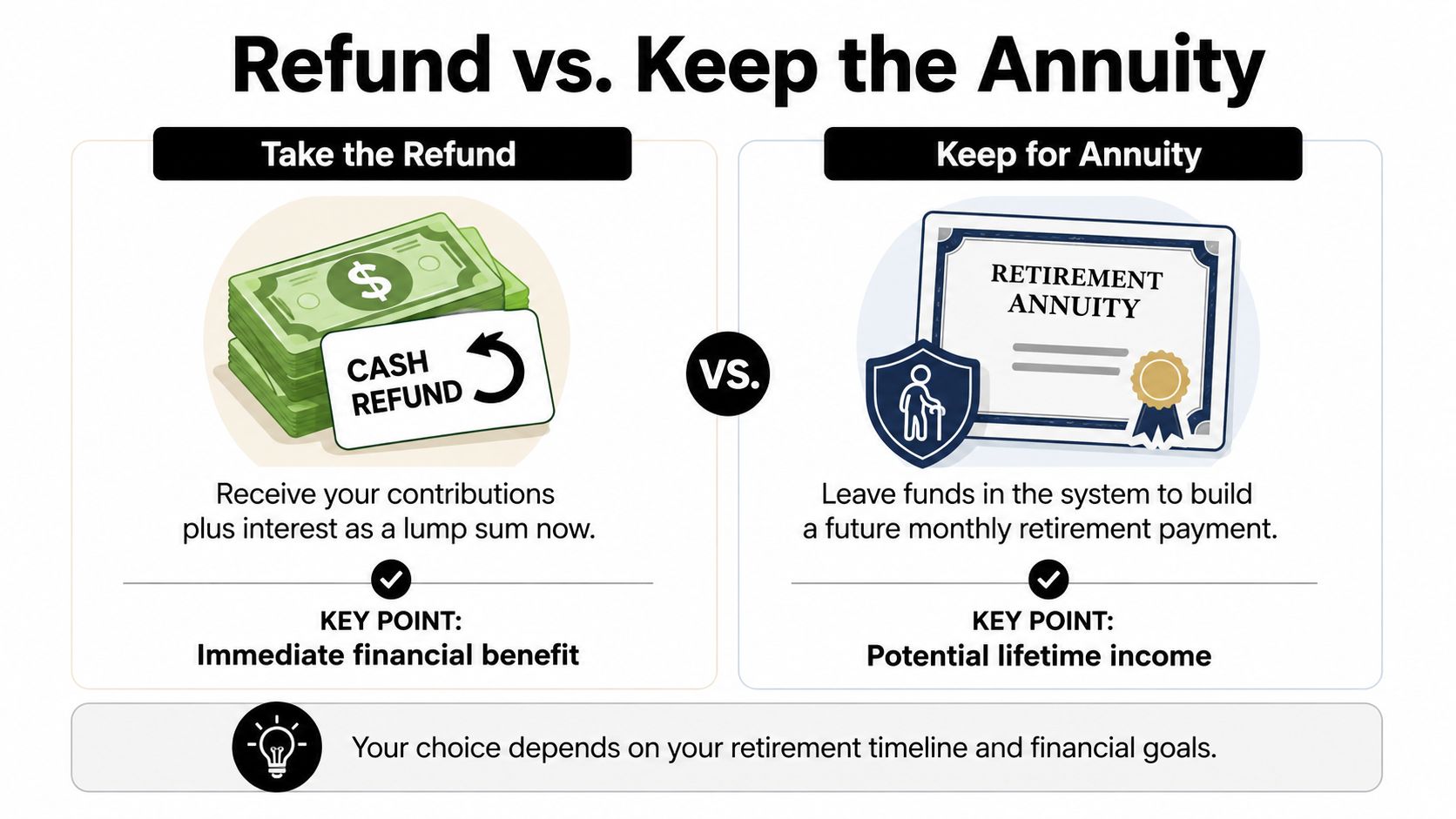
What the annuity side looks like
The standard FERS formula is generally 1% of the high-3 average salary times years of service, with 1.1% available only at age 62 or later with 20 or more years of service. That is the future income stream you give up when you take the refund instead. For the basic formula details, see OPM FERS annuity computation.
Using the earlier example, a worker with a $80,000 high-3 and 5 years of service would be looking at about $4,000 per year under the standard formula. That is not the refund amount. It is the annual pension value of keeping that service in the annuity calculation.
How to weigh the tradeoff
A refund gives you immediate access to your own contributions plus interest. An annuity gives you a future income stream that can last for life, which is a different kind of value. If you need cash for debt, transition costs, or an emergency cushion, the refund can make sense. If you are already close to retirement or you have enough service to build a meaningful annuity, the future income is often worth more than a one-time payout.
A deferred retirement path adds another layer to the decision, because age and service thresholds can change what you are giving up. The rules around that are easier to judge once you know whether your service could later support a deferred benefit or an annuity supplement, and your guide to the FERS annuity supplement is useful for that comparison.
Video
The practical rule is simple. If the refund is the only realistic way to recover your own contributions, it can be a clean exit. If the service may support a meaningful annuity later, the decision deserves a harder look than the lump-sum amount alone.
Taxes, Exceptions, and Things That Change the Number
A refund estimate can still miss the actual deposit by a wide margin. Taxes, prior service, and reemployment rules can change the final figure, and some of those changes happen automatically if the record is incomplete or the election is handled late. Treat the worksheet as a reconstruction of the payroll file, not as a guarantee.
Tax treatment and rollover choices
A FERS refund is generally subject to 20% federal withholding unless you choose a direct rollover to an IRA or another eligible plan. A direct rollover keeps the pre-tax amount inside the retirement system you move it to, while a cash payout can leave you with a smaller deposit after withholding. That gap matters when the estimate was built from gross deductions and you were expecting the full amount to hit your account.
The election itself can change the result as much as the math. Federal employees sometimes choose the payout quickly and only later realize that a rollover fits the tax picture better. If you want a broader comparison of cash-out options in another financial context, the article on credit overpayment retrieval options 2026 shows how different refund mechanisms can change what people receive.
Exceptions That Change the Refund Amount
Prior federal service that was refunded earlier can require a redeposit if you want the time credited again later. Divorce settlements can also carve out part of the benefit through a court-ordered split. If you later return to federal employment, the refund can come back into the picture with an interest charge attached, because the earlier refund does not disappear from the retirement record.
The FERS Supplement can complicate planning too, since it affects retirement timing rather than refund math itself. Employees who are weighing departure and possible later retirement should avoid treating the supplement and the refund as separate decisions with no overlap.
Watch the 31-day rule: if you return to federal employment too quickly after separation, you can end up owing the refund back with interest to preserve creditable service.
The point is not to discourage refunds. It is to keep a clean estimate from being thrown off by a detail sitting in the personnel file.
Filing the Refund and When to Get Help
Once the estimate is close, the filing step is mostly a records check. The application usually goes through your former agency's HR office or OPM's retirement process, and the paperwork has to line up with the service history you already rebuilt. When the file is complete, processing is usually faster than people expect. When it drags, the delay usually comes from missing records, not from the refund calculation itself.
What to submit
The refund application is usually filed on the FERS retirement refund form, with supporting SF-50 copies and any identity or payment details the agency asks for. You also need to choose between direct rollover and a taxable payout before the file goes in, because that choice changes what you receive. If your service record includes old employment, prior refunds, or time from more than one agency, include anything that helps OPM match the deductions to the right periods.
The hard part is often not the form. It is reconstructing the record so the form has something accurate to support it. A clean application usually moves faster than a file built on guesses, and that is why missing personnel records cause so many delays.
When to bring in help
Some cases are straightforward. Others need a second set of eyes.
- Multiple agencies: different payroll systems can leave gaps that make a DIY estimate shaky.
- Breaks in service: missing years are where contribution estimates go off the rails.
- Prior refunds or redeposits: these change the service history and can affect the final amount.
- Divorce orders: court-ordered splits need careful handling before any payout.
- Return-to-federal-work plans: reemployment changes the refund decision fast.
If you want another perspective on refund mechanics in a different context, credit overpayment retrieval options 2026 shows how timing and recovery rules can change what a person gets back.
Realistic timing
A clean file can move in a matter of weeks, but missing records stretch the process. If you are missing LES data, prior-agency records, or anything tied to an older service period, the estimate is only as good as the file behind it.
Federal Benefits Sherpa offers a free 15-minute benefit review for exactly this kind of problem. If you want a second set of eyes on the refund estimate before you file, visit Federal Benefits Sherpa and get the numbers checked against your service history, pay records, and retirement goals.


Dedicated to helping Federal employees nationwide.
“Sherpa” - Someone who guides others through complex challenges, helping them navigate difficult decisions and achieve their goals, much like a trusted advisor in the business world.
Federal Benefits Sherpa, LLC
12724 Gran Bay Parkway West, Suite 410, Jacksonville, FL 32225
Email: [email protected]
Phone: (833) 753-1825
© 2024 Federalbenefitssherpa. All rights reserved
Federal Benefits Sherpa is an independent organization and is not affiliated with or endorsed by the U.S. government or any federal agency.