
Blogs

Blog title place here
We understand that every federal employee's situation is unique. Our solutions are designed to fit your specific needs.

Blog title place here
We understand that every federal employee's situation is unique. Our solutions are designed to fit your specific needs.

Blog title place here
We understand that every federal employee's situation is unique. Our solutions are designed to fit your specific needs.
A Federal Employee's Guide to FEGLI Life Insurance
When you start your federal career, you're handed a bundle of benefits, and one of the most significant is the Federal Employees' Group Life Insurance (FEGLI) program. It's the government's way of providing a foundational layer of financial protection for you and your family. In fact, most new federal and postal employees are automatically enrolled in the Basic coverage, creating an immediate safety net right from day one.
What Is FEGLI Life Insurance and How Does It Work?

Think of FEGLI as a pre-built financial foundation that comes with your job. It's the largest group life insurance program in the world, and for good reason—it covers over four million federal employees, retirees, and their family members. The whole point is to offer you accessible and convenient term life insurance directly through your employer, paid via simple payroll deductions.
For the vast majority of feds, participation is automatic. Unless you go out of your way to sign a waiver, you're enrolled in FEGLI Basic coverage from your first day. This isn't just some minor perk; it's a core piece of your overall benefits package, designed to work in tandem with your retirement savings in the Thrift Savings Plan (TSP) and your FERS or CSRS pension.
The Blueprint for Your Financial Security
Understanding FEGLI is like having the blueprint for your financial house. The government gives you the foundation (the Basic coverage), but it’s up to you to decide whether to build on top of it with additional coverage options. My goal here is to help you read that blueprint, from the automatic enrollment all the way to the critical choices you’ll have to make down the road.
Your journey with FEGLI involves several key decision points over your career:
- Initial Enrollment: Right at the start, you have to decide whether to keep the automatic Basic coverage or waive it.
- Adding Optional Coverage: You'll have opportunities—usually tied to specific life events or rare open seasons—to add extra layers like Option A, B, or C.
- Navigating Career Changes: You need to understand how your coverage and, more importantly, your costs will change as you get older and receive promotions.
- Retirement Decisions: This is the big one. You'll face crucial choices about reducing or keeping your coverage, and these decisions will have a lasting impact on your finances throughout retirement.
To give you a clearer picture of the FEGLI landscape, here's a quick summary of the different coverage components.
FEGLI Coverage at a Glance
| FEGLI Component | Coverage Amount Basis | Who Is Covered |
|---|---|---|
| Basic | Your annual salary, rounded up to the next $1,000, plus an extra $2,000. | You (the employee) |
| Option A | A flat $10,000. | You (the employee) |
| Option B | 1 to 5 multiples of your annual salary, rounded up. | You (the employee) |
| Option C | 1 to 5 multiples of $5,000 for your spouse and $2,500 for your kids. | Spouse and eligible children |
This table shows how each piece of FEGLI is structured, from the foundational Basic plan to the optional layers you can add for yourself and your family.
The Office of Personnel Management (OPM) is the official source for all things FEGLI, and their site is where you can dig into the fine print on eligibility, plan details, and qualifying life events that allow you to make changes.
This is not a 'set it and forget it' benefit. Your FEGLI coverage requires active management to ensure it continues to meet your family's needs without becoming a financial burden, especially as you near retirement. Making the right choices at the right time is essential for building a secure future.
Breaking Down the Four Parts of FEGLI Coverage
Think of your FEGLI life insurance like a four-course meal. You start with a main dish that everyone gets, and then you can add on a few side dishes to build a plan that's right for you. The program is built on a foundational piece, Basic Insurance, with three optional layers you can add to customize your coverage.
It's hard to overstate just how massive this program is. FEGLI is the largest group life insurance program in the world, covering over 4 million federal employees, retirees, and their families. To give you a sense of its scale, as of December 2020, Department of Defense employees alone accounted for 18% of all participants government-wide.
A big reason for its popularity is that the government helps foot the bill, paying for one-third of the premiums for the Basic coverage you’re automatically enrolled in. You can dig into the program's history and structure to see how it became such a cornerstone of federal benefits.
Let's break down each component, one by one, to see how your total protection is actually built.
Part 1: The Foundation is FEGLI Basic
Everyone starts with FEGLI Basic. It's the core of the program and the part you’re automatically enrolled in when you start your federal career. Calculating your coverage amount is pretty straightforward.
- Start with your annual basic salary.
- Round it up to the next highest thousand.
- Then, just add $2,000.
That final number is your Basic Insurance Amount, or "BIA." For example, if your salary is $85,500, you’d round that up to $86,000 and add $2,000, giving you a Basic death benefit of $88,000. Simple as that.
Plus, Basic coverage has a nice built-in feature for younger feds called the "Extra Benefit," and it doesn't cost you a dime. If you're 35 or younger, this feature actually doubles your Basic coverage. The multiplier then goes down by 10% each year until it disappears completely by the time you turn 45.
Part 2: Option A for a Simple Boost
The first optional layer you can add is Option A. This one is simple: it’s a flat $10,000 of additional coverage. It was designed as a no-fuss, low-cost way to bump up your death benefit without any complicated math.
The cost for Option A is based on your age and goes up every five years. It's usually a bargain when you're younger, but it’s definitely something you'll want to keep an eye on to make sure it's still worth it as you get older.
Part 3: Option B for Maximum Customization
This is where the real power of FEGLI lies. Option B is by far the most flexible and potent part of the program, letting you purchase a serious amount of additional life insurance in multiples of your annual salary.
You can choose coverage equal to one, two, three, four, or even five times your annual salary (after rounding it up to the next thousand). This is how you can truly tailor your coverage to handle big-ticket needs, like paying off a mortgage or ensuring there's money for your kids' college education.
Important Takeaway: Option B offers the biggest bang, but it comes with a catch—its premiums are not subsidized by the government at all. The cost is based purely on your age and can get incredibly expensive once you hit your 50s and beyond. This makes it the most critical part of your FEGLI plan to review regularly.
Part 4: Option C for Family Protection
Last but not least, Option C lets you extend life insurance protection to your family. It's also sold in multiples, just like Option B, but the amounts are tailored for family members.
- For your spouse: You can buy one to five multiples of $5,000 in coverage, for a maximum of $25,000.
- For your eligible dependent children: You can buy one to five multiples of $2,500, for a maximum of $12,500.
One of the best features here is that a single premium covers all of your eligible children under age 22, no matter how many you have. This makes Option C a very efficient way to secure a modest amount of coverage for your entire family under one umbrella. And just like the other options, the premiums for Option C are based on your age, not the age of your spouse or children.
How Your FEGLI Premiums Change Over Your Career
One of the biggest surprises for federal employees is how the cost of their FEGLI life insurance changes over time. It’s a classic case of “set it and forget it” coming back to bite you. While your Basic coverage premium is pretty stable (and Uncle Sam chips in), the optional coverages tell a completely different story.
What starts as a cheap and easy benefit can quietly balloon into a major expense if you’re not paying attention.
Think of your FEGLI Optional premiums as a cost staircase you climb throughout your career. Every five years, you take another step up. The first pay period after you turn 35, 40, 45, and so on, your premium for Options A, B, and C automatically increases. This is the engine that drives the cost of the program.
A policy that felt like a great deal in your 30s can become a real financial headache by your late 50s. This catches so many feds off guard, creating sticker shock right when they’re trying to ramp up their retirement savings.
The different parts of FEGLI are designed to work together, but it's the optional layers that have these built-in price hikes.
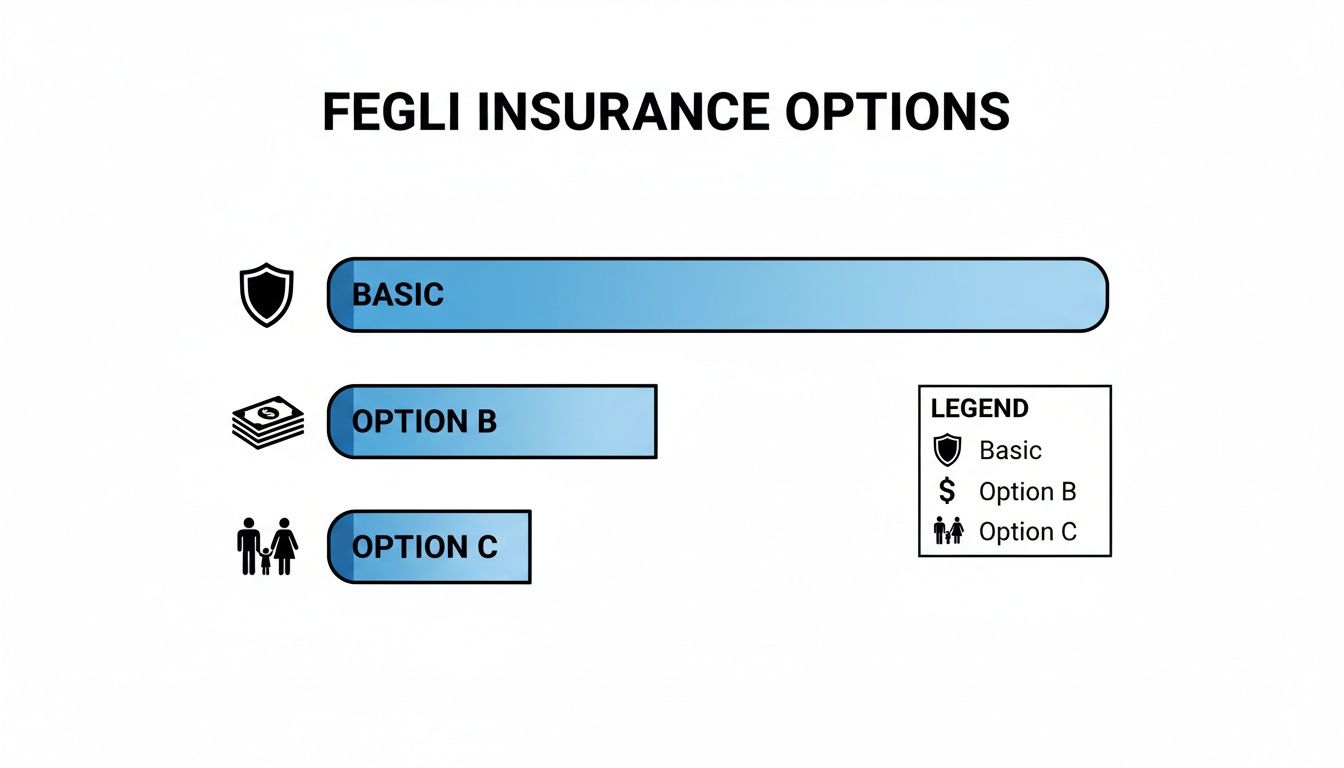
This just gives you a quick visual on how Basic, Option B, and Option C fit into the overall FEGLI program.
The Real Story Behind Premium Hikes
The premium rates for FEGLI have a long history. The Basic premium has stayed fairly consistent—currently it’s $0.225 biweekly for every $1,000 of coverage—because the government pays for a third of it. But the optional rates are where you see the real cost story unfold.
For example, an employee under 35 pays just $0.02 per $1,000 for Option B. But that rate climbs steeply over the years. We saw some significant rate hikes as recently as 2021, when some age brackets saw costs jump by 10% based on new actuarial data. You can always check the most up-to-date numbers by reviewing the current premium structures on the official OPM site.
Simply knowing that these increases are coming is the first step to managing your benefits wisely and avoiding a financial pinch down the road.
Key Insight: The optional parts of your FEGLI life insurance are designed to get more expensive as you get older. This isn't a flaw in the system, but rather a feature of group term insurance that you must plan for. Ignoring these built-in price increases can derail your financial planning later in your career.
Watching Option B Costs Climb
Option B is where these cost increases really hit home because it allows for the highest amount of coverage—up to five times your annual salary.
Let’s walk through a clear example. The table below shows just how dramatically the bi-weekly premium for $100,000 of Option B coverage can change as an employee gets older. You can literally see that "cost staircase" in action.
Sample Bi-Weekly FEGLI Option B Premium Increases By Age
| Employee Age Bracket | Bi-Weekly Premium per $1,000 | Example Cost for $100,000 Coverage |
|---|---|---|
| Under 35 | $0.020 | $2.00 |
| 35-39 | $0.030 | $3.00 |
| 40-44 | $0.040 | $4.00 |
| 45-49 | $0.060 | $6.00 |
| 50-54 | $0.100 | $10.00 |
| 55-59 | $0.180 | $18.00 |
| 60-64 | $0.360 | $36.00 |
| 65-69 | $0.480 | $48.00 |
| 70-74 | $0.900 | $90.00 |
| 75-79 | $1.200 | $120.00 |
| 80 and over | $2.400 | $240.00 |
As you can see, the cost for the exact same amount of coverage multiplies quickly. A 60-year-old is paying 18 times more than someone under 35. Fast forward to age 80, and that same coverage now costs an incredible 120 times more than it did at the start of their career.
This predictable escalation is precisely why you need to be proactive with your FEGLI. By looking ahead at these future costs, you can make smarter decisions today about how much coverage you actually need and whether it makes sense to explore other options, like a private policy, that might offer better long-term value. Planning ahead puts you in control, helping you build a financial safety net that supports you instead of becoming a burden in retirement.
What Happens to Your FEGLI When You Retire?
Retirement is the make-or-break moment for your FEGLI life insurance. The decisions you make right as you’re wrapping up your federal career will lock you into a path that dictates how much coverage you'll have and what you'll pay for it—for the rest of your life. It's a common and costly mistake to just let it ride without a solid plan, as many retirees find themselves paying more and more for a benefit that’s steadily shrinking away.
This isn't a box to check off lightly. Deciding what to do with your FEGLI needs to be part of a bigger picture, a holistic retirement planning strategy that makes sure all the pieces of your financial life work together.
The Five-Year Rule: Your Ticket to Keeping FEGLI
Before you can even start weighing your options, you have to clear one major hurdle to carry any FEGLI coverage into retirement. It’s known as the “5-year rule,” and it's non-negotiable.
To qualify, you need to meet two simple conditions:
- You must be retiring on an immediate annuity, not a deferred one.
- You must have been continuously covered by the FEGLI parts you want to keep for the five years of service right before you retire.
If you've worked for the government for less than five years, you have to have been enrolled for your entire period of service. If you miss this five-year window, you lose the option to continue your FEGLI. It’s a crucial milestone to keep on your radar.
Your Basic Insurance: The Three Big Choices
Once you've met the 5-year rule, your first big decision is what to do with your Basic insurance. You get three choices, and each one involves a serious trade-off between how much you pay and how much coverage you keep.
Here’s how the three paths break down:
- 75% Reduction: This is the default choice and what most people end up with. Your Basic coverage stays at its full value until you hit age 65 (or when you retire, if that's later). From that point, the policy's value starts to drop by 2% every month until it’s worth only 25% of what it was. The big appeal? Once you're 65, the premiums for this drastically reduced coverage are free.
- 50% Reduction: If you pick this, your Basic coverage also starts reducing at age 65, but more slowly—at 1% per month. The reduction stops once it hits 50% of its original value. You’ll pay a higher premium for this option, but you get to keep a larger permanent death benefit.
- No Reduction: This is your most expensive route. You can choose to keep 100% of your Basic coverage for the rest of your life, but it comes with a much, much higher price tag. And you'll be paying those premiums forever.
Crucial Takeaway: That "free" 75% Reduction option sounds great, but it means you're losing a huge chunk of your coverage. For example, a $120,000 Basic policy will eventually shrink to just $30,000. You really have to ask yourself if that smaller amount is still enough to protect your family.
Making the right call here requires a clear understanding of the long-term numbers. Our complete guide on federal employee life insurance after retirement dives deeper into the calculations to help you see these options side-by-side.
Dealing with Your Optional FEGLI in Retirement
So, what about Options A, B, and C? The rules are simpler, but the financial reality can be brutal if you aren't ready for it.
As long as you’ve had these optional coverages for the past five years, you can keep them. The catch? The cost changes dramatically. You are now on the hook for the full, unsubsidized premium, and those premiums will jump every five years as you get older.
Let’s run a quick scenario. Say a retiree has $250,000 in Option B coverage.
- At age 65, their monthly premium is $104.
- At age 70, it shoots up to $195 a month.
- By the time they're 80, that same coverage costs a staggering $520 every single month.
This is the trap that catches so many federal employees off guard. The cost keeps climbing while the death benefit stays the same. People end up paying a fortune for insurance that just isn't worth the price anymore. Option C, which covers your family, works the same way—the premiums are based on your age and they get very expensive, very fast.
Without a plan, it's easy to get priced out of your own life insurance right when your family might need it. This is exactly why taking a hard look at your FEGLI before you retire isn't just a good idea—it's essential for your financial security.
Comparing FEGLI with Private Life Insurance
After seeing how the costs of your FEGLI life insurance can balloon over time, you’re probably wondering what else is out there. That’s a smart question. But this isn't an all-or-nothing decision. The best way to look at this is to see FEGLI as one piece of your financial puzzle, not the whole picture.
Thinking strategically means putting FEGLI—especially the expensive Option B—head-to-head with what you could get from a private life insurance policy. When you do, you’ll uncover a fundamental difference that could easily save you thousands of dollars over the long haul.
It all boils down to one word: stability.
The Predictability of Private Term Insurance
The biggest headache with FEGLI Option B is the constant price hike. As you’ve seen, the premiums jump every five years, and they follow you right into retirement, where the increases get even steeper. This makes budgeting a nightmare right when you need financial predictability the most.
Private term life insurance is a whole different ballgame. You can buy a policy with a level premium, which means your rate is locked in solid. It’s guaranteed not to change for the entire term of the policy, which is usually 20 or even 30 years.
This gives you two massive advantages:
- Budget Certainty: You’ll know exactly what you’re paying every single month for decades to come. No surprises, no five-year sticker shock.
- Long-Term Savings: For most people, particularly if you’re in decent health, a level-term policy is dramatically cheaper over its lifespan than relying on FEGLI Option B alone.
Think of a private term policy like a fixed-rate mortgage—you lock in your payment, and it never changes. FEGLI Option B is more like an adjustable-rate mortgage where you know for a fact that the payments are scheduled to go up.
Building a Hybrid Insurance Strategy
Now, this doesn't mean you should rush to cancel all your FEGLI. The government-subsidized Basic portion is often a fantastic value and well worth keeping. The real secret is to find the right blend for your situation. A popular and highly effective strategy is to combine the best of both worlds.
You can hold on to your affordable Basic FEGLI coverage and then layer a private term policy on top to get the full amount of protection you really need. This hybrid approach lets you secure a large death benefit for your family without getting stuck with FEGLI's runaway costs down the road.
Performing a Gap Analysis
So, how do you figure out the right mix? You need to do what we call a "gap analysis." It sounds technical, but it’s just a straightforward process of figuring out what your family would actually need financially if you were gone and comparing that number to the coverage you already have.
Ask yourself these questions:
- Debt Repayment: How much would it take to wipe out the mortgage, car loans, and any credit card balances?
- Income Replacement: How much money would your family need to live comfortably, and for how many years?
- Future Goals: What about big-ticket items on the horizon, like sending your kids to college?
Once you have that total, you can see how your current FEGLI stacks up. Is it enough, too much, or not even close?
For many feds, this simple analysis reveals that a smart combination of Basic FEGLI and a cost-effective private term policy offers the strongest, most affordable protection for the long run.
Making Confident Decisions About Your FEGLI

We’ve covered a lot of ground, and hopefully, you now have a much clearer picture of how FEGLI life insurance works. If there's one thing to take away, it's this: FEGLI can be a fantastic benefit, especially when you're just starting your federal career. But its value can—and often does—change dramatically as you get older and start planning for retirement.
The right choices for you are deeply personal. They hinge on your health, your family's situation, and what you want your financial future to look like. This means you need to move from being a passive recipient of your benefits to being an active manager of your own financial well-being.
Shifting from Passive to Active Management
So what does being an active manager look like? It means you’re not just setting and forgetting your coverage. You're regularly looking at what you have and what it's costing you, asking some tough but necessary questions along the way.
- Is my current coverage level still what my family actually needs?
- Are the premiums for my optional coverage, which keep going up, still a good deal?
- What’s my game plan for dealing with FEGLI costs once I retire?
Answering these honestly is the first step toward a solid financial strategy. The absolute worst time to start thinking about this is right before you retire—that can be a very expensive mistake.
The most successful federal retirees are the ones who treat their benefits not as a static package but as a dynamic toolkit. By actively managing your FEGLI, you ensure it keeps working for you without turning into a financial burden.
Where Personalized Guidance Becomes Invaluable
This is where getting some personalized advice can make all the difference. A thorough benefits review helps you put your specific situation under the microscope, weigh the pros and cons of your options, and build a life insurance strategy that supports the secure retirement you've worked so hard for.
Our experts at Federal Benefits Sherpa can walk you through this process, making sure you don't leave money on the table or keep paying for coverage that no longer fits your life. A great place to begin is with our essential FEGLI enrollment guide. It's time to take control.
FEGLI FAQs: Your Top Questions Answered
Let's tackle some of the most common questions federal employees have about their FEGLI coverage. Getting clear on these points is crucial for making smart choices about your life insurance.
Can I Just Increase My FEGLI Coverage Whenever I Want?
Unfortunately, no. FEGLI isn't like a private plan where you can easily up your coverage. The opportunities to add or increase your FEGLI are few and far between.
You really only get a chance during a Qualifying Life Event (QLE)—think marriage, the birth or adoption of a child, or a divorce. Outside of a QLE, you have to wait for a rare open season (they don't happen often!) or go through the process of proving you're in good health with a physical exam if you previously waived coverage. This is why the decisions you make when you're first hired and during any QLE are so incredibly important.
What Exactly Is the FEGLI "Living Benefit"?
The Living Benefit is a feature of your Basic insurance that lets you access some or all of that money while you're still alive. It's designed for a very specific, difficult situation: terminal illness.
To qualify, a doctor must confirm that your life expectancy is nine months or less. This benefit gives you a lump-sum, tax-free payment to use however you need—whether for medical bills, final arrangements, or just quality time with family. It's important to understand, though, that any money you take through the Living Benefit is subtracted from the final death benefit your heirs will receive. This makes having your beneficiaries in order absolutely critical. You can learn more about what is a beneficiary designation form and why it matters in our detailed guide.
I Have a Big TSP Balance. Do I Really Need to Keep FEGLI?
This is one of the most important questions a federal employee can ask, and the answer really comes down to your personal financial strategy. It's easy to look at a healthy TSP balance and think you're covered, but savings and insurance play two very different roles.
Your TSP is a long-term investment account. Life insurance, on the other hand, provides an immediate, tax-free pile of cash for your loved ones the moment they need it most. If you rely only on your TSP, your family might have to sell off investments to cover expenses. If the market is down, that's a terrible time to sell, and they'll also have to deal with the tax consequences of those withdrawals.
Think of life insurance as a financial shock absorber. It gives your family instant liquidity to handle funeral costs, pay off a mortgage, and just breathe, all without having to touch your carefully built retirement nest egg.
The smartest move is to look at what your family would actually need. Figure out their expenses, consider the taxes on your TSP, and then decide if that balance is truly enough on its own. For many, a dedicated life insurance benefit is the key to protecting both their family's well-being and their hard-earned retirement savings.
Understanding the nuances of your federal benefits is the first step toward a secure retirement. The experts at Federal Benefits Sherpa are here to provide the personalized analysis you need to make confident decisions. Schedule your free benefits review today.


Dedicated to helping Federal employees nationwide.
“Sherpa” - Someone who guides others through complex challenges, helping them navigate difficult decisions and achieve their goals, much like a trusted advisor in the business world.
Email: [email protected]
Phone: (833) 753-1825
© 2024 Federalbenefitssherpa. All rights reserved