Master open season for fegli: Your Essential FEGLI Enrollment Guide
Here's a common point of confusion for federal employees, so let's clear it up right away: there is no regular, annual open season for FEGLI. This is probably the single most important thing to grasp about your federal life insurance, because waiting around for an enrollment window that never comes is a surefire way to miss your chance.
The Myth of a Regular FEGLI Open Season
Every year, like clockwork, the Federal Benefits Open Season rolls around, usually from mid-November to mid-December. It’s that familiar time when you can enroll in or switch up your Federal Employees Health Benefits (FEHB) or your dental and vision plans (FEDVIP). It's a predictable, reliable opportunity to tweak your benefits for the year ahead.
But the Federal Employees' Group Life Insurance (FEGLI) program plays by a completely different rulebook.

Think of it this way: your other benefits have a door that swings open every single year. FEGLI's door is locked, and you only get a key on very specific occasions. If you don't use that key when you have it, the door locks again—sometimes for good.
Why FEGLI Enrollment Is So Different
So, why the strict rules? It really comes down to managing risk and keeping the program affordable for the entire pool of federal employees. If anyone could sign up for a big life insurance policy whenever they wanted, many would wait until they were sick or had a reason to believe they needed it.
This is a classic insurance problem called adverse selection, and it would cause premiums to skyrocket for everyone.
To prevent that, the Office of Personnel Management (OPM) tightly controls when you can enroll or make changes. Your opportunities are limited to just a few scenarios:
- Right when you're first hired into federal service.
- After a Qualifying Life Event (QLE), like getting married or having a baby.
- By providing proof of medical insurability (a tough process with no guarantees).
- During a rare, OPM-declared open season—the last one was in 2016, and there's no promise another will ever happen.
The bottom line is this: You can't just passively wait for an opportunity to adjust your FEGLI coverage. You have to be ready to act during the very specific, limited windows that open up for you.
FEGLI vs Other Federal Benefits Enrollment
It's helpful to see just how different FEGLI is from the other benefits you're used to managing. This table puts it into perspective.
| Benefit Program | Regular Open Season? | Primary Enrollment Method |
|---|---|---|
| FEGLI | No | New hire window, life events, or proving insurability. |
| FEHB/PSHB | Yes | Annual open season or qualifying life events. |
| FEDVIP | Yes | Annual open season or qualifying life events. |
As you can see, the approach to managing your life insurance has to be much more deliberate. Knowing when and how you can make changes is the first, most critical step in getting your coverage right.
Your Golden Ticket: The New Hire Enrollment Window
For new federal employees, the clock starts ticking on day one. Your first 60 days in a benefits-eligible job are, without a doubt, the single best opportunity you'll ever have to lock in comprehensive life insurance coverage.
Think of this period as your golden ticket—a one-time, no-questions-asked chance to enroll in the full range of FEGLI options.
This initial window is completely unique. Unlike any other time in your career, you don’t need to provide medical evidence of insurability. It is, by far, the easiest and most direct path to setting up a strong financial safety net for your family.
Automatic Enrollment and Your Critical Choices
When you start your federal service, you're automatically enrolled in Basic FEGLI. This foundational coverage is a great starting point, but let's be realistic—it's often not enough to cover major financial responsibilities like a mortgage or future college tuition bills.
The real power of this new hire window is your ability to elect the optional coverages.
During these first 60 days, you can freely choose from:
- Option A for a standard $10,000 benefit.
- Option B to add coverage up to five times your annual salary.
- Option C to provide coverage for your spouse and eligible dependent children.
This decision is more than just filling out paperwork; it’s a cornerstone choice for your family's long-term security. The decisions made during this period, often happening while you're juggling the pressures of a new role, can feel overwhelming. You can learn more about managing this initial phase by understanding the federal employee probationary period.
The new hire window is your only guaranteed opportunity to elect the full range of FEGLI Optional insurance without undergoing a physical exam or answering medical questions. Missing it means facing a much more difficult path later on.
The Long-Term Impact of Waiving Coverage
Choosing to waive or simply ignore your optional FEGLI elections during this initial window has significant, lasting consequences. If you decline the extra coverage, that door closes firmly behind you. You can't just change your mind a few months or years down the road and decide to opt-in.
Instead, you’d have to wait for a Qualifying Life Event (QLE) or attempt the difficult process of proving your insurability through a medical examination—a process with no guarantee of approval. This is exactly why financial advisors often stress how important it is to carefully consider your life insurance needs right at the beginning of your federal career.
Your future self will thank you for taking a moment now to assess your needs and make an informed decision when the process is at its absolute simplest. Securing comprehensive coverage early provides immediate peace of mind and builds a solid foundation for your entire federal career and eventual retirement.
Using Life Events to Unlock FEGLI Changes
Since there’s no predictable, annual open season for FEGLI, it’s easy to feel like whatever you decided on day one is set in stone. But life is rarely that simple. Major personal milestones are one of the few ways you can get a chance to go back and adjust your life insurance.
These are what the government calls Qualifying Life Events (QLEs). Don't think of a QLE as a true open season; it's more like a special key that temporarily unlocks the door to your FEGLI options. It gives you a short, focused window to make specific changes that make sense for your new situation.
This flowchart shows the simple, yet crucial, decision new hires have to make right at the beginning.
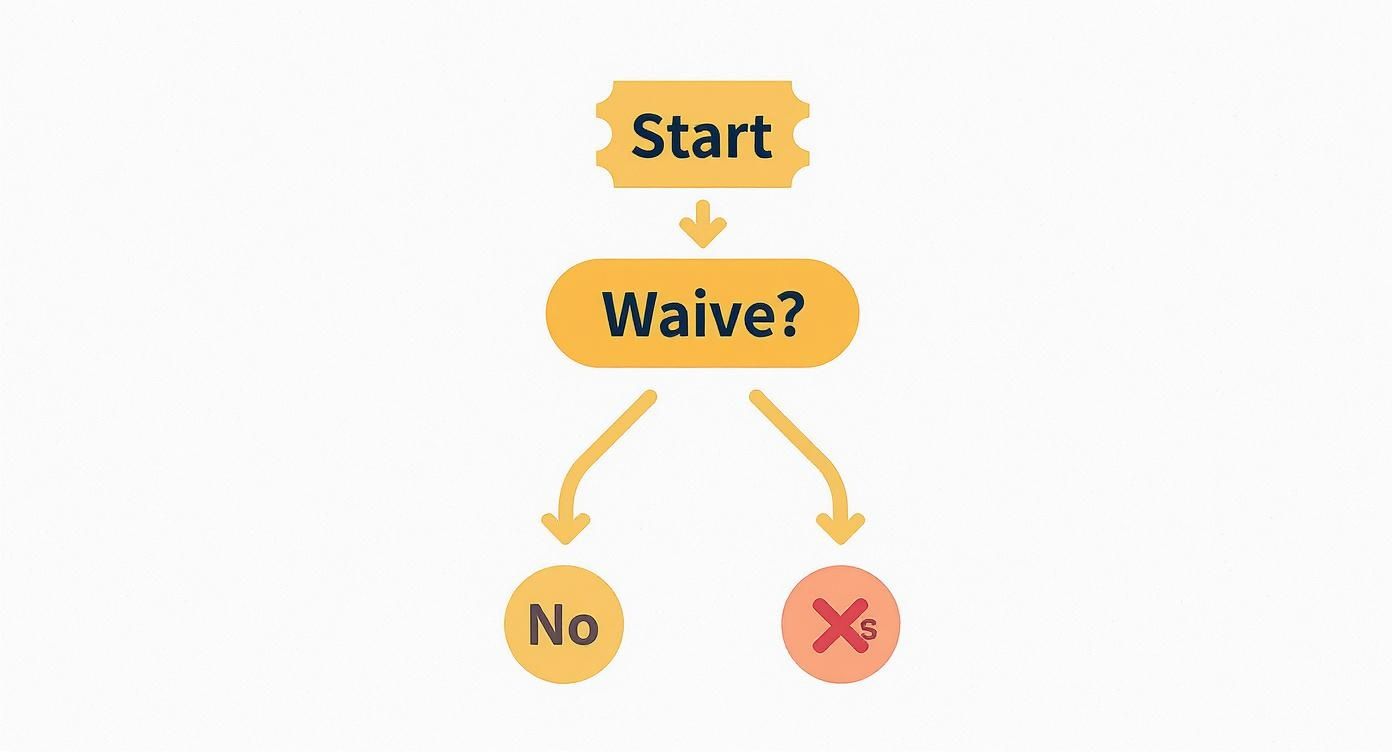
As you can see, waiving coverage from the start has some serious downstream effects, which is why that initial enrollment period is your most straightforward path to getting insured.
What Counts as a Qualifying Life Event
The federal government has a very specific list of events that it knows will directly impact your family and your finances. These are the triggers that let you make FEGLI changes after you’re hired.
Common QLEs that give you a green light to modify your FEGLI coverage include:
- Marriage or Divorce: Getting married lets you enroll or increase your own coverage to protect your new spouse. A divorce might be a reason to decrease or cancel coverage.
- Birth or Adoption of a Child: Welcoming a child to your family allows you to enroll or increase your existing coverage. This is especially relevant for Option C, which covers your eligible kids.
- Death of a Spouse: Losing a spouse is a devastating event that also allows you to re-evaluate and change your coverage to reflect your new family reality.
Each of these events kicks off a strict 60-day window from the date it happens. You absolutely have to act within this timeframe.
If you miss the 60-day window following a QLE, that opportunity is gone for good. You can't go back and claim it later. The door to making changes locks again until another life event happens.
Matching the Change to the Event
Here's a critical point: a QLE doesn’t just throw open the doors to any and all FEGLI changes you might want to make. The adjustments you make have to be directly related to the life event itself.
For example, getting married is a perfectly good reason to sign up for Basic coverage if you had previously waived it, or to add multiples of Option B to better protect your new spouse. But getting married wouldn't be a reason to add coverage on a child you had five years ago.
This "consistency" rule is in place to make sure people are adjusting their insurance based on genuine new needs, not just trying to time things in their favor. Properly managing these benefits is a core part of securing your family’s future, and you can dig deeper into this topic in our guide to federal employee survivor benefits.
You have to be proactive. Know what counts as a QLE, mark that 60-day deadline on your calendar, and be ready to get the right forms to your human resources office right away. These moments are your best—and often only—chance to make sure your FEGLI coverage keeps up with your life.
So, you missed the new hire window for FEGLI and don't have a Qualifying Life Event coming up. Does that mean you're out of luck forever?
Not necessarily, but the only remaining path is a tough one. It’s less of an enrollment and more of an application—one where you have to prove you’re a good risk.
The Last-Resort Option: Proving Your Insurability
If you waived FEGLI and have no other way in, you can apply for coverage by submitting a Request for Insurance (SF 2822). But here's the catch: this route requires you to get a full physical exam, and you have to pay for it yourself.
Think of it this way: when you're a new hire or have a life event, the door is wide open. They don't ask about your health. But with this method, the door is closed, and you have to knock and convince them to let you in based on your medical records.
What to Expect from the Medical Underwriting Process
Once you go down this path, your HR office steps back and the Office of Federal Employees' Group Life Insurance (OFEGLI) takes over. This is where medical underwriting begins, a deep dive into your health to see if you're an acceptable insurance risk.
Here’s how it generally plays out:
- Get the Form: Start by asking your HR office for the SF 2822, Request for Insurance.
- Schedule a Physical: You’ll need to book (and pay for) a medical exam. Your doctor will fill out a section of the form with all the details about your current health.
- Submit to OFEGLI: Once you and your doctor have completed the form, your HR office sends it off to OFEGLI on your behalf.
I can't stress this enough: approval is not a sure thing. OFEGLI will scrutinize your entire medical history. If they find anything that suggests you're a higher-than-average risk, they will deny your request.
Unlike enrolling after a life event, this process isn't about your job status—it's 100% about your health. Any significant pre-existing condition could easily result in a denial.
A Reality Check on This Approach
Trying to get coverage by passing a physical should always be your absolute last resort. Because there's no regular open season for fegli, this difficult application process is the only other door, but it’s full of obstacles and has no guarantee of success.
And if you're denied? That's it. There’s no appeal.
This is exactly why benefits specialists always hammer home the importance of enrolling during your first 60 days on the job or within 60 days of a QLE. Those are your golden tickets—no questions asked, no medical exams, guaranteed approval. Relying on passing a physical later in your career is a gamble you don't want to take.
The Rare FEGLI Open Season: An Unexpected Opportunity
Unlike the annual open seasons for health insurance or other federal benefits, a FEGLI open season doesn't follow a predictable schedule. In fact, it's not a scheduled event at all. Think of it less like an annual appointment and more like a surprise eclipse—it only happens when the Office of Personnel Management (OPM) specifically calls for one, and that’s exceptionally rare.
Just how rare are we talking? Many federal employees go their entire careers without ever seeing one. The last FEGLI open season was back in 2016. Before that, you have to rewind all the way to 2004. That’s a 12-year gap. There's simply no guarantee another one will ever happen.
Why Do They Happen at All?
So, if they aren't for regular enrollment, what's the point? Historically, these rare open seasons are triggered by major, structural changes to the FEGLI program itself. They’re OPM's way of giving employees a chance to adjust their coverage in response to a significant policy overhaul, not for routine sign-ups. This is exactly why you should never bank on one appearing when you need it.
The FEGLI program has been around for a long time. President Dwight D. Eisenhower signed it into law on August 29, 1954, creating what became the largest group life insurance program in the world. Initially, it offered a basic term life policy for federal workers. You can find more about FEGLI's history and structure to see how it has evolved.
It's best to think of a FEGLI open season as an unexpected bonus, not a reliable planning tool. If one is ever announced, it’s a valuable—and very brief—window to reassess your coverage.
If OPM were to declare another open season, you would definitely hear about it. It would be big news across the federal community. Your agency's HR department would send out notifications, and OPM would release detailed instructions.
Should that rare chance ever come around, your first move should be a careful review of where you are in life and what your financial responsibilities look like. The specific rules of that open season will determine what changes you can make, so you'll need to follow the official guidance to the letter.
Making Sense of Your FEGLI Coverage Options
To make smart choices during a rare enrollment window, you first need a solid grip on what you’re actually signing up for. Federal life insurance isn't some off-the-shelf product; think of it more like a set of building blocks you can use to design coverage that fits your life. Let's cut through the jargon and see how it all works.

The foundation of the entire program is Basic Insurance. If you're a new federal employee, you're automatically enrolled in this part. The coverage amount is calculated by taking your annual salary, rounding it up to the next thousand dollars, and then adding another $2,000. The best part? The federal government pays for about one-third of the premium, which makes it a very affordable starting point.
Getting to Know the Optional Coverages
While Basic coverage is a great start, the real power to protect your family comes from the optional add-ons. The FEGLI program grew over time, adding three optional tiers to the original framework. This lets you stack extra protection right on top of your Basic insurance. For a deep dive into these layers, our complete guide to federal life insurance (FEGLI) has you covered.
These options are your tools for building a real financial safety net.
- Option A (Standard): This is the simplest and most straightforward add-on. It gives you a flat $10,000 in extra coverage. Easy.
- Option B (Multiples of Salary): This is where you can get some serious coverage. It lets you buy an amount equal to one, two, three, four, or even five times your annual salary. If you have a young family and a mortgage, electing the maximum five times your salary can be a game-changer for income replacement.
- Option C (Family): This one is designed to cover your spouse and eligible dependent children. You can buy up to five "multiples," where each multiple provides $5,000 for your spouse and $2,500 for each eligible child. For new parents, this can offer immediate peace of mind.
Understanding these distinct options is crucial. While a regular open season for FEGLI doesn't exist, knowing what each option does prepares you to act decisively when a life event or a rare enrollment period occurs.
At the end of the day, the right combination is all about your personal situation. By understanding how each piece works, you can confidently build a coverage plan that truly protects what matters most to you.
Answering Your Top FEGLI Enrollment Questions
When it comes to federal benefits, FEGLI often brings up the most questions. It just doesn't work like the health insurance plans we're used to. Let's tackle some of the most common things federal employees ask.
Why Isn't There a Regular FEGLI Open Season?
This is the big one. Unlike the annual open season for health benefits, FEGLI doesn't have a predictable, yearly enrollment window. The reason comes down to risk.
If everyone could sign up for life insurance whenever they wanted, many would wait until they were sick to get coverage. This concept, known as "adverse selection," would cause premiums to skyrocket for the entire federal workforce.
To keep the program stable and affordable, FEGLI limits enrollment to specific times—like when you're first hired or right after a major life event—before your personal health situation has had a chance to dramatically change.
Can I Sign Up for FEGLI After I Retire?
Unfortunately, no. You can't enroll in FEGLI for the first time once you've retired. Carrying your life insurance into retirement is a benefit you have to plan for ahead of time.
This is where the crucial "five-year rule" comes into play.
The rule is simple but strict: you must be enrolled in FEGLI for the five full years leading up to your retirement date to be eligible to keep it. If you're thinking about retiring in the next few years, now is the time to make sure your FEGLI coverage is in order.
I Missed the 60-Day Window for a Life Event. Now What?
Life gets busy, and deadlines can slip by. If you miss the 60-day window to change your coverage after a Qualifying Life Event (QLE) like a marriage or the birth of a child, that chance is gone for good. You can't go back and use that event to enroll later.
Your only options are to wait for another QLE to happen in the future or to try and get coverage by submitting evidence of insurability. That means passing a physical exam, which can be costly and comes with no guarantee of approval.
How Would I Find Out About a Rare Open Season?
On the rare occasion that the Office of Personnel Management (OPM) does announce a FEGLI open season, you won't have to look for it. The news will come to you.
Your agency's HR department will send out official notifications, and OPM will plaster the information all over its website. It's a major event, and they make sure every eligible employee knows about it.
Making sense of these rules is a lot easier when you have someone in your corner. At Federal Benefits Sherpa, we specialize in helping federal employees navigate their benefits so they can retire with confidence.