
Blogs

Blog title place here
We understand that every federal employee's situation is unique. Our solutions are designed to fit your specific needs.

Blog title place here
We understand that every federal employee's situation is unique. Our solutions are designed to fit your specific needs.

Blog title place here
We understand that every federal employee's situation is unique. Our solutions are designed to fit your specific needs.
Federal Retirement Pay Dates: A Complete Annual Guide
You retire on the last day of April, turn in your badge, and expect the first annuity deposit to appear in May. Then the calendar moves forward, your salary stops, the lump-sum leave payment has its own timing, and the retirement deposit still hasn't arrived. The immediate question isn't just how much you'll receive. It's which payment arrives on which date, what month it covers, and how much cash you need between those events.
Federal retirement pay dates work best as a cash-flow calendar. OPM's rule is straightforward once you separate the dates involved, but confusing those dates can leave a new retiree funding ordinary expenses with credit cards, short-term loans, or an unnecessary withdrawal from the TSP. This guide gives you a calendar-specific way to plan the transition, verify deposits, and handle exceptions.
Why Federal Retirement Pay Dates Are a Cash-Flow Question
The first mistake retirees make is treating retirement as one date. You need to model at least three:
- Separation date: The retirement date recorded by your agency, generally reflected in your personnel documentation.
- Annuity commencement or pay-status date: The point at which OPM recognizes the annuity as payable under the applicable retirement rules.
- First-disbursement date: The date the electronic payment is released and clears your bank.
Those dates can sit in different parts of the calendar. A separation near month-end may leave you with a final salary payment or leave payout before the annuity begins, while the first regular annuity deposit may cover a month that has already ended. OPM explains that the annuity payment is for the prior month, and its example says a May annuity is paid on June 1. See OPM's annuity payment guidance before building your personal schedule.
Build the bridge before you retire
Write the dates on one page. Add the final salary check, any lump-sum annual leave payment, expected interim annuity timing, TSP withdrawals, Social Security income, and recurring bills. Don't treat delayed retirement credits or an eventual final computation as available cash until OPM confirms the payment.
The Federal pay and COLA guide for 2026 can help you separate annual adjustments from the dates on which your annuity arrives. For broader background on how federal retirement income fits into the U.S. retirement system, US retirement explained is a useful companion resource.
Planning rule: Your retirement budget should be funded from the date money clears your account, not from the date an agency or OPM says the benefit has accrued.
A calendar also protects you from weekend and holiday shifts. A payment can move earlier because the scheduled date isn't a business day, but the covered pay period doesn't move with it. That distinction is the difference between correctly managing a checking account and assuming an early deposit represents an extra benefit.
The First-Business-Day Rule and the Prior-Month Convention
OPM's central rule is simple: federal annuity payments generally arrive on the first business day of the month for the benefit accrued during the previous month. A payment received on June 1 covers May, not June. OPM states that the payment is always for the prior month and uses the May annuity paid on June 1 as its example. Review the OPM payment explanation when you need to confirm the covered period.
A business day means a weekday that isn't a federal holiday observed for payment operations. If the first calendar day isn't a banking day, the payment date changes according to the applicable Treasury payment calendar. The practical consequence is important: an adjusted deposit date changes when money arrives, not which month the money covers.
Apply the rule to the 2026 calendar
Use this sequence:
- Identify the month of the benefit being paid.
- Find the first calendar day of the following payment month.
- Check whether that date is a weekend or federal holiday.
- Move the deposit to the applicable business day shown on the official schedule.
For example, a March annuitant receives the March benefit on April 1, 2026, and the April benefit on May 1, 2026. The June 1, 2026 payment is scheduled for a Monday, so it remains on June 1. The deposit date advances or adjusts, but the underlying entitlement remains tied to the prior month.
You can use an Excel business days formula to test weekday and holiday adjustments in a personal spreadsheet. Don't let a spreadsheet replace OPM or Treasury's official calendar, though. Use it to model your bank balance, then verify the result against the payment notice.
The New Year's Day adjustment demonstrates why the calendar can feel compressed. When January 1 falls on a non-banking day, the payment moves to the preceding available business day, which can place the end-of-year and early-January deposits closer together than a normal monthly sequence.
The 2026 Federal Retirement Pay Date Calendar
Keep this table beside your bank statements. It shows the standard first-of-month date and the adjusted date when the calendar requires a shift. The covered benefit is the previous month's annuity in each case.
| Month | Standard Date | 2026 Adjusted Date | Shift Reason |
|---|---|---|---|
| January | January 1 | January 2 | New Year's Day |
| February | February 1 | February 2 | Weekend |
| March | March 1 | March 2 | Weekend |
| April | April 1 | April 1 | No adjustment |
| May | May 1 | May 1 | No adjustment |
| June | June 1 | June 1 | No adjustment |
| July | July 1 | July 1 | No adjustment |
| August | August 1 | August 3 | Weekend |
| September | September 1 | September 1 | No adjustment |
| October | October 1 | October 1 | No adjustment |
| November | November 1 | November 2 | Weekend |
| December | December 1 | December 1 | No adjustment |
The schedule above follows the ordinary first-business-day framework described by OPM. Confirm the operational date with the U.S. Treasury settlement calendar before relying on it for a large transfer, mortgage payment, or planned withdrawal.
What deserves attention in your budget
Several entries deserve more attention than the others:
- January: New Year's Day affects the opening payment date.
- February and March: Weekend adjustments move the deposit into the following business day.
- May: Memorial Day doesn't alter the May 1 annuity deposit because it occurs later in the month.
- July: Independence Day is observed on a different business day, but July 1 remains the scheduled annuity date.
- August and November: Weekend placement changes the first available banking date.
- December: The December 1 payment arrives early in the month, while year-end tax and account reconciliation may occur separately.
Four of the twelve 2026 disbursements land on the first calendar day without an adjustment. That makes the table more useful than a generic rule. Put the adjusted dates into your bank's bill-pay calendar, but leave room for the first payment after separation to follow a different timeline because case processing and interim pay can intervene.
How Weekends and Federal Holidays Shift Payment Dates
Don't assume every federal holiday changes a retirement deposit. The holiday must affect the scheduled payment date or the banking operation connected to that date. A holiday later in the month generally doesn't move a first-of-month annuity payment.
Use the first day of the month as the starting point, then ask whether it falls on a weekend or a recognized federal payment holiday. If it does, the deposit is adjusted to the applicable business day. The Treasury payment calendar controls operational execution, while OPM's annuity guidance controls the benefit timing.
Three 2026 examples
| Holiday | Date Observed | Original Pay Date | Adjusted Pay Date | Reason for Shift |
|---|---|---|---|---|
| New Year's Day | January 1, 2026 | January 1 | January 2 | The standard date requires a business-day adjustment |
| Memorial Day | May 25, 2026 | May 1 | May 1 | The holiday occurs after the scheduled payment date |
| Independence Day | July 3, 2026 | July 1 | July 1 | The observed holiday doesn't fall on the standard payment date |
These examples show why reading the holiday list alone isn't enough. January's holiday is relevant to the opening date, while Memorial Day and Independence Day don't move the May or July first-of-month annuity disbursement.
Don't change the covered month
Suppose a payment posts earlier because the normal date is unavailable. It still represents the same prior-month benefit. Don't label it as the current month's income in your budgeting software, or you may count the same cash twice when the next scheduled deposit arrives.
Veterans Day, Columbus Day, and Juneteenth can create confusion when retirees compare different agency calendars or bank holiday schedules. A bank may display a pending transaction differently from the Treasury release date, and an agency's payroll calendar may not match OPM annuity operations. Check the payment record and bank posting before escalating a perceived delay.
A shifted payment date is a banking adjustment, not a change to your annuity entitlement.
First Annuity Timing From Separation to First Deposit
Your SF-50 separation date starts the retirement chronology, but it doesn't guarantee that money will appear immediately. OPM says about 75% of retirees are placed into interim pay within 30 days after OPM receives a completed application. The later final annuity remains subject to the first-business-day payment rule. Read OPM's first retirement payment FAQ for the official benchmark.
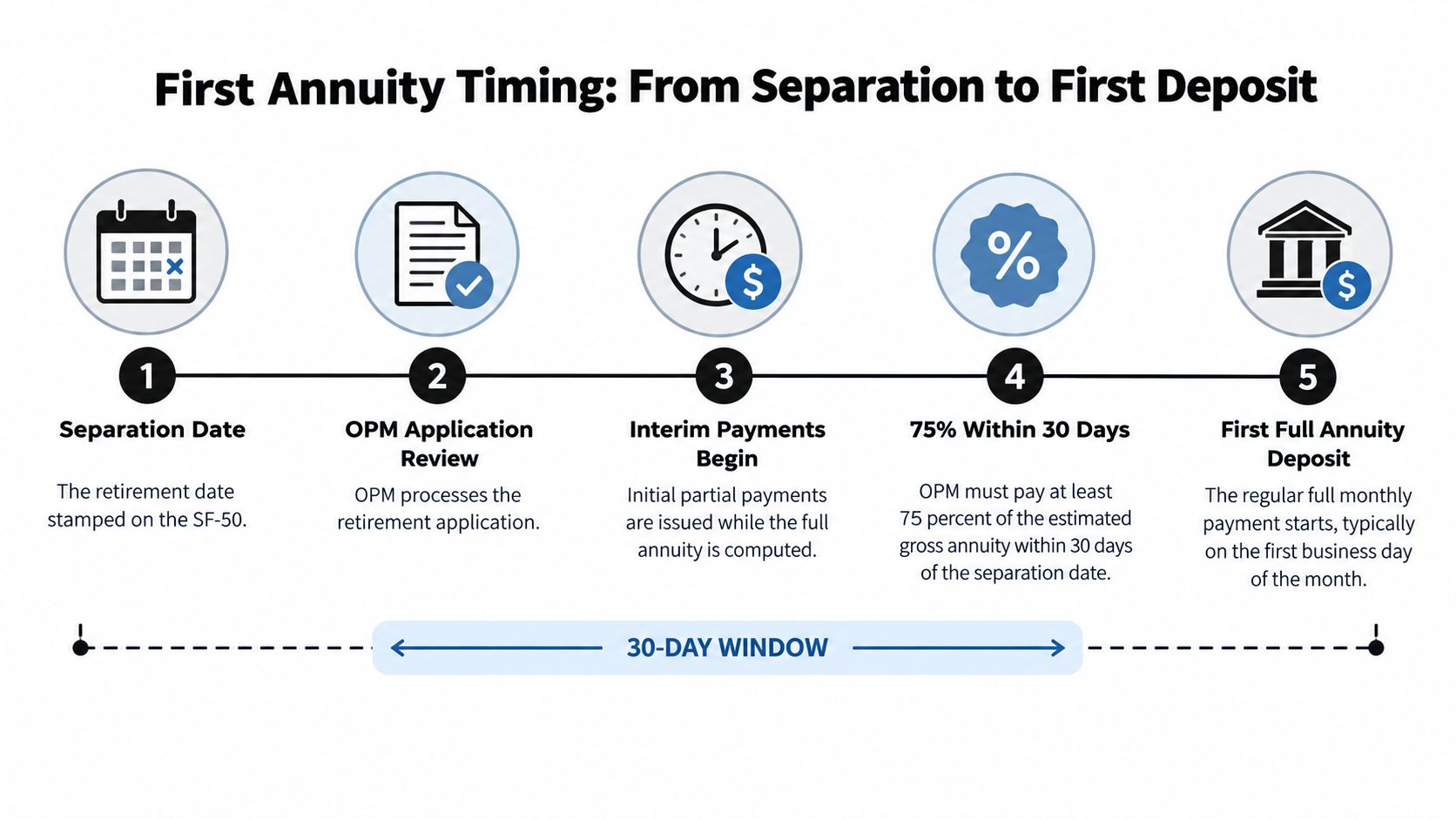
Interim pay is a temporary payment while OPM completes the formal calculation. It isn't the same as the final annuity. The amount can change after OPM reviews service, deductions, elections, and other case details.
Model three possible timelines
A clean file moves from agency certification to OPM review, then into interim pay, followed by a final computation. Complete forms, consistent service records, and prompt agency processing reduce avoidable friction.
A manually adjudicated case takes longer when OPM must resolve a missing document, an inconsistent service record, or an unresolved election. The calendar date of separation doesn't force the final computation to finish on that date.
A CSRS and FERS service-credit issue can require additional review when the record contains a transfer, deposit, redeposit, or creditable-service question. Don't spend against an estimated final amount until the case record supports it.
Common file problems include missing retirement applications, incomplete service documentation, unresolved sick-leave conversion questions, and deposit-service calculations requiring review. For a deeper explanation of administrative bottlenecks, see OPM retirement processing delays.
Use three columns in your cash-flow worksheet: separation date, pay-status date, and first deposit date. Add a fourth column for whether the payment is interim or final. That simple distinction prevents you from treating a temporary deposit as proof that the permanent monthly rate has been established.
How to Confirm Your Payment Landed on Schedule
A missing deposit doesn't automatically mean your annuity was canceled. First determine whether the payment was released, whether your bank posted it, and whether OPM changed the amount or payment method.
Check these records in order:
- Bank statement: Look for the Treasury or OPM deposit on the expected business date. A pending entry may not be available for spending yet.
- Online Retirement Account: Sign in and open the payment history. Look for the gross payment, deductions, net amount, and covered pay period.
- Monthly statement: Review the Statement of Monthly Rate and Deductions for changes in withholding, insurance, or other deductions.
Use a disciplined missing-payment checklist
Wait until the end of the banking day. Then ask the bank to confirm whether a Treasury deposit is pending, rejected, or held because of an account or routing problem. If the bank finds no transaction, review whether your direct-deposit information changed or whether an offset could affect the net payment.
Compare the online payment record with the bank statement. A gross amount can appear in OPM's history while the bank receives only the net amount after deductions. If OPM shows no payment record, contact OPM using the phone number printed on your most recent statement and keep your retirement claim number available.
Don't open a case based only on a morning delay. Bank posting times vary, and the first business day can end before the transaction becomes available. Document the expected date, the account checked, the bank's response, and the OPM record before escalating.
Exceptions, Retroactive Pay, and Survivor Benefit Timing
The ordinary first-business-day schedule is a baseline, not a promise that every retirement-related deposit will arrive on that date. Survivor annuities, retroactive adjustments, and court-directed payments can follow separate processing paths.
A survivor benefit is tied to the survivor's eligibility and commencement rules, not to the next regular annuity cycle. The payment may therefore appear outside the ordinary monthly pattern while OPM establishes eligibility, verifies documentation, and calculates the benefit. Families handling a death should use a dedicated federal retirement survivor benefits guide rather than applying the retiree's calendar mechanically.
Read unexpected deposits carefully
A retroactive adjustment can arrive as a separate payment after OPM finishes a calculation or corrects an earlier amount. It may not match the scheduled annuity because it represents accumulated differences, deductions, or another case-specific correction. Treat it as a reconciliation item until the accompanying notice explains the payment.
Court-ordered allocations, divorced-spouse rights, garnishments, and fiduciary arrangements can change who receives the money and how the net amount is calculated. A payment sent to a third party may not appear in the retiree's account even though the underlying annuity remains active.
When an unexpected deposit appears:
- Match the notice: Compare the payment with OPM correspondence and the retirement case file.
- Check tax coding: Review the eventual IRS Form 1099-R for the correct tax year and distribution reporting.
- Separate gross from net: Reconcile deductions, offsets, and any court-directed allocation.
- Don't spend the difference immediately: Wait until OPM identifies whether the money is a correction, retroactive amount, or regular payment.
The special processing path matters because these deposits can arrive on a different business day from the normal annuity. Your bank statement tells you when money arrived. OPM's payment record and correspondence explain why.
Frequently Asked Questions About Federal Retirement Pay Dates
Why does my bank show the deposit as pending?
OPM or Treasury can release a payment while your bank still displays it as pending. Banks control their own posting and funds-availability processes, so a pending entry isn't the same as an unavailable or canceled annuity.
Check the bank statement, the online payment history, and the net amount after deductions. If the transaction remains pending through the banking day, ask the bank whether it needs to release, reject, or investigate the deposit.
How long does it take for funds to clear?
There's no single clearing interval you should assume for every bank. Use the scheduled payment date as the planning date, but budget conservatively until the deposit is available in your account.
If the payment isn't visible by the end of the expected banking day, confirm with the bank first. Then use the contact information on your latest OPM statement. Give OPM the exact date, expected amount, and account status rather than reporting only that the payment is late.
What happens when Veterans Day, Columbus Day, or Juneteenth affects banking?
A holiday matters only if it affects the payment operation or the scheduled date. Don't move every annuity deposit because a holiday appears in the month.
Check the official Treasury payment calendar and compare it with OPM's payment record. If your bank uses a different display convention, rely on the actual transaction status and covered pay period, not a calendar app alone.
Does a January COLA adjustment change the payment date?
An annual adjustment can change the amount shown on a later statement, but it doesn't erase the prior-month payment convention. Review the monthly rate and deductions statement to distinguish an amount change from a date change.
If the net deposit differs, compare gross annuity, insurance deductions, tax withholding, and other deductions before assuming OPM changed the payment schedule.
What happens if I retire in the middle of a month?
A partial month may be handled differently from a complete month because the annuity commencement rules depend on the retirement type and separation circumstances. Don't assume the first payment represents a full calendar month.
Ask OPM or your agency retirement counselor which date starts entitlement, then record that date separately from the first disbursement date. This is especially important when the final salary period and annuity period overlap in your cash-flow plan.
Why did two deposits arrive in one month?
Two deposits can appear in one calendar month when a regular annuity payment coincides with a separate retroactive correction, interim-to-final reconciliation, or other special payment. That doesn't necessarily mean you've received two regular monthly benefits.
Read each payment's description, gross amount, deductions, and covered period. Keep the accompanying OPM notice with your tax records and don't treat the second deposit as recurring income.
Should I call OPM or use the online account?
Use the online account to inspect payment history and statements first. Call the OPM Retirement Services line using the number printed on your statement when the record is missing, the amount is wrong, or the bank can't locate the deposit.
If a payment remains materially unresolved after you verify the bank, document every contact and request a case reference. Escalate through the channel OPM provides for the retirement case rather than repeatedly submitting incomplete inquiries.
What should I do about a missing or partial deposit?
Use this short sequence:
- Confirm the date: Check the applicable first-business-day schedule.
- Check the bank: Ask whether the deposit is pending, rejected, or restricted.
- Review OPM history: Compare gross, deductions, net deposit, and covered month.
- Check for offsets: Look for changes that could reduce the net payment.
- Contact OPM: Use the number on your latest statement and retain the response.
Federal retirement pay dates become manageable once you stop treating them as isolated calendar entries. Build your first-year plan around separation, pay status, and cleared cash, then reconcile every deposit against the month it covers.
Federal Benefits Sherpa helps federal employees and retirees organize retirement income, benefit elections, and cash-flow decisions through personalized planning, benefit reviews, and gap analysis. Visit Federal Benefits Sherpa to connect your retirement pay dates with the rest of your federal benefits plan.


Dedicated to helping Federal employees nationwide.
“Sherpa” - Someone who guides others through complex challenges, helping them navigate difficult decisions and achieve their goals, much like a trusted advisor in the business world.
Federal Benefits Sherpa, LLC
12724 Gran Bay Parkway West, Suite 410, Jacksonville, FL 32225
Email: [email protected]
Phone: (833) 753-1825
© 2024 Federalbenefitssherpa. All rights reserved
Federal Benefits Sherpa is an independent organization and is not affiliated with or endorsed by the U.S. government or any federal agency.