Navigating Federal Retirement Survivor Benefits
When you pass away, what happens to the federal retirement income your family depends on? That's the question at the heart of federal survivor benefits.
These benefits are a form of insurance built into your federal retirement plan. By electing a survivor annuity, you ensure that a portion of your monthly pension continues to be paid out to your eligible spouse or children after you're gone. It’s a critical safety net that provides a reliable, ongoing stream of income for your loved ones.
Understanding Your Survivor Benefits Safety Net
Think of it this way: over your entire career, you've been building a financial foundation for your retirement. Your pension is the main structure. Federal retirement survivor benefits act as a permanent support beam for that foundation, making sure it stays strong for your spouse even when you're no longer there.
This isn't an automatic feature; it's a conscious decision you make at retirement. Without it, your pension payments stop entirely upon your death. For many families, that sudden loss of income would be financially devastating. Electing a survivor benefit is how you prevent that from happening.
The Three Pillars of Survivor Support
A surviving spouse’s financial security rarely comes from a single source. Instead, it’s usually built on three distinct components that work together. Getting a handle on how each one operates is the first step toward making a smart plan.
Let's take a quick look at the main types of survivor benefits available to federal families.
Overview of Federal Survivor Benefit Components
Benefit ComponentWhat It ProvidesPrimary BeneficiariesPension Survivor AnnuityA lifelong monthly payment from your FERS or CSRS pension.Surviving spouse, and in some cases, dependent children.Thrift Savings Plan (TSP)The full balance of your TSP account.The beneficiaries designated on your TSP-3 form.Social Security Survivor BenefitsMonthly payments based on your Social Security earnings record.Surviving spouse, former spouses, and dependent children.
Each of these pillars plays a unique role in creating a comprehensive financial plan for your survivors.
The three main components are:
Pension Survivor Annuity: This is the big one—a predictable, lifelong monthly check for your surviving spouse, paid from either the Federal Employees Retirement System (FERS) or the Civil Service Retirement System (CSRS).
Thrift Savings Plan (TSP): Your TSP account is a completely separate asset, similar to a 401(k). The entire balance passes directly to whomever you named on your TSP-3 beneficiary form, offering a lump sum or a series of payments.
Social Security Survivor Benefits: For most FERS employees, Social Security provides another vital layer of support. It can pay out monthly benefits to eligible spouses, children, and sometimes even former spouses.
Planning for survivor benefits is fundamentally an act of care. It's about consciously deciding how to best protect the people who matter most, ensuring they have stability and peace of mind long into the future.
In this guide, we'll break down each of these components so you know exactly what to expect. We’ll start by digging into the FERS and CSRS survivor annuity options, then show you how your TSP and Social Security fit into the overall picture. From there, we'll get into the nitty-gritty of making your election and filing for benefits, giving you a clear roadmap from start to finish.
Comparing FERS and CSRS Survivor Annuities
When you're mapping out your family's financial future, one of the most critical steps is getting to know the ins and outs of your specific federal retirement system. The government has two main systems—the modern Federal Employees Retirement System (FERS) and the older Civil Service Retirement System (CSRS)—and they couldn't be more different in how they handle federal retirement survivor benefits.
Think of them as two different roadmaps to the same destination: your loved one's long-term security. Each has its own rules, its own routes, and its own costs.
For most feds on the job today, FERS is the system that counts. It’s built on a three-legged stool: a basic pension, Social Security, and the Thrift Savings Plan (TSP). CSRS, on the other hand, is a legacy pension plan that stands on its own, generally without Social Security. These fundamental differences have a huge impact on how survivor benefits work, what they cost, and the choices you'll face when you retire. Let's dig in.
The diagram below gives you a bird's-eye view of how these pieces fit together to create a financial safety net for your family.
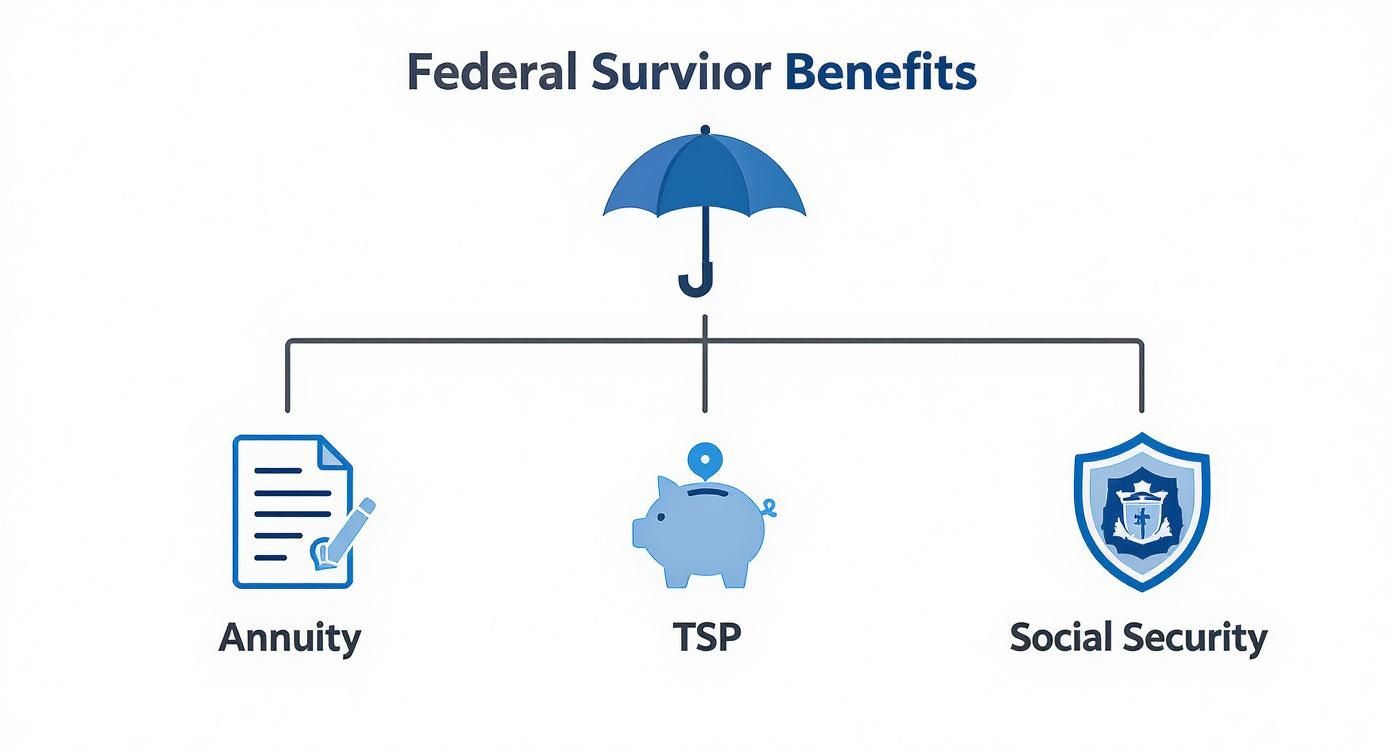
As you can see, the pension annuity is just one piece of the puzzle. Your TSP and Social Security also play major roles, and we'll cover how they all interact a bit later.
FERS Survivor Benefit Options and Costs
If you're under the FERS system, you have a straightforward but significant decision to make at retirement. You have to decide if you want to provide a survivor annuity, which means taking a small hit on your own pension to guarantee a future income stream for your spouse.
You’ve got two main choices on the table:
Full Survivor Annuity (50% Option): This is the most common election. It provides your surviving spouse with 50% of your full, unreduced pension. The cost? A permanent 10% reduction to your own monthly annuity.
Partial Survivor Annuity (25% Option): This offers a smaller safety net, giving your survivor 25% of your unreduced pension. For this, your own pension is reduced by 5%.
You can choose to provide no survivor benefit, but it’s a big decision that requires your spouse's written, notarized consent. Taking this path means your pension payments stop for good when you pass away, and it could also mean your spouse loses their eligibility to stay on your Federal Employees Health Benefits (FEHB) plan.
As for eligibility, you generally need at least 10 years of creditable service (with five being civilian) to offer a survivor annuity. You also need to have been married for at least nine months before your death, though OPM can waive this rule in cases of accidental death or if you had a child together.
CSRS Survivor Annuity Calculations
For our long-serving feds under the CSRS system, things work a little differently. Instead of picking a flat percentage, the survivor benefit is based on a specific formula. The maximum a surviving spouse can receive is 55% of the retiree’s unreduced annuity—a bit more generous than FERS.
The cost is also calculated with a unique formula. Your pension is reduced by 2.5% on the first $3,600 of your annual annuity, and then by 10% on any amount above that. For many retirees, this calculation results in a slightly smaller reduction than the flat 10% under FERS for a similar level of benefit. You can learn more about the math behind your pension and see how these reductions impact your bottom line by reading up on how to calculate your FERS retirement.
At the end of the day, the core decision is identical for both FERS and CSRS employees: you are trading a small piece of your own retirement income today for the certainty of providing for your spouse tomorrow. The key is to understand the exact math for your system.
The Office of Personnel Management (OPM) is the agency that manages both systems and sets all the rules. For FERS employees who pass away while still in service, OPM also handles the Basic Employee Death Benefit (BEDB). This is a lump-sum payment—which has grown to $37,055.54 for deaths after December 1, 2021—designed to provide immediate financial help on top of any monthly annuity.
A Side-by-Side Look at FERS and CSRS
Sometimes the easiest way to see the differences is to put them right next to each other. The table below breaks down the key features of the survivor annuity for both retirement systems.
FERS vs. CSRS Survivor Annuity at a Glance
FeatureFERS Survivor AnnuityCSRS Survivor AnnuityMaximum Spousal Benefit50% of your unreduced pension.55% of your unreduced pension.Cost for Full BenefitA flat 10% reduction of your pension.A formula-based reduction (2.5% on first $3,600, 10% on the rest).Partial Benefit OptionYes, you can elect a 25% benefit for a 5% pension reduction.Yes, you can elect a benefit based on a smaller portion of your annuity.Coordination with Social SecurityYes, it is designed to work alongside Social Security survivor benefits.No, CSRS operates independently of Social Security.
This comparison really highlights the distinct designs of each system. FERS is built to integrate with other benefits, while CSRS is a more self-contained plan.
Whether you're FERS or CSRS, electing a survivor annuity is one of the most important decisions you'll make. It directly impacts your family's financial health for years to come, and it deserves careful consideration.
How TSP and Social Security Complete the Picture
Your federal pension is the foundation of your survivor benefits plan, but it's not the whole story. To get the full picture of the financial safety net you’re leaving for your family, you have to look at two other massive pillars of support: your Thrift Savings Plan (TSP) and Social Security.
These three components—the FERS/CSRS annuity, TSP, and Social Security—are designed to work together, each playing a different but crucial role. Think of your survivor annuity as a steady, lifelong income stream for your spouse. Your TSP, on the other hand, acts as a separate pool of inherited capital, and Social Security adds yet another layer of monthly payments.
Let's break down how these two assets complete the financial security plan for your loved ones.

Your Thrift Savings Plan: A Direct Inheritance
Your TSP account is best thought of as a separate financial legacy, completely independent of your OPM pension. When you pass away, the entire balance of your TSP—whether it’s in a Roth or Traditional account—goes directly to the people you’ve named on your TSP-3, Designation of Beneficiary form.
This isn’t a monthly payment; it’s an inheritance of the full account value. That's a critical distinction. The money bypasses probate and is paid out according to your explicit instructions on that form. This is why keeping your TSP-3 updated is one of the single most important administrative tasks of your entire career.
A common and costly mistake is assuming a will or trust can override your TSP-3 form. It cannot. The TSP-3 is the final word on who gets your money, regardless of what other legal documents say.
Once a beneficiary inherits the funds, they have several choices. This flexibility is a huge advantage, allowing them to tailor the payout to their own financial needs.
Lump-Sum Payment: They can take the entire balance at once, though this can come with significant tax implications.
Installment Payments: They can set up monthly, quarterly, or annual payments to stretch the funds out over time.
TSP Beneficiary Participant Account: A surviving spouse can roll the inherited TSP into their own special account, letting the money stay invested and continue growing tax-deferred.
Annuity Purchase: The beneficiary can use the funds to purchase a life annuity, creating another stream of guaranteed income for themselves.
For a deeper dive into how this powerful retirement tool works, check out our simple guide on how the TSP works.
Social Security Survivor Benefits: A National Safety Net
For FERS employees, Social Security provides the third and final pillar of survivor support. Much like your pension, Social Security can provide a monthly income to eligible family members after your death, based on your lifetime earnings record. It’s a cornerstone of our national retirement system and a vital financial resource.
The scale of this program is immense. In 2025, Social Security is projected to award survivor benefits to approximately 5.8 million people, which is about 7.8% of the 73.9 million total recipients. These survivors receive an average monthly benefit of about $1,546, amounting to a staggering $8.9 billion paid out every single year. You can explore more about these statistics by reviewing the latest data snapshots from the SSA.
So, who qualifies for these benefits? The rules are specific but designed to cover a wide range of family situations.
Who Can Receive Social Security Survivor Benefits
Eligible SurvivorConditions for Receiving BenefitsSurviving SpouseCan start receiving benefits as early as age 60 (or age 50 if disabled).Surviving Spouse (caring for a child)Can receive benefits at any age if they are caring for the deceased's child who is under age 16 or disabled.Unmarried ChildrenEligible if under age 18 (or up to 19 if a full-time high school student). Also eligible at any age if they were disabled before age 22.Dependent ParentsCan receive benefits if they are age 62 or older and were financially dependent on the deceased employee.
It's important to remember that these benefits are not automatic. The surviving family members must apply for them through the Social Security Administration. The amount they get is a percentage of your benefit, which depends on the survivor's age and relationship. For example, a widow or widower at their full retirement age typically receives 100% of what your benefit would have been.
Together, your FERS annuity, TSP inheritance, and Social Security survivor benefits create a robust, multi-layered financial defense for your family, ensuring they have stability and security for years to come.
Making a Strategic Survivor Benefit Election
Deciding on your survivor benefit is easily one of the most critical financial choices you'll make when you retire. It’s a classic trade-off: you accept a permanent reduction to your own pension now in exchange for providing a lifelong income for your spouse later. This decision isn't just about the numbers; it's a deeply personal one that requires a hard look at your family's specific situation.
At its core, you're weighing the cost of the benefit against the security it provides. For instance, if you're a FERS employee and elect the full survivor benefit, you're looking at a 10% reduction to your pension for the rest of your life. While that might sound like a big hit, the peace of mind it buys can be priceless. It guarantees your spouse will have a steady, predictable income, no matter what happens down the road.
Analyzing the Real-World Financial Impact
To really understand this, you have to run the numbers. Let’s create a simple scenario with a FERS employee we'll call "Sarah." Imagine her full, unreduced pension is calculated to be $4,000 per month.
Here’s how her choice would play out for her and her husband:
Full Survivor Benefit (50%): Sarah’s pension is reduced by 10%, which is $400. She now receives $3,600 per month. If she passes away first, her husband gets $2,000 a month (50% of her full $4,000 pension) for the rest of his life.
Partial Survivor Benefit (25%): The reduction is smaller, just 5% ($200). Sarah receives $3,800 per month. Her husband would later receive $1,000 a month (25% of her full $4,000 pension).
No Survivor Benefit: Sarah takes home her full $4,000 each month. But when she dies, the pension payments stop. Completely. Her husband receives nothing further from her federal pension.
Laying it out like this makes the trade-off crystal clear. You have to ask yourself: is having that extra $400 per month during my retirement more important than guaranteeing my spouse a $2,000 monthly income after I'm gone?
This isn't just a math problem; it's a risk management decision. You are insuring your spouse's future against the loss of your pension income—an income that cannot be easily replaced.
Considering Your Family's Unique Situation
There is no "right" answer here because every family is different. The best choice for you depends entirely on your family's overall financial health, your ages, and what you both expect for the future.
Before you make a final call, talk through these key factors:
Spouse's Age and Health: A younger spouse or one with ongoing health issues could potentially rely on that survivor benefit for many, many years.
Spouse's Own Retirement Savings: Does your spouse have their own pension? A healthy TSP or 401(k)? A financially independent spouse might change the calculation, making a smaller benefit—or even none at all—a reasonable option.
Access to FEHB: This is a big one. For many, electing any survivor annuity is the only way for a surviving spouse to keep their Federal Employees Health Benefits (FEHB) coverage. Losing FEHB could lead to staggering, unexpected medical bills.
Social Security Survivor Benefits: Your spouse will likely be eligible for Social Security survivor benefits, but it’s best to see this as a supplement, not a replacement. While Social Security is a massive program—distributing $104.7 billion in a single month (December 2024)—survivors received just $8.9 billion of that. The average survivor benefit was only about $1,546 per month, which is tough to live on alone. You can find more U.S. Social Security spending data on USAFacts.org.
Exploring the 'Pension Maximization' Strategy
Some federal employees look into an alternative approach called "pension maximization." The idea is to waive the OPM survivor annuity and buy a private life insurance policy instead. You'd take your full, unreduced pension and use that extra money (the part that would have been the reduction) to pay the life insurance premiums.
This can work in very specific cases. For example, if the federal employee is in fantastic health and can get a cheap policy, or if their spouse is much older. But it comes with some serious risks. A life insurance payout is usually a lump sum, not a guaranteed monthly check, which requires careful financial management. Plus, the cost and even availability of life insurance can be all over the map, and unlike federal retirement survivor benefits, the payout won't get adjusted for inflation.
A Step-by-Step Guide to Applying for Benefits
When a loved one passes away, the last thing you want to deal with is a mountain of government paperwork. Applying for federal retirement survivor benefits can feel daunting, especially during such a difficult time. This guide is designed to walk you through it, step by step, so you know exactly what to do, which forms to find, and how to sidestep common delays.
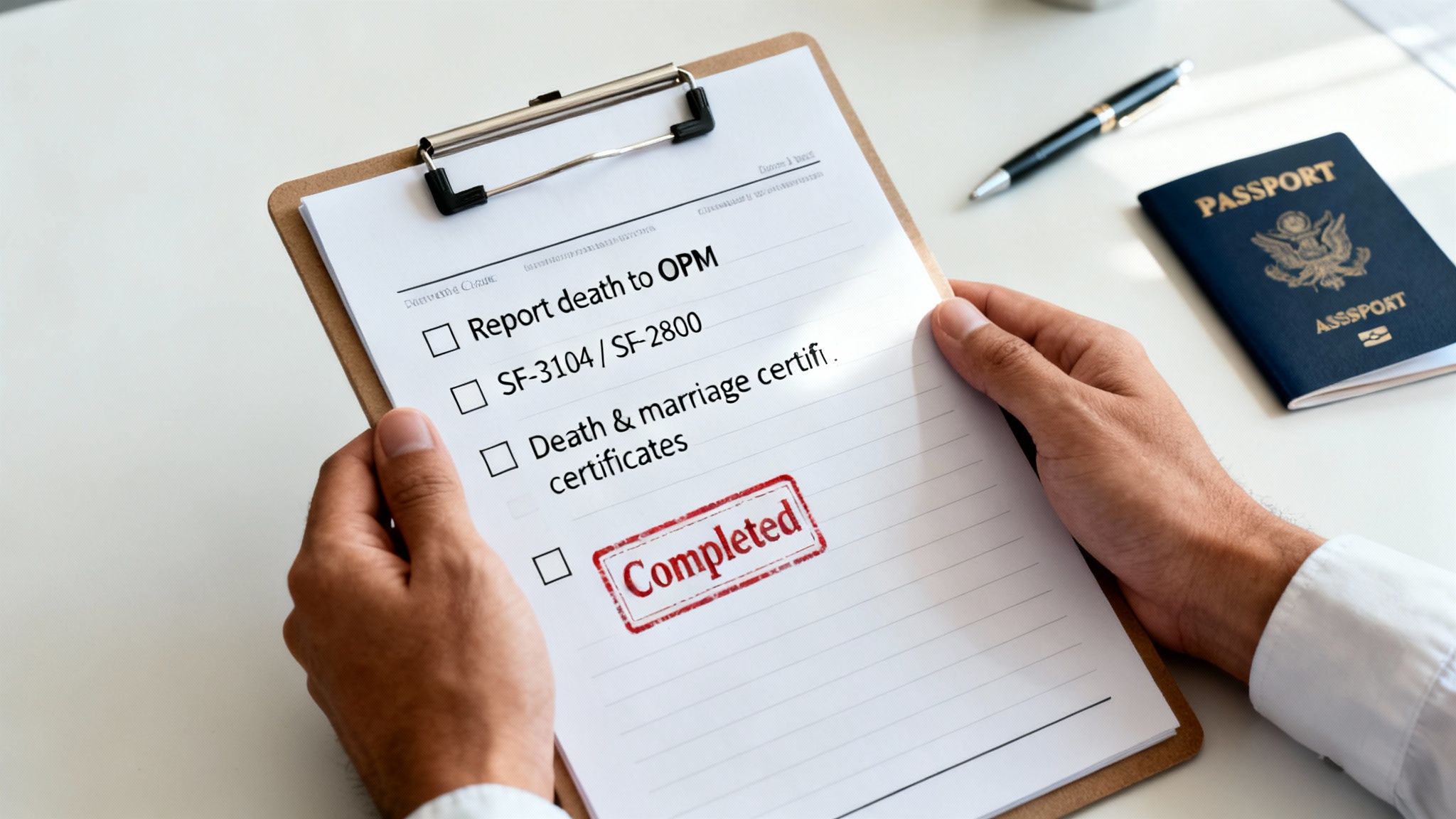
The entire process kicks off with one crucial first step: notifying the Office of Personnel Management (OPM) of the death. You can call their retirement services, but many find it simpler to report it online.
First Steps and Key Forms
Once you've notified OPM, they will mail you a comprehensive application packet. This packet will include the specific forms you need to claim benefits, which vary depending on whether the deceased was under CSRS or FERS.
While you're waiting for that packet to arrive, you can get a head start by gathering your supporting documents. The two main forms you’ll be working with are:
SF 2800 (for CSRS): This is the Application for Death Benefits (CSRS).
SF 3104 (for FERS): This is the Application for Death Benefits (FERS).
These forms will ask for quite a bit of detail about the deceased employee and their family. The best advice I can give is to take your time and fill them out completely and accurately. That alone will prevent most major delays. For a deeper dive into the process, you can learn more by navigating federal employee death benefits in our full guide.
Your Documentation Checklist
Along with the main application, you'll need to submit several certified documents to prove your identity and eligibility. It’s a good idea to start tracking these down as soon as you can, since getting official copies can sometimes take a few weeks.
You will almost always need to provide:
The employee’s death certificate: This must be a certified copy, not a photocopy.
Marriage certificate: Essential for proving a spousal relationship.
Birth certificates: Needed for any eligible children who are also applying for benefits.
Think of it like getting ready to do your taxes. Having all your documents organized and at your fingertips before you even start the forms makes everything go smoother and feel far less stressful. You won't have to keep stopping to find things, and you'll reduce the chance of making a mistake.
Avoiding Common Application Pitfalls
Unfortunately, it’s often the simplest mistakes that cause the biggest delays in processing survivor benefits. If OPM receives an incomplete application, they have to send it back. This forces you to make corrections and resubmit, adding weeks or even months to the timeline.
Here are the most common errors we see people make:
Missing Signatures or Dates: Every single line that requires a signature must be signed and dated. It’s worth a final double-check before you seal the envelope.
Incomplete Information: Don’t leave sections blank. If a question doesn’t apply to your situation, simply write "N/A" instead of skipping it.
Forgetting Supporting Documents: Make a checklist and ensure every required document, especially the certified death certificate, is included in your packet.
Using Photocopies Instead of Certified Copies: OPM is very strict about this. They require certified, official copies for key documents like birth, death, and marriage certificates. Regular photocopies will be rejected.
By following the instructions carefully and making sure your packet is complete, you can help make this process as seamless as possible. This frees you up to focus on what truly matters—taking care of your family—during a challenging time.
Answering Your Top Survivor Benefit Questions
Let's face it, federal retirement rules can feel like a maze. It's totally normal to have questions about how these benefits apply to your life and your family. We've pulled together some of the most common questions we hear from federal employees to give you direct, clear answers. These are the tricky situations that often trip people up, so getting them right is key to solid planning.
What Happens to My Survivor Benefit Election if I Get Divorced?
Divorce is a major life event that can throw a wrench into your survivor benefit plans, especially if a court order is involved. If a judge awards a portion of your benefits to a former spouse, that order is legally binding on the government. This can dramatically reduce, or in some cases completely wipe out, the benefit available for a current or future spouse.
It's absolutely critical to notify OPM right after a divorce. You need to understand exactly how the court order affects your annuity and update your beneficiary forms for other assets, like your TSP.
What if the court order is removed or your former spouse passes away? You might get a chance to elect benefits for a new spouse, but the window to act is very small and the deadlines are strict. This is one of those complex areas where talking to a federal benefits expert can save you a world of headache.
Can I Change My Survivor Benefit Election After I Retire?
For the most part, the decision you make at retirement is set in stone. However, life happens, and a few specific events can give you a rare second chance.
If you were single when you retired and get married later, you generally have two years from the date of your marriage to elect a survivor annuity for your new spouse. A similar window might open if your marriage ends and you remarry down the road.
Just be aware that making this change isn't free. It will trigger a permanent reduction to your own pension from that point forward. It’s a serious financial decision, and OPM will likely require your new spouse's written consent before they process it.
Are Survivor Benefits Available for Children?
Yes, and this is a fantastic feature of your benefits. Both FERS and CSRS provide a survivor annuity for eligible children, and it’s completely separate from any spousal benefit you choose. Think of it as an automatic safety net for your kids—it’s paid out no matter what you decide for your spouse.
An eligible child is usually unmarried and under 18. The benefit continues until age 22 if they are a full-time student. For a child who was disabled before age 18, this benefit can last their entire lifetime, providing crucial long-term support.
The children's survivor annuity is a fixed monthly amount that gets an annual cost-of-living adjustment (COLA). It’s designed to provide direct financial support to your children, independent of any other benefit.
This ensures that even if a surviving spouse isn't eligible for a benefit or has also passed away, your children are still taken care of by the federal retirement system.
How Are Federal Survivor Benefits Taxed?
Survivor annuity payments are treated as taxable income by the IRS. But it’s not always 100% taxable. A portion of each payment may be considered tax-free, which is essentially the government returning the after-tax money you paid into the pension fund during your career. OPM sends out a Form 1099-R each year that spells it all out, showing the total paid and the exact taxable amount.
The real wild card is state taxes. How your state treats pension income can make a huge difference in a survivor's take-home pay.
No Income Tax States: If you live in a state like Florida or Texas, you're in the clear—no state tax on the annuity.
Full Exemption States: Places like Pennsylvania and Illinois are also great for federal retirees, as they completely exempt federal government retirement income from state taxes.
Partial Exemption States: Many states fall in the middle, offering partial breaks. For example, Virginia is set to allow retirees to exclude up to $40,000 of retirement income starting in 2025.
Fully Taxable States: A handful of states tax every penny of your pension with no special treatment.
This is why you have to know your local tax laws. On top of the annuity, any death benefits paid from the Thrift Savings Plan (TSP) are also taxable. How that money is taxed depends on whether it was in a Traditional (pre-tax) or Roth (after-tax) account. A beneficiary should always sit down with a tax professional to figure out their obligations and make a smart plan.
Planning for your family’s future is the most important work you’ll do in retirement. The decisions you make about federal retirement survivor benefits will echo for years to come. At Federal Benefits Sherpa, our specialty is guiding federal employees through these complex choices. Schedule your free 15-minute benefit review today to make sure you're on a clear and confident path forward.
