
Learning Center
TSP Withdrawal Form: Which One to Use and How to File
Are you looking for a TSP withdrawal form before you've decided which kind of withdrawal you're eligible to request? That's a common starting point, but it reverses the process: your employment status, beneficiary status and reason for withdrawing determine the request you should use.
The other question is just as important: how much money will reach your bank account? A correct form can still produce an unwelcome result if you mistake the gross withdrawal for spendable cash.
Match Your Situation to the Right TSP Form
TSP withdrawal form by situation
| Your situation | Form or online request | Who it fits | Key note |
|---|---|---|---|
| Separated from federal service | TSP-99 (WEB) via My Account | Participants who have left federal service | Check whether an early-distribution exception applies before choosing a payment |
| Beneficiary of a deceased participant | TSP-99 (WEB) | Beneficiaries requesting payment from a deceased participant's account | Documentation and eligibility differ from a participant request |
| Still employed and eligible by age | TSP-75 (WEB) | Current civilian employees and uniformed-service members who meet the age requirement | Age-based in-service withdrawal; review withholding choices |
| Still employed with a qualifying financial hardship | TSP-76 (WEB) | Current employees who meet the hardship requirements | Federal withholding and possible additional tax affect the money available |
| Request needs signatures or notarization | Printed copy of the generated web form | Anyone whose request requires additional signed or notarized information | Print, sign and submit as instructed; completing the online screens may not finish the transaction |
Start with your situation, not a downloaded PDF
According to the Federal Retirement Thrift Investment Board's TSP forms guidance, most transactions can be completed through My Account; its 2019 withdrawal-process changes replaced the former TSP-70 Request for Full Withdrawal with TSP-99, while the age-based in-service pathway applies to participants age 59½ or older.
That history explains why older search results can be confusing. A guide telling you to download the former full-withdrawal application may describe a retired process rather than the request you should complete today.
The online workflow asks about your circumstances and generates a web form summarizing your choices. Instead of finding a blank document and deciding which boxes seem closest, you answer questions that establish the applicable withdrawal path.
Treat the table as a routing guide, not proof of eligibility. Being employed and having an unexpected expense doesn't automatically establish a qualifying financial hardship. Likewise, receiving a deceased participant's account doesn't mean you should answer the questions as though you were the original participant.
Know when paper still matters
A digital request can still require an offline action. If the generated instructions call for a signature, notarization or supporting information, complete that requirement through the submission method TSP specifies.
Practical rule: Reaching the end of the online questions isn't the same as completing every requirement for payment.
Use official forms and instructions from TSP's website, not a stored copy attached to an old email or an unofficial form library. Keep educational assistance separate from official processing: Federal Benefits Sherpa is an independent organization and isn't affiliated with or endorsed by the Office of Personnel Management, the Social Security Administration, the Federal Retirement Thrift Investment Board (TSP), or any government agency.
Before selecting a row, answer these questions:
- Separation: Have you left federal service, or are you still employed?
- Beneficiary status: Are you requesting money as the participant or as a beneficiary?
- In-service eligibility: If you're still employed, does your age or a qualifying hardship support the request?
An accurate answer at the beginning prevents you from preparing the wrong request at the end.
Withdrawal Options After Leaving Federal Service Compared
Separated participant withdrawal options
| Option | How it is set up | Tax timing | Usually fits when |
|---|---|---|---|
| Partial withdrawal | A single payment of a specified amount | The taxable portion of a cash payment generally enters the payment year's income | You have a specific expense and want the remainder invested |
| Total distribution | The entire available balance leaves the account | A cash payout can concentrate taxable income in the payment year; transfer treatment differs | You intend to close the account |
| Annuity purchase | Part or all of the balance purchases an annuity | Tax treatment applies to annuity payments according to their taxable portion | You want protection against outliving savings |
| Installments | Recurring automatic withdrawals | Taxable portions are accounted for as payments are received | You need recurring income while the remaining balance stays invested |
| Combination | A mix of withdrawal methods | Each component follows its applicable treatment | You have both immediate expenses and ongoing income needs |
The TSP withdrawal guidance for retirement identifies these principal choices and combinations, with the separated-participant request producing TSP-99 (WEB); it also explains that separation before age 55, or before age 50 for certain qualifying public-safety employees, generally exposes most withdrawals to the IRS early-distribution penalty, subject to exceptions.
Match the payment structure to the expense
A partial withdrawal addresses a defined need without requiring you to empty the account. Say you want to clear a debt after retiring. You can compare the cost of taking that payment with continuing the debt payments, while leaving the unneeded TSP balance invested.
A total distribution fits a decision to close the account, not a decision to leave federal employment. Moving to a private-sector job doesn't by itself mean you need to remove your TSP savings. Before choosing this option, distinguish receiving cash from moving eligible money directly to another retirement account.
An annuity purchase converts the amount used for the purchase into an income arrangement. For example, someone whose pension covers housing but not other recurring essentials might compare an annuity with investment-funded withdrawals. Review the survivor features and purchase terms before committing funds.
Installments provide recurring automatic payments while the remaining account balance stays invested. They can help cover a regular gap between retirement income and household spending, but they don't eliminate investment risk or the need to review your withdrawal pace.
Combinations can serve different purposes
You don't have to make every dollar serve the same job. A separated participant might take a partial payment for a necessary home repair, then use installments for ongoing expenses. Someone else might use part of the balance for an annuity and retain the rest for flexible withdrawals.
The important distinction is between access to money and a sustainable income plan. An available withdrawal method isn't automatically the best method for your household.
Before selecting one, check:
- Age at separation: Confirm which early-distribution rules apply to your actual circumstances.
- Other retirement income: Account for pension payments, Social Security and other dependable income before setting TSP withdrawals.
- Tax bracket: Consider how the taxable payment fits with other income during the payment year.
Choose a partial withdrawal for a specific need, installments for recurring income, and an annuity when lifetime-income protection is the priority. Reserve a total distribution for an intentional account-closing decision, after comparing the tax treatment and destination of the money.
Taxes, Withholding and What You Actually Receive
Illustrative hardship withdrawal: gross to net
This hypothetical example assumes the entire requested amount is taxable and the standard hardship withholding election applies. It illustrates the difference between cash received and the eventual tax cost, not a personalized tax estimate.
| Line | Amount | Notes |
|---|---|---|
| Gross withdrawal requested | $10,000 | Hypothetical amount entered on the request |
| Federal withholding at the hardship default | −$1,000 | Hypothetical calculation using the default described below |
| Cash deposited before state tax | $9,000 | Gross request less federal withholding |
| Possible additional early-distribution tax | Up to $1,000 | Hypothetical additional tax if the entire taxable amount is subject to it |
| State income tax | Not withheld by TSP | State tax may still be due |
The TSP guidance on taking money from your account states that financial-hardship withdrawals generally have 10% federal withholding unless waived or increased, may face an additional 10% early-distribution tax, are reported on Form 1099-R, and require an in-service payment destination to be established at least seven days before requesting the withdrawal.
Withholding isn't your final tax bill
Federal withholding is money sent toward your federal tax obligation. It isn't a determination that you've paid everything you'll owe, and it isn't the same thing as an early-distribution penalty.
In the example, the bank deposit reflects withholding, but it doesn't settle every tax consequence. If additional tax applies, you need to account for it separately when preparing your return. Don't assume TSP has automatically reserved enough for that obligation.
TSP generally withholds federal income tax from the taxable portion. For eligible payment types, you may be able to change the election or waive withholding, but the choices available depend on the payment. Don't apply the hardship default to every separated-participant distribution.
TSP doesn't withhold state or local income tax. That omission doesn't make the payment exempt from those taxes, so review the treatment where you file and consider whether you need to reserve cash or make estimated payments.
A larger deposit after waiving withholding doesn't mean a smaller tax bill. It means you've kept more of the money that may be needed to pay it.
Identify the taxable portion before doing the math
An account containing Roth money requires more care than treating every dollar as taxable. Check the traditional and Roth portions shown in My Account and confirm how your proposed distribution will be treated. Don't assume that every Roth-related payment is automatically tax-free.
TSP reports distributions to you, the IRS and applicable state tax agencies. Keep the payment confirmation with your tax records so you can compare the reported gross distribution, taxable amount and withholding against your request.
For broader retirement-income planning, the guide to TSP and taxes can help you organize the questions to resolve before making an election.
Use this review before approving the amount:
- Gross: What amount will leave the TSP account?
- Withholding: What federal income tax will TSP retain?
- Possible penalty: Does an early-distribution exception apply?
- State exposure: What might you owe that TSP won't withhold?
- Net: What reaches the bank, and what must remain available for taxes?
Documents and Information to Gather Before You Start
Prepare a reference folder before opening the request. You may not need to upload every item, but having accurate records beside you reduces guesswork and makes discrepancies easier to resolve.
Your identity and eligibility records
- Account identification: Have your TSP account number and the exact name on the account available. If your records don't match your current legal name, resolve the mismatch rather than switching between names during the request.
- Employment status: Keep your separation personnel action, such as your SF-50, or current employment details handy. Use it to confirm your separation date and status; don't assume every request requires uploading the document.
- Birth date: Check the date of birth in your account against your identification. An incorrect record can affect which withdrawal choices appear.
- Beneficiary information: For a deceased participant's account, gather the beneficiary's identification, account correspondence and intended payment details. Follow the beneficiary-specific instructions rather than substituting the deceased participant's banking information.
If you can't locate a personnel record, contact your agency's human resources or records office. For an account discrepancy or uncertainty about acceptable documentation, contact TSP before submitting.
Consent, banking and expense records
- Spouse's details: If you're married, have your spouse's accurate name and contact information ready. Check whether your request requires consent, notification or a notarized document, and arrange that before submitting the final packet.
- Payment destination: Verify the routing number, account number, account type and account ownership against a bank statement or your bank's instructions. Never guess from a deposit slip or an unfamiliar number on a check.
- Hardship records: Keep bills, notices and other records supporting the expense together. Retain them and supply them through TSP's specified channel if requested.
- Prior distribution records: If you've received TSP payments before, keep the previous tax reporting statement and relevant confirmations available. They can help you understand how gross payments and withholding were recorded, though they don't establish the treatment of a new withdrawal.
Before submitting: An empty field is a problem to resolve, not an invitation to estimate a spouse's information or bank account number.
Keep sensitive documents in a secure location and send them only through the authorized submission method. A carefully checked packet helps prevent avoidable requests for corrections, missing information and payment delays.
Processing Timelines and Payment Setup Dates
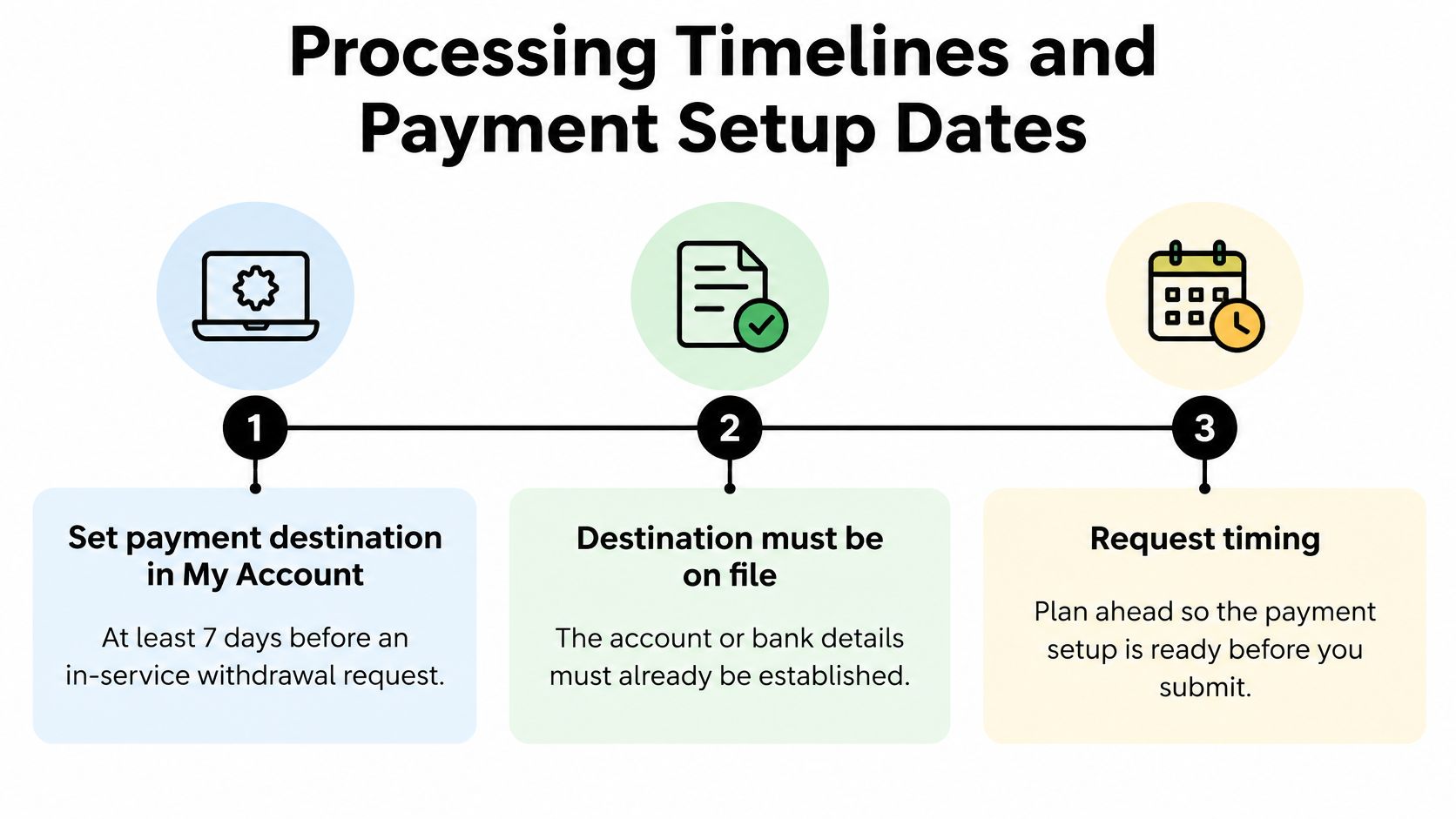
When do you need the money to be available? Plan backward from that date, because setting up a payment destination, completing the request and processing it are separate steps. The amount you request is also the gross amount, not necessarily the cash you receive after withholding and any applicable penalties.
This timeline shows why payment setup belongs before an in-service request.
Complete the prerequisites first
Establish the destination. Set up and verify your payment destination in My Account at least seven days before submitting an in-service request. Entering bank information as part of the request does not remove this waiting period, so include it in your schedule.
Finish required signatures. If the generated request requires a printed form, arrange any signatures, spousal consent or notarization before sending it. Online questions are only one part of the process. A request still awaiting a required signature is not complete.
Submit and preserve the record. Save the confirmation, generated summary and copies of required documents together. These records help you identify the specific request if you need to check its status.
Track processing without assuming a payment date
Processing times vary by request type. Check the current instructions and status in My Account rather than relying on a general estimate as a promised arrival date. TSP releasing a payment and the funds becoming available in your account are also separate steps.
- Watch for action requests: Respond promptly if TSP asks for a correction or more information.
- Check the payment method: Allow time for the payment to reach you after TSP releases it.
- Retain tax records: Keep the payment-year confirmation for comparison with the tax statement when it becomes available.
An incomplete form or payment destination that cannot be used may delay processing while you correct the problem. A delay can affect the schedule you expected, so don't treat the original submission date as a guarantee.
If the money is intended for a mortgage closing, tuition or another fixed obligation, start early and keep an alternative funding plan until the payment arrives. Avoid committing to a nonrefundable expense based only on a request that is still being processed.
The TSP withdrawal timeline planning guide can help you organize the steps. Use the information in My Account to set a schedule that reflects your request type and payment setup.
How to Complete the Request and Avoid Costly Errors
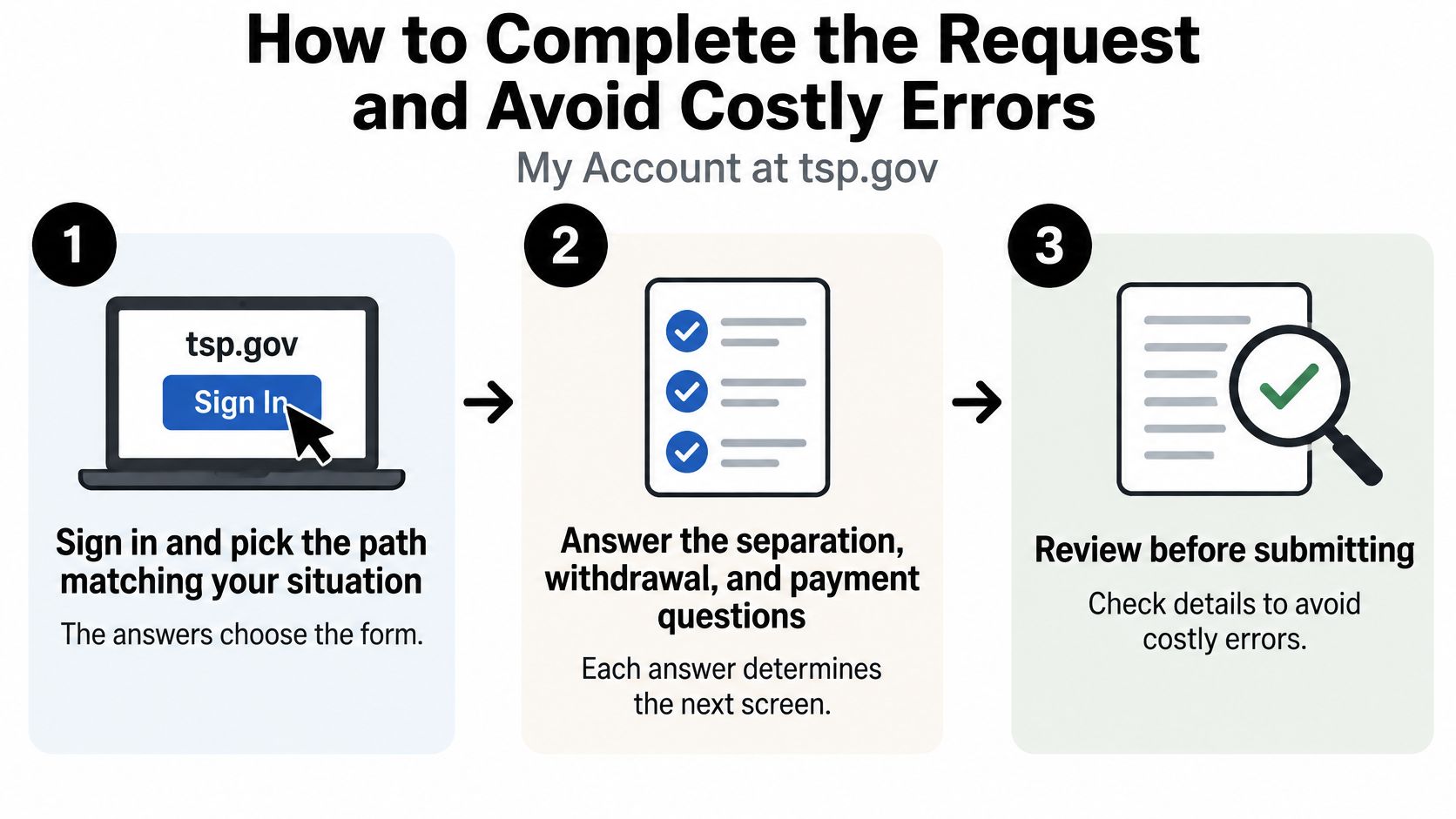
Use My Account on TSP's official website, with your records and withdrawal calculation beside you. If a screen or generated instruction differs from an older guide, follow the current official workflow.
The process is easier to follow when you separate routing, payment choices and final review.
Enter the request deliberately
Sign in and select the path matching your situation. Start from your account rather than an old saved application. The workflow should reflect whether you're requesting your own money or acting as a beneficiary.
Answer the eligibility questions accurately. Confirm employment status, age-related information and the reason for an in-service withdrawal where applicable. If you've separated but the workflow treats you as actively employed, investigate the account record instead of forcing an in-service request through.
Enter the gross withdrawal amount. Compare the entry with your calculation of spendable cash. A common mistake is entering the amount needed for a bill without allowing for withholding. Before taking the full available balance, compare whether a smaller payment or installments meet the actual need.
Review the withholding election. Select only an option offered for your payment type, and make a separate plan for any remaining tax obligation. Waiving withholding to cover an immediate expense can create a later cash shortage.
Confirm the payment destination. Match the displayed banking information against your verified records, including the account type. If the destination isn't ready for use, resolve that issue rather than assuming TSP will redirect the money automatically.
Treat the summary as the final application
Read the generated summary line by line. Check the payment method, gross amount, tax election, destination and personal information. Don't approve a familiar-looking document without checking the choices it records. If you began with an obsolete paper-form reference, use the request generated by the current questions instead.
Complete any required offline actions. Print, sign, obtain required consent, arrange notarization and submit through the stated channel. Don't sign a document in advance if the notarial instructions require signing in the notary's presence. For a fillable document that TSP specifically directs you to complete, the PDFWix guide to filling forms explains practical PDF-entry methods; it doesn't replace TSP's signature or submission requirements.
Submit, save and monitor. Preserve the confirmation and check for follow-up messages. If hardship documentation is requested, send the relevant records through the channel TSP identifies rather than replying through an unrelated email address.
Resolve discrepancies using the right comparison
A tax statement can show a gross distribution larger than your bank deposit without either record being wrong. Compare the gross payment, taxable portion and withheld tax before treating the difference as an error.
If the requested amount, destination or account status looks incorrect, contact TSP promptly and ask what correction or cancellation options remain available. Don't submit a duplicate request as a shortcut unless TSP instructs you to do so.
Check the amount and destination with the same care you'd use before sending a bank transfer. A correct form name doesn't protect you from an incorrect payment instruction.
Related TSP Rules That Change Your Withdrawal
The withdrawal request records a decision, but several other account rules can change what you should enter. Review them before treating the available balance as unrestricted spending money.
Separation timing and family rights
Separation-based penalty exceptions require attention to your employment history, not just your age when requesting money. Compare your actual separation date with the eligibility discussion under “Withdrawal Options After Leaving Federal Service Compared,” and confirm any exception before counting on a penalty-free payment.
Spousal consent is separate from naming a beneficiary. Your marital status and withdrawal choice can affect the instructions generated for the request, so identify the required spouse-related action before scheduling submission. Bring the accurate details and any required signed documents described in the preparation checklist.
Beneficiary designations govern who receives a remaining balance under the applicable account rules. Taking a withdrawal isn't a substitute for updating that designation. After a major change in retirement plans or family circumstances, review the beneficiary record directly rather than assuming the withdrawal request changed it.
Loans and the amount actually available
An outstanding TSP loan needs its own review. Don't assume every figure shown on an account statement represents money currently available for a withdrawal, and don't subtract the same loan balance twice if My Account already excludes it from the available amount.
Say a separated participant wants cash for a home repair and also has an outstanding loan. The practical sequence is to confirm the available withdrawal balance, determine what happens to the loan, and then calculate an affordable gross payment. Treating the statement's headline balance as the withdrawal ceiling can produce an incorrect plan.
Use these next actions to keep the issues separate:
- Eligibility uncertainty: Confirm the applicable exception with TSP or a qualified tax professional before requesting payment.
- Consent requirement: Finish the required spouse-related paperwork before submitting the generated request.
- Legacy change: Review the beneficiary designation as a separate account-maintenance task.
- Outstanding borrowing: Check loan status and the displayed available balance before entering an amount.
The practical guide to TSP withdrawal rules can help organize related questions, including how in-service access and required distributions fit into planning. Resolve the rule that affects your decision before choosing the payment, rather than trying to repair the result afterward.
Confirm Your Form Before You Request Funds
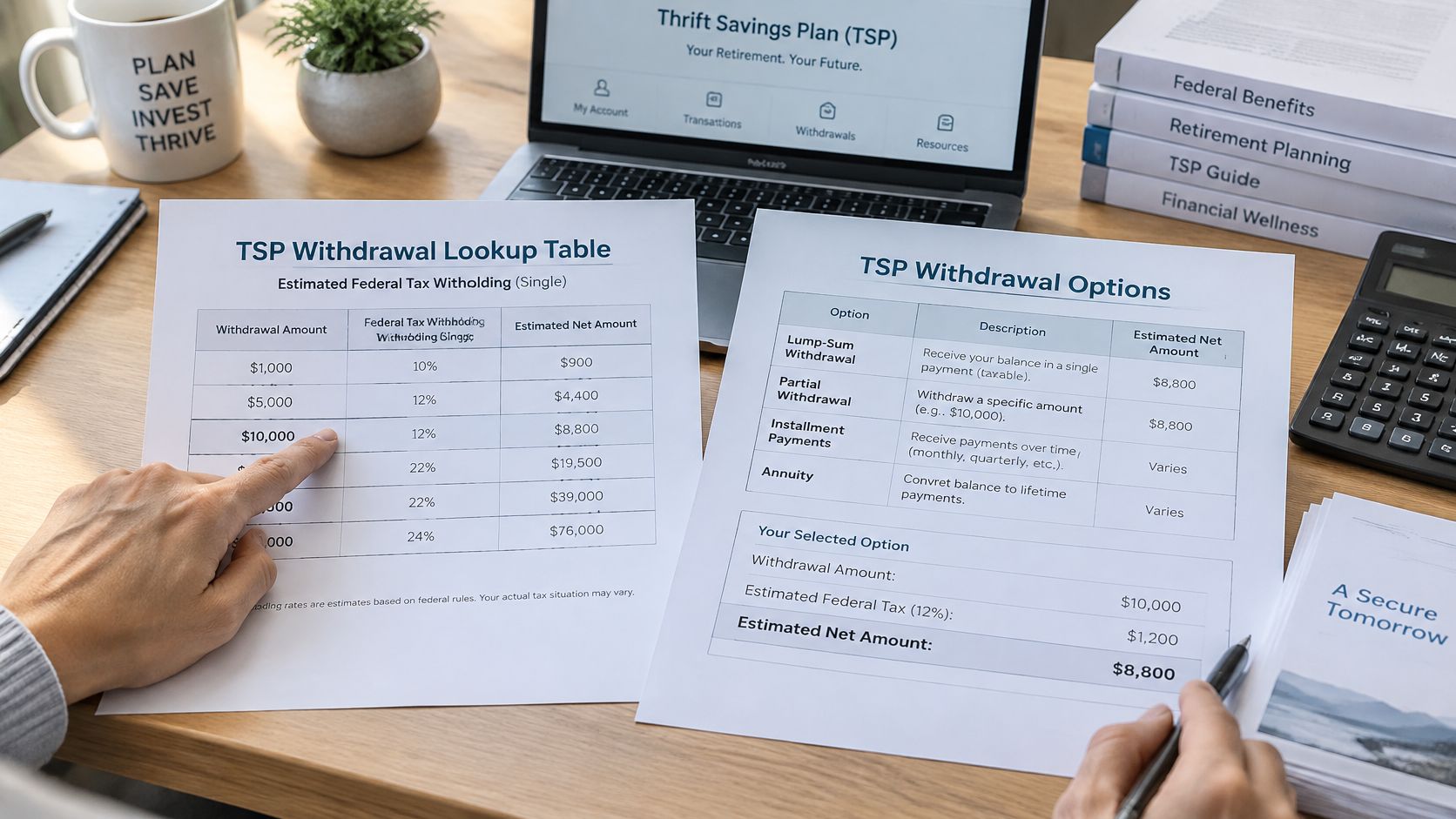
Before requesting funds, put the generated form beside your cash-flow calculation and check that they describe the same decision.
Finish with a deliberate review
- Confirm the route: Match your circumstances to the situation table, including whether you're acting as a beneficiary.
- Compare the outcome: Choose the payment structure intentionally and verify the amount you'll have available after withholding and any tax reserve.
- Assemble the packet: Resolve missing records, consent and notarization before sending an incomplete request.
- Prepare the destination: Complete payment setup and the required waiting period before an in-service request.
- Preserve confirmation: Submit only after reviewing the generated summary, then save the record and monitor status.
Official TSP forms, account instructions and learning resources remain the source of truth for filing. Check the illustrative tax math against your own account composition and circumstances, and don't assume you can reverse a completed withdrawal.
For a structured educational starting point, our Learning Center at Federal Benefits Sherpa includes plain-English guides to the SF-50 and the TSP beneficiary form. We're an independent resource, not the office that approves or processes your payment.
Use the accompanying video as another opportunity to pause and consider your choices before submitting.
The final check is straightforward: the right request, the intended gross amount, a verified destination and a realistic net payment.
Our free on-demand class explains TSP withdrawal choices alongside the pension, insurance and survivor decisions that shape retirement income. Visit Federal Benefits Sherpa to explore the class and consider a personalized Gap Report before deciding how your TSP withdrawals should fit your retirement plan.


Dedicated to helping Federal employees nationwide.
“Sherpa” - Someone who guides others through complex challenges, helping them navigate difficult decisions and achieve their goals, much like a trusted advisor in the business world.
Federal Benefits Sherpa, LLC
12724 Gran Bay Parkway West, Suite 410, Jacksonville, FL 32225
Email: [email protected]
Phone: (833) 753-1825
© 2024 Federalbenefitssherpa. All rights reserved
Federal Benefits Sherpa is an independent organization and is not affiliated with or endorsed by the U.S. government or any federal agency.