
Blogs

Blog title place here
We understand that every federal employee's situation is unique. Our solutions are designed to fit your specific needs.

Blog title place here
We understand that every federal employee's situation is unique. Our solutions are designed to fit your specific needs.

Blog title place here
We understand that every federal employee's situation is unique. Our solutions are designed to fit your specific needs.
S Fund TSP Guide: Allocation and Rebalancing Strategy
You're halfway through your federal career, your TSP balance is finally meaningful, and the C Fund dominates the statement because it felt like the obvious choice. Then a colleague mentions the S Fund, and you start wondering whether you've missed a useful source of diversification.
That same question looks very different near retirement. A federal employee five years from the Minimum Retirement Age may remember the S Fund's 26.3% loss in 2022 and have no appetite for a similar decline while preparing to claim a FERS pension or begin withdrawals. The right question isn't whether the S Fund has produced strong returns. It's how much of your total retirement portfolio can withstand its volatility at your current career stage.
Why Federal Employees Are Looking at the S Fund Right Now
Consider two employees. A 42-year-old GS-12 has contributed steadily to her Roth TSP and watched large U.S. companies drive the C Fund. She's now concerned that relying heavily on large-cap stocks leaves her exposed to one part of the domestic market. The S Fund looks attractive because it adds companies outside the S&P 500 rather than merely increasing the same large-cap exposure.
A 58-year-old auditor faces the opposite decision. Retirement is close enough that a sharp equity decline could affect the timing of withdrawals, separation, or a move into an income-oriented allocation. For this employee, the S Fund may still have a role, but the position must be sized around spending needs and recovery time, not around its strongest historical periods.
The practical distinction: Younger employees can use the S Fund as a growth sleeve. Near-retirees should treat it as a controlled risk allocation.
The S Fund complements the C Fund. It isn't a replacement for the C Fund, and it doesn't provide international exposure. The I Fund serves that international role, while the G and F Funds provide different forms of fixed-income and government-securities exposure. Combining C and S gives a federal employee much broader coverage of U.S. publicly traded stocks than holding the C Fund alone.
Inflation concerns, concentration in dominant large-cap names, and interest in broader market participation have all made the S Fund more visible. But visibility shouldn't determine your allocation. Sizing is the key decision. A modest S Fund position can diversify a large-cap-heavy portfolio. An oversized position can turn a balanced TSP into a concentrated small- and mid-cap bet.
What the S Fund Is and What It Owns
The TSP S Fund tracks the Dow Jones U.S. Completion Total Stock Market Index, according to the official TSP S Fund description. In practical terms, it holds U.S. companies outside the S&P 500, the index tracked by the C Fund.
The C Fund and S Fund work together across the domestic stock market. The C Fund covers the largest U.S. companies. The S Fund adds companies outside that large-cap group, including small- and mid-cap businesses. That makes the S Fund a useful complement, not a complete portfolio.
The index weights companies by market capitalization, adjusted for shares available to public investors. Its holdings can change during index reconstitution, so the fund is not a hand-picked collection of speculative companies. It is a broad benchmark for the remaining investable U.S. equity market.
The S Fund provides domestic stock exposure. The I Fund serves a different purpose through international stocks, while the G and F Funds provide other forms of government-securities and fixed-income exposure. The S Fund also carries more sensitivity to economic growth, interest rates, and changes in market participation than a portfolio concentrated in the largest U.S. companies.
The fund's cost structure is favorable. Recent TSP materials and independent tracking place the S Fund's expense ratio around 0.059%, as documented in the TSP fund materials. Low expenses leave more of the benchmark's return in an investor's account. They do not protect the account from market declines.
If you are still separating fund selection from contribution allocation and interfund transfers, review this simplified explanation of how the TSP works.
S Fund vs C Fund at a glance
| Feature | S Fund | C Fund |
|---|---|---|
| Market segment | U.S. stocks outside the S&P 500 | Large-cap U.S. stocks in the S&P 500 |
| Primary role | Adds small- and mid-cap domestic exposure | Core large-cap domestic exposure |
| Geographic exposure | United States | United States |
| Risk character | More economically sensitive and volatile | Large-cap equity volatility |
| Portfolio relationship | Complements the C Fund | Complements the S Fund and other assets |
Use the S Fund as an equity sleeve within your TSP allocation. Near retirement, size it around your withdrawal needs and recovery time, rather than treating its broader domestic exposure as a reason to make it the portfolio's center. It is not a stabilizer, cash reserve, or substitute for the G Fund.
Long-Term Performance and the Volatility That Comes With It
If you are five to ten working years from retirement, the S Fund's long-term record is only half the decision. You also need enough time and stable assets to withstand a major decline without selling shares at depressed prices.
The TSP Data Center lists the fund's since-inception annualized return at 9.33% through its latest reporting period. Alternative TSP trackers show a similar since-inception annual return near 9.9% as of August 2026 in the historical annual returns data. Those results support a long-term growth role, not an unlimited allocation.
The recent annual figures show how uneven the path can be. The S Fund lost 26.3% in 2022, after returning 12.5% in 2021, 31.9% in 2020, and 28.0% in 2019, according to the TSP share-price history. Strong years can follow sharp losses, but the timing of each return matters when withdrawals are close.
The TSP share-price history reports the S Fund's worst drawdown since inception at 57.4%. That decline is manageable only if your allocation, other TSP funds, and income plan give the account time to recover. Employees still contributing can buy shares during a downturn. Retirees withdrawing from the account may have to sell them.
The return story needs the risk story beside it
The TSP share-price history includes a 16.93% annual return figure for the S Fund during a published historical period. The official fund objective focuses on potentially high long-term returns from small and medium-sized U.S. companies. Neither point makes that return a reasonable yearly expectation.
Independent data in the historical annual returns data places the S Fund's 10-year annualized return around 12.2% and annualized standard deviation around 22.0% as of mid-August 2026. That volatility is substantial for an account expected to support withdrawals soon. Use the S Fund as a controlled equity sleeve within an overall TSP glide path, not as a standalone retirement bet.
| Period or measure | S Fund information | What it means |
|---|---|---|
| Since inception | 9.33% annualized in TSP publication | Long-term growth has been strong |
| Alternative tracker view | Near 9.9% annualized as of August 2026 | Independent tracking is broadly similar |
| 2019 | 28.0% | Strong upside can arrive quickly |
| 2020 | 31.9% | Recovery periods can be powerful |
| 2021 | 12.5% | Returns vary considerably by year |
| 2022 | -26.3% | Sharp losses are part of the package |
| Worst drawdown since inception | 57.4% | Recovery can require substantial patience |
The record supports using the S Fund for long-term equity growth. It does not support calling it safe, treating it as an income source, or assuming it automatically improves the portfolio. Past returns describe what happened. They don't tell you whether your current balance can tolerate the next decline.
How the S Fund Compares to C, I, G, F, and the L Funds
Each TSP fund serves a different job. The S Fund earns a place by expanding domestic equity exposure beyond large companies. It doesn't earn that place by replacing every other fund.
The C Fund remains the large-cap U.S. core. The I Fund adds non-U.S. exposure. The G Fund provides government securities designed for stability within the TSP, while the F Fund provides bond-market exposure and can behave differently from stocks. Neither G nor F will usually deliver the S Fund's equity-growth potential, but both can help provide ballast when stocks fall.
The L Funds combine several TSP funds and adjust their mix over time according to a target retirement horizon. That creates an important trap. If you hold an L Fund and add a separate S Fund position, you may be increasing small-cap exposure without realizing it. You haven't necessarily diversified. You may have duplicated one sleeve inside an existing diversified allocation.
TSP Fund Comparison
| Fund | Index or mandate | Volatility profile | Drawdown severity | Role in a TSP portfolio |
|---|---|---|---|---|
| S Fund | U.S. stocks outside the S&P 500 | High equity volatility | Can be severe | Small- and mid-cap domestic sleeve |
| C Fund | S&P 500 | Large-cap equity volatility | Significant in equity bear markets | Core U.S. stock exposure |
| I Fund | International stock mandate | International equity volatility | Can be substantial | Geographic diversification |
| G Fund | Government securities | Low relative to stock funds | Designed as a stabilizing holding | Capital-preservation and spending reserve role |
| F Fund | Bond-market mandate | Fixed-income market sensitivity | Can decline when rates rise | Bond diversification and ballast |
| L Funds | Age- or date-oriented blended allocation | Changes with the glide path | Designed to become more conservative over time | Automatic diversification and rebalancing |
The TSP Lifecycle Fund guide is useful for employees deciding whether they'd rather manage individual fund weights or use an automatically changing allocation.
My recommendation is straightforward. Use the S Fund as a slice of total equity exposure, not as the whole equity book. If your portfolio already includes an L Fund, inspect the underlying allocation before adding S Fund shares. If you hold only the C Fund, the S Fund can broaden domestic exposure, but it won't solve every diversification problem because it remains entirely invested in U.S. stocks.
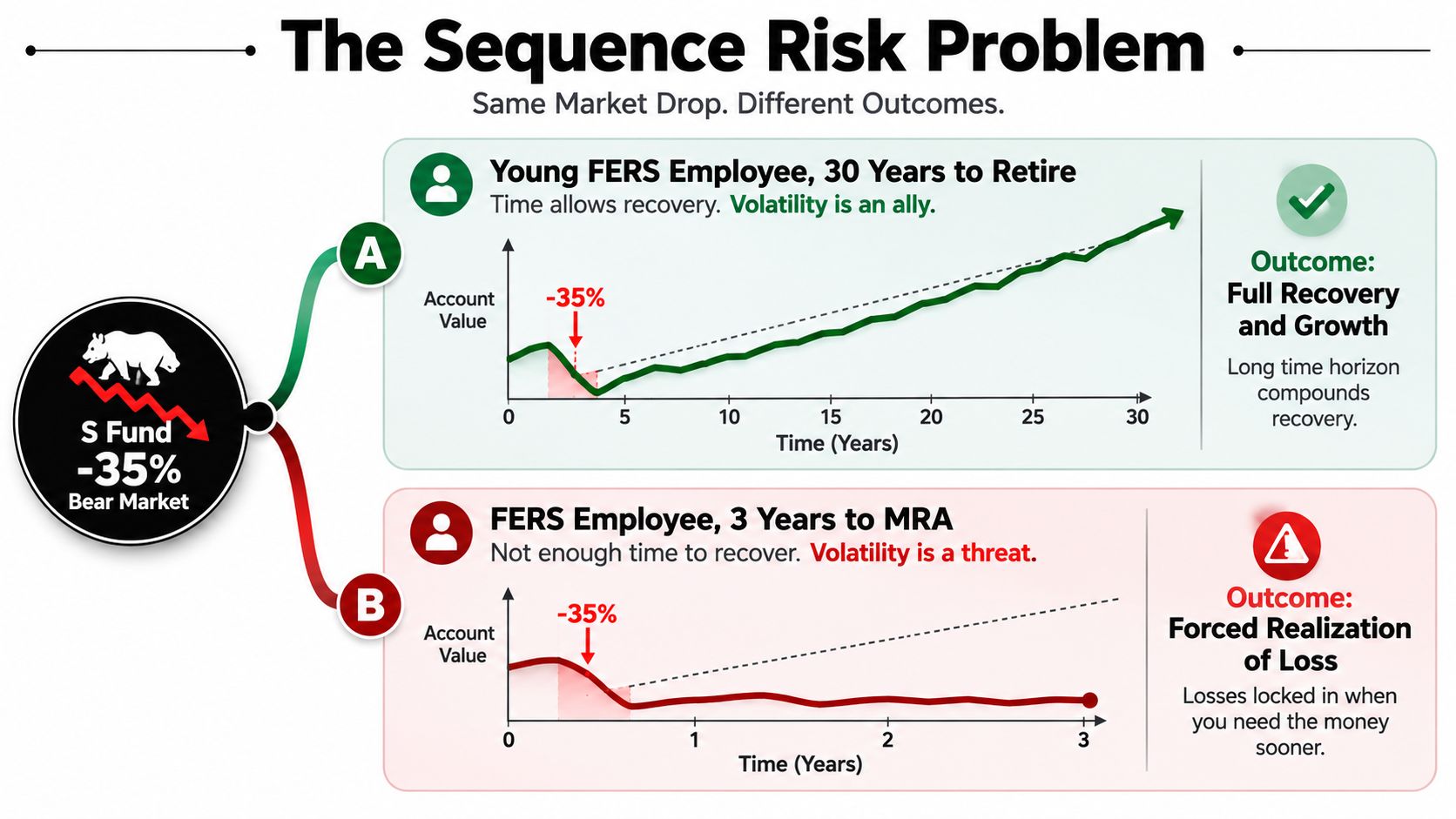
The Sequence Risk Problem Most S Fund Articles Skip
Long-run averages protect younger investors better than they protect near-retirees. If an employee is three years from the Minimum Retirement Age and the S Fund falls 35%, the account may not have enough time to recover before withdrawals begin. The employee may also be contributing less, preparing to separate, or shifting attention from accumulation to income.
Sequence-of-returns risk is the danger that poor returns arrive at the wrong time. Two investors can experience the same average return over a career and finish with very different outcomes if one suffers major losses near the beginning of withdrawals. A contribution made during a decline can buy more shares. A withdrawal made during a decline locks in the reduced value of shares sold.
Recovery is not the same as cash flow
The statement “the market eventually recovers” may be historically comforting, but it doesn't pay a current bill. A federal employee with a FERS annuity, Social Security plans, and TSP withdrawals needs a spending structure that can function during a prolonged equity decline.
The G Fund is especially relevant because it gives TSP participants a way to hold a government-securities allocation inside the plan. During periods when investors move away from stocks, a reserve in a stabilizing fund can reduce the need to sell the S Fund immediately. That reserve doesn't eliminate inflation risk or guarantee a complete retirement solution, but it changes the timing pressure.
Near-retirement rule: Don't ask only whether the S Fund will recover. Ask what will fund your spending while it recovers.
A heavy S Fund sleeve can behave worse than its historical average suggests because the average includes years when the investor had time to keep contributing. Your personal timeline may not. Employees within the final working years should judge the S Fund against the date of their first likely withdrawal, not merely against a distant retirement average.
This is why I reject the idea that every employee should hold a large S Fund position just because small-cap stocks have delivered attractive long-term returns. Recovery time is an investment asset. Younger employees have more of it. Near-retirees have less.
Allocation Ranges and Rebalancing Mechanics That Work
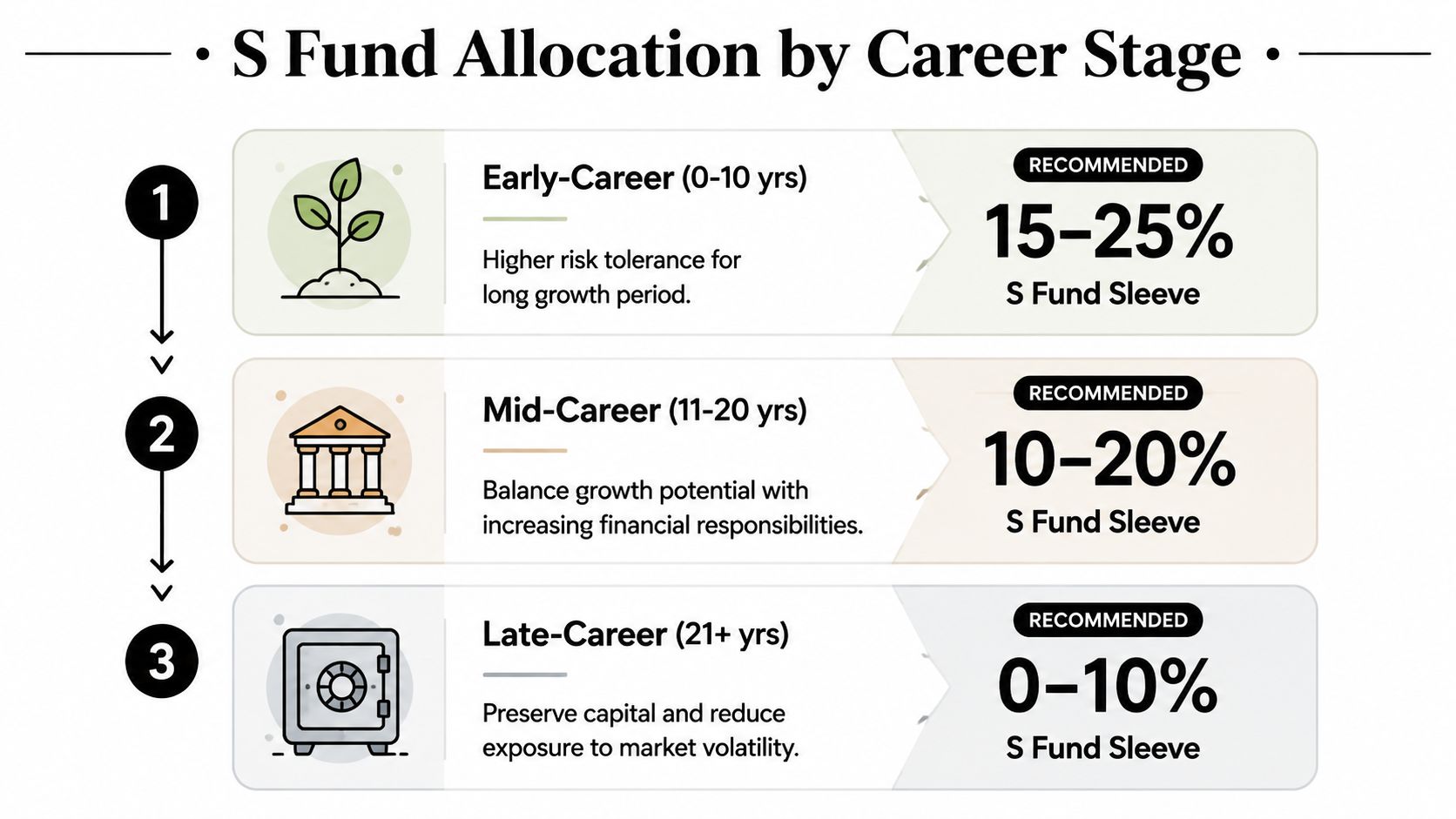
I use career stage as the starting point, then adjust for the employee's pension, outside accounts, withdrawal plans, and ability to tolerate a major decline. These are planning ranges for the S Fund sleeve within the overall TSP, not promises and not substitutes for a complete retirement analysis.
- Early career: A 15% to 25% S Fund allocation can be reasonable for an employee with a long accumulation horizon and the discipline to stay invested through steep declines.
- Mid-career: I generally prefer 10% to 15% for a balanced domestic equity supplement. The employee still has time to recover, but the account may now represent a larger share of future retirement income.
- Within 10 years of retirement: I'd generally cap the S Fund at 5% to 10%, and I'd consider an age-appropriate L Fund if the employee doesn't want to manage the glide path personally.
The allocation should fit inside the equity portion of the plan. If you're 70% in stocks overall, a 15% S Fund position in the total account is not the same as 15% of your equity allocation. Be precise about the denominator before you make a change.
How to rebalance inside the TSP
An interfund transfer changes how your existing balance is allocated. A contribution allocation change controls where future payroll contributions go. Those are separate decisions, and changing one doesn't automatically accomplish the other.
You can rebalance on a calendar, such as annually, or use thresholds, such as reviewing the account when a holding moves materially away from its target. Calendar-based rebalancing is easier to follow. Threshold-based rebalancing responds to market movement but requires more attention and a clear rule.
Suppose a mid-career employee targets a 60/30/10 mix of C Fund, S Fund, and G Fund. If the S Fund rises sharply and becomes larger than its target, the employee can direct an interfund transfer back toward the target and reset future contribution allocations so new money doesn't continue pushing the S Fund above its intended size. The point isn't to predict the next move. It's to sell relative strength and restore the risk level the employee already chose.
The TSP investment strategies guide for federal employees provides additional context for comparing self-managed allocations with an L Fund approach.
An L Fund can handle rebalancing and glide-path changes automatically, but it may not match an employee's precise pension income, tax strategy, or withdrawal reserve. Individual funds provide control, while L Funds reduce the risk that an employee forgets to update the allocation. Choose the system you're most likely to follow consistently.
Your Next TSP Decision and the Questions Worth Asking
Before changing your S Fund position, log in to My Account and write down the current allocation. Check both the existing balance and the future contribution allocation, because they can differ. Then confirm that your contribution strategy still reflects your retirement date, risk tolerance, and broader household investments.
Use this short checklist:
- Pull the current allocation. Identify the S Fund percentage in the TSP and across other retirement accounts.
- Confirm contributions. Make sure payroll contributions are directed according to your target mix and that you're receiving the available agency contribution structure.
- Choose the sleeve size. Use your years to retirement as the starting point, then account for withdrawals, pension income, and outside assets.
- Set a review date. Put an annual or semiannual reminder on your calendar rather than reacting to headlines.
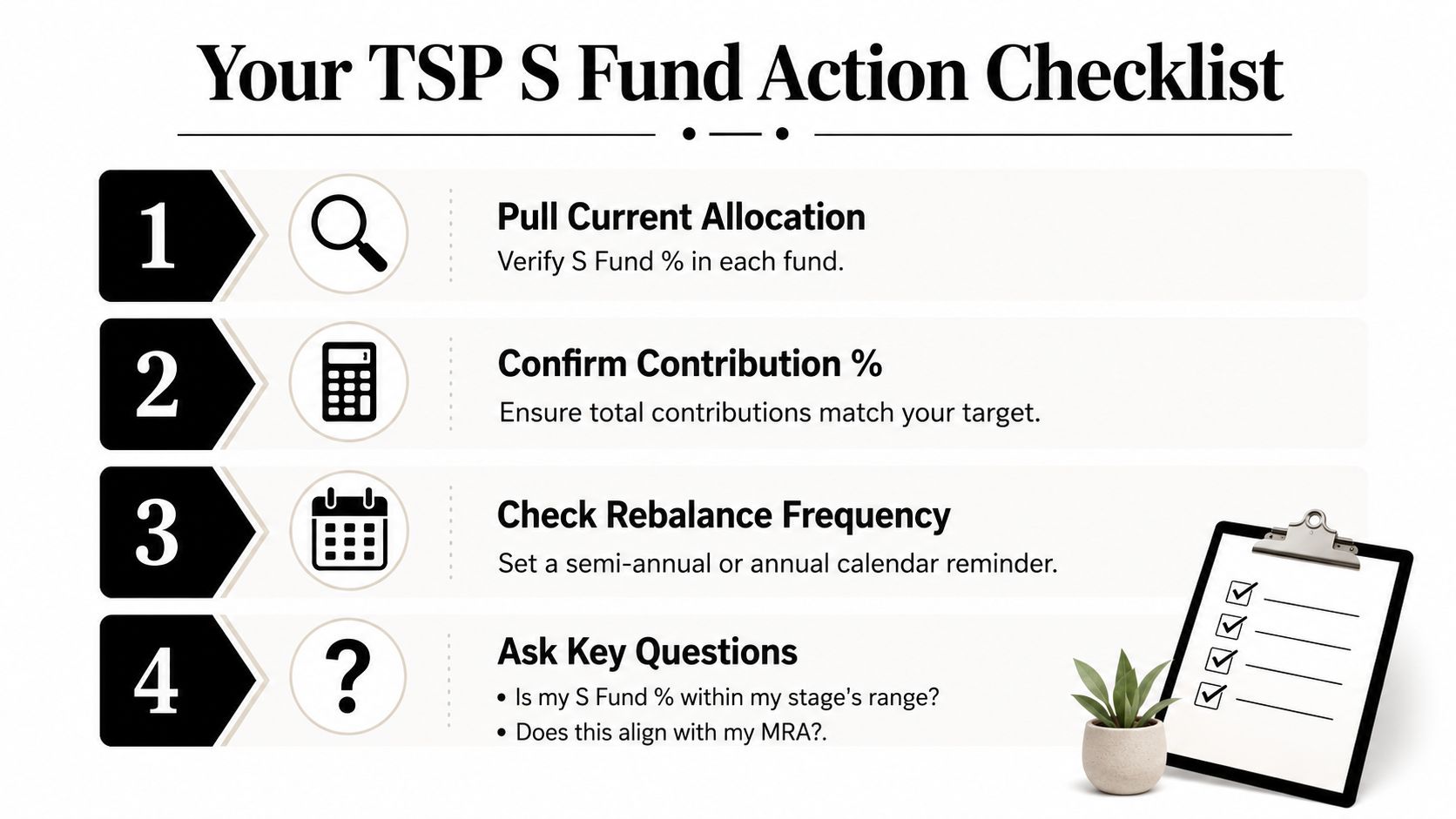
Ask yourself three questions before you submit the change:
- How concentrated is my small-cap exposure across the TSP, an IRA, and a spouse's retirement accounts?
- What happens to my withdrawal plan if the S Fund falls sharply just before retirement?
- Which tax bucket holds the S Fund, Roth or traditional, and does that placement fit my broader tax strategy?
Review the allocation at least annually and after a major change in retirement timing, income, health, family obligations, or risk tolerance. The S Fund can be a valuable growth sleeve, but it should remain one controlled component of a broader federal retirement plan.
Federal Benefits Sherpa offers educational TSP guidance, personalized benefit reviews, retirement planning, and gap analysis reports that help federal employees connect TSP decisions with FERS, Social Security, and healthcare planning. If you're unsure whether your S Fund allocation matches your retirement timeline, visit Federal Benefits Sherpa for help evaluating the broader picture.


Dedicated to helping Federal employees nationwide.
“Sherpa” - Someone who guides others through complex challenges, helping them navigate difficult decisions and achieve their goals, much like a trusted advisor in the business world.
Federal Benefits Sherpa, LLC
12724 Gran Bay Parkway West, Suite 410, Jacksonville, FL 32225
Email: [email protected]
Phone: (833) 753-1825
© 2024 Federalbenefitssherpa. All rights reserved
Federal Benefits Sherpa is an independent organization and is not affiliated with or endorsed by the U.S. government or any federal agency.