TSP Lifecycle Income Fund The Ultimate Guide for Federal Employees
If you're a federal employee on the cusp of retirement, or already there, your entire financial mindset has to shift. The TSP Lifecycle Income Fund (L Income Fund) is built for this exact transition. It's the most conservative fund in the Thrift Savings Plan, designed to protect what you’ve built rather than to chase aggressive growth.
Think of it this way: this fund isn't about making you rich; it's about helping you stay rich in retirement.
Your Financial Anchor as You Approach Retirement
After decades of saving and investing, the game changes. You’re no longer focused on accumulating wealth—you're focused on making sure the money you worked so hard for will last for the rest of your life. This is precisely where the TSP L Income Fund comes into play. It was created for federal employees who simply can't afford to watch their nest egg shrink during a market downturn.
Imagine your TSP account is a ship you've sailed your entire career. Early on, you could navigate through stormy, high-growth waters because you had plenty of time to recover if things got rough. But now, as you approach the harbor of retirement, the mission is all about safe passage. The L Income Fund is the anchor designed to hold your ship steady, minimizing the violent rocking that can come from a volatile stock market. It’s built for stability, not for speed.
Who Is This Fund Really For?
The main goal here is to protect your principal from taking a major hit. The fund does this by holding an extremely conservative mix of assets, with a huge allocation to government securities. This approach is a perfect fit for a few specific groups of people.
Those About to Retire: If you're just a few years out from leaving your federal job, you might want to lock in your gains and dial down the risk significantly.
Current Retirees: For those already drawing an income from their TSP, the L Income Fund provides a stable, predictable foundation for those monthly withdrawals.
The Extremely Cautious: Some people, no matter their age, just can't stomach market swings. If capital preservation is your absolute number one priority, this fund delivers.
At its core, the L Income Fund makes a simple trade-off: it swaps the potential for high returns for the peace of mind that comes with stability. It's a critical tool for anyone focused on making their savings last through retirement.
This guide will pull back the curtain on exactly how this fund works, from its asset mix to its historical performance. Once you understand the mechanics, you can decide if this slow-and-steady approach is the right move for your own retirement plan.
How the TSP L Income Fund Works
The TSP L Income Fund is built on a straightforward idea: to be the most stable and conservative investment you can choose within the Thrift Savings Plan. It wasn't designed for exciting growth spurts; it was designed for capital preservation, making it a financial anchor for many federal employees already in or very near retirement.
Think of it as a fixed-ingredient recipe. Unlike the other L Funds that change their mix over the years, the L Income Fund's formula is set in stone. This consistency is its main advantage, providing a buffer that helps protect your savings from the market's wilder swings. Its job is to provide a modest income stream while, most importantly, safeguarding the nest egg you've spent a career building.
This concept map really captures the essence of the L Income Fund's purpose.
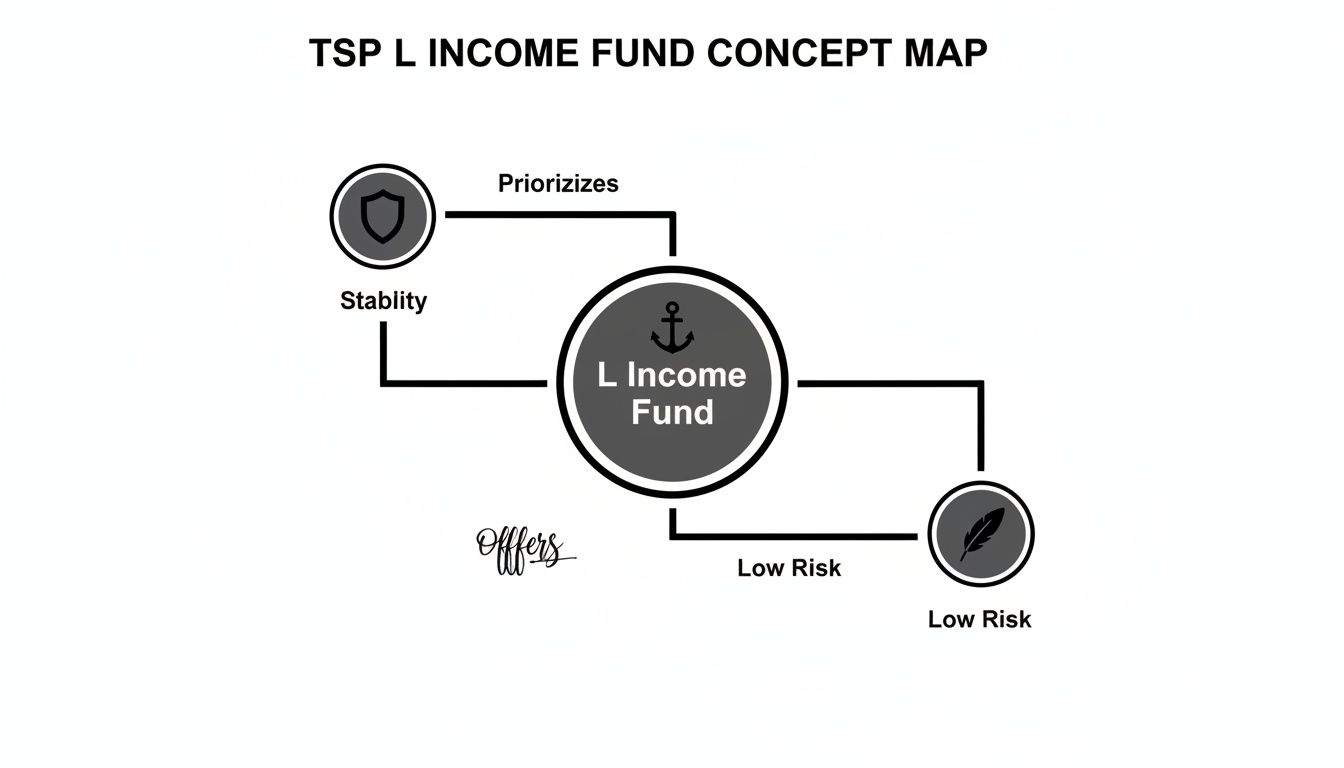
As you can see, everything about this fund comes back to stability and low risk. It's built to be a dependable foundation during your retirement years.
The Fixed Asset Allocation Strategy
The secret to the fund's stability is all in its asset mix. This isn't just a random blend; it's a specific, deliberate allocation heavily tilted toward the safest investments the TSP has to offer.
Launched way back on August 1, 2005, the L Income Fund's allocation is locked in. Let's take a look at the exact breakdown.
TSP L Income Fund Asset Allocation Mix
This table shows exactly how the L Income Fund is invested across the five core TSP funds. Notice how dominant the G Fund is.
TSP FundFund TypeAllocation PercentageG FundGovernment Securities72%F FundFixed Income Index6%C FundLarge-Cap U.S. Stocks11%I FundInternational Stocks8%S FundSmall/Mid-Cap U.S. Stocks3%
This mix means over 78% of your money is in government securities and bonds, which are far less volatile than stocks. The remaining slice, just a hair over 20%, is invested in stocks to give your money a little nudge to help it keep up with inflation over the long haul.
The L Income Fund’s design is a classic risk-reward trade-off. It consciously gives up the potential for higher returns in exchange for much lower risk. The goal is to ensure a sudden market crash won't deliver a devastating blow to your account balance.
To see how this conservative approach stacks up against other options, it's worth exploring our complete guide on how to use the TSP for smart federal savings.
Daily Rebalancing: The Automatic Course Correction
So, how does the fund stay locked into that precise 72/6/11/8/3 split? The TSP has an automatic process that runs every single business day: rebalancing.
The market is always moving, which means the value of the G, F, C, S, and I funds changes constantly. On a day when stocks do well, the C, S, and I Funds will grow, and their percentage of the L Income Fund's pie will creep up.
Rebalancing is the mechanism that fixes this drift.
If the stock funds grow and become too large a piece of the pie, the TSP automatically sells off a small bit of the excess gains.
It then takes that money and buys more of the bond funds (G and F) to bring the allocation back to its target.
This happens every day behind the scenes. It's a disciplined, unemotional process that forces the fund to "sell high and buy low" in a very small, consistent way, keeping its conservative posture perfectly intact. This strategy is a real-world application of the principles behind a sound bond-stock allocation by age, ensuring the risk level remains appropriate for someone living off their investments.
Navigating L Income Fund Performance and Risk
When you’re retired or getting close, all the Wall Street jargon like "standard deviation" or "CAGR" feels pretty meaningless. What you really need to know is simple: "Is my money safe?" and "Will this account provide the stability I need for the long haul?" Let's break down the TSP Lifecycle Income Fund's performance in plain English to answer those exact questions.
Think of market volatility like turbulence on a flight. Investing in aggressive funds like the C, S, and I funds is a bit like flying a stunt plane—it can be a thrilling ride with incredible gains, but it also comes with stomach-churning drops. The L Income Fund, on the other hand, is your modern commercial airliner on a calm day. The journey is smooth, predictable, and designed to get you to your destination without any heart-stopping plunges. That smoothness is what financial pros call low volatility.

This fund isn't designed to break records with flashy returns; it's built to build your confidence. Looking at its performance over 3, 5, and 10-year periods, a clear pattern emerges: slow, steady, and dependable growth. Its main job isn't to beat the stock market but to protect your nest egg when the market inevitably hits a rough patch.
What Historical Returns Really Tell Us
The L Income Fund's track record is probably its most compelling selling point. It has a long history of delivering consistent, low-risk returns through all sorts of economic weather. Many federal employees nearing retirement gravitate to it for this very reason—it's a proven performer.
From its start in 2005 through December 2025, it delivered a 4.6% compound annual growth rate. That may not sound huge, but it was enough to turn a $1,000 investment into $2,525. That's a 152.5% total return that outpaced many other conservative bond portfolios. You can dig into more of the numbers and find other insights by checking out the TSP L Income fund at TSPFolio. This steady-Eddie performance is a direct result of its fixed asset mix, which is heavily anchored in the safety of the G and F funds.
The Power of Low Drawdown
One of the most critical numbers for any retiree, yet one that's often overlooked, is the maximum drawdown. This figure tells you the biggest drop the fund has ever experienced from its peak value to its lowest point. It’s the real-world answer to the question, "How bad could it have gotten?"
For aggressive stock funds, that number can be downright terrifying—we’re talking drops in the -40% to -50% range during major market crashes. With the L Income Fund, it's a completely different story.
Key Takeaway: The fund's fixed allocation keeps its stock exposure low (just 22% combined in C, S, and I funds). This acts as a shield, protecting investors from the brutal 20-30% losses that can hammer stock-heavy portfolios. The worst dip this fund ever saw was a much more manageable -11.0%.
That one statistic says it all. While losing 11% is never fun, it’s a whole lot easier to recover from than a -30% or -40% loss that could permanently derail your retirement plans.
A Comparative Look at Risk vs. Reward
To really get a feel for the L Income Fund's place in your strategy, it helps to see how it stacks up against the other TSP options.
Fund OptionPrimary GoalHistorical VolatilityMaximum Drawdown (Approx.)L Income FundCapital PreservationVery Low~ -11%G FundAbsolute PreservationExtremely Low0% (Cannot lose value)C FundAggressive GrowthHigh~ -50%S FundVery Aggressive GrowthVery High~ -55%
This table makes the L Income Fund's unique role crystal clear. It offers way more protection than the pure stock funds but still has a little bit of growth potential to help you keep up with inflation—something the G Fund can’t quite do on its own.
Ultimately, evaluating the TSP Lifecycle Income Fund isn't about chasing the highest possible returns. It’s about understanding its purpose: to be a dependable, low-stress foundation for your retirement income. Its history shows it does that job well, offering peace of mind through predictable, if modest, growth.
Comparing The L Income Fund To Other TSP Funds
To really get a feel for the TSP Lifecycle Income Fund, you have to see how it stacks up against your other investment options. It’s not just another fund in the lineup; it’s a highly specialized tool designed for a very specific job. The only way to know if it's right for you is to compare it directly to the other Lifecycle (L) Funds and a do-it-yourself strategy using the individual core funds.

This comparison helps drive home its unique role as the final destination for capital preservation within the entire Thrift Savings Plan ecosystem.
L Income Fund vs. Other L Funds
The biggest difference between the L Income Fund and its siblings (like the L 2065, L 2050, etc.) all boils down to one simple concept: the glide path.
Think of the other L Funds as airplanes on a long-haul flight, with their retirement date as the destination. Early in the journey, these funds are invested aggressively—mostly in stocks (C, S, and I Funds)—to give your money the best chance to grow. As they get closer to that target date, they automatically "glide" into a more conservative mix, dialing back the stocks and adding more bonds.
The L Income Fund is the final landing strip.
It’s the most conservative asset mix that all other L Funds are slowly moving toward over time. The L Income Fund has no glide path because it has already arrived. While an L 2030 fund is still descending for a landing, the L Income Fund is already parked at the gate.
This makes the choice pretty clear. If you’re still years away from retirement and need your money to grow, a target-date L Fund is designed for that purpose. But if you're already in retirement and your top priority is protecting what you've saved, the L Income Fund is your go-to tool.
L Income Fund vs. A DIY Approach
Of course, you can always build your own portfolio using the five individual funds: G, F, C, S, and I. This "do-it-yourself" approach gives you total control but also means you're in the driver's seat for all the decision-making. If you're curious, you can see how this compares to other investment vehicles like mutual funds and ETFs, as the L Income Fund functions a lot like a very conservative mutual fund.
Choosing the L Income Fund is like hiring a professional manager for a pre-mixed, conservative portfolio. The perks are straightforward:
Automatic Rebalancing: The TSP does all the daily work to keep the asset mix on target. You don’t have to lift a finger.
Simplicity: It’s a true “set it and forget it” option for anyone who wants to prioritize safety without the hassle.
Emotional Discipline: Because it's automated, it helps you avoid the temptation to panic-sell during a market downturn.
On the flip side, a DIY approach offers complete flexibility. You could, for example, build an even more conservative mix with 90% in the G Fund, or add a bit more international stock if you feel strongly about it. This just means you have to log in periodically and rebalance the account yourself. For those who enjoy being more hands-on, there are plenty of top TSP investment strategies for federal employees to explore.
A Head-To-Head Comparison
Sometimes, the best way to see where things stand is a simple, direct comparison. This table lays out the L Income Fund’s purpose and risk profile against the other TSP choices.
TSP L Income Fund vs. Other TSP Funds at a Glance
Fund OptionPrimary GoalRisk LevelGrowth PotentialBest ForL Income FundCapital PreservationVery LowLowRetirees focused on protecting their principal.Other L FundsBalanced GrowthVaries (High to Low)Varies (High to Low)Investors seeking an automated, age-based strategy.G FundAbsolute PreservationLowest PossibleVery LowThose who want zero risk of principal loss.C/S/I FundsAggressive GrowthHigh to Very HighHigh to Very HighYounger investors with a long time horizon.DIY MixCustomized GoalsYou DecideYou DecideHands-on investors who want total control.
At the end of the day, choosing the TSP Lifecycle Income Fund is a strategic decision based on where you are in life and how much risk you're comfortable with. It isn't built to compete with the high-flying growth potential of the C or S Funds. Instead, it offers a safe harbor, giving you peace of mind by putting the protection of your hard-earned savings above everything else.
Is the L Income Fund Right for Your Retirement Strategy?
Figuring out the right TSP fund isn't about finding the single "best" option. It's about finding the one that fits you—your age, your goals, and where you are on your career path. The TSP Lifecycle Income Fund is a very specific tool for a very specific job, and you need to know exactly what that job is before you put it to work.
Think of it this way: your TSP is a financial toolkit. You wouldn't grab a sledgehammer to hang a picture frame. In the same way, the L Income Fund is designed for one main purpose: protecting what you've already built. If your mission is capital preservation, it’s a fantastic tool. But if you're still in the building phase of your career, it's probably the wrong choice.
The Ideal L Income Fund Investor
So, who is this fund really built for? If any of the descriptions below sound like you, the L Income Fund is definitely worth a closer look. It's for people whose financial priorities have shifted from growth to stability.
Federal Employees Nearing Retirement (5-10 Years Out): As you get closer to your last day on the job, your mindset changes. You're less focused on hitting home runs and more focused on not striking out. Moving a portion of your TSP into the L Income Fund can be a smart way to lock in the gains you’ve spent a career building.
Current Federal Retirees: Once you've retired, your TSP is no longer a growth engine; it's a source of income. The L Income Fund's stability gives you a solid foundation to draw from, without the constant worry that a market downturn will devastate your account balance right when you need it most.
Investors with a Very Low Risk Tolerance: Let's be honest, some people just can't stomach the wild swings of the stock market. If market volatility gives you heartburn, the L Income Fund’s low-drama, steady-as-she-goes approach can provide priceless peace of mind.
When to Look at Other Options
It's just as important to understand who the L Income Fund is not for. A younger employee in their 20s, 30s, or even 40s who puts their entire TSP into this fund is making a huge mistake.
Time is the most powerful asset for a younger investor. You have decades for your money to grow and, crucially, decades to recover from any market dips along the way. Your goal should be aggressive growth, which you'll find in the C, S, and I Funds. The L Income Fund’s conservative returns just won't cut it.
The L Income Fund trades high growth potential for high stability. This is a great deal for a retiree, but it can cripple the long-term wealth of someone still early in their career.
Pros and Cons at a Glance
Sometimes the best way to make a decision is to see the good and the bad laid out side-by-side. Here’s a straightforward look at the L Income Fund’s strengths and weaknesses.
Pros:
Exceptional Stability: With its huge allocation to the G Fund, it’s one of the safest places you can put your money in the TSP, insulating you from major market meltdowns.
Simplicity: It’s a true "set it and forget it" option for anyone who wants a conservative portfolio without having to manage it.
Peace of Mind: The fund is designed for a smooth ride. That kind of predictability is exactly what most retirees are looking for.
Cons:
Low Growth Potential: Don't expect big returns here. The fund is designed to preserve capital, not grow it, and will likely just keep pace with or slightly beat inflation.
Not for Accumulation: It is absolutely the wrong tool for someone trying to build their nest egg. Using it for accumulation is like trying to drive a car with the emergency brake on.
The numbers really tell the story. Since its inception in 2005, the L Income Fund has delivered a 4.6% compound annual growth rate. That means $1,000 invested back then would be worth about $2,525 today—a total return of 152.5%. Its fixed allocation (72% G Fund, 6% F Fund, 22% stocks) helped it avoid the worst of market crashes. While riskier L Funds saw maximum drawdowns of -21.5% to -29.2%, the L Income Fund's worst drop was only -11.0%.
Remember, this doesn't have to be an all-or-nothing choice. You can use the L Income Fund as a stabilizing anchor in a more diversified portfolio. To get a better handle on how this might fit into your broader plan, check out our complete guide to Thrift Savings Plan withdrawal options.
Common Questions About the L Income Fund
Alright, let's get into the nitty-gritty. You understand what the TSP Lifecycle Income Fund is designed to do, but now the practical, real-world questions start popping up. It's one thing to know the theory, but another to decide if it's the right final home for your hard-earned retirement savings.
Let's walk through the questions I hear most often from federal employees who are in your shoes.
Can I Actually Lose Money in the L Income Fund?
Yes, you can, but let’s put that risk into perspective. It’s not the kind of gut-wrenching drop you might see in the stock market.
The L Income Fund keeps about 22% of its portfolio in the C, S, and I stock funds. That small slice of the pie means that when the market has a bad year, the fund's value will dip. But—and this is the important part—it’s anchored by a massive 72% allocation to the G Fund, which is guaranteed by the U.S. government to never lose principal.
That G Fund stake acts like a powerful shock absorber. To give you an idea, the worst drop the L Income Fund has ever had was a manageable -11.0%. That’s a fraction of what more aggressive funds lost in the same market crash.
The risk of loss is real, but it’s minimal. Think of it as a shallow dip in the road, not a terrifying plunge off a cliff. The fund is built for stability, aiming to prevent the kind of catastrophic losses that could derail your retirement.
How Does This Fund Actually "Generate Income"?
This is a great question because the name "Income Fund" can be a little misleading. It doesn't pay out a dividend or a monthly interest check like a traditional bond. The "income" part comes from how a retiree uses the fund.
First, it produces modest, slow-and-steady growth from its blend of bond interest and stock appreciation. The goal here isn't to hit a home run; it's to gently grow your nest egg, hopefully staying a step ahead of inflation.
Second, that stable growth creates a reliable pool of money you can draw from. You can set up systematic monthly withdrawals from your TSP, effectively creating your own paycheck. Because the fund’s value doesn’t swing wildly, you can do this without the constant fear that a market crash will force you to sell your investments at a huge loss. Its stability is what makes it a dependable source for creating that retirement income stream.
Should I Put My Entire TSP in the L Income Fund When I Retire?
I get this question all the time, and for most people, the answer is probably no. While the L Income Fund is fantastic for preserving your capital, going 100% in might be too conservative, even in retirement.
Remember, your retirement could last 30 years or more. You'll likely need some growth to make sure your money lasts as long as you do. Many financial planners suggest a "bucket" strategy or something similar to balance safety with growth.
A few popular approaches include:
A Core and Explore Strategy: You could put the bulk of your TSP, say 70-80%, in the L Income Fund for stability. The remaining 20-30% could stay in funds like the C or S Fund to capture long-term growth potential.
The G Fund Combo: For maximum safety, some retirees pair the L Income Fund with the G Fund. This creates an ironclad foundation while still getting a tiny bit of growth from the L Income Fund's stock allocation.
The right mix really comes down to you—your personal comfort with risk, your other income sources like a FERS pension and Social Security, and what you want your money to do for you long-term. An all-or-nothing strategy is rarely the best path.
What Are the Steps to Move My Money?
Switching your investments into the TSP Lifecycle Income Fund is refreshingly simple. You can do it all online in just a few minutes, no complicated paperwork required.
Here’s a quick rundown of the process:
Log In to Your TSP Account: Head over to the official TSP website at tsp.gov and log in to "My Account."
Find the Investment Options: Once you're in, you'll see options for "Contribution Allocations" (for future paychecks) and "Interfund Transfers" (for money already in your account). To move your existing balance, you’ll want to start an Interfund Transfer.
Choose Your New Mix: The system will show you where your money is currently invested. You can then tell it to move 100% (or any other percentage) of your balance into the L Income Fund.
Review and Confirm: Before anything is final, you'll get a chance to double-check your choices. Make sure it looks right, then confirm the transaction.
After you submit the request, the change usually takes effect at the close of the next business day. It’s a very straightforward process that puts you in complete control.
Navigating the complexities of your federal benefits is a critical step toward a secure retirement. At Federal Benefits Sherpa, we specialize in helping federal employees create a clear and confident path forward. To ensure your TSP strategy aligns perfectly with your overall retirement plan, consider scheduling a complimentary benefits review with our experts.
Learn how we can help at https://www.federalbenefitssherpa.com.
