
Learning Center
Phased Retirement Federal Employees Guide to Half-Time Work
You may be at that point where retirement is no longer a distant idea, but a real decision sitting on your desk.
You can retire now. Your service record supports it. Your annuity is part of the conversation. But walking out all at once doesn't feel quite right. Maybe you still care about the mission. Maybe your team leans on your experience. Maybe you want more time for family, travel, or health, but you're not ready for a clean break from work.
That's where phased retirement enters the picture for federal employees. It isn't a shortcut out the door, and it isn't just a lighter schedule. It's a formal bridge that lets some retirement-eligible employees step down gradually while helping their agency keep critical knowledge in place a little longer.
Introduction to Phased Retirement for Federal Employees
A familiar 2026 scenario goes like this. You have enough service to retire, but your office is training newer staff, a major project is still in motion, and people keep coming to you for the history behind past decisions. You want more room for family, health, or life outside work. Your agency wants time to pass along the knowledge you built over years of service.
That is the job phased retirement was designed to do.

Under federal law, phased retirement was set up as a formal transition option for retirement-eligible employees. OPM later put the rules into effect through its implementing guidance. The point was not to create a faster exit. The point was to create a controlled handoff from full-time service to full retirement.
That distinction matters.
Phased retirement works like a bridge built for two groups at once. For the employee, it can soften the shift from a full workweek to full retirement. For the agency, it can preserve institutional knowledge long enough for mentoring, training, and continuity. If you hear the phrase and assume it means "retire early with fewer hours," you will miss the reason the program exists.
What phased retirement is, and what it is not
Phased retirement allows an eligible full-time federal employee to move into an approved part-time arrangement while beginning to receive part of a retirement benefit. It sits between staying in your current full-time role and separating completely.
A good way to picture it is a relay race. One runner does not drop the baton and walk away. There is a marked exchange zone, and both runners are involved in the handoff. Phased retirement is that exchange zone. The program is structured to support work transfer, not just work reduction.
That also helps explain what phased retirement should not be confused with. It is different from ordinary part-time work. It is different from a voluntary separation incentive or another agency departure program that is mainly built to encourage employees to leave. Those options answer different problems. Separation incentives focus on departure. Phased retirement focuses on transition and knowledge transfer.
Why this still matters in 2026
In 2026, that difference is easy to overlook because many employees are hearing about downsizing, restructuring, and agency-specific exit offers. If those programs are in the air, phased retirement can sound like just another way out. It is not.
It fits a narrower situation. You are already eligible to retire. Your agency is willing to approve the arrangement. Your experience still has day-to-day value, especially if newer employees need coaching or your office needs a planned transfer of responsibility.
For that group, the questions are practical:
- Are you eligible under the federal rules?
- Does your agency have to approve it, and how much discretion does it have?
- What changes in your income, service credit, and benefits during the phased period?
- How does this compare with a separation incentive or a straight retirement decision in 2026?
Those are the points that usually cause confusion, because phased retirement sounds simple from a distance. Up close, it is more like a carefully marked transition lane. If the lane fits your situation, it can be useful. If you mainly want a quick exit, another option may be the better match.
How Phased Retirement Works as a Bridge to Full Retirement
A clearer way to view phased retirement is through a common office transition. A senior specialist is ready to stop carrying a full workload, but the agency is not ready to lose years of institutional knowledge in one day. Phased retirement creates a formal middle stage where both needs can be met.
The core structure
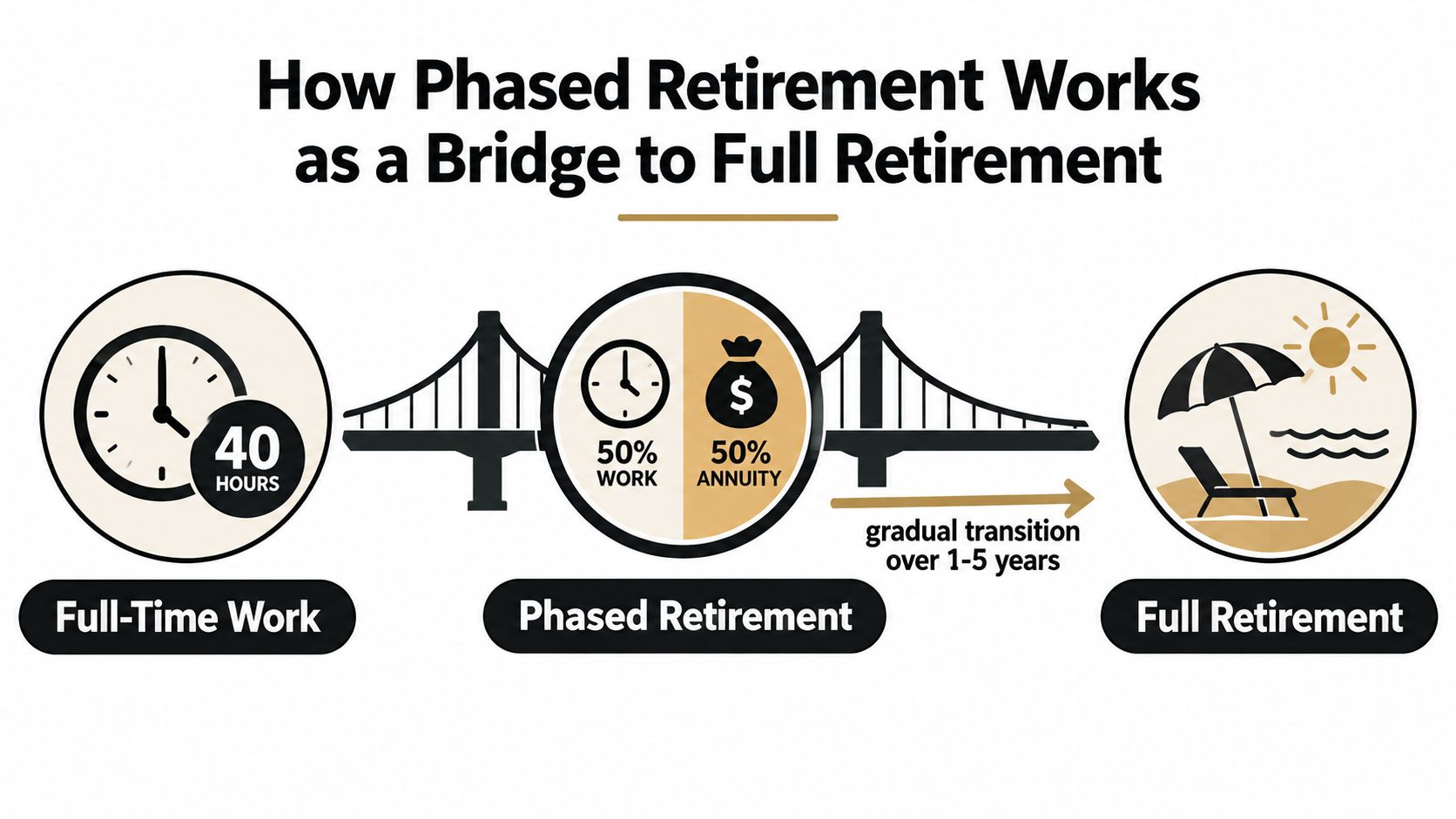
Under OPM's phased retirement rules, the arrangement generally works as a split. You work about half time and begin receiving a partial annuity at the same time, based on OPM's phased retirement implementation guidance discussed earlier in this article. Your paycheck drops because your schedule drops. Your retirement income begins because you are entering a formal retirement status, not just a casual part-time arrangement.
That distinction matters.
A lot of employees hear "reduced schedule" and assume phased retirement is part-time work with a retirement label attached. It is closer to a handoff period built into the retirement system. You remain on the job in a reduced capacity while also stepping into retirement income in a structured way.
Why it is called a bridge
The bridge idea fits because phased retirement connects two statuses that are usually separate. On one side, you are a full-time employee. On the other, you are fully retired. In the middle, you are doing some of each.
A highway analogy helps here. Full retirement is the exit. Phased retirement is the exit lane that gives you room to slow down, merge responsibility, and transfer what you know before you are fully off the road.
That makes it very different from a separation incentive in 2026. Incentive programs are designed to speed up departures. Phased retirement is designed to structure a transition, especially when an office still needs your experience for training, mentoring, or continuity.
What you are actually doing during the phased period
The work side of phased retirement is not supposed to function like a quiet glide path where you do less of everything. The program was built around continued contribution, often with a knowledge-transfer focus. In plain English, the agency is not just keeping you around for extra time. It is using that time to pass along judgment, processes, and context that are hard to replace with a handbook.
That can include:
- coaching a newer employee who may inherit your duties
- documenting workflows that only a few people fully understand
- helping transfer relationships, case history, or technical judgment
- reducing disruption while a team adjusts to a staffing change
This is why phased retirement tends to fit a narrower group of employees than broad exit offers do. It works best when your departure needs a runway.
How it compares with other retirement-related paths
Three options can sound similar at first, but they solve different problems:
- Part-time work reduces hours, but it does not automatically place you in phased retirement status or start a phased annuity.
- Immediate retirement ends your federal employment and starts your full retirement path at once.
- The FERS Supplement is a separate benefit concept, not a work arrangement. If you want a plain-English comparison, this guide to the FERS Supplement retirement bridge explains how that piece works.
Why agencies may care about this structure
From an agency perspective, phased retirement can solve a very specific workforce problem. A key employee is retirement-eligible, but a direct handoff would create risk. The phased period gives managers time to plan the transfer instead of absorbing the loss all at once.
That is one reason some HR and operations teams discuss retirement options alongside broader process design. If your leadership is trying to streamline employee lifecycle with Power Platform, phased retirement may come up as one step in a larger hire-to-retire process rather than as a stand-alone benefit.
Keep the main idea simple. Phased retirement is a structured transition for employees who are already retirement-eligible and whose agencies want a gradual, knowledge-transfer bridge instead of a one-day departure.
Eligibility and Approval Rules You Must Meet
A common 2026 scenario looks like this: an employee is old enough and has enough service to retire now, but the agency is not ready to lose years of institutional memory in one handoff. That is the narrow lane phased retirement was built for. It is less like an early exit and more like a planned relay, where work knowledge gets passed before the baton fully changes hands.
The rules that screen people in, or out
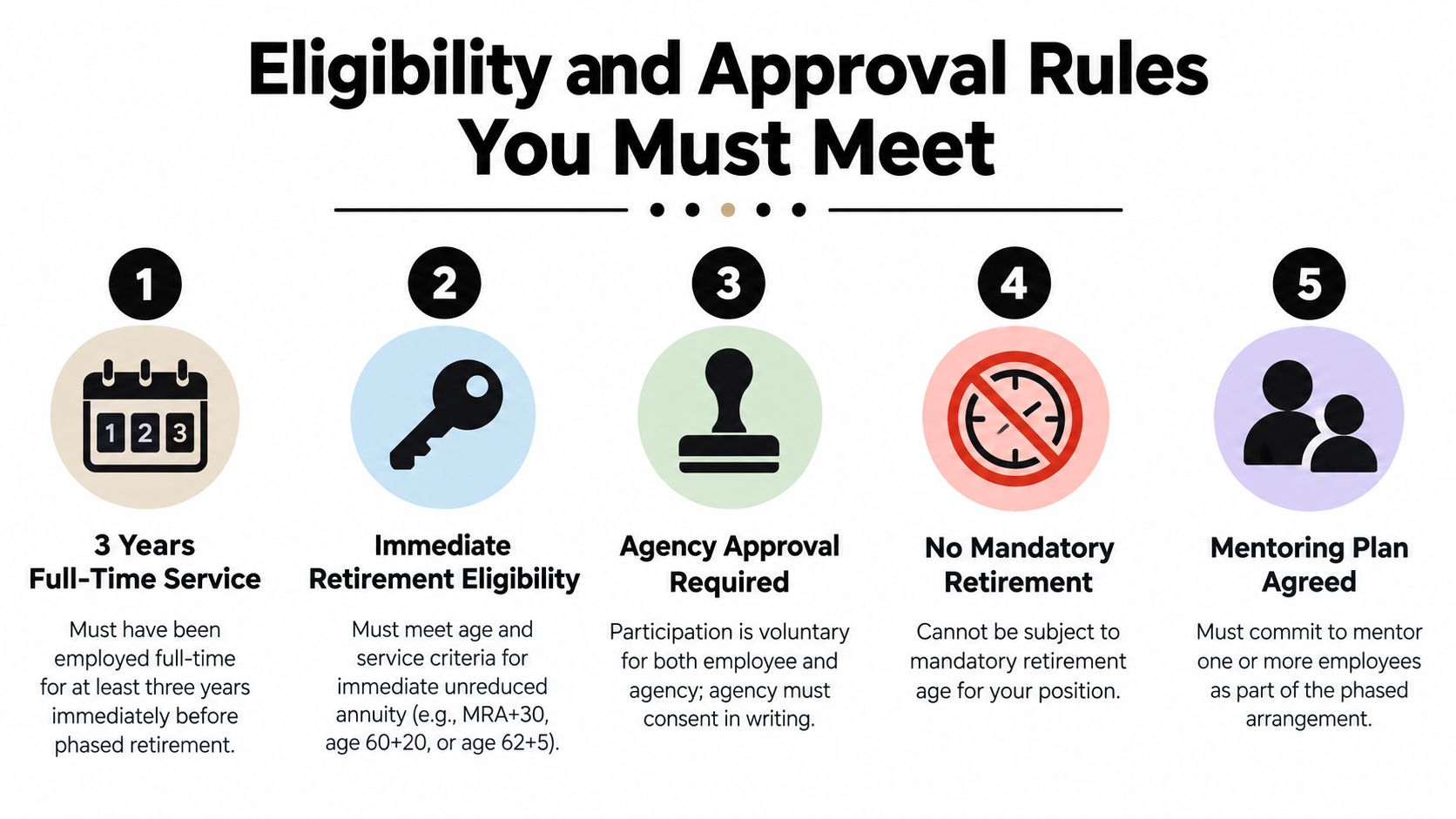
Start with the basic gate. Phased retirement is available only to employees who already qualify for retirement and whose agencies approve the arrangement. Under OPM's phased retirement FAQ, that includes being employed full-time for the previous 3 years, and for many FERS employees it also means meeting an immediate retirement path such as:
- Minimum retirement age with at least 30 years of service
- Age 60 with at least 20 years of service
That combination trips people up.
Some employees hear “phased” and assume it works like easing into retirement before they are otherwise eligible. It does not. A better way to read the rule is this: full retirement eligibility gets you onto the field, and phased retirement gives the agency a structured way to keep you in a reduced role for a limited transition.
Why approval matters more than many employees expect
Paper eligibility is only one half of the test. The other half is agency value.
Your agency has to agree that keeping you part time serves a purpose, usually because you can train others, document specialized processes, or transfer relationships and operational knowledge that would be hard to replace quickly. That is the distinction between phased retirement and newer separation incentives that may show up in workforce planning discussions in 2026. Incentive programs are often designed to encourage departures. Phased retirement is designed to support a managed handoff.
A simple comparison helps here. Separation incentives ask, “How do we reduce headcount or encourage exits?” Phased retirement asks, “How do we keep mission knowledge long enough to transfer it well?”
A practical self-check before you ask HR
Use these questions as a first screen:
- Are you already eligible for immediate retirement under your system?
- Have you been in full-time employment for the last 3 years?
- Can you describe what knowledge you would transfer, to whom, and over what period?
- Would your office benefit from keeping you in a reduced schedule instead of replacing you right away?
- Is your supervisor likely to support a transition plan tied to training, mentoring, or continuity?
If several of those answers are unclear, the request usually needs more work before it goes to HR.
The practical takeaway
Meeting the rules gets you considered. Agency approval determines whether phased retirement is available in practice.
If you still need to confirm whether you have reached the retirement threshold itself, this FERS retirement eligibility simplified guide can help you verify that first. Then you can evaluate the separate question that matters here: whether your agency sees enough knowledge-transfer value to approve the arrangement.
Practical rule: Lead with a transition plan, not just a request for fewer hours. A stronger pitch is, “Here is how I can help transfer knowledge while I move toward retirement.”
How Pay and Federal Benefits Change During Phased Retirement
A lot of employees reach this point and ask the same practical question: What does my paycheck look like if I do this?
Phased retirement changes the shape of your income. It does not work like a separation incentive, where the goal is to leave. It works more like a transition contract. You stay in the mission part time, you keep transferring knowledge, and your income becomes a combination of part-time pay and a partial annuity.
Your income becomes a two-part stream
During phased retirement, you are usually paid for part-time work and you also begin receiving part of the retirement benefit tied to the service you already earned.
A simple way to picture it is a bridge with two supports. One support is your reduced salary. The other is your partial annuity. Together, they carry you from full-time work to full retirement.
That structure can feel comfortable for some households and tight for others. The difference usually comes down to whether your spending plan can handle a lower paycheck before full retirement begins.
What changes later when you fully retire
The phased period still counts. It is not a pause button and it is not treated the same way as walking out the door under a buyout or other agency exit incentive.
When you later move from phased retirement to full retirement, OPM uses a special composite calculation. In plain English, the government does not ignore the time you worked while phased. It folds that period into a later recalculation under phased retirement rules, as noted earlier.
That point matters because phased retirement is built for continuity. The design assumes you are still contributing, still mentoring, and still adding service during the transition.
Income and Benefits During Phased Versus Full Retirement
| Benefit Element | During Phased Retirement | At Full Composite Retirement |
|---|---|---|
| Salary | Paid at the reduced rate tied to the phased work schedule | No salary from the federal position after full separation |
| Retirement annuity | Partial annuity begins during phased status | Recalculated under composite rules when full retirement begins |
| Additional retirement credit | Continues to build during the phased period | Reflected in the later annuity calculation |
| Work status | Part-time federal service with an approved phased arrangement | Fully retired from that role |
| Budget planning | Requires coordinating salary and annuity at the same time | Shifts to retirement-income planning only |
Benefits require a line-by-line review
This is the part that often causes confusion.
Employees sometimes assume every benefit continues in the same way with fewer work hours. Some do continue. Some change in timing, deduction method, or election choices. That is why this decision works best with your agency estimate, not with general online summaries.
Focus on these areas:
- Health coverage: Confirm how FEHB carries through phased status and into full retirement. A quick review of this guide to FEHB for federal employees can help you ask better questions before meeting with HR.
- TSP contributions: Reduced salary can change how much you contribute and how you think about matching.
- Life insurance: Check how payroll deductions during phased work line up with later retiree coverage choices.
- Social Security timing: A phased arrangement does not decide your claiming strategy for you. That remains a separate retirement income decision.
The question that usually clarifies the decision
A better test than “Will I earn less?” is “Will this mix of part-time pay and partial annuity support my household while I finish work in a mentoring role?”
That question gets to the purpose of phased retirement in 2026. It is not a softer exit. It is a structured knowledge-transfer bridge. If that bridge helps both your agency and your household, the arrangement may fit. If the numbers strain your budget or the mentoring role is unclear, a different path may make more sense.
Timelines and Agency Steps From Application to Full Retirement
A phased retirement request often starts with a simple question to HR and turns into a longer agency process than many employees expect. That is because you are setting up two things at once. You are changing your work schedule, and you are also entering a formal retirement status that has to be documented correctly.
The basic sequence
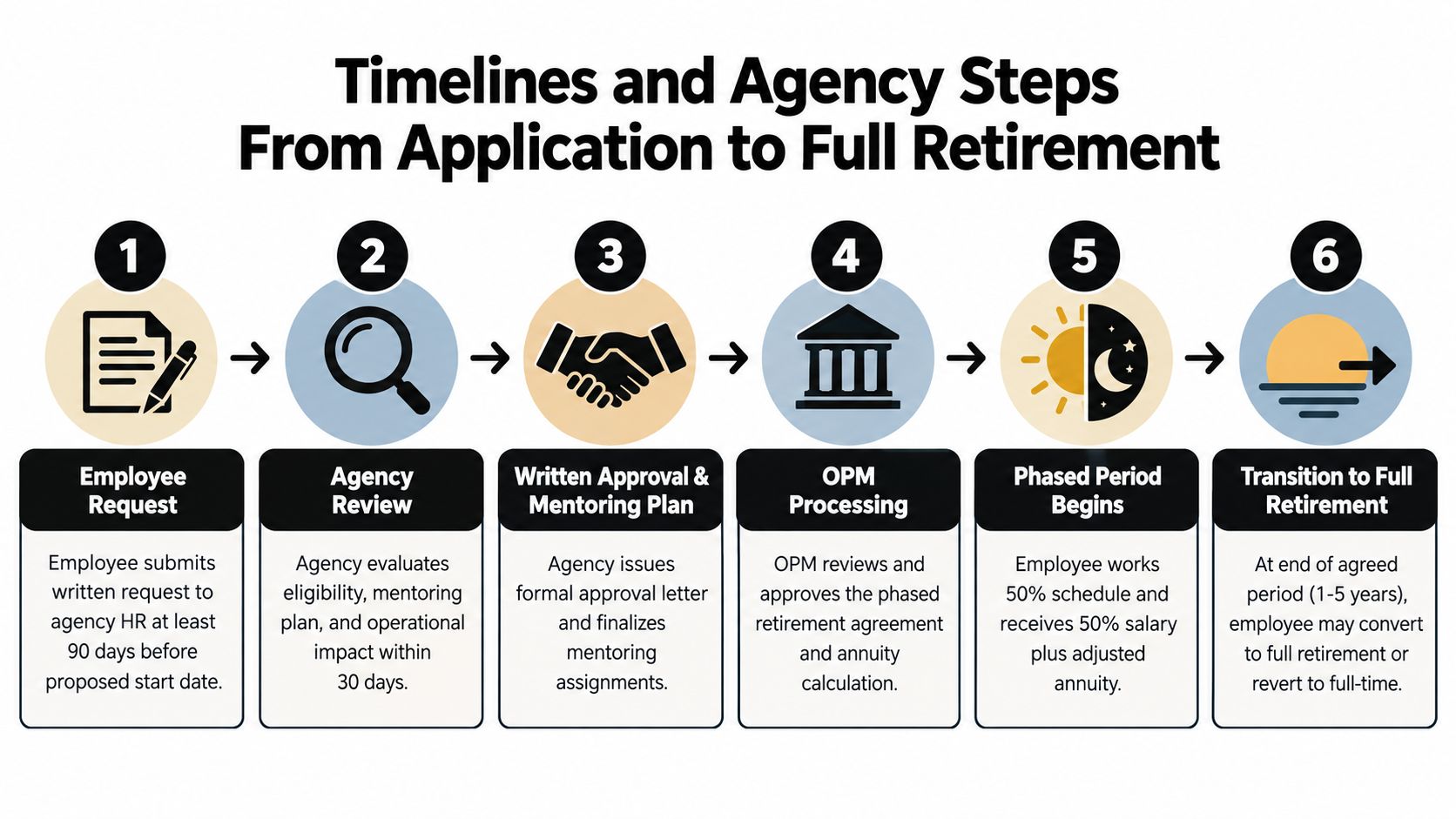
The path usually follows a set order, even if the pace differs by agency.
- You start the conversation internally. That often means HR, your supervisor, or both.
- Your agency checks eligibility. Service history, retirement coverage, and policy requirements have to line up.
- Management reviews the business case. This is often the hinge point. Phased retirement works best when the office can explain why a part-time schedule paired with knowledge transfer helps the mission.
- The arrangement is documented and approved. A mentoring plan or transition plan may be part of that file.
- Retirement processing is coordinated. Your agency and OPM have to handle the status change in the right order.
- You enter phased retirement status. That happens after the approvals are in place.
- You later choose full retirement. At that point, the phased period is folded into your final retirement treatment under the applicable rules.
A practical way to view this is as a handoff chain. If one person is waiting on another office, the whole chain slows down.
Where delays usually happen
Many employees assume OPM is always the main source of delay. Sometimes that is true. Just as often, the wait begins inside the agency before anything reaches OPM.
A supervisor may like the idea, while senior leadership sees little value in a reduced schedule. HR may need time to verify retirement coverage or service credit. The office may also need a clear mentoring assignment, because phased retirement is designed as a structured knowledge-transfer bridge, not a lighter schedule on the way out.
That distinction matters. If management cannot explain who benefits from the knowledge transfer, approval gets harder.
Why the agency context matters more in 2026
In 2026, some agencies are weighing phased retirement against more direct separation tools. Those are very different choices. Phased retirement keeps an experienced employee in place part time so the agency can transfer skills in an orderly way. A separation incentive or scheduled departure program is built for a faster exit.
One example appeared in OPM's 2026 direct-retirement program for healthcare and insurance employees, with paid administrative leave scheduled to begin August 31, 2026, and separation scheduled for March 1, 2027, as reported by Federal News Network's coverage of OPM incentives for healthcare and insurance employees.
That does not mean phased retirement is off the table. It does mean your request will be judged in the context of what agency leaders are trying to accomplish. If leadership is focused on faster reductions, a knowledge-transfer bridge may get less support. If continuity and mentoring are high priorities, phased retirement may fit well.
The planning takeaway
Ask two timeline questions early.
First, how long does your agency usually take to review and approve a phased retirement request? Second, does leadership currently favor retention and transition, or faster separations?
Those answers tell you more than a generic timeline chart. They help you judge whether phased retirement is a realistic bridge to full retirement in your office, or whether another path is more likely to match agency priorities.
Real World Example Scenarios That Show the Tradeoffs
Rules become clearer when you place them in real work lives.
Scenario one with a mentoring-heavy transition
Karen is a FERS employee who has reached her minimum retirement age and has at least 30 years of service. She's ready to step back, but not ready to disappear. Her office is training newer staff on a specialized workload, and her supervisor knows that replacing her institutional knowledge won't happen overnight.
Phased retirement fits because her reduced schedule supports two goals at once. She gets more personal time, and the agency keeps her involved long enough for structured mentoring. For Karen, the appeal isn't “retiring early.” The appeal is keeping one foot in the mission while letting the rest of life expand.
Her tradeoff is emotional as much as financial. She has to accept that she's no longer in a full-time leadership rhythm. Some people find that freeing. Others find it awkward at first.
Scenario two with a cleaner glide path
Daniel is age 60 with at least 20 years of service under FERS. He qualifies, but his situation is different. He doesn't manage a team, and his office can function without a long handoff. He's considering phased retirement mainly because he wants a gentler transition into retirement, not because the agency urgently needs continuity.
For him, the central question is whether the reduced schedule is worth the administrative complexity. If his agency sees little operational benefit, approval may be harder. Even if approved, he has to decide whether a short phased period is better than choosing a retirement date and preparing thoroughly for it.
What these stories show
The same legal framework can feel very different depending on the role.
- Knowledge-transfer roles often make the strongest case.
- Independent positions may have a weaker business case even when the employee qualifies.
- Employees who want identity continuity often value phased retirement more than those who are fully ready to close the chapter.
- Employees under agency separation pressure may find the window for a phased arrangement narrower than it looks on paper.
One person sees a bridge. Another sees extra paperwork for a benefit they may not need. That difference is normal.
Decision Checklist and Next Steps Before You Apply
By this point, the decision usually comes down to fit. Not just legal fit, but practical fit.
A good phased retirement decision sits at the intersection of retirement eligibility, agency support, household income needs, and your willingness to use the period as a genuine transition rather than just a reduced schedule request.
A strong pre-application checklist
Use this list before you ask HR for forms or start discussing dates:
- Eligibility fit: You already qualify for immediate retirement, and your prior service pattern supports the program requirements.
- Agency fit: Your office has a reason to keep you in a reduced role, especially for continuity, mentoring, or transition support.
- Financial fit: Your budget can handle the shift from full salary to a mixed income arrangement.
- Lifestyle fit: You want a gradual off-ramp, not just retirement income as soon as possible.
- Timing fit: Your agency's current workforce strategy doesn't make phased retirement unrealistic from the start.
Questions to bring to HR and your supervisor
Don't walk in with only a personal preference. Bring decision-grade questions.
Ask things like:
- Does the agency currently support phased retirement requests in my type of role?
- What documentation would be needed to justify the arrangement?
- How would my workload and mentoring responsibilities be defined?
- What benefit elections should I review before choosing a start date?
When a personalized review helps
This is one of those topics where a generic retirement estimate may not be enough. A review that fits your situation can help you compare three separate paths: stay full-time longer, move into phased retirement, or retire fully on a chosen date.
That kind of review is where a planning service can be useful. For example, Federal Benefits Sherpa offers retirement planning support, benefit reviews, and gap analysis for federal employees who need to understand how a transition choice may affect income and benefits.
The best phased retirement decisions usually come from clear records, a realistic budget, and an honest read of agency culture.
If you're serious about applying, gather your service history, confirm your retirement eligibility, sketch out a possible reduced-work role, and talk with your supervisor early. A thoughtful proposal is often easier for an agency to evaluate than a vague request for less work.
If you're considering phased retirement and want help comparing it against full retirement or other transition paths, Federal Benefits Sherpa offers federal-focused benefits reviews and retirement planning support built around your actual service and benefit picture. A focused review can help you see whether a half-time bridge fits your finances, your agency reality, and the retirement life you're trying to build.

Dedicated to helping Federal employees nationwide.
“Sherpa” - Someone who guides others through complex challenges, helping them navigate difficult decisions and achieve their goals, much like a trusted advisor in the business world.
Federal Benefits Sherpa, LLC
12724 Gran Bay Parkway West, Suite 410, Jacksonville, FL 32225
Email: [email protected]
Phone: (833) 753-1825
© 2024 Federalbenefitssherpa. All rights reserved
Federal Benefits Sherpa is an independent organization and is not affiliated with or endorsed by the U.S. government or any federal agency.