
Blogs

Blog title place here
We understand that every federal employee's situation is unique. Our solutions are designed to fit your specific needs.

Blog title place here
We understand that every federal employee's situation is unique. Our solutions are designed to fit your specific needs.

Blog title place here
We understand that every federal employee's situation is unique. Our solutions are designed to fit your specific needs.
Medicare Advantage for Federal Retirees: Complete 2026 Guide
Why do so many federal retirees focus on whether Medicare Advantage adds extra benefits, but ignore the question that decides the winner over a 10 to 20 year retirement, what happens after you add up the Part B premium, plan premiums, network limits, and real use of care?
The answer is blunt. Medicare Advantage for federal retirees can be a smart move for the right household, but it is not automatically the cheaper or safer option. The right choice depends on how your FEHB plan coordinates with Medicare, how often you use care, whether your doctors are in network, and whether the promised Part B reimbursement offsets the costs you'll carry year after year. Nationally, Medicare Advantage has become the dominant Medicare coverage model, with 35.2 million of 64.2 million Medicare beneficiaries enrolled in 2026, up from 47% in 2021 (KFF). That scale matters because federal retirees are shopping in a mature market, not a niche experiment.
What Medicare Advantage Means for Federal Retirees
Why do federal retirees keep asking whether Medicare Advantage is “better Medicare” when the core question is whether it fits their retirement costs and doctor access? The short answer is that Medicare Advantage is Medicare through a private insurer, usually built to combine hospital and medical coverage in one plan, with extras such as dental, vision, or hearing benefits. For federal retirees, the central issue is whether an FEHB-linked Medicare Advantage option improves total coverage enough to justify less flexibility.
The basic structure matters
With Original Medicare, the federal government runs your coverage through Part A and Part B. With Medicare Advantage, a private insurer administers Medicare benefits under Medicare rules, and the plan usually expects you to use its network. Medicare's own comparison guidance says MA plans generally use provider networks and usually do not cover care outside the United States (Medicare.gov). That network structure is where many retirees get caught later.
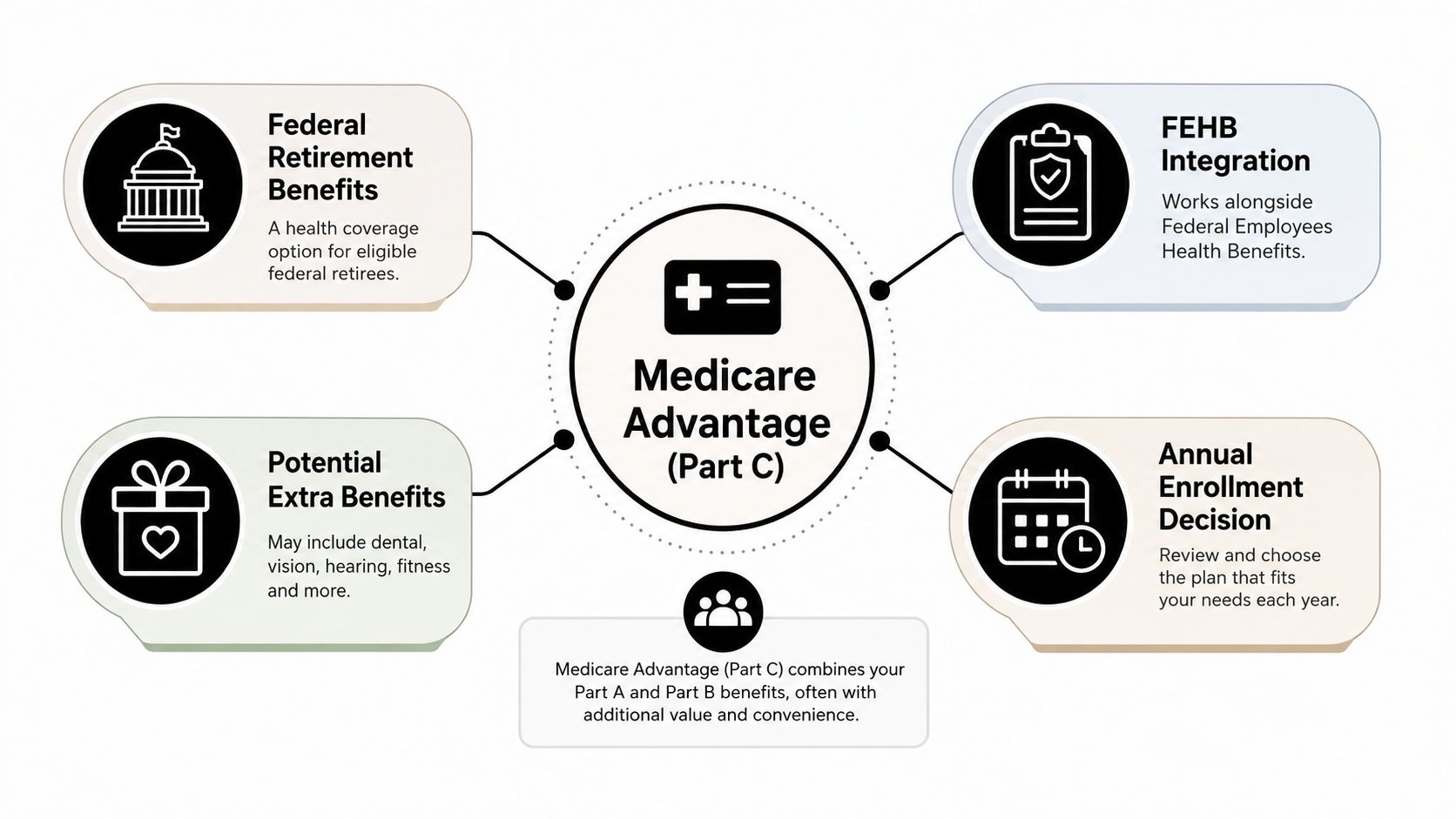
For federal retirees, FEHB-linked MA plans add another layer. OPM says these plans wrap around Medicare Parts A and B and can include extra benefits, but they still follow Medicare enrollment rules and plan design (OPM Medicare information). You are not comparing “free extras” against nothing. You are comparing one integrated setup against another, and the difference shows up in your monthly cost, your provider access, and how much risk you take on if your health needs change.
Practical rule: if you care more about seeing almost any doctor than about extra benefits, start with Original Medicare plus FEHB. If you want bundled extras and can stay inside a network, MA deserves a serious look.
The catch is that federal retirees already have FEHB, which changes the math. A standard Medicare beneficiary compares MA against Original Medicare alone. A federal annuitant compares MA against a strong existing FEHB baseline. That is a different decision, and it is why generic Medicare advice misses the mark. The Part B premium reimbursement can help, but it only wins if it outweighs the plan premium, network limits, and the out-of-pocket costs you use over a long retirement.
Eligibility and Enrollment Rules for Federal Annuitants
You cannot treat this as a casual plan switch. For FEHB-linked Medicare Advantage, you generally need both Medicare Part A and Part B. If you only have Part A, you are not in the enrollment lane that federal retirees usually mean when they talk about this setup. That eligibility requirement comes first, because it determines whether the rest of the decision even applies to you.
The enrollment windows are not interchangeable
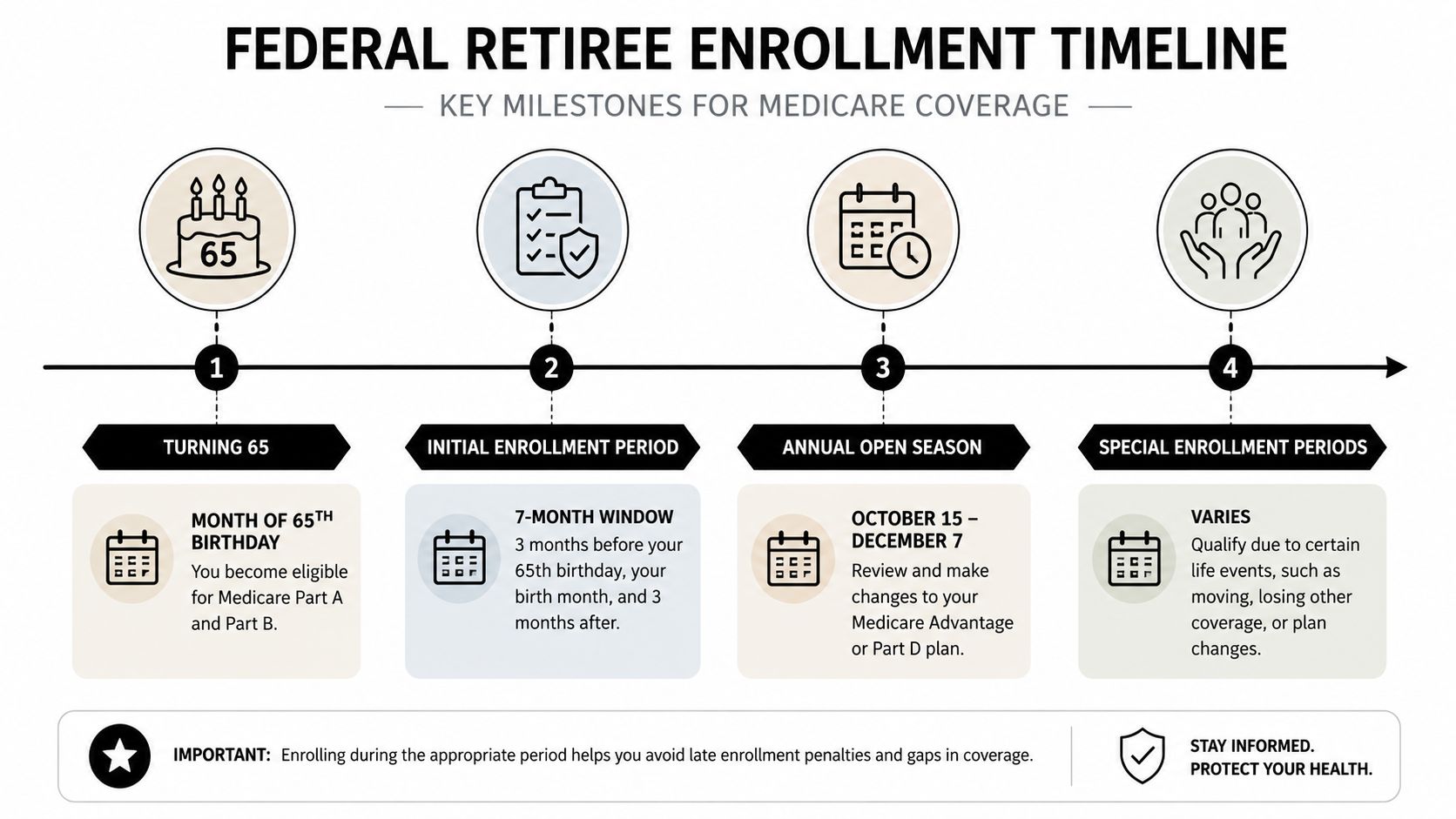
Medicare enrollment does not run on one universal calendar. You have your Initial Enrollment Period, the annual Medicare election window, and Special Enrollment Periods tied to life events or other qualifying changes. FEHB changes follow their own timing, so retirees often have to coordinate Medicare dates with FEHB open season to avoid a gap in coverage or miss a plan election.
The mistake is assuming you can choose MA whenever you want. You cannot. If you want to move from your current FEHB setup into a Medicare Advantage arrangement, you have to line up the Medicare side and the FEHB side correctly. If you miss the Part B timing, late enrollment can follow you for years, and that matters more over a long retirement than in a short budgeting exercise.
Verify the mechanics before you touch your coverage
Start with OPM's Medicare guidance, then read your plan's enrollment rules, then match both to your retirement dates (OPM Medicare information). If you still need a clear summary of how FEHB works in retirement, use this overview of FEHB retiree health insurance essentials.
Do not ask, “Can I enroll?” until you have asked, “What happens if I enroll and later need to undo it?”
For federal annuitants, the primary question is whether you can enter Medicare Advantage without weakening the FEHB protection you already count on. Check your Medicare status, your spouse's status, and the exact effective dates before you change anything. The Part B premium reimbursement only helps if the full package, plan premium, provider limits, and the out-of-pocket costs you typically use over time, comes out ahead.
Medicare Advantage vs Original Medicare with FEHB
Which setup fits a federal retiree better, Original Medicare plus FEHB or FEHB-linked Medicare Advantage? The answer comes down to how much you value freedom of choice versus plan structure, and whether a Part B reimbursement outweighs the premium you keep paying, the network limits you accept, and the risk of higher costs when you use care over a long retirement.
Original Medicare plus FEHB usually gives you broader access to doctors and less day-to-day plan control. FEHB-linked Medicare Advantage can add extra benefits and sometimes a reimbursement, but it also puts you inside a managed plan with rules that can matter a lot once your health care use becomes routine.
| Feature | FEHB-Linked Medicare Advantage | Original Medicare + FEHB |
|---|---|---|
| Provider access | Usually network-based | Broader flexibility |
| Extra benefits | Often includes dental, vision, or hearing | Depends on FEHB plan design |
| Network restrictions | More restrictive | Fewer restrictions |
| Travel portability | More limited, especially outside the U.S. | Generally stronger |
| Prescription coverage | Often bundled or coordinated differently | FEHB and Medicare coordination varies by plan |
| Referral pressure | Can be plan-dependent | Usually less plan control over access |
Where MA helps, and where it can hurt
MA works for federal retirees who already know their doctors are in network, expect predictable care, and will use the plan extras often enough to justify the switch. It also works for someone who wants a more managed monthly setup and is willing to trade flexibility for structure. That is the core benefit.
The trade-off shows up fast once you start using the plan. Medicare says MA plans usually rely on networks and may cost more outside them, so the plan can be a poor fit if you see specialists, split time between states, or want to see providers without checking every visit first (Medicare.gov). Over a 10- to 20-year retirement, those limits matter more than the sales pitch around extra benefits.
Why the FEHB comparison is different
FEHB changes the decision because you already have a strong base of coverage. You are not starting from zero. The key question is whether you should give up some flexibility in exchange for a managed Medicare setup that may reimburse part of your premium, while still leaving you exposed to network rules and out-of-pocket use over time.
That is why federal retirees need to compare the full package, not just the reimbursement headline. If you want a straight explanation of how the FEHB side works with Medicare, use this guide to FEHB and Medicare for federal retirees. If you want a broader look at supplement-style coverage thinking, find coverage with Liberty Insurance gives a useful frame for how retirees weigh added coverage against the cost of keeping flexibility.
The Cost Tradeoff Most Retirees Overlook
Most retirees make a bad call. They hear about Part B premium reimbursement and treat it like free money. It is not. The key test is whether that reimbursement beats the full cost of switching, including the Part B premium you still pay, the plan premium, the network limits, and the out-of-pocket risk that builds over time.
The full cost equation is bigger than one reimbursement
A plan that gives back part of your Part B premium can still cost you more overall. OPM says FEHB-linked MA plans can work alongside Medicare Parts A and B and may add extra benefits, while Medicare says MA plans can use networks and can cost more outside them. That means the decision is not reimbursement alone, it is reimbursement minus premiums, minus access limits, minus the cost of using care when you need it (OPM Medicare information, Medicare.gov).
The projected Part B premium trend also matters because the base cost keeps moving. Published estimates put it at about $209.50 per month in 2027 and $360.60 per month by 2035. A reimbursement that looks solid early in retirement can shrink in value later, depending on how the plan is designed and how long you stay enrolled (OPM Medicare information).
Bottom line: a reimbursement only helps if it outweighs the premiums, the restrictions, and the care costs you are taking on, not if it just looks attractive on paper.
Three retiree profiles, three different outcomes
A healthy retiree with few claims can usually tolerate more network restriction because they use fewer services. Someone who sees specialists and gets regular testing needs to pay much closer attention to access, referrals, and repeated approvals. A retiree with chronic conditions should be the most skeptical of any plan that narrows provider choice, because utilization risk grows over time.
The longer the retirement horizon, the more the small costs matter. Over 10 to 20 years, the question is whether a monthly reimbursement really beats the chance of higher out-of-pocket exposure when health needs change. That is why the answer flips depending on whether you are focused on premium relief or on what your care pattern looks like.
If you are building a retirement budget around this choice, use this guide to planning for healthcare costs in retirement. Price the whole retirement, not one month of it.
Spouse Coverage and Travel Portability Concerns
This is the part many retirees skip and later regret. Household rules and travel behavior can wipe out the appeal of an otherwise decent Medicare Advantage offer. If your spouse is not on Medicare, or you spend time away from your home area, you need to know exactly what the plan allows before you sign anything.
The spouse question is not automatic
Federal retirees often assume a family FEHB arrangement will work the same way after one spouse moves to Medicare Advantage. It usually does not. The retiree's Medicare status and the spouse's Medicare status both matter, and the FEHB-linked MA arrangement depends on how the plan handles eligibility.
Government Executive reported that only a small fraction of Medicare-eligible federal retirees had taken the extra step to enroll in MA options offered through FEHB for the 2024 plan year, after noting that many retirees were enrolled in both Parts A and B and a large share were not taking the MA step (Government Executive). That gap is one reason family logistics still confuse people. If one spouse is not Medicare-eligible, do not assume the plan neatly mirrors your old FEHB setup.
Travel can expose the weakest part of MA
Medicare says MA plans generally use provider networks and usually do not cover care outside the U.S. (Medicare.gov). That matters if you travel often, split time between states, or want to see doctors outside the service area. Original Medicare plus FEHB usually gives you a better portability story.
If you travel a lot, network rules are not a minor detail. They are the difference between a plan that works on paper and one that works in real life.
The practical rule is simple. If your household is mixed, one spouse on Medicare and the other not, or if your retirement life includes substantial travel, treat MA as a plan with friction until proven otherwise. You want a coverage arrangement that fits your actual life, not just the sales brochure.
Your Medicare Advantage Decision Checklist
Use this as a hard yes-or-no screen. If any answer is weak, slow down before you switch. A bad Medicare decision is hard to undo, and the cost shows up over time in premiums, access, and out-of-pocket claims.
Run these five checks
- Confirm both Medicare parts. Make sure you and your spouse, if covered, are enrolled in the Medicare parts the plan requires.
- Check your doctors. Run your primary care doctor and specialists through the plan's network search before you make an election.
- Price the full year. Compare your likely out-of-pocket costs over a normal year, not just the monthly premium.
- Test your travel pattern. If you spend time away from your service area, verify that the plan still works where you go.
- Match the plan to your health use. If you have chronic care, regular specialist visits, or planned procedures, do not let a reimbursement check distract you from access limits.
The core question is not whether the reimbursement looks attractive on paper. The question is whether that payment offsets the combined cost of the plan premium, the network restrictions, and the risk of higher use over a long retirement. If you are healthy, stay local, and your doctors are in network, MA can make sense. If you use specialists often, travel regularly, or want the widest access, Original Medicare plus FEHB usually protects you better.
Use this FEHB and Medicare guide to cross-check the coverage issues retirees compare most often. Then line up your own providers, prescriptions, and travel habits against the plan design, not against hope.
Next Steps and Getting Personalized Guidance
If you're leaning toward Medicare Advantage, do not enroll until you've checked your doctors, your spouse's status, and the timing between Medicare and FEHB elections. If you're leaning toward staying put, use that same discipline to make sure your current FEHB plan still fits your prescriptions, specialists, and travel habits. Either way, the right answer is the one that survives a long retirement, not just a single annual premium comparison.
Federal Benefits Sherpa works with federal employees and retirees who want a plain-language review of their benefit choices, including retirement healthcare planning, gap analysis, and a short benefit review. That kind of personalized check matters because this decision turns on details many individuals miss when they compare plans on their own.
If you want a second set of eyes on your FEHB and Medicare choice, visit Federal Benefits Sherpa and ask for a personalized review before your next enrollment window closes. They can help you pressure-test whether Medicare Advantage really fits your retirement, or whether staying with Original Medicare and FEHB gives you the better long-term result.


Dedicated to helping Federal employees nationwide.
“Sherpa” - Someone who guides others through complex challenges, helping them navigate difficult decisions and achieve their goals, much like a trusted advisor in the business world.
Federal Benefits Sherpa, LLC
12724 Gran Bay Parkway West, Suite 410, Jacksonville, FL 32225
Email: [email protected]
Phone: (833) 753-1825
© 2024 Federalbenefitssherpa. All rights reserved
Federal Benefits Sherpa is an independent organization and is not affiliated with or endorsed by the U.S. government or any federal agency.