
Learning Center
FERS Retirement Example: Pension, Survivor and Income
You're at the kitchen table with a coworker who has almost your same grade and almost your same years. One of you wants out at 57. The other is staying until 62. The estimator shows two monthly checks, and neither of you knows which number you can actually live on.
A clear FERS retirement example doesn't stop at that pension check. The annuity is one layer. Social Security and the Thrift Savings Plan sit next to it, and the years before age 62 don't look like the years after it. A survivor election can shrink the check for life.
What follows is the math a benefits counselor would walk through at that table. Every dollar has a named assumption. Where a choice is permanent, the warning comes before the multiplication.
Your FERS Pension Estimate at a Glance
Priya and Andre share a $100,000 high-3 average salary and 30 years of service. Priya retires at 62. Andre leaves at 60. Their gross pensions aren't close, and the gap is the accrual factor, not a mystery in the software.
Annual pension equals high-3 average salary times years of creditable service times the accrual factor. On OPM's guide to FERS retirement types, that factor is 1% for most retirements. It rises to 1.1% only when you retire at age 62 or later with at least 20 years of service. The same $100,000 high-3 and 30 years produces about $30,000 a year ($2,500 a month) at 1%, and about $33,000 a year ($2,750 a month) at 1.1%, before survivor elections, taxes, or insurance.
Gross annuity on a $100,000 high-3
| Retirement profile | Accrual factor | Years of service | Annual annuity | Monthly annuity |
|---|---|---|---|---|
| Age 62, 30 years | 1.1% | 30 | $33,000 | $2,750 |
| Age 60, 30 years | 1% | 30 | $30,000 | $2,500 |
| Age 57, 30 years (MRA plus 30) | 1% | 30 | $30,000 | $2,500 |
| Age 62, 20 years | 1.1% | 20 | $22,000 | $1,833 |
| Age 60, 20 years | 1% | 20 | $20,000 | $1,667 |
| Age 62, 10 years | 1% | 10 | $10,000 | $833 |
The 1.1% line is a cliff. At age 62 with 19 years, 1% of $100,000 times 19 is $19,000. One more year of service flips the factor, and the same salary produces $22,000. Crossing both age 62 and 20 years is worth about $3,000 a year on this salary, before any other adjustment.
Immediate unreduced eligibility generally includes age 62 with 5 years, age 60 with 20 years, or the minimum retirement age with 30 years. An MRA plus 10 case is harsher. Age 57 with 10 years starts from the 1% formula at $10,000, then takes a 5% cut for each year under 62. Five years is a 25% cut, so the gross figure falls to $7,500.
Practical rule: Find your row, then multiply your own high-3 by the factor and by your years. Don't spend someone else's dollar figure.
Every amount above is gross. Survivor reduction, federal and state tax, health premiums, and the annuity supplement aren't in the table. FERS employees are also eligible for an agency TSP contribution equal to 1% of basic pay even when they make no voluntary contributions, so the pension line was never meant to be the whole plan.
Building Your High-3 Salary and Service Count
Think of the high-3 like a batting average built from a player's three best consecutive seasons, not a career total. One weak year early in the career doesn't drag the figure down. A late promotion can lift it, but only if the higher pay sits inside three years that run back to back.
High-3 is the average of your highest three consecutive years of basic pay. Overtime, bonuses, and lump-sum leave payouts generally don't count. That's the mistake that makes a homemade estimate look richer than the one OPM will pay.
What goes into the average and the years
| Input | What counts | What usually doesn't |
|---|---|---|
| Pay | Basic pay in three consecutive years | Overtime, bonuses, lump-sum leave |
| Civilian time | Service on which retirement deductions were paid | A gap with no deposit or credit |
| Part of a year | Whole months of creditable service | Rounding a partial year up to the next full year |
| Add-ons | Unused sick leave at retirement, a paid military deposit | Unpaid military time you only hope will count |
Here's a clean paycheck example. Basic pay of $95,000, $98,000, and $101,000 across three consecutive years averages to a high-3 of $98,000. You add the three figures and divide by three. You don't pick the single best year, and you don't blend in a bonus that hit in year three.
Service is counted the same careful way. A record of 29 years and 9 months is 29.75 years, not 30. Partial years count by the month. A 0.5 full-time-equivalent job held for 10 years counts as 5 years of creditable service, not 10. People who worked part time for a long stretch often discover this only when the estimate comes back short.
Unused sick leave adds service at retirement. It doesn't raise the high-3. A military deposit can add service if you paid it. A gap in the record is the most common reason an estimate runs low, because a missing deposit or an undocumented detail never shows up in the multiplication.
Check the payroll history and the service record before you trust any estimate, including one you built yourself.
If you want the pay rules in more detail, the FERS high-3 calculation guide walks through which earnings belong in those three years. Get that average and that service count right first. Every later dollar in this FERS retirement example is just those two numbers times a factor.
Walking One Career Through the Formula
Marcus is 62. His service record shows 24 years and 6 months. His payroll history supports a high-3 of $86,000. He wants the gross basic annuity, not a rounded guess from a coworker.
The flow below is the same path, from the service count to the yearly check.
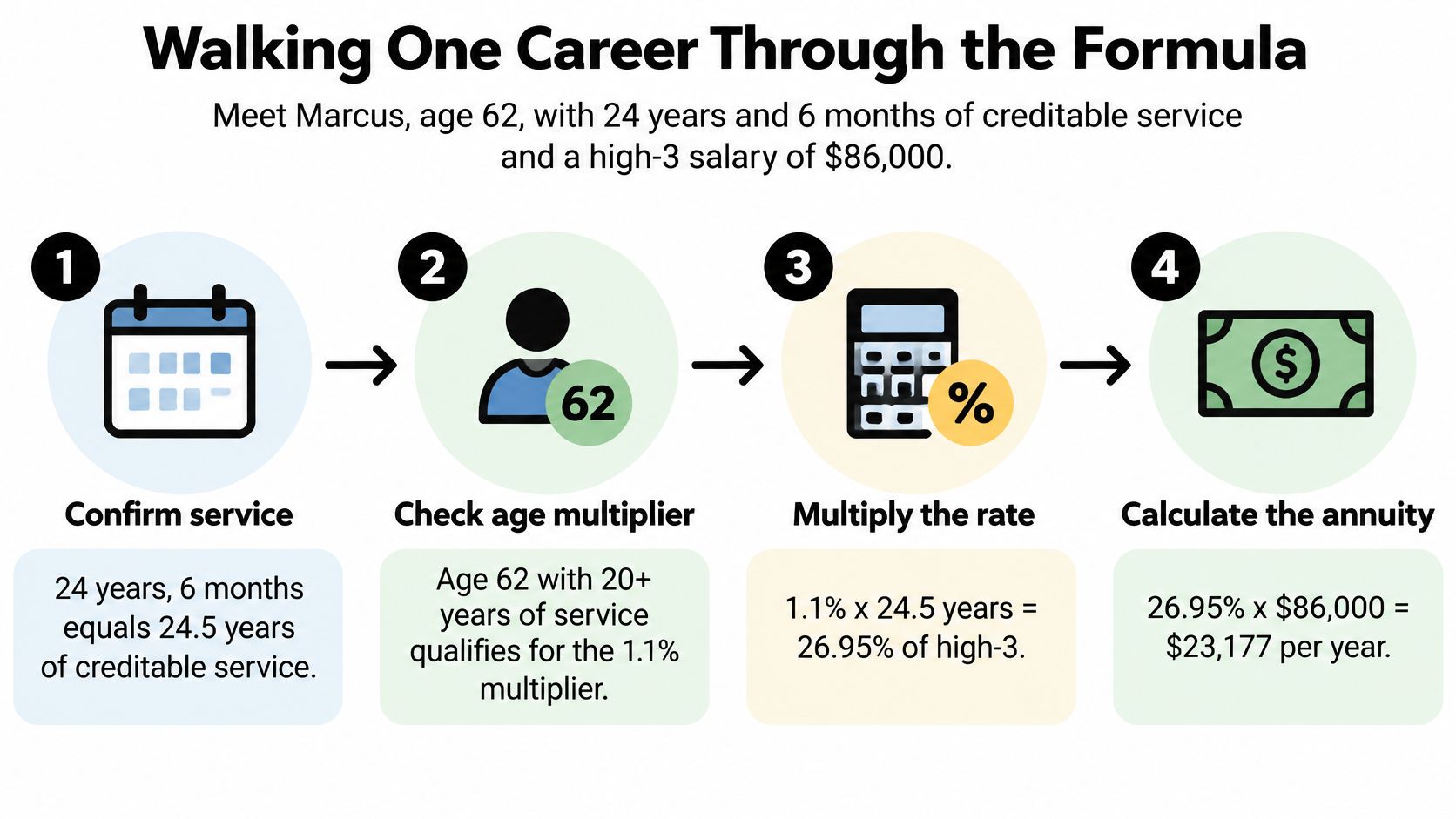
Five steps on Marcus's record
- Confirm service at 24.5 years from the official service record, not from memory.
- Confirm the high-3 at $86,000 from basic pay only.
- Check the age and service rule. At 62 with 20 or more years, the factor is 1.1%.
- Multiply 1.1% by 24.5 years. That is 26.95% of high-3.
- Multiply $86,000 by 26.95%. The gross basic annuity is $23,177 a year, about $1,931 a month.
That monthly figure is what hits the estimate before anyone talks about a spouse, taxes, or insurance. Write it down as gross. People lose the plot when they start subtracting in their heads halfway through the multiplication.
What leaving at 60 would have cost
Had Marcus retired at 60 with 22.5 years, the factor would have stayed at 1%. Then 22.5% of $86,000 is $19,350 a year, about $1,613 a month.
The gap is $3,827 a year. It comes from two places, not one. He picked up two more years of service, and he crossed into the 1.1% factor by waiting until 62 with more than 20 years. Retiring "a little early" isn't a small haircut when both pieces move at once.
These are gross basic annuity figures. A survivor reduction and taxes come off later, and they come off both paths. The early path doesn't get a discount on those cuts.
The same method works for any career. Swap in your high-3 and your service. Check whether age and years earn 1% or 1.1%. Then multiply, and label the result gross until you've made the survivor choice.
Survivor Annuity Trade-Offs in Real Dollars
The survivor election is permanent. It's the one decision in this example that can cut your income for decades, and you can't unwind it because a later budget feels tight.
Start from the $30,000 unreduced annuity in the earlier table, the 30-year case at 1%. OPM's FERS computation guidance sets two standard combinations. The maximum survivor benefit pays the spouse 50% of the unreduced annuity and reduces the retiree by 10%. The partial benefit pays 25% and reduces the retiree by 5%. Electing nothing leaves the full $30,000 with the retiree and $0 with a spouse.
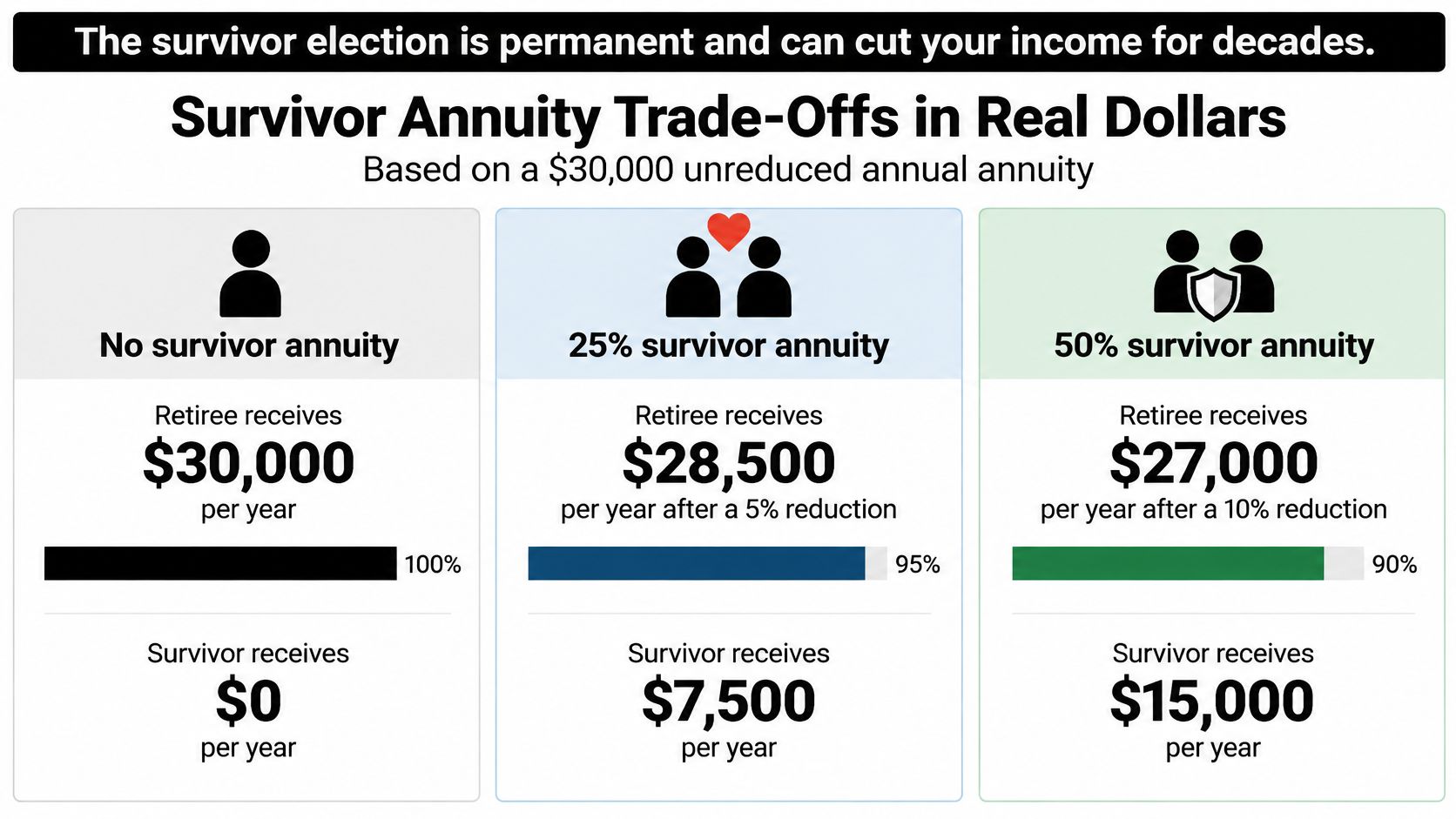
Three elections, one $30,000 annuity
| Election | Reduction to retiree | Retiree annuity per year | Survivor monthly after death |
|---|---|---|---|
| No survivor benefit | None | $30,000 | $0 |
| Partial survivor (25% to spouse) | 5% | $28,500 | $625 |
| Full survivor (50% to spouse) | 10% | $27,000 | $1,250 |
The full option costs $3,000 a year while both of you are alive. After the retiree's death it transfers $15,000 a year, or $1,250 a month, to the surviving spouse. The partial option costs $1,500 a year now and leaves $7,500 a year, or $625 a month, later. OPM treats the 50% with 10% and the 25% with 5% as the standard FERS survivor-election options.
A married employee generally needs spousal consent to elect less than the full survivor benefit. You don't get to pick the richer retiree check in private and explain it later.
Model both cash-flow paths. Look at the survivor's own income, the household bills that don't shrink when one person dies, and any pension or Social Security the spouse would still have. The guide to FERS survivor benefits lays out who must consent and what the spouse receives.
Don't compare only the retiree's first monthly check. The full election looks expensive on day one and looks very different the month after a death. This short walkthrough shows why the first deposit isn't the comparison that matters.
Bridging the Gap Before Age 62
If you retire at 57, your household may have five years before Social Security can begin at 62. During that stretch, the FERS annuity and, if you qualify, the annuity supplement can form two income layers. The supplement is temporary. It does not replace Social Security or continue after age 62.
The Congressional Research Service material on the FERS annuity supplement explains that the supplement is payable only until age 62, regardless of when you claim Social Security. Earnings above the Social Security earnings limit can reduce it. Part-time work or consulting may therefore change the amount available in the years you planned to use this bridge. Check the rules that apply to your situation before including the full supplement in your budget.
What each retirement age actually gives you
| Retire at | Supplement years before 62 | Social Security status | Gap to plan for |
|---|---|---|---|
| Age 57 | 5 years | Not claimable until 62 | Five years of pension and supplement, with no Social Security |
| Age 60 | 2 years | Not claimable until 62 | Two years of supplement, then Social Security may begin at 62 |
| Age 62 | None | Claimable now | No bridge; pension and Social Security may begin together |
Use the table as a cash-flow map, not a promise that every benefit starts automatically. At 57, plan for five years when your pension and any supplement you qualify for must cover expenses before Social Security can begin. At 60, that bridge is two years. At 62, you may be able to start Social Security, but your claim decision and benefit amount depend on your own record.
Write down the monthly income you expect before age 62, then the income you expect after the supplement ends. Name each assumption, including whether you will work after retiring and when you plan to claim Social Security. The bridge has an end date, so identify what will replace it.
Check current rules before setting a retirement date
Proposals and current benefit rules are different things. Do not treat a proposed change as an enacted rule, or assume that every retiree has the same eligibility. The FERS supplement guide explains how the supplement works. Confirm current eligibility and earnings rules before you commit to a retirement date or count the supplement as income.
Adding TSP and Social Security to Total Income
A household retires with an estimated FERS pension of $30,000 a year, adds a hypothetical $24,000 in annual Social Security, and withdraws $16,000 from the Thrift Savings Plan (TSP). Together, those three income layers total $70,000 before tax. Each figure is illustrative, not a personal estimate. Replace all three with your own records before using the total to plan spending. The Congressional Research Service report on federal retirement describes the FERS structure: a pension, Social Security, and the TSP.

One household, three layers, labeled as assumptions
Start with the pension: $30,000 a year in this example, based on 30 years of service and a $100,000 high-3 salary, before any survivor-benefit reduction. Add $24,000 a year for Social Security, a hypothetical amount that must be replaced with the benefit on your Social Security Administration statement. The final layer is $16,000 in annual TSP withdrawals, calculated as 4% of an illustrative $400,000 balance. That withdrawal is an example, not a promise that your balance or income will match it.
| Income source | Starts | Illustrative annual amount | Basis |
|---|---|---|---|
| FERS basic annuity | At retirement | $30,000 | 30 years at 1%, $100,000 high-3, before survivor reduction |
| FERS annuity supplement | Retirement until age 62 | Varies | Depends on eligibility and the earnings test; excluded from total |
| Social Security | Claimed at 62 or later | $24,000 | Hypothetical; replace with the SSA statement figure |
| TSP withdrawals | At retirement | $16,000 | 4% of an illustrative $400,000 balance |
| Total before tax (excluding supplement) | Combined | $70,000 | Sum of the three layers above |
The $70,000 total excludes the annuity supplement because that income ends at age 62. It is a temporary bridge, not a lifetime layer. Your household cash flow can therefore look different before and after 62: before 62, the supplement may contribute if you qualify; after it ends, Social Security may begin if you claim it. The table leaves the supplement out so the total does not count temporary income as lasting income. TSP withdrawals and traditional Social Security are generally taxable, so take-home income will be lower.
Now test the TSP layer at 3%, 4%, and 5% of your balance. For the example's $400,000 balance, those rates produce annual withdrawals of $12,000, $16,000, and $20,000, respectively. These are illustrations, not guaranteed income or a forecast of how long the balance will last. Use your own balance and consider how each withdrawal amount changes the household total.
If you elect a survivor benefit, use the reduced pension in your calculation. In the earlier example, a full election lowers the $30,000 pension to $27,000. Recalculate the three-layer total with that pension and your own Social Security and TSP figures. A survivor election is a lasting choice, so confirm its effect on household income before you make it.
Confirm Your Numbers Before You Retire
Don't set a retirement date off a rounded pension. Treat the next pass as a go or no-go gate. Three inputs have been assumed all the way through, and each one can move the dollars.
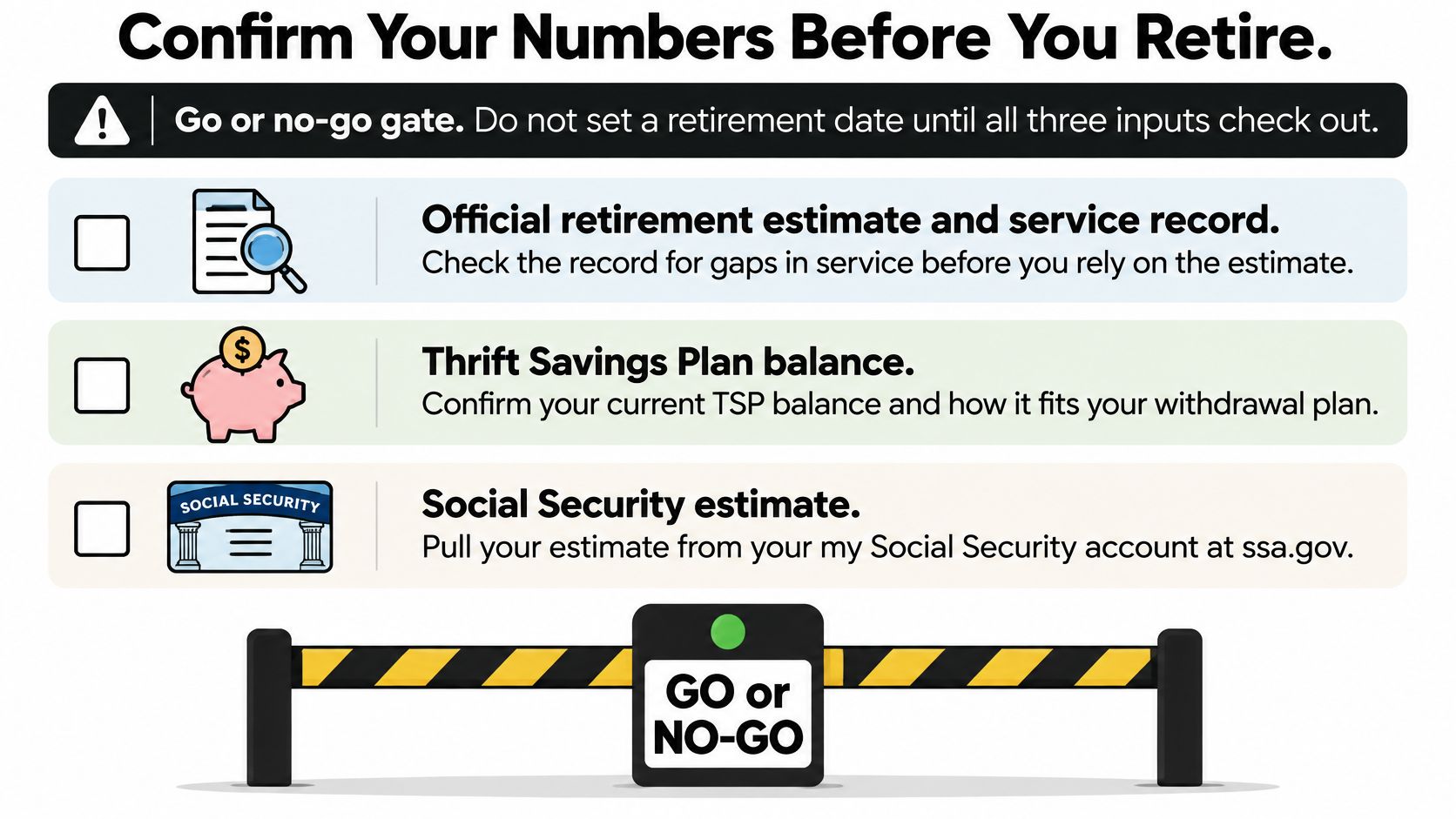
- Pull the official retirement estimate and the service record. Look for gaps in creditable service, unpaid deposits, and part-time periods counted as full time.
- Replace the hypothetical Social Security figure with the benefit on your SSA statement at the age you plan to claim.
- Write down the current TSP balance and test a withdrawal rate at 3%, 4%, and 5%, not just the 4% illustration above.
Then rerun the earlier tests in one sitting. Confirm the high-3 uses basic pay only, with overtime and lump-sum leave left out. Check whether your age and service earn 1% or 1.1%. Count the bridge years if you retire before 62, and put the survivor election next to your spouse's expected income.
This isn't optional paperwork. Don't pick a retirement date or a survivor election until the pension, the bridge, and the total-income figure all agree. If they don't, you're still estimating.
A benefits counselor or a fee-only planner who works with federal benefits can do that check with you. Federal Benefits Sherpa is one option that offers a benefit review against your record and a gap analysis of the total income picture, alongside agency retirement counseling and your own SSA and TSP statements.
Federal Benefits Sherpa helps federal employees work through a FERS retirement example, from the high-3 and the service count to the survivor election, the years before age 62, and the TSP and Social Security layers that sit beside the pension. A review can line those inputs up against your record and show where the income gap is. Visit Federal Benefits Sherpa when you want that check before you lock in a date.


Dedicated to helping Federal employees nationwide.
“Sherpa” - Someone who guides others through complex challenges, helping them navigate difficult decisions and achieve their goals, much like a trusted advisor in the business world.
Federal Benefits Sherpa, LLC
12724 Gran Bay Parkway West, Suite 410, Jacksonville, FL 32225
Email: [email protected]
Phone: (833) 753-1825
© 2024 Federalbenefitssherpa. All rights reserved
Federal Benefits Sherpa is an independent organization and is not affiliated with or endorsed by the U.S. government or any federal agency.