
Learning Center
FERS Minimum Retirement Age: MRA Chart by Birth Year
The FERS minimum retirement age is 55 if you were born before 1948, 56 if you were born from 1953 through 1964, and 57 if you were born in 1970 or later. Years that fall between those bands add months, so the age is not always a round birthday.
Hitting that age only opens a door. It doesn't tell you what the annuity will pay. Two people can share the same FERS minimum retirement age and leave with very different results, because years of service decide whether the payment is reduced and whether waiting until 60 or 62 is the better move.
If your MRA shows up next spring, does that mean you should retire, or only that one option has become available?
FERS Minimum Retirement Age by Birth Year
Find your birth year and read across. That cell is your minimum retirement age (MRA).
The Office of Personnel Management sets this FERS minimum retirement age on a birth-year scale from 55 to 57. Employees born before 1948 have an MRA of 55. For 1948 through 1952 the age rises in two-month steps: 55 years 2 months, 55 years 4 months, 55 years 6 months, 55 years 8 months, and 55 years 10 months. Birth years 1953 through 1964 sit at 56. From 1965 through 1969 the steps resume, from 56 years 2 months through 56 years 10 months. Anyone born in 1970 or later has an MRA of 57. Two similar careers can still face different minimum ages when the birth years fall a few years apart.
| Birth year | Minimum retirement age (MRA) |
|---|---|
| Before 1948 | 55 |
| 1948 | 55 years 2 months |
| 1949 | 55 years 4 months |
| 1950 | 55 years 6 months |
| 1951 | 55 years 8 months |
| 1952 | 55 years 10 months |
| 1953 to 1964 | 56 |
| 1965 | 56 years 2 months |
| 1966 | 56 years 4 months |
| 1967 | 56 years 6 months |
| 1968 | 56 years 8 months |
| 1969 | 56 years 10 months |
| 1970 or later | 57 |
How to read your row
Use the year on your birth record, then write the result in years and months. Those months can move the first open date into a later calendar year.
Say you were born in 1966. Your MRA is 56 years 4 months. A March 10 birthday doesn't put you at the MRA on that March date in the year you turn 56. You reach it four months later. A June retirement date that year would still be early for an MRA-based annuity.
Match the birth date in your personnel file to the date you used. A wrong year shifts the whole row. This schedule reflects rules in effect as of October 2026, and benefit rules change, so confirm it with your agency before you set a date.
Why Your Birth Year Sets Your Minimum Age
Your birth year works like a boarding time printed on a ticket. Working longer does not move that time. It changes what you can do once the gate opens.
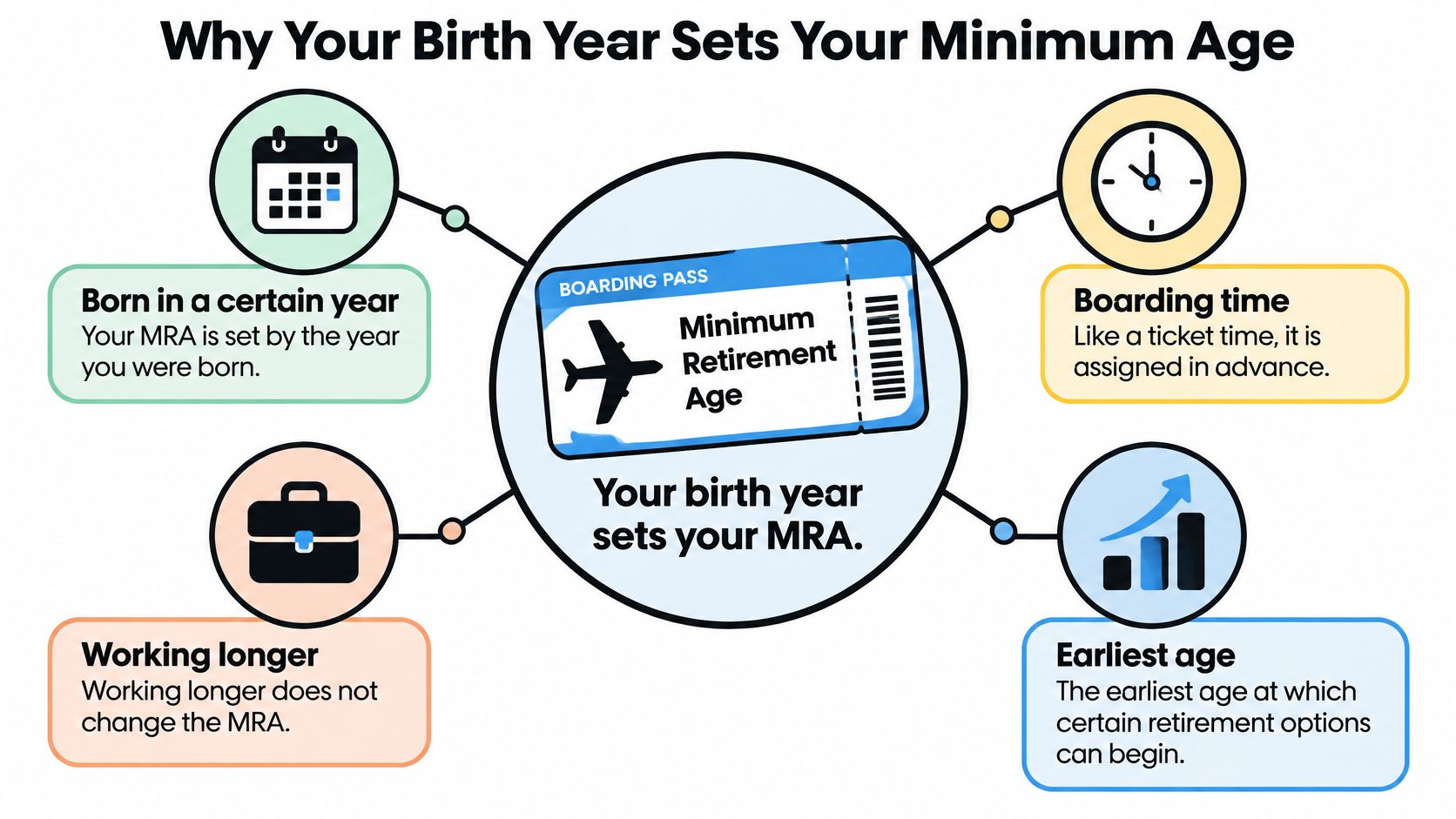
Your birth year sets the earliest age at which certain immediate FERS annuity options can begin. It does not set a required retirement date. Many employees work past it, and some should.
Age 62 is a second gate. Under MRA+10 rules, that is the age when the annuity stops being reduced. Reaching your MRA and reaching 62 answer different questions.
The schedule climbs in steps, then lands on 57 for 1970 and later. A coworker born three years before you can have a lower minimum even when your jobs look the same. The Office of Personnel Management lists the FERS minimum retirement age as 57 for employees born in 1970 or later.
The part that changes your payment is what you bring to the gate. Two employees born in 1970 share an MRA of 57. With 30 years, one can retire at 57 with no age reduction. With 20 years, the other waits until 60 for no reduction. With 10 to 19 years, an employee can start at 57, but the annuity is reduced until 62. Same minimum age, three different payments.
Practical rule: Birth year sets the MRA. Service years decide which option is open. The option you pick sets the payment.
The MRA is only the first gate. It tells you when the gate can open. It does not tell you what your annuity will pay when you walk through.
Which Retirement Options Open at Your MRA
The same MRA produces different annuities once you sort the cases by service.
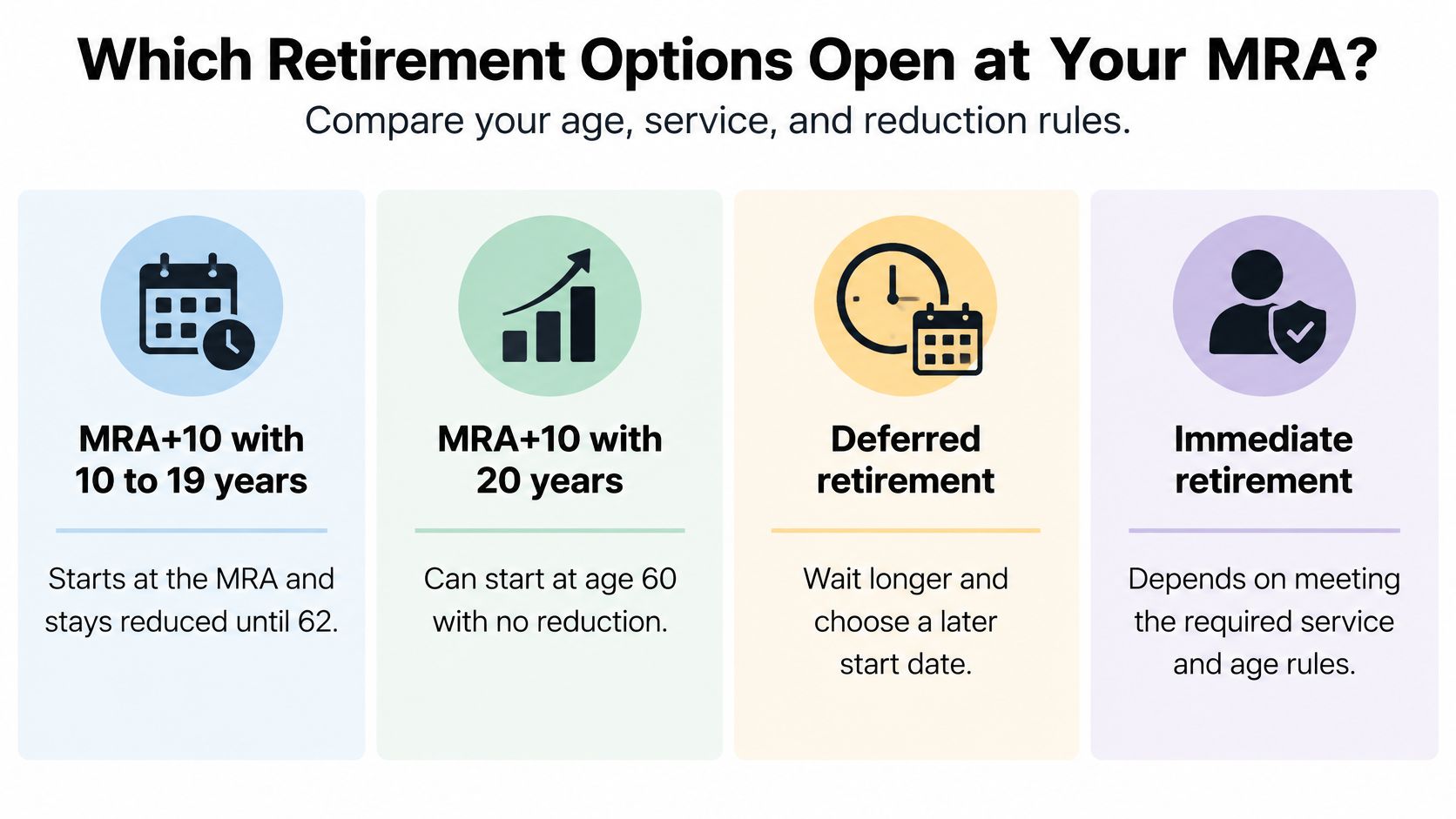
| Option | Starting age | Service needed | Annuity reduction |
|---|---|---|---|
| MRA+10, 10 to 19 years | Your MRA | 10 to 19 years | Reduced until age 62 |
| MRA+10, 20 years | Age 60 | 20 years | No reduction |
| MRA+10, 30 years | Your MRA | 30 years | No reduction |
| Deferred retirement | Age 62 | 5 years | No reduction, payment starts at 62 |
MRA+10 means you are at or above your MRA and you have at least 10 years of service. That is the entry test. It is not a promise of a full payment.
When the reduction applies
The Office of Personnel Management confirms that an MRA+10 annuity is reduced before age 62. The reduction does not apply when you have at least 30 years and retire at the MRA, or at least 20 years and begin the annuity at age 60. Ten, twenty, and thirty years at one MRA are three different outcomes.
A deferred annuity can start at 62 with 5 years of service and without that age reduction. Choosing it means you wait, and you give up an immediate payment in the years between separation and 62.
If you have 10 to 19 years, the reduction is the main trade against waiting until 62. Also separate the pension question from the FERS annuity supplement, because being eligible to retire is not the same as receiving every related benefit. If you also run a side business, questions in planning retirement as a business owner help you weigh a federal exit against income you still control.
Leaving on the first day you can doesn't automatically beat a later, unreduced start. Health coverage, Social Security timing, and TSP withdrawals still have to be priced in.
The table states the rules. The next cases show what those rules do to three people.
How Years of Service Change the Result

Two employees can share a birthday. They can reach the same minimum retirement age on the same day and still collect very different monthly checks. The MRA opens the door. Your years of service decide which version of the annuity you keep once you walk through it.
The Office of Personnel Management sets the FERS minimum retirement age so that an employee born in 1968 reaches it at 56 years and 8 months. Hold that birthday steady and change only the service total.
Dana has 10 years. She retires at 56 years and 8 months under MRA+10, and her annuity stays reduced until she reaches 62. Her real choice is a smaller check now against a larger one later. Before she files, she should also confirm whether her health coverage carries her to Medicare.
Sam has 20 years. He cannot start unreduced at the MRA. He waits until 60, roughly three years past the shared minimum age, and the reduction falls away. Those three years need funding from somewhere, which is why his TSP withdrawals and Social Security timing move to the front of the plan.
Priya has 30 years. She can begin unreduced at the MRA itself. Her pension question settles earliest of the three. What is left is the work around it: keeping insurance intact and spacing out the other income.
One minimum age, three outcomes. The annuity formula is not what shifts between them. The variable is whether the age reduction applies, and that hinges on how many years you bring and which age you start at.
A plain eligibility map, like this guide to FERS retirement eligibility, shows which row you are in before you pick a month. Exact dollars depend on your salary history and your official service record, so read Dana, Sam and Priya as illustrations of the rules.
How to Work Out Your Own Retirement Date
Work the date on paper before you tell your supervisor anything.
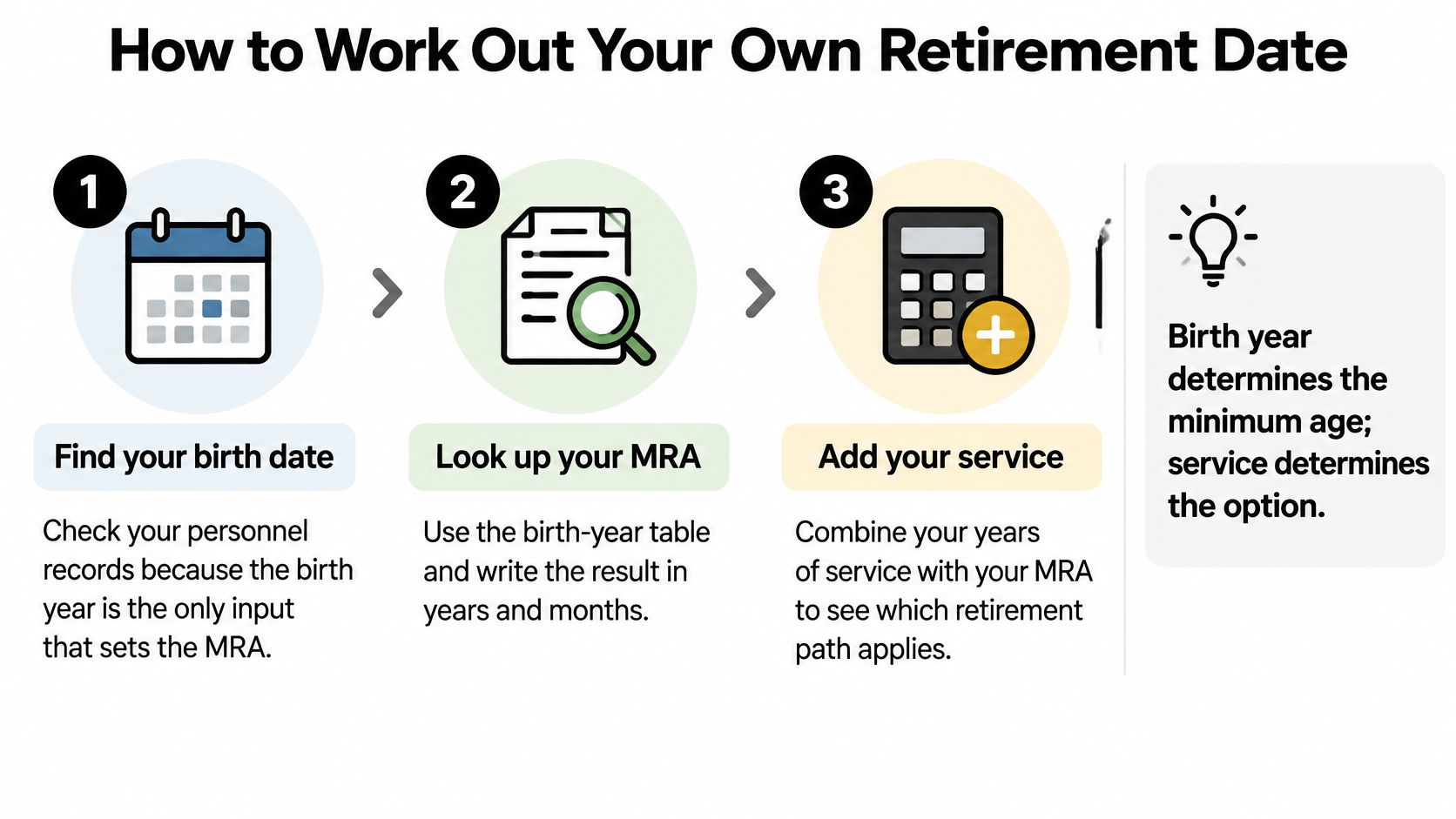
- Find your birth date on your personnel records. The birth year is the only input that sets the MRA. A remembered year is not good enough.
- Look up that year in the birth-year table. Write the MRA in years and months, including any extra months, so the calendar date is real.
- Add up creditable service, including periods the record counts. You need to know whether you have 10, 20, or 30 years. People often slip here because memory drops deposits, breaks, and part-time service.
- Match the total to an option. MRA+10 starts at 10 or more years. With 20 years, an unreduced start can begin at 60. With 30 years, an unreduced start can begin at the MRA.
- Mark whether your case is reduced, and whether waiting until 62 removes that reduction. Write both dates, not just the one you hope to use.
- Add your MRA date as the earliest possible start, and mark age 62 beside it. A FERS retirement calculator is useful only after those two dates and the service total are filled in.
A finished worksheet shows four things: an MRA date, a service total, a chosen option, and a yes or no on the reduction.
Mistakes That Cost Federal Retirees Money
The expensive mistake is treating the MRA as a quit date. It only sets the earliest start for certain options. You can keep working past it, and staying can be the higher-paying choice.
- Assuming the first legal leave date is the best one: Waiting can avoid a reduction, but you still have to price health-insurance continuity, Social Security timing, and TSP withdrawals. Fix it by writing the monthly difference next to the years you would wait.
- Counting service from memory: A few missing years can move you into another row of the option table. Fix it by matching your total to the official record before you choose.
- Using a schedule you saved years ago: Rules in effect as of October 2026 can change. Fix it by confirming the current MRA and option details with your agency before an irreversible election.
Four short checks take less time than correcting a retirement action in the first year you are off the payroll.
Confirm Your MRA Before You Set a Date
Confirm the MRA, the service total, and the option before you pick a retirement date. Gather your SF-50, a recent pay stub (your LES), your TSP statement, and your Social Security statement. Those four records let a benefits specialist check the age and the service math against your own file.
Our process has four steps. Learn the basics with the free class or Learning Center, talk with Joe for 15 minutes, get your Gap Report, then decide what's next. The Gap Report is most accurate when it uses those same documents to project income and flag possible shortfalls. You can call 833-753 1825 or 904-490 6926. We provide education and benefits planning, not investment advice.
Today, look up your birth-year MRA in the table and write down your service total.
Federal Benefits Sherpa gives federal employees a clear way to test an MRA date against service, pension income, and the benefits that change when you leave. If you want help judging a start at your FERS minimum retirement age against a later unreduced annuity, visit Federal Benefits Sherpa. Bring your service dates and your questions, and take the next planning step with a specialist who works these rules every week.


Dedicated to helping Federal employees nationwide.
“Sherpa” - Someone who guides others through complex challenges, helping them navigate difficult decisions and achieve their goals, much like a trusted advisor in the business world.
Federal Benefits Sherpa, LLC
12724 Gran Bay Parkway West, Suite 410, Jacksonville, FL 32225
Email: [email protected]
Phone: (833) 753-1825
© 2024 Federalbenefitssherpa. All rights reserved
Federal Benefits Sherpa is an independent organization and is not affiliated with or endorsed by the U.S. government or any federal agency.