
Learning Center
Delaying Social Security: The Federal Employee Guide
A worker who delays Social Security past full retirement age can earn an 8 percent increase for each year of delay through age 70, with the higher amount becoming the base for future payments, according to the Social Security Administration's delayed retirement planner. For a federal employee, the choice is about more than when a Social Security check starts. It also involves which income source covers expenses during the wait, how a FERS or CSRS annuity fits with TSP withdrawals, and what income a surviving spouse may keep.
Delaying can fit well, poorly, or not at all, depending on those pieces. Start with the benefit amounts, then consider whether your pension, any FERS supplement, work income, and TSP can cover the gap.
Monthly Benefit by Claiming Age
A $2,000 full retirement age benefit becomes about $2,480 per month when a person with a full retirement age of 67 claims at 70, a three-year delay that raises the amount by about 24%. For people born in 1943 or later, the Social Security Administration delayed retirement planner states that delayed retirement credits add 8% per year, or approximately 0.667% per month, after full retirement age. Credits stop at age 70, so waiting beyond that age does not increase the monthly retirement benefit. These amounts are before cost-of-living adjustments or other benefit rules.
Use $2,000 as a reference amount. If your own full retirement age benefit is $2,500, multiply each figure in the table by 1.25. If it is $1,600, multiply by 0.8. The percentages remain the same for the birth years shown, making it easier to translate a statement amount into an estimate for different claiming ages.
Monthly benefit by claiming age on a $2,000 full retirement age benefit
| Claiming age | Monthly if FRA is 67 | Monthly if FRA is 66 |
|---|---|---|
| 62 | $1,400 | $1,500 |
| 65 | $1,733 | $1,867 |
| 66 | $1,867 | $2,000 |
| 67 | $2,000 | $2,160 |
| 69 | $2,320 | $2,480 |
| 70 | $2,480 | $2,640 |
How to read the two columns
For a full retirement age of 67, claiming at 70 follows three years of delayed credits. At 8% per year, the benefit is 24 percent higher, increasing from $2,000 to $2,480. With a full retirement age of 66, claiming at 70 follows four credit years, or 32 percent more, bringing $2,000 to $2,640.
The difference comes from the time available to earn credits, not a different annual credit rate. Two coworkers with the same $2,000 full retirement age benefit can therefore receive different increases at 70: the person whose full retirement age is 66 has one additional year of credits compared with the person whose full retirement age is 67.
The early claiming side of the table
Claiming before full retirement age reduces the benefit. In this worked example, the reduction is 5/9 of 1 percent per month for the first 36 months before full retirement age, then 5/12 of 1 percent for each earlier month. That formula brings the full retirement age 67 example to about $1,400 at 62. The full retirement age 66 example is about $1,500 because the worker claims fewer months early.
The delayed credit is a statutory program formula applied to your own worker benefit for months after full retirement age. It is not an investment return on checks you could have collected and invested, and it does not track TSP fund performance. Nor does it pay skipped benefits as a lump sum.
The increase from delaying is permanent in your monthly benefit calculation, and later cost-of-living adjustments apply on top of that higher base.
A higher monthly amount has a cost: each month you wait is a month without a Social Security check. Compare the gap with the income available from your FERS or CSRS annuity, any FERS supplement that remains payable, and planned TSP withdrawals. Those sources can help fund the wait, but they are separate from the Social Security earnings test. The key household question is whether your other income can cover expenses until the larger benefit begins, and how the choice affects income for a surviving spouse.
Your birth year determines which column applies, while your federal income sources shape whether waiting is manageable. The table shows the benefit change; the decision also depends on how your retirement income is sequenced.
Full Retirement Age and the Credit Clock
Delayed credits don't begin when you retire from federal service, stop working, or start drawing a pension. They begin only after you reach full retirement age. A person who leaves federal service at 62 but has a full retirement age of 67 spends five years avoiding an early claiming reduction by waiting, yet earns no delayed retirement credits during those years.
The comparison below shows why the starting age matters so much in the claiming decision.
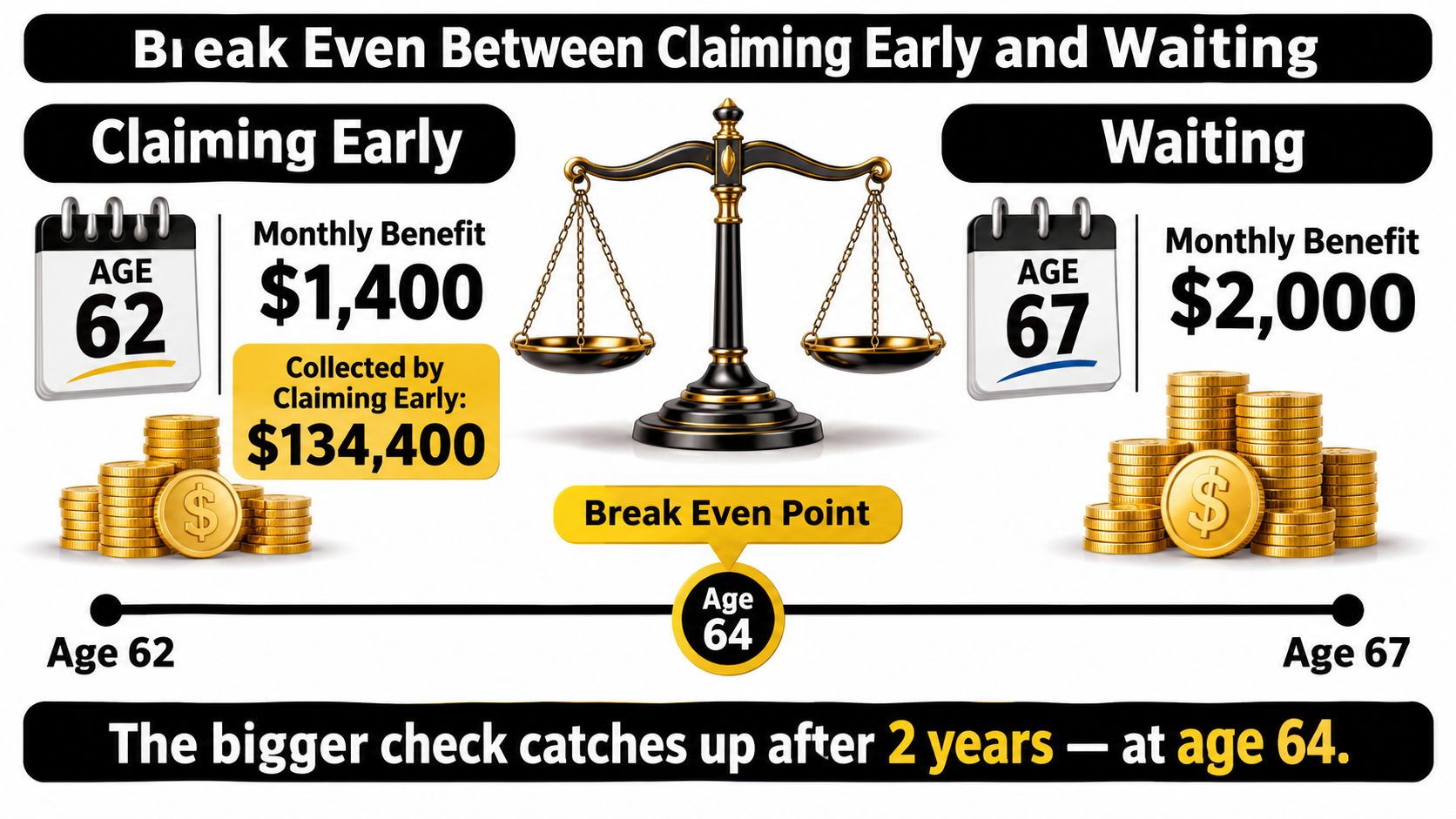
The Social Security Administration historical account of the 1983 amendments explains that the Social Security Amendments of 1983 gradually raised full retirement age from the historical age of 65 to 66 in 2009 and ultimately to 67 in 2027. People born after 1959 generally have a full retirement age of 67, while earlier cohorts fall between 65 and 67 depending on birth year. The same historical account notes that the amendments covered federal civilian employees hired after December 31, 1983, and most federal elected officials and senior executive level political appointees beginning in January 1984.
That federal hire date point matters because a CSRS only career and a FERS career are not on the same Social Security coverage footing. Two retirees can have long federal service and very different Social Security records. Your statement, not your years of federal service alone, tells you what benefit amount the claiming percentages will act on.
Full retirement age and maximum delayed credit by birth year
| Birth year | Full retirement age | Credit years until 70 |
|---|---|---|
| 1943-1954 | 66 | 4 years |
| 1955 | 66 and 2 months | 3 years 10 months |
| 1956 | 66 and 4 months | 3 years 8 months |
| 1957 | 66 and 6 months | 3 years 6 months |
| 1958 | 66 and 8 months | 3 years 4 months |
| 1959 | 66 and 10 months | 3 years 2 months |
| 1960 or later | 67 | 3 years |
Partial years still count
You don't need to wait in whole years. Each delayed month adds about 0.667 percent for the cohorts covered here. A person born in 1955, with full retirement age at 66 and 2 months, has 46 months until 70. Multiplying those months by the monthly credit gives roughly 30.7 percent by age 70 in this arithmetic example, not a flat 24 percent or 32 percent.
This monthly feature gives you flexibility. If your plan funds the wait to 68 but not comfortably to 70, claiming at 68 still captures the credits earned for the months you delayed. You're not forced into an all or nothing choice between full retirement age and 70.
The short video below walks through the claiming age mechanics in visual form.
Before running any break even comparison, write down three inputs from your own record. You need your birth year, your full retirement age, and the full retirement age benefit amount on your Social Security statement. Those three lines control every later calculation in a federal retirement plan.
Break Even Between Claiming Early and Waiting
Break even math answers one narrow question. At what age does the larger monthly check repay the total amount you gave up by not claiming earlier? It doesn't predict how long you'll live, and it doesn't measure the value of survivor income. Treat it as longevity arithmetic, then decide how much weight that arithmetic deserves.
The chart below puts the early and delayed paths on the same timeline.
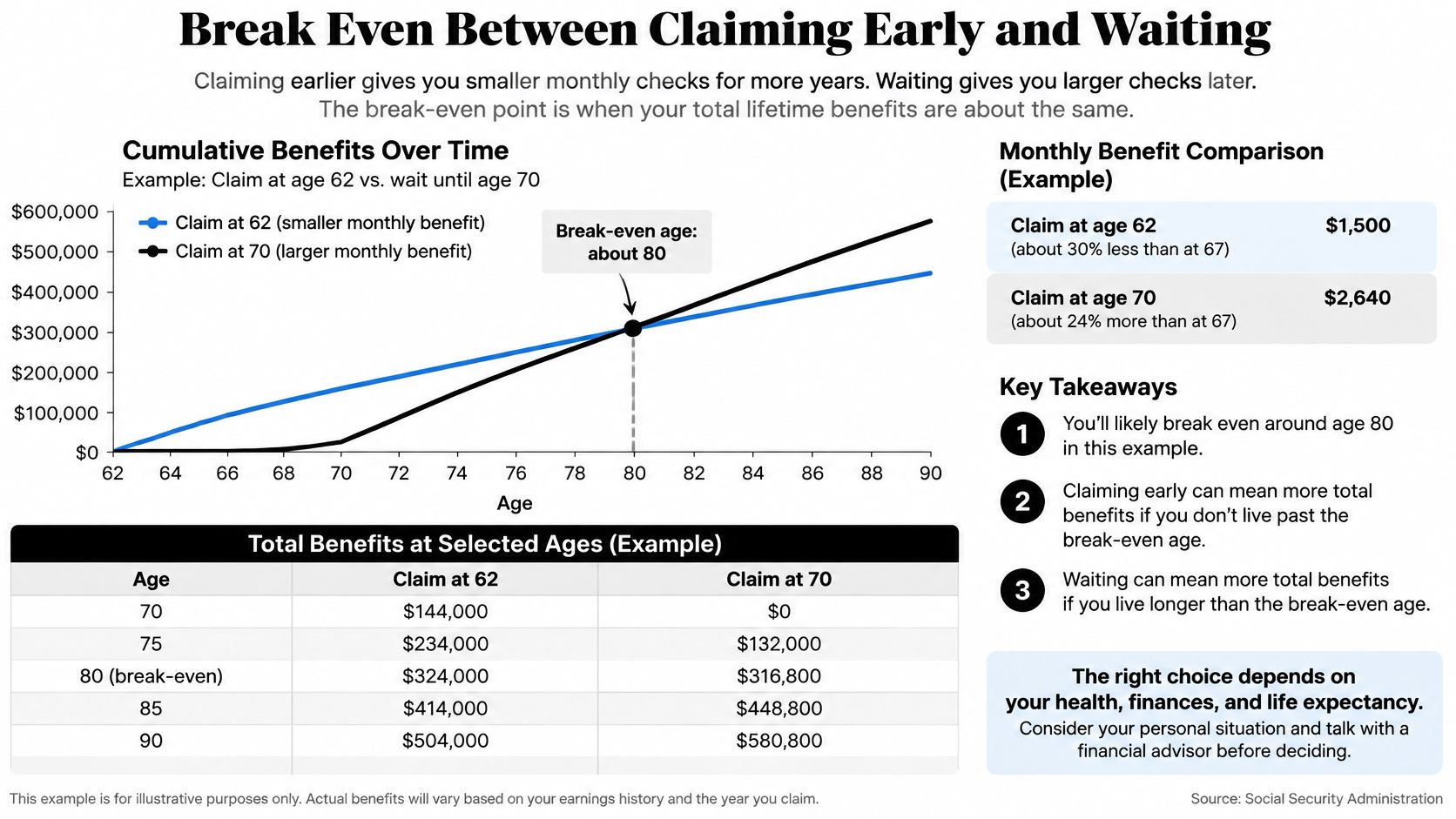
For this worked example, use a $2,000 benefit at full retirement age 67. Claiming at 62 pays about $1,400 a month, while waiting to 70 pays about $2,480 a month. The person who claims at 62 collects roughly $134,400 from age 62 through 69, and the age 70 benefit is about $1,080 a month higher, so simple division places break even near age 80 when no cost of living adjustment or investment return is assumed.
Simple break even versus waiting on a $2,000 FRA 67 benefit
| Comparison | Payments given up | Extra per month | Approximate break even |
|---|---|---|---|
| Claim at 62 instead of 70 | $134,400 | $1,080 | Near age 80 |
| Claim at 67 instead of 70 | $72,000 | $480 | Near age 82 to 83 |
| Claim at 62 instead of 67 | $84,000 | $600 | Around age 78 or 79 |
Why the middle comparison takes longer
Waiting from 67 to 70 skips about $72,000 in this example because you'd give up three years of $2,000 checks. The reward is $480 more each month from 70 onward. Dividing $72,000 by $480 gives 150 months, or about 12.5 years, which lands around age 82 to 83.
That result surprises people who assume waiting from 62 to 70 must always have the latest break even. It doesn't, because the early claim is reduced so heavily. Moving from $1,400 to $2,480 creates a much larger monthly gap, and that larger gap repays the skipped checks faster once payments begin.
Three forces that move the age
Cost of living adjustments raise both the early and delayed checks. Because they apply to both paths, they usually shift this simple result only modestly in a household comparison, although the delayed path receives adjustments on a larger starting amount. Don't double count them by adding cost of living growth to only one side.
Opportunity cost pushes break even later. If claiming early lets you leave TSP money invested, while delaying requires selling TSP shares to replace the missing Social Security income, the delayed path gives up more than the face value of skipped checks. The reverse can also happen if early Social Security is spent while TSP withdrawals during a delay come from cash or stable holdings you'd otherwise keep idle.
Health pulls the practical decision in the other direction. A serious health condition or a strong family pattern of shorter lives makes an early 80s break even less persuasive, even if the spreadsheet is correct. Good health doesn't guarantee you'll pass break even, but it makes the longevity bet behind Delaying Social Security more reasonable.
Household test: For the higher earner in a marriage, break even shouldn't be the sole test because the larger benefit can continue for a surviving spouse after the worker dies.
That survivor effect can make delay valuable even when the worker's personal break even looks distant. A single retiree with no survivor goal and a tight bridge budget may reasonably weigh the table more heavily. A married higher earner is buying income for two lifetimes, not one.
Working While Benefits Are Delayed
Work and claiming aren't a simple either or choice. You can work and delay filing, work and claim after full retirement age, or in some cases work modestly while claiming early. The earnings test decides whether claiming before full retirement age will temporarily reduce checks.
The Social Security Administration publication on how work affects benefits states that in 2026, the limit before full retirement age is $24,480, with $1 withheld for every $2 of earnings above the annual limit. In the year full retirement age is reached, the limit is $65,160 for earnings before the full retirement age month, with $1 withheld for every $3 above the limit, and beginning with the full retirement age month, earnings no longer reduce benefits.
2026 Social Security earnings test
| When | 2026 earnings limit | Withholding | Withheld benefits |
|---|---|---|---|
| Under full retirement age all year | $24,480 | $1 for every $2 over the limit | Recalculated at full retirement age to credit withheld months |
| Year full retirement age is reached, before that month | $65,160 | $1 for every $3 over the limit | Recalculated at full retirement age |
| From the full retirement age month on | No limit | None | Not withheld |
What counts as earnings
The test counts wages, bonuses, commissions, vacation pay, and self employment income. For a former federal employee, that can include consulting income after retirement and some leave payouts treated as wages. Phased retirement pay and reemployment wages also belong in the earnings bucket, so you need to estimate the full calendar year before filing early.
It doesn't count pensions, annuities, investment income, interest, veterans benefits, or other government or military retirement benefits. That's a key federal distinction. Your FERS or CSRS annuity doesn't trip the Social Security earnings test, and ordinary TSP withdrawals aren't wages for this purpose. You can therefore fund a delay with pension and TSP income without creating earnings test withholding, because you haven't filed and because that income isn't counted as work earnings anyway.
Withheld does not mean erased
Many readers assume a withheld check is permanently lost. SSA recalculates benefits at full retirement age to credit months in which benefits were withheld because of excess earnings. The cash flow pain is real during the withholding period, but the later benefit receives credit for those withheld months rather than treating every early claimed month the same.
A special first year monthly rule can also matter when you retire in the middle of a year after already earning above the annual limit. It can allow benefits for months in which you're retired under the monthly test, instead of judging the whole year only by annual pay. Confirm the current monthly amount and self employment rules before relying on it.
If you're comparing retirement work rules with disability work rules, keep the programs separate and review working on disability with Bell Law for that distinct context. Disability earnings rules are not the retirement earnings test, and mixing them can lead to the wrong filing choice.
Use the path that matches your earnings. Consulting or phased retirement pay below the limit may sit beside an early claim. Earnings far above the limit before full retirement age usually make delaying the filing cleaner than claiming and watching checks stop.
Treat the FERS supplement separately. It's payable only after federal retirement and is reduced if the retiree earns above the Social Security annual earnings limit before age 62. A bridge plan that includes post retirement work should treat the supplement as conditional income, not as a fixed check you can count in full regardless of earnings.
Spousal and Survivor Effects of Waiting
A higher Social Security benefit can protect a spouse who outlives the worker, but the effect depends on which benefit is being paid. While both spouses are alive, a spousal benefit is generally up to 50 percent of the worker's primary insurance amount, the worker's benefit at full retirement age, in the standard planning example. Delayed retirement credits do not increase that spousal benefit. If the higher earner waits from full retirement age to 70, their own check grows, while the living spouse's spousal amount does not grow by those same credits.
The visual below separates the two paths.
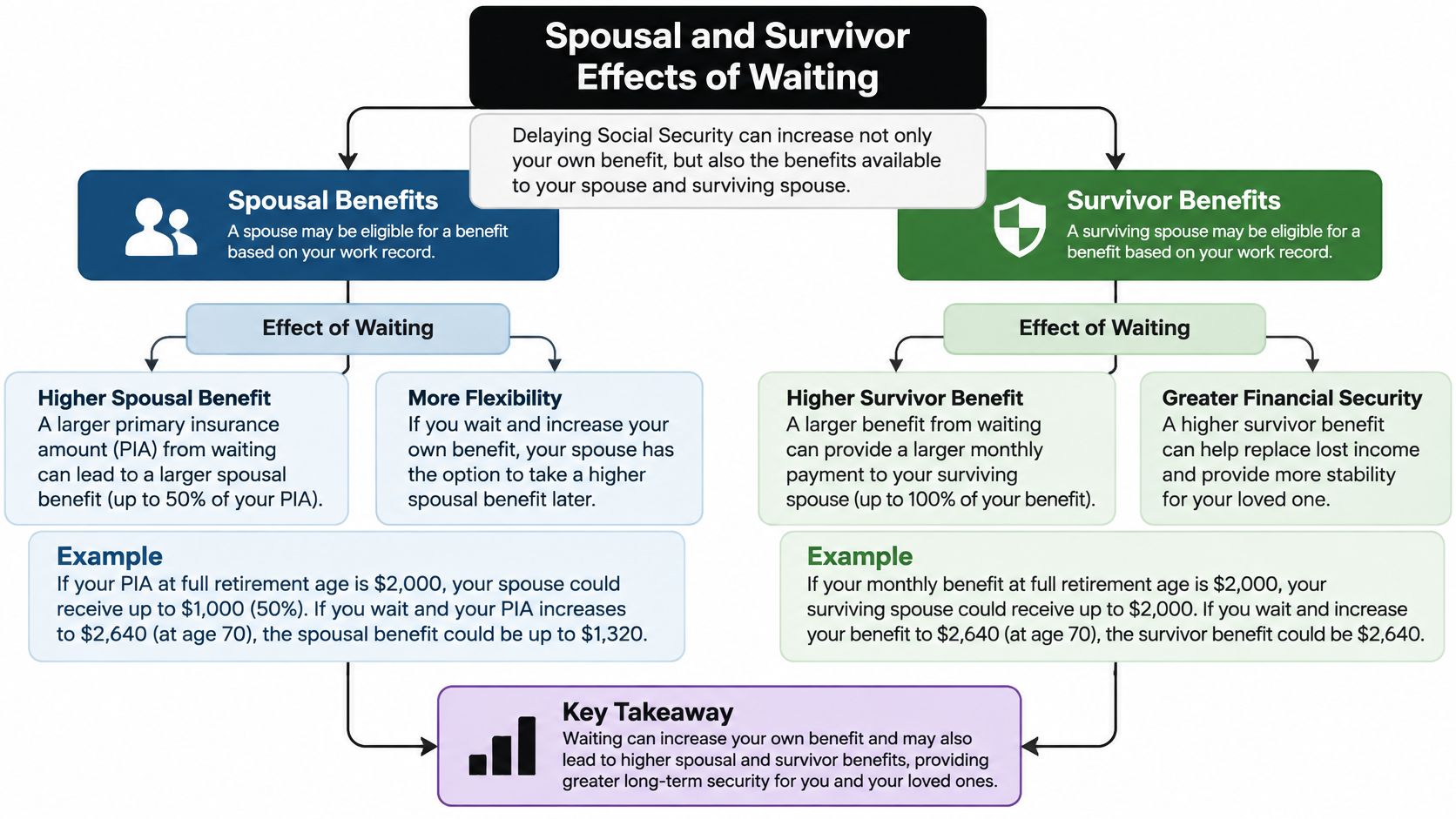
A survivor benefit works differently. A surviving spouse may receive up to the amount the deceased worker was receiving, or would have received, including delayed credits, subject to a reduction if the survivor claims early. The larger benefit can therefore serve as a household longevity hedge: it may continue for the spouse who lives longer after the first death ends the smaller Social Security check.
One household example
Suppose the federal employee has the larger earnings record and receives $2,480 a month by claiming at 70 in this illustrative household. The spouse's own benefit at 67 is $1,000 a month. While both are alive, they receive both amounts under the applicable benefit rules.
If the employee dies first, the spouse can move to the $2,480 survivor amount at the survivor's full retirement age in this example. The survivor then receives $2,480 in household Social Security income, rather than continuing on the spouse's own $1,000 benefit alone. Waiting has helped set the survivor's income floor, not just increased the worker's check during their lifetime.
The lower earner's timing may follow a different logic. If bills require income sooner, that spouse might claim their own smaller benefit earlier and later switch to the higher survivor benefit if the higher earner dies first. Cash flow can shape the smaller record's timing, while protecting the survivor can shape the higher earner's decision.
A delay does not raise both spouses' checks in the same way, so use a guide to calculating spousal Social Security benefits to understand how the living spouse's amount is determined. Keep retirement survivor income distinct from other forms of dependent support when you compare programs supporting eligible dependents.
Avoid basing a plan on old claiming strategies. Deemed filing applies to many current claims, and file and suspend is closed to new claims. You generally cannot claim one benefit while freely suspending and growing another as older strategies described.
A FERS or CSRS survivor annuity is a separate choice. Electing federal pension survivor protection reduces the pension under its rules, and it does not replace Social Security survivor benefits. Compare both choices against one household goal: how much income should remain after the first death from the pension survivor annuity, Social Security, TSP, and other assets combined?
Federal Income That Funds the Wait
Delaying Social Security is a federal income-sequencing decision: the pension, any FERS supplement, work income, cash, and TSP withdrawals can cover different parts of the wait. The goal is to choose a bridge that supports current spending without undermining later income or survivor protection. Which sources are available depends partly on when you leave federal service.
The Social Security regulation on delayed retirement credits provides that credits apply for months after full retirement age and before age 70. For people born after 1942, the credits reach 8% annually, with no additional credit after age 70. Those credits increase the future Social Security benefit; they do not pay the bills during the waiting years. That is where pension income and planned TSP withdrawals matter.
Scenario A retiring at minimum retirement age with 30 years
A FERS employee who retires at minimum retirement age with 30 years starts the FERS annuity, and the FERS supplement may cover part of the period before age 62. The supplement is paid after retirement from federal service, not to someone who remains in that federal job until 62.
At 62, the supplement stops. That change can make claiming Social Security feel like the natural next step, but the end of the supplement does not itself determine the best claiming age. Another option is to use planned TSP withdrawals from 62 to 70. The annuity provides a base, the supplement helps with the earlier bridge, and TSP withdrawals can cover some of the later gap while Social Security grows after full retirement age.
Keep the earnings test separate from this income sequence. Earnings above the Social Security annual limit can reduce the supplement before age 62. A retiree who takes a high-paying job should not count on receiving the full supplement while earning above that limit. Pension and TSP income are separate sources for funding the bridge, not substitutes for understanding how work earnings affect the supplement.
Scenario B retiring at 62 with full retirement age 67
A FERS employee retiring at 62 has no supplement to help fund the wait. One path combines the annuity with a modest TSP withdrawal and a Social Security claim at 62. Another uses larger temporary TSP withdrawals until 70, then relies less on TSP once the higher Social Security benefit begins.
Each path shifts the timing of income. Claiming at 62 can preserve more TSP savings in the early years, but the Social Security amount is reduced. Waiting requires more withdrawals from TSP at first, in exchange for a larger monthly benefit later. Check whether those withdrawals still leave flexibility for taxes, health costs, home repairs, and a spouse's lifetime spending. The withdrawal plan should cover the bridge without becoming an unsustainable long-term spending rate. For help comparing methods, see our guide to TSP withdrawal options in retirement.
Scenario C a CSRS retiree with an updated statement
A CSRS retiree should review a current Social Security statement rather than rely on an old estimate that may reflect different assumptions about the Windfall Elimination Provision and Government Pension Offset. Benefit estimates can change when those provisions are treated differently, so use the updated statement before deciding Social Security is too small to matter.
If the current estimate is larger and would become the surviving spouse's only Social Security income, delaying deserves renewed consideration. A CSRS annuity may help fund the wait without large TSP withdrawals, particularly when household spending is controlled. If the benefit remains small and neither spouse depends on it for survivor income, claiming earlier may still fit the household's needs.
Which account pays the bills until 70, and what survivor income does that wait protect?
Taxes also affect how much income remains available to fund the bridge. Depending on combined income, part of Social Security may be taxable. Large TSP withdrawals can also raise taxable income and affect future Medicare IRMAA brackets. Consider the annuity, supplement, work income, TSP withdrawals, and Social Security in sequence, year by year. The aim is to understand both the cash available now and the lasting income the delayed claim may provide.
Decide Whether Delaying Fits Your Retirement
Delay toward 70 when the higher earner is in decent health, the household can cover spending from the FERS or CSRS annuity, any FERS supplement that still applies, work income, cash, or a planned TSP withdrawal, and a larger survivor benefit is a real goal. That combination gives the delayed credit time to work without forcing debt or distress sales. It's especially compelling when the larger benefit will support a spouse who has a much smaller Social Security record.
Claim earlier when the budget fails without Social Security, health makes an early 80s break even unlikely, or you need the net check now despite pre full retirement age earnings. Claiming earlier is also sensible when preserving TSP liquidity matters more than maximizing guaranteed income. There's no prize for reaching 70 with a bridge plan that made the intervening years financially fragile.
Never wait past 70 to claim a retirement benefit for delayed credits, because the credits stop there. If you're already past full retirement age and still deciding, every additional month to 70 can add credit, but months after 70 add no delayed retirement credit. Put a filing decision on the calendar before that birthday.
The checklist below turns the decision into one page you can complete from your statement and retirement estimates.
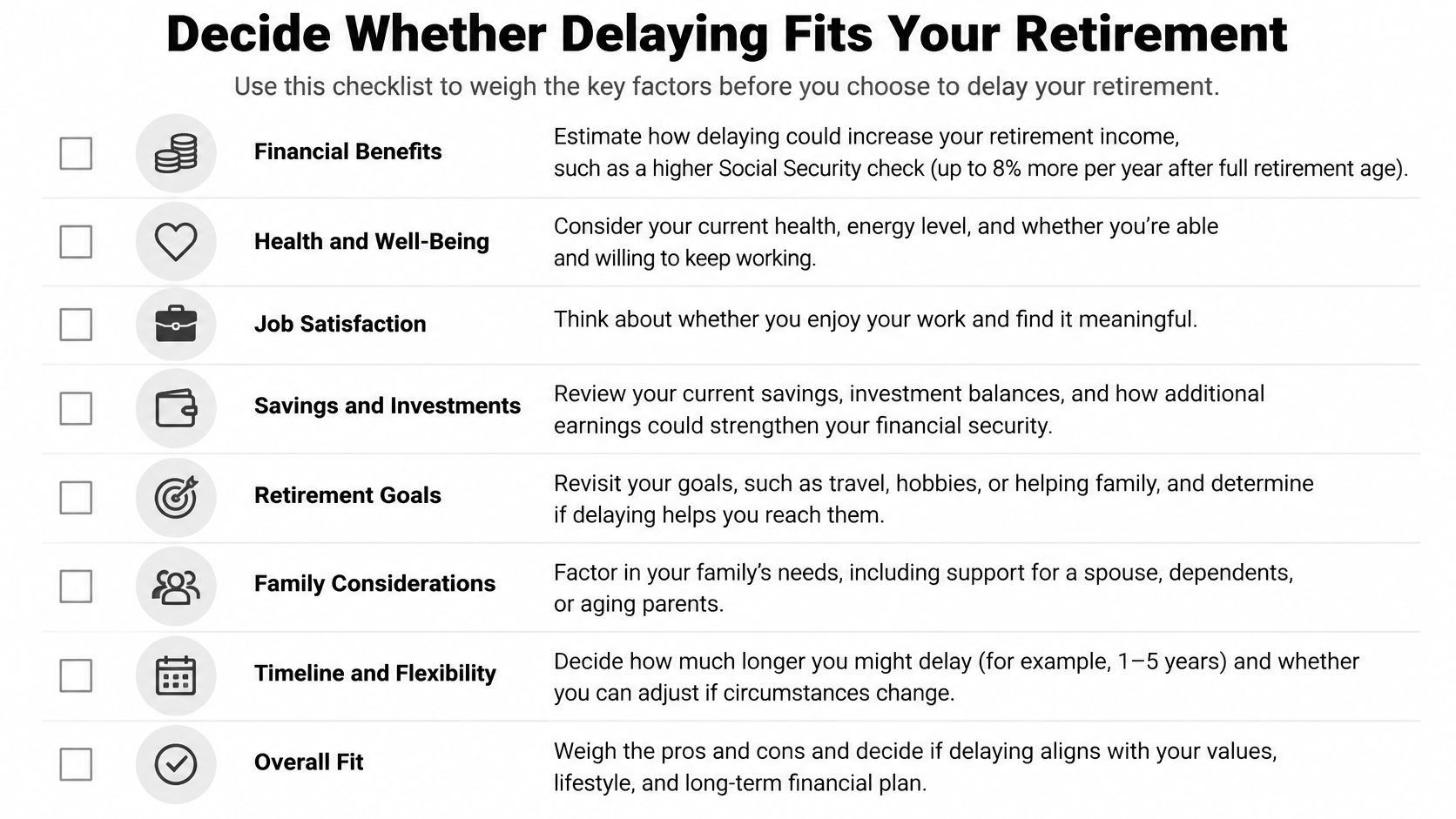
- Statement amounts: Write your estimated benefit at 62, at full retirement age, and at 70.
- Bridge source by year: Name the account or paycheck that covers spending for each year you delay.
- Survivor amount: Write the Social Security amount your spouse would keep if you die first, and the amount you'd keep if your spouse dies first.
- Tax and Medicare note: Estimate whether bridge TSP withdrawals change the tax on benefits or future Medicare premiums, using the key rules for when Social Security benefits are taxed.
- Work note: List expected wages or consulting income before full retirement age and whether the FERS supplement is still in play.
If you want those lines set beside your pension, survivor election, FEHB, and TSP, our process has four steps: learn the basics with the free class or Learning Center, talk with Joe for 15 minutes, get your Gap Report, then decide what's next. We help people who are 10 years from retirement, retiring this year, leaving early, and already retired, under FERS or CSRS.
This education is not tax, legal, investment, or securities advice. Federal Benefits Sherpa is independent of OPM and SSA, and benefit rules change. Your current Social Security statement and the current year earnings limits control the final filing decision, so verify both before you apply.
Put your own statement amounts, FERS or CSRS annuity, supplement end date, TSP bridge, and survivor target on one page before you choose a filing age, then visit Federal Benefits Sherpa to learn the basics, book a short conversation, and see how a Gap Report can show whether Delaying Social Security strengthens your federal retirement income.


Dedicated to helping Federal employees nationwide.
“Sherpa” - Someone who guides others through complex challenges, helping them navigate difficult decisions and achieve their goals, much like a trusted advisor in the business world.
Federal Benefits Sherpa, LLC
12724 Gran Bay Parkway West, Suite 410, Jacksonville, FL 32225
Email: [email protected]
Phone: (833) 753-1825
© 2024 Federalbenefitssherpa. All rights reserved
Federal Benefits Sherpa is an independent organization and is not affiliated with or endorsed by the U.S. government or any federal agency.