Social Security Benefits Taxed: Key Rules
Social Security benefits taxed has become routine for many retirees, not a niche problem. SSA projections show the share of beneficiary families whose benefits are taxed rising from less than 10% in 1984 to an annual average of about 56% from 2015 through 2050 (SSA research summary). If you're a federal employee with a FERS pension, TSP withdrawals, and Social Security on the horizon, the tax trap is the same one that catches people every year, your income looks modest, but the IRS still counts more of it than you expect.
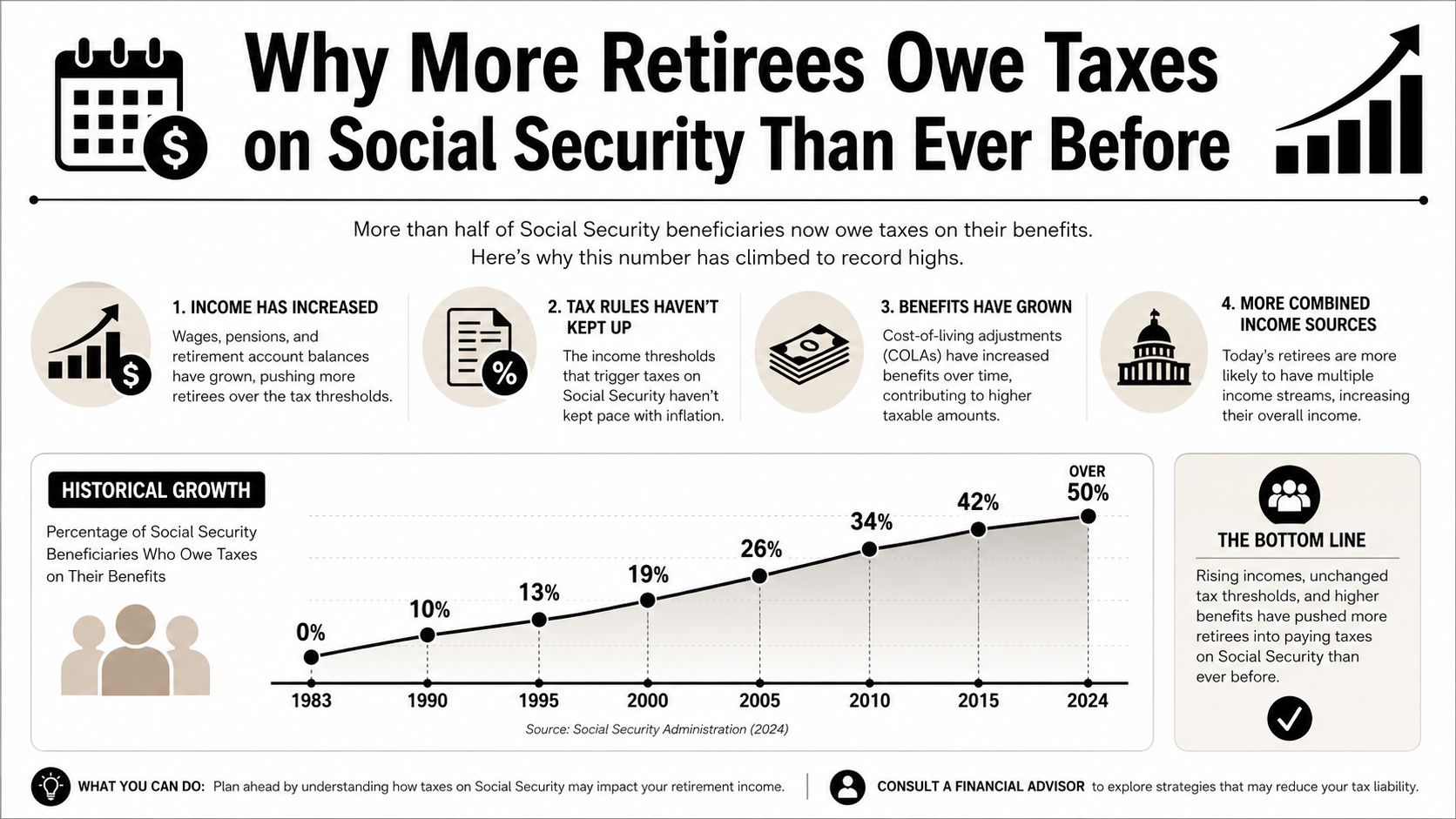
Why More Retirees Owe Taxes on Social Security Than Ever Before
The tax hit on Social Security started with the 1983 Social Security amendments, took effect in 1984, and began with thresholds of $25,000 for single filers and $32,000 for married couples. Congress later added the higher tier in 1993, which is how current law can tax up to 85% of benefits, a point the SSA research summary lays out clearly.
Those thresholds never moved with inflation, so the taxable share keeps spreading. That is the whole story. What looked like a narrow tax for higher-income retirees now reaches far more households, including federal retirees who assume their pension and Social Security sit safely in separate buckets.
A FERS pension, TSP withdrawals, part-time earnings, and investment income all stack into the same tax picture. Federal employees get caught because the income can feel ordinary while the IRS still counts enough of it to pull Social Security into tax territory. If you want to keep up with tax law shifts that affect that exposure, find tax law updates.
Practical rule: If your retirement income includes a pension, TSP distributions, part-time work, or investment income, run the numbers before you assume your Social Security is safe from tax.
The IRS and Congress do not care that the income feels middle class. They care about the formula, and that formula is what pushes many retirees into paying tax on benefits they expected to keep.
How Provisional Income Determines Your Tax Exposure
The IRS does not look at Social Security in isolation. It uses combined income, often called provisional income, and that formula decides whether your benefits are taxed at all (IRS reminder on Social Security taxability). The calculation is simple, adjusted gross income + tax-exempt interest + one-half of Social Security benefits.
That last piece catches a lot of retirees off guard. Wages and pensions are not the only items that matter. Tax-exempt municipal bond interest also counts in provisional income, because the IRS includes tax-exempt interest in the formula (IRS FAQs on Social Security income). Even a child's benefits can become taxable if the child has enough other income, which shows the rule is broader than the usual retiree-only explanation (IRS FAQs on Social Security income).
Use this order:
- Start with your AGI.
- Add any tax-exempt interest.
- Add one-half of your Social Security benefits.
- Compare the total with the IRS thresholds.
If you retire under FERS, your pension and TSP withdrawals land in that first line. Part-time consulting income does too. Roth income works differently because the distribution side can be tax-free, but the planning point does not change. You are managing what enters provisional income, not just what hits your checking account.
Bottom line: “Cash income” and “taxable income” are not the same thing. The IRS uses a wider net, and that is why modest-looking retirement income can still trigger Social Security taxation.
Tax-exempt income trips up another group. Some retirees avoid taxable interest and assume they have reduced their exposure. They have not, if they replaced that income with other money that still enters the provisional-income formula. That is a common failure point, and I would correct it before the first benefit check arrives.
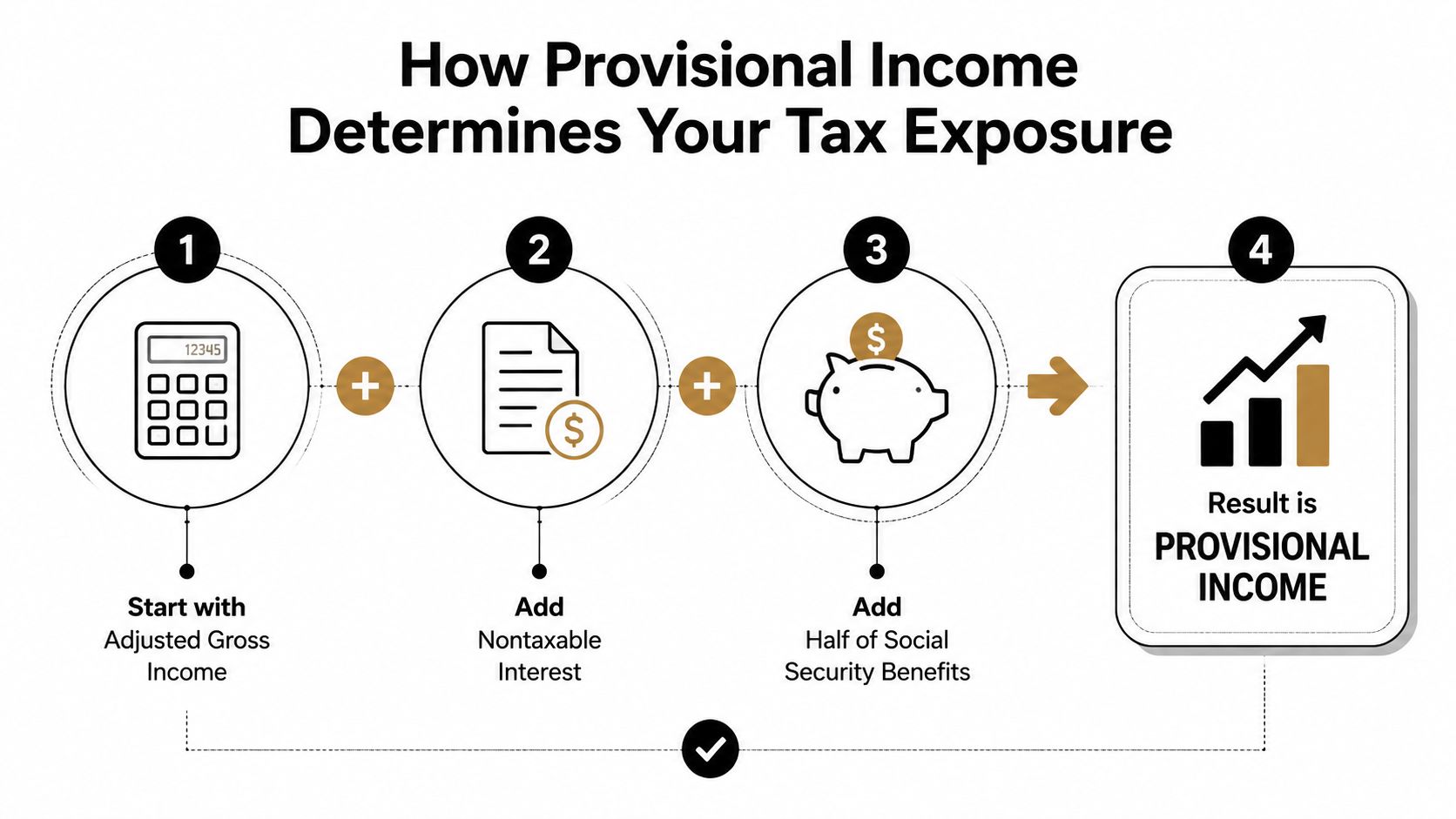
A quick visual helps. The order matters, because once you understand the formula, you can control the inputs.
Federal Tax Thresholds and the 50% and 85% Taxation Bands
The tax rules are blunt. Under the lower threshold, Social Security benefits are generally not taxed. Once combined income rises above that point, a portion can become taxable, and at higher income levels, up to 85% of benefits can be included in taxable income.
| Filing Status | Base Threshold | Upper Threshold | Max Taxable Benefits |
|---|---|---|---|
| Single | $25,000 | $34,000 | Up to 85% |
| Married Filing Jointly | $32,000 | $44,000 | Up to 85% |
These thresholds are low enough that ordinary retirement income can push you over them. For a single filer, taxation can start once combined income exceeds $25,000. For a married couple filing jointly, the starting point is $32,000.
The middle band matters just as much. Between the lower and upper thresholds, up to 50% of benefits can be taxed, and above the top threshold, up to 85% can be taxed. That 85% figure is not a tax rate on the benefit itself. It means as much as 85% of the benefit amount can be pulled into taxable income.
Use this rule: the lower threshold tells you when taxation starts, the upper threshold tells you when the maximum exposure kicks in.
The policy shift is real. According to the CRS summary, the share of benefit payments taxed rose from 12.2% in 1994 to 38.2% in 2022, and the share of benefits paid as federal income tax rose from 2.2% in 1994 to 6.6% in 2022. That is a major change in retirement tax exposure, and it is exactly why federal retirees should watch the provisional-income formula so closely.
A Federal Retiree Tax Scenario With Real Numbers
A retired federal couple can get hit without doing anything exotic. Say one spouse retires under FERS, starts Social Security, and the couple also takes planned TSP withdrawals for living expenses. On paper, that sounds disciplined and middle-of-the-road. In practice, those income pieces can combine fast enough to push benefits into the taxable bands.

How the trap forms
Start with the pension. It lands in adjusted gross income. Add a TSP withdrawal, and you've added more AGI. Then add half of each spouse's Social Security benefit, because that's how the formula works. You don't need a huge income stream to get there, just a steady one.
The mistake most retirees make is treating each source separately. The IRS doesn't. It stacks them. That's why a careful withdrawal strategy matters more than a generic “spend from the TSP first” slogan. The timing and size of those withdrawals can decide whether the couple stays under the base threshold or slides into the 50% and then the 85% band.
Why a small change can hurt
A modest extra withdrawal, or even part-time consulting income, can be enough to move the couple into the higher band. Once that happens, more of their Social Security is pulled into taxable income, and the effective cost of the extra dollar can be higher than expected because it can increase the taxability of the benefit itself.
That's the trap. One additional dollar of non-Social Security income can trigger more than one dollar of taxable income once the benefit phase-in kicks in. For federal retirees, that's why “just a little more TSP” is not always harmless.
Direct advice: Run the tax picture before you make the withdrawal, not after. Retirement income decisions should be coordinated, not improvised.
Special Rules for Federal Employees Including WEP and GPO
Federal employees with split careers need to separate two ideas that get mixed up all the time. WEP and GPO can reduce the size of a Social Security benefit, but they don't cancel the tax rules that apply to whatever benefit remains. If you're eligible for Social Security after working in covered employment, the taxable-benefit rules still apply to the reduced amount.
What these provisions do
Windfall Elimination Provision affects workers who receive a pension from employment not covered by Social Security. That usually matters when a career includes both covered and non-covered service. Government Pension Offset affects spousal and survivor benefits tied to a government pension from non-covered employment. They're benefit-reduction rules, not tax rules.
The practical point is blunt. If WEP or GPO lowers your monthly benefit, that doesn't protect you from the taxation formula once you start receiving Social Security. The IRS still looks at combined income, and the benefit amount after reductions still goes into the math.
Why federal employees get caught off guard
Federal workers who moved between systems, or who have earlier non-covered service, often assume the pension reduction somehow simplifies taxes. It doesn't. It just changes the benefit amount you're calculating against. Your FERS pension, TSP distributions, and any benefit that survives WEP or GPO still sit inside the same provisional-income structure.
For a straight explanation of WEP mechanics, a focused resource is this federal employee guide to WEP. Use it as a technical reference, not as a substitute for a full retirement projection.
Practical rule: If your career includes both covered and non-covered service, don't ask only “Will WEP hit me?” Ask “What does my total retirement income do to Social Security taxation?”
Tax Planning Strategies to Reduce Taxable Social Security Benefits
The cleanest way to reduce taxable Social Security is to control provisional income before the year ends. That means managing TSP withdrawals, the timing of Roth conversions, and the order in which you draw from different accounts. If you wait until tax season to think about it, you've already missed the opportunity.
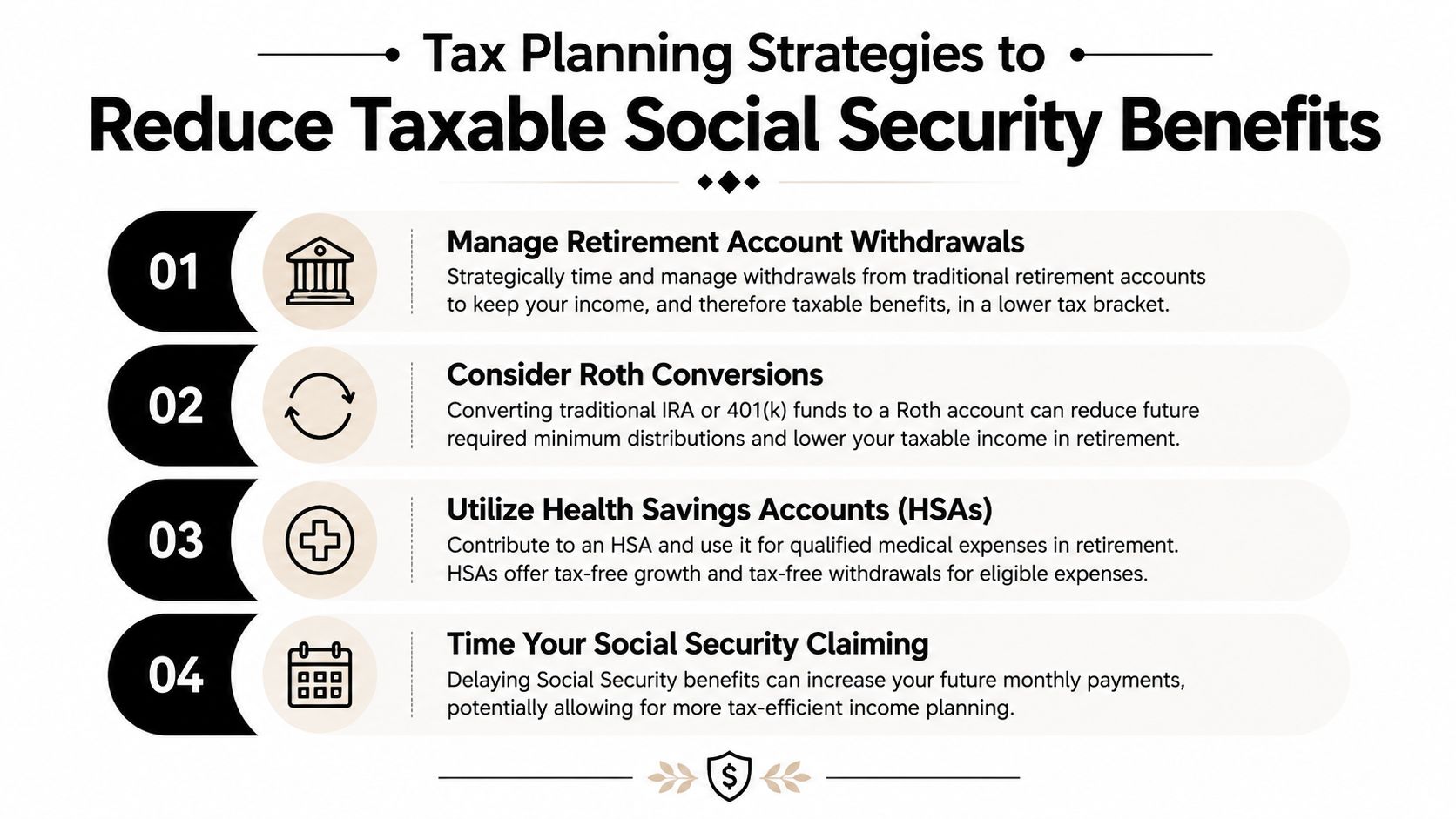
The moves that matter
- Manage Retirement Account Withdrawals: Keep TSP distributions sized so you don't unnecessarily push provisional income over the line. The right amount depends on whether you're trying to stay below the base threshold or avoid the upper band.
- Consider Roth Conversions: A Roth strategy can create tax-free income later, but the conversion year itself can raise taxable income. That's useful only if you plan the timing carefully.
- Utilize Health Savings Accounts: HSA funds can cover qualifying costs without adding to the same taxable-income pressure that retirement withdrawals do.
- Time Your Social Security Claiming: Delaying benefits while drawing from other sources can give you more control over provisional income in the early years of retirement.
The best strategy depends on where you are in the income range. Lower-income retirees may only need to watch modest withdrawals. Federal employees with larger TSP balances need more aggressive sequencing, because the first dollar of unnecessary income can drag benefits into the taxable zone.
A useful companion guide for account movement and rollover decisions is this Roth IRA strategy resource for TSP owners. Read it with one question in mind, how does this transaction affect my provisional income, not just my account balance?
State Taxes on Social Security and Next Steps for Your Plan
Federal tax is only part of the picture. Most states don't tax Social Security benefits, but a handful still do, and the details vary enough that you should check them before choosing where to retire. If you're comparing retirement destinations, state treatment can matter just as much as the monthly benefit itself.
For a state-by-state retirement lens, this plain-English ageing resource is a good place to compare broader lifestyle and planning factors without getting buried in jargon. Pair that with a state retirement review, because tax rules and living costs should be evaluated together.
The federal debate isn't settled either. Recent policy materials show proposals to raise thresholds or eliminate taxation for some filers, and the SSA's own materials discuss alternative designs, including higher thresholds starting in 2027 or full taxation above specified income levels in 2028 (CRS product). That means the rules are under active discussion, not frozen in place.
If you're serious about protecting retirement income, do three things now. First, run a provisional-income calculation using your own pension, TSP, and expected Social Security numbers. Second, review how your withdrawal timing changes taxable income. Third, compare retirement locations with an eye on both federal and state tax treatment. For a practical state comparison, use this guide to the best states for retirement as one input, not the whole decision.
Federal Benefits Sherpa helps federal employees make these retirement decisions with less guesswork and fewer tax surprises. If you want a clearer read on your Social Security exposure, your TSP withdrawal timing, and how your full benefit picture fits together, visit Federal Benefits Sherpa and start with a benefit review that's built for federal retirement planning.
