What is a Survivor Annuity? A Federal Employee Guide
A survivor annuity is essentially an insurance policy for your pension. It’s a guaranteed monthly income that kicks in for your surviving spouse after you’re gone, acting as a critical financial lifeline. This is easily one of the most important decisions you'll make when you plan your federal retirement.
Unpacking the Survivor Annuity
Imagine your federal pension is a steady river of income you'll rely on throughout retirement. When you elect a survivor annuity, you're creating a smaller, secondary stream from that river. This new stream continues flowing to your spouse even after your own has ended. It isn't a separate pot of money; it's a continuation of your hard-earned benefits, designed to give your loved one long-term stability.
But this decision is about so much more than just the money. For most federal families, choosing a survivor annuity is the only way a surviving spouse can keep their Federal Employee Health Benefits (FEHB) coverage. Losing that group health insurance can be financially devastating, which often makes the survivor annuity a non-negotiable part of a secure retirement plan.
For a quick overview, here's a simple breakdown of what a survivor annuity offers.
Survivor Annuity at a Glance
FeatureDescriptionGuaranteed IncomeProvides a predictable, recurring monthly payment to your surviving spouse for life.Health InsuranceSecures continued eligibility for the Federal Employee Health Benefits (FEHB) program.Financial SecurityProtects your spouse from a sudden, sharp drop in household income.CostPaid for via a small reduction in your monthly pension during your lifetime.
This table shows just how foundational this benefit is to a solid retirement strategy. It's about protecting the person you've built a life with.
Core Purpose and Key Benefits
The main goal here is simple: prevent a sudden and catastrophic drop in income for your spouse. By taking a small reduction in your own monthly pension check, you're buying them a predictable source of funds for the rest of their life.
The benefits are clear and powerful:
Continuous Income: A steady, reliable payment arrives for your spouse every month.
FEHB Eligibility: This is the big one. It preserves your spouse's access to federal health insurance.
Financial Security: It protects your loved one from unexpected financial hardship.
Peace of Mind: You can retire knowing your spouse will be taken care of.
This benefit is a true cornerstone of the federal retirement system, and the numbers from the Office of Personnel Management (OPM) prove it. In FY2022, out of more than 2.7 million people receiving a civil service annuity, 475,562 were survivor annuitants. That’s nearly 18% of all recipients. You can read more about the significance of these federal benefits to get the full picture.
The choice to elect a survivor annuity is a foundational act of financial planning. It transforms your individual pension into a lasting legacy of security for your family, safeguarding their well-being long after you are gone.
While the federal survivor annuity is a unique benefit tied to your government service, the private sector has its own world of annuity products. To get a sense of how they compare, you might look into what a single premium immediate annuity (SPIA) is. This guide, however, will stick to the specific options available to you as a federal employee.
Comparing FERS and CSRS Survivor Benefits
To really understand what a survivor annuity is, you have to look at it through the lens of the two major federal retirement systems: the Civil Service Retirement System (CSRS) and the Federal Employees Retirement System (FERS). They both offer this crucial protection for your loved ones, but they were built on completely different foundations.
Think of it this way: CSRS is the original, old-school system. It was designed as a generous, standalone pension plan but didn't include Social Security. Then, in 1987, FERS came along, designed as a modern "three-legged stool" that combines a smaller basic pension with Social Security and the Thrift Savings Plan (TSP). This fundamental difference is the key to why the survivor benefits—what they pay and what they cost—are so distinct.
Payouts and Costs: A Tale of Two Systems
The most immediate difference you'll notice is in the numbers. The maximum benefit your surviving spouse can receive and the cost you'll pay for it are not the same across the two systems.
CSRS Maximum Payout: A surviving spouse can receive up to 55% of the retiree's full, unreduced annuity. The cost is a bit tricky, calculated using a formula based on the first $3,600 of your annuity and then 10% of whatever is left.
FERS Maximum Payout: The top benefit is 50% of the retiree's unreduced annuity. The cost is much simpler—it's a straight 10% reduction in your monthly pension. FERS also offers a smaller, partial option: 25% coverage for a 5% reduction.
This infographic breaks down the essential purpose of a survivor annuity, a concept that's central to both retirement plans.
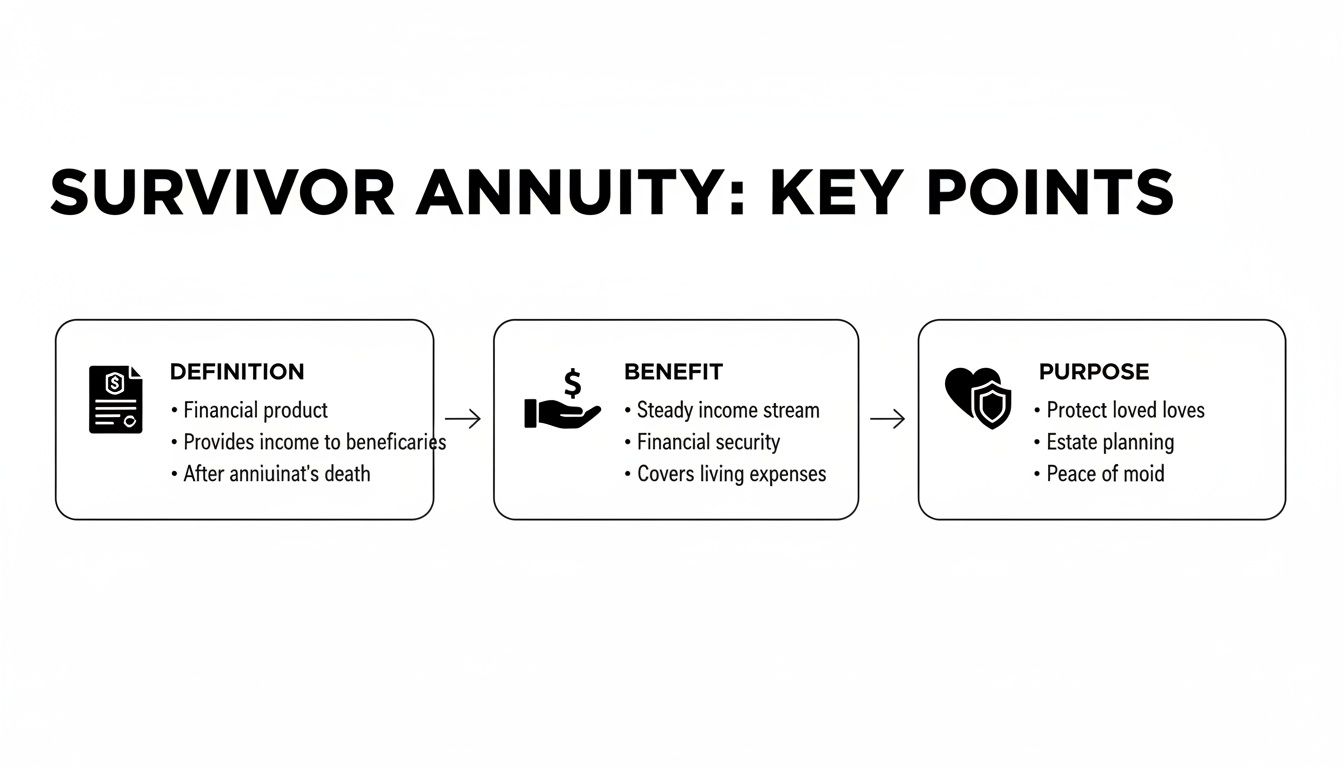
As you can see, no matter which system you're in, the goal is the same: providing a financial safety net for the people you care about most.
Why CSRS Benefits Often End Up Higher
On paper, the difference between 55% and 50% might not seem like a big deal. In reality, though, CSRS survivor annuities are often significantly larger.
Why? It's because the starting CSRS pension is typically much higher. CSRS employees contributed more of their salary and had more generous accrual rates, resulting in a bigger base pension. Since the survivor benefit is just a percentage of that bigger base, the final dollar amount paid to the spouse is also larger.
The statistics tell a clear story. By FY2022, CSRS survivors still accounted for 80.1% of all survivor annuitants, though FERS is slowly catching up. The median monthly benefit for a CSRS survivor was $1,712—more than three times the FERS median of $560.
This gap highlights just how different the underlying pension calculations are. A 2023 court decision reinforced this, confirming a uniform 50% formula for FERS, even for employees who have time under both systems. If you'd like to dive deeper, you can learn more about how survivor annuity benefits are determined.
For FERS employees, it's absolutely vital to understand how your plan works. Our detailed guide to FERS survivor benefits for federal employees is a great place to start.
FERS vs CSRS Survivor Annuity Comparison
Sometimes, seeing things side-by-side makes all the difference. This table breaks down the key distinctions between the two systems at a glance.
FeatureFERS (Federal Employees Retirement System)CSRS (Civil Service Retirement System)Maximum Survivor Benefit50% of the unreduced annuity55% of the unreduced annuityCost for Maximum Benefit10% reduction of retiree's annuity2.5% of the first $3,600 + 10% of the remainderPartial Benefit OptionYes, 25% benefit for a 5% costYes, can elect less than the maximumSocial Security IntegrationYes, designed to work alongside itNo, generally not covered by Social SecurityTSP ComponentYes, a core part of the systemNo, TSP participation was limited
The table makes the trade-offs clear. But what if you have service time under both systems? If you're a "FERS Transferee," your survivor annuity will be a blend of both CSRS and FERS rules. This can get complicated fast, and it’s a situation where getting some expert guidance can be incredibly valuable.
Who Can Receive a Survivor Annuity?

Before we get into the numbers, let’s talk about who is actually eligible to receive a survivor annuity. The Office of Personnel Management (OPM) has a clear set of rules designed to protect the people who were financially counting on the federal employee.
For a surviving spouse, the most important rule usually comes down to the length of the marriage. In most cases, you must have been married to the federal employee for at least nine months right before their death.
This rule is there for a reason: to prevent last-minute marriages just to secure federal benefits. But OPM knows that life is complicated and has built in some important exceptions.
Exceptions to the Nine-Month Marriage Rule
That nine-month requirement isn't set in stone. If the employee's death was accidental, the rule is completely waived. A spouse from a marriage of any length can qualify for a survivor annuity under these tragic circumstances.
There's another major exception: children. If a child was born of the marriage, even if the marriage itself was shorter than nine months, the surviving spouse is still eligible for benefits. It's a common-sense approach that protects families formed in good faith.
Active vs. Retired Employees: The Rules Change
The eligibility rules also depend on a crucial detail: did the federal employee pass away while still on the job (in service) or after they had already retired? The service time requirements are different for each scenario.
Death After Retirement: If the employee dies after retiring, the main hurdle is already cleared—they must have chosen to provide a survivor annuity when they filled out their retirement paperwork. The surviving spouse just needs to meet the marriage duration rules we discussed.
Death In Service: If an employee passes away while still working, their spouse can still be eligible for an annuity. The key here is that the employee must have completed at least 10 years of creditable service under FERS (18 months for CSRS) for their spouse to qualify for monthly payments.
The timing of death—in service versus after retirement—is a critical distinction. For an active employee, meeting that 10-year FERS service mark is what unlocks the monthly survivor annuity for their spouse.
While our focus here is on federal retirement benefits, it's worth noting that other government programs might offer support. For example, some veterans and their survivors may qualify for VA Aid and Attendance benefits, which can provide an additional layer of financial help.
What About Former Spouses and Children?
Survivor benefits aren't just for the current spouse. A former spouse can be entitled to a full or partial survivor annuity if a court orders it as part of a divorce settlement. This isn't just a handshake agreement; it has to be a formal Qualified Domestic Relations Order (QDRO) filed directly with OPM to be legally binding.
Unmarried dependent children can also receive their own survivor benefits. These payments usually continue until they turn 18, or up to age 22 if they are a full-time student. For a child who was disabled before age 18, the benefits can continue for life.
Importantly, these children's benefits are a separate pot of money. They are calculated independently and do not reduce the annuity paid to a surviving spouse, ensuring all dependents are protected.
How Survivor Annuity Costs and Payouts Are Calculated

It’s essential to understand that a survivor annuity isn't a free perk. Think of it as a trade-off. You agree to a small reduction in your own monthly pension during retirement in exchange for providing a lifelong income for your spouse after you’re gone.
So, how does the math actually work? Let's break it down. We'll focus on the FERS system, since that's what covers the vast majority of current federal employees. The calculations are pretty straightforward and hinge on two key choices you'll make when you retire.
The Two Main FERS Survivor Annuity Options
Under FERS, you have two primary ways to leave a survivor benefit for your spouse. Each one has a different payout for them and a different cost for you.
Full Survivor Benefit: This gives your spouse 50% of your unreduced basic annuity. To make this happen, your own annuity is reduced by 10%.
Partial Survivor Benefit: This gives your spouse 25% of your unreduced basic annuity. The cost is lower, reducing your annuity by just 5%.
You can think of it like an insurance plan. The full benefit provides a bigger safety net for your spouse, but it comes with a higher "premium"—the reduction to your pension. The partial option offers a smaller cushion at a lower cost.
A Practical Calculation Example
The best way to get a feel for this is to walk through a real-world example. Let's imagine a retiring FERS employee, Alex, whose unreduced basic annuity is calculated to be $3,000 per month.
Scenario 1: Alex Elects the Full 50% Survivor Benefit
Cost to Alex: Alex's pension is reduced by 10%.
Calculation: $3,000 x 10% = $300 reduction
Alex's Monthly Annuity: $3,000 - $300 = $2,700
Benefit for Alex’s Spouse: The spouse gets 50% of Alex’s unreduced annuity.
Calculation: $3,000 x 50% = $1,500
Spouse's Monthly Annuity: $1,500
In this case, Alex receives $2,700 a month while alive. After Alex passes, their spouse is guaranteed $1,500 a month for the rest of their life.
Scenario 2: Alex Elects the Partial 25% Survivor Benefit
Cost to Alex: Alex's pension is reduced by 5%.
Calculation: $3,000 x 5% = $150 reduction
Alex's Monthly Annuity: $3,000 - $150 = $2,850
Benefit for Alex’s Spouse: The spouse gets 25% of Alex’s unreduced annuity.
Calculation: $3,000 x 25% = $750
Spouse's Monthly Annuity: $750
Here, Alex enjoys a slightly higher monthly check ($2,850), but the survivor benefit for their spouse is cut in half ($750). The decision really boils down to balancing your own income needs against your spouse's future financial security.
The most important detail here is that the survivor's payout is always based on your unreduced annuity. The cost is a percentage taken from your pension, but the benefit is calculated from your original, full amount.
For anyone who wants to really dive into their own numbers, check out our guide on how to calculate annuity payments like a pro.
Benefits for Employees Who Die in Service
What happens if a federal employee tragically passes away before they can retire? As long as they met certain service requirements, their surviving spouse can still receive benefits. An employee needs at least 18 months of creditable civilian service for their family to be eligible for any death benefit.
To qualify for a monthly survivor annuity, the deceased employee must have completed at least 10 years of creditable service. If they hit that mark, the survivor is also entitled to the Basic Employee Death Benefit (BEDB).
This is a lump-sum payment made up of a base amount (around $37,000 in 2022 and adjusted for inflation) plus half of the employee's final salary. This benefit can be paid out as a single lump sum, in installments, or even rolled over into the TSP.
The Insurable Interest Option
But what if you want to provide for someone who isn't your spouse—like a child, a domestic partner, or a sibling? This is where the insurable interest election comes into play.
To be eligible, you have to be in good health at retirement, and the person you name must be financially dependent on you. Be warned, the cost for this option is much steeper than a spousal benefit. The reduction to your annuity can range from 10% to 40%, depending on the age difference between you and your beneficiary. It's a less common choice, but a critical one for those with unique family circumstances.
Integrating Your Annuity with Taxes and Social Security
A survivor annuity provides a wonderful safety net, but it's important to remember it doesn't exist in a vacuum. This income is part of a bigger financial picture that includes federal and state taxes, not to mention Social Security. Getting a clear-eyed view of how all these pieces fit together is the only way to build a realistic income plan for your surviving spouse.
First things first: survivor annuity payments are taxable income. This isn't a free ride. Your surviving spouse will owe federal income tax on every dollar they receive, and most states will want their cut, too, depending on their local tax laws.
What does that mean in practical terms? The gross monthly annuity isn't what your spouse will actually see in their bank account. Just like with a paycheck, taxes get taken out first. You absolutely have to factor in this reduction when you're trying to figure out how much income your family will truly need down the road.
Navigating the Social Security Maze
Beyond taxes, the next big piece of the puzzle is Social Security. It’s a common point of confusion. A surviving spouse is often eligible for Social Security benefits, either from their own work history or based on the deceased federal employee’s record. The catch is, they can't double-dip and collect both full benefits at the same time; they will simply receive whichever of the two amounts is higher.
This usually leaves a surviving spouse with a choice:
Their Own Benefit: They can claim Social Security based on their own lifetime earnings.
Survivor Benefit: They can claim a survivor benefit based on their deceased spouse's earnings, which is often the higher amount.
Spousal Benefit: In some situations, a spousal benefit might be in play if the federal retiree was already collecting Social Security.
The most important thing to remember is that the survivor annuity from your federal pension and the survivor benefit from Social Security are two different things. For FERS employees, one doesn't cancel out the other. But you have to understand how they work in tandem to accurately forecast your spouse's future income.
Planning for survivor income requires a holistic view. You have to look at the FERS annuity, Social Security, and TSP withdrawals as interconnected streams that form a complete river of retirement funding for your loved one.
The GPO and WEP Roadblocks for CSRS Families
Now, for those under the older Civil Service Retirement System (CSRS), things get a lot trickier. The rules here can cause a massive, and often shocking, reduction in the Social Security benefits you might be counting on. This is all because of two infamous provisions: the Government Pension Offset (GPO) and the Windfall Elimination Provision (WEP).
Since CSRS employees didn't pay into Social Security during their federal careers, Congress created these rules to prevent what they saw as "double-dipping" from a system they didn't fully contribute to.
The financial hit can be devastating:
Government Pension Offset (GPO): This rule can slash—or completely wipe out—any Social Security spousal or survivor benefit a CSRS spouse might otherwise receive. The formula is brutal: the GPO reduces the Social Security benefit by two-thirds of the amount of the CSRS pension.
Windfall Elimination Provision (WEP): This one attacks the Social Security benefit a CSRS retiree might get from their own work record, say from a job they held before or after their federal career where they did pay Social Security taxes.
These two provisions are notoriously complex and widely misunderstood, leading to some truly nasty surprises for families in retirement. To get into the nitty-gritty, check out our complete guide to Social Security benefits for federal employees. For any CSRS family, understanding these offsets isn't just a good idea—it's absolutely essential for building a reliable retirement plan.
The Election and Application Process
Getting a survivor annuity set up is a two-step dance. The first step is yours, happening right when you retire. The second step belongs to your spouse, but it only happens after you're gone. Knowing what to do—and when—at each stage is the key to making sure everything goes smoothly.
The most critical moment is when you’re filling out your retirement paperwork. This isn't something that just happens automatically; you have to make a conscious choice on your application (like the SF-3107 for FERS employees). You’ll formally elect the full survivor benefit, a partial one, or none at all.
Here's a really important point: if you decide to elect anything less than the full spousal benefit, you can't make that decision alone. Your spouse has to provide their written, notarized consent.
This spousal consent rule is a crucial safeguard built into the system. It’s there to make sure both partners are on the same page about a decision that deeply affects the surviving spouse's financial future and their ability to keep their health insurance.
Making Changes After Retirement
Once your retirement is finalized by the Office of Personnel Management (OPM), your survivor benefit election is pretty much set in stone. But, life happens, and there are a few specific situations that can crack open a window to make a change.
These exceptions are rare and come with very strict deadlines:
Marriage after retirement: If you were single when you retired but get married later, you have two years from your wedding date to elect a survivor annuity for your new spouse.
Death of a spouse: If your spouse passes away before you, you can notify OPM. They will stop the reduction in your pension, and your monthly payment will go back up to the full, unreduced amount.
Divorce: A divorce decree might order you to provide a survivor benefit to your ex-spouse. On the other hand, if there's no court order, a divorce also allows you to cancel an existing spousal election.
How a Surviving Spouse Claims Benefits
When a federal retiree passes away, the surviving spouse needs to get the ball rolling to claim their benefits. The very first thing to do is report the death to OPM. You can do this online through their website or by giving their retirement services line a call.
Once notified, OPM will mail the survivor a detailed application packet with instructions. This packet will ask for a few key documents to get the claim processed.
You'll typically need to send in:
A certified copy of the death certificate.
A copy of your marriage certificate.
The specific application forms that OPM sends you.
Getting these documents back to OPM accurately and without delay is the best way to avoid a long wait. As soon as they process everything, they will stop the retiree's pension payments and start sending the monthly survivor annuity directly to the surviving spouse.
Answering Your Top Questions About Survivor Annuities
Even after you get a handle on the basics, a few specific questions always seem to pop up when it's time to make a decision. Let's tackle some of the most common ones we hear from federal employees wrestling with this choice.
Getting these details right is about more than just paperwork; it’s about securing your family’s financial future.
Can I Change My Mind After I Retire?
This is a big one. For the most part, once OPM finalizes your retirement and your survivor annuity election is locked in, it's a done deal. It’s generally an irrevocable decision.
However, life happens, and there are a couple of very specific exceptions. If you retire single and get married later, you have a two-year window from your wedding day to elect a survivor annuity for your new spouse. Similarly, if your marriage ends due to death or divorce, you might be able to adjust or cancel your election. These scenarios come with tight deadlines and tricky rules, so getting expert advice is crucial to avoid missing a critical opportunity.
What Happens to Our Health Insurance if I Say No to the Annuity?
Pay close attention here, because this is probably the most important piece of the puzzle. If you decide not to provide a survivor annuity for your spouse, their Federal Employee Health Benefits (FEHB) coverage ends the moment you pass away.
To keep their FEHB coverage for life, your spouse must be entitled to a survivor annuity payment. Even the smallest partial annuity is enough to maintain that eligibility. For many federal couples, protecting access to affordable health insurance is the single biggest reason they elect a survivor benefit.
Losing FEHB can be a massive financial blow. The cost of finding a comparable private health plan, especially for an older individual, can be astronomical. This turns the survivor annuity decision into a critical healthcare planning choice, not just an income one.
If I Elect an Annuity, Do We Still Need Life Insurance?
That really depends on your family's complete financial picture. Think of a survivor annuity and life insurance as two different tools in your financial toolkit—they do different jobs, but they work great together.
The Survivor Annuity: This is your long-term solution. It provides a reliable, monthly check to cover day-to-day living expenses, ensuring the bills get paid consistently.
Life Insurance: This is your short-term solution. It delivers a tax-free, lump-sum payout to handle immediate, large expenses like funeral costs, paying off the mortgage, or clearing out other debts.
Many feds wisely choose to have both. The annuity keeps the household running smoothly for the long haul, while a life insurance policy (like FEGLI or a private plan) provides instant cash to settle the estate and wipe the financial slate clean. It's a powerful combination for creating a truly secure safety net.
Navigating these critical retirement decisions can feel overwhelming. The choices you make today will echo for decades. At Federal Benefits Sherpa, we simplify the complexities of your federal benefits to help you build a secure future. Book a free 15-minute benefit review to get clarity and confidence in your retirement plan.
