How to Calculate Annuity Payments Like a Pro
Figuring out the value of an annuity all comes down to a bit of math. You’ll be working with a few standard formulas, plugging in numbers like your payment amount, the interest rate, and how long the annuity runs. The real trick is picking the right formula for what you want to know—are you trying to find its lump sum value today (Present Value), or what it will all be worth down the road (Future Value)?
Decoding the Language of Annuity Calculations
Before we jump into the formulas, you have to get comfortable with the terminology. These are the core components, the building blocks of any annuity calculation. If you mix them up, you’ll get a number that looks right but is actually way off. It's a common mistake I see people make.
Let's quickly create a reference for these key variables. Think of this as your cheat sheet for every annuity formula you'll encounter.
Key Variables in Annuity Formulas
This table breaks down the essential inputs you'll need, no matter what kind of annuity you're trying to calculate.
VariableSymbolWhat It RepresentsPresent ValuePVThe annuity's total worth in today's dollars. It's the lump sum you'd get right now.Future ValueFVThe total value of the annuity at a specific point in the future, including all payments and interest.Payment AmountPMTThe fixed amount of money you receive or pay each period (e.g., your monthly check).Interest RaterThe rate of return or interest earned per period, often called the discount rate.Number of PeriodsnThe total number of payments over the annuity's entire lifespan.
With these terms in your back pocket, the formulas start to make a lot more sense.
The idea of putting a price on a future income stream has been around for a surprisingly long time. One of the earliest known attempts to formalize this was back around 225 A.D. The Roman legal scholar Ulpianus created one of the first life tables to estimate lifespans, which was crucial for pricing lifetime income streams. You can actually read more about these early actuarial methods and see how far back these concepts go.
Ordinary Annuity vs. Annuity Due
Now, here’s a detail that can trip people up: the timing of the payments. It makes a huge difference in the final calculation, and it's what separates an ordinary annuity from an annuity due.
An ordinary annuity makes payments at the end of each period. Bonds are a perfect example; they typically pay interest to bondholders after the period has concluded.
On the other hand, an annuity due makes payments at the beginning of each period. Your rent or a car lease is almost always an annuity due—you pay on the first of the month for the month ahead.
This distinction is critical. Why? Because a payment made at the beginning of a period gets one extra period to earn interest. All else being equal, an annuity due will always be worth more than an ordinary annuity.
Nailing down these fundamentals—the core variables and the payment timing—is the first and most important step. It ensures you grab the right formula from your toolkit and avoid easily preventable mistakes right from the get-go.
Finding the Present Value of Future Income Streams
It’s one thing to know you have money coming in the future, but it’s another thing entirely to know what that money is worth today. This is the core idea behind Present Value (PV), a concept that's incredibly useful for making smart financial decisions, whether you're looking at a lottery jackpot or a legal settlement.
Essentially, PV answers a straightforward question: How much money would I need to invest right now, at a specific interest rate, to generate a series of identical payments over a set period?
Let's walk through a real-world scenario to make this concrete. Imagine you've won a legal settlement that guarantees you $5,000 every year for the next 10 years. The money funding this settlement is expected to be invested and earn a steady 4% interest annually. To figure out what that entire stream of payments is worth as a single lump sum today, we'll use the present value of an ordinary annuity formula.
The Formula Unpacked
The formula itself can look a little daunting, but don't let the symbols scare you. It’s just a mathematical shortcut for figuring out how the value of money shrinks over time when you factor in interest.
Here's the formula: PV = Pmt * [ (1 - (1 + r)^-n) / r ]
Let's break down what each part means using our settlement example:
Pmt (Payment): This is the fixed payment you get each period. For us, Pmt = $5,000.
r (Interest Rate): This is the interest rate for each period. With an annual rate of 4%, r = 0.04.
n (Number of Periods): This is simply the total number of payments. Since we have 10 annual payments, n = 10.
By plugging these numbers into the formula, we can pinpoint the exact lump sum needed today.
This visual shows how the core variables—Present Value (PV), Future Value (FV), Number of Periods (n), and the Interest Rate (r)—all work together in these calculations.
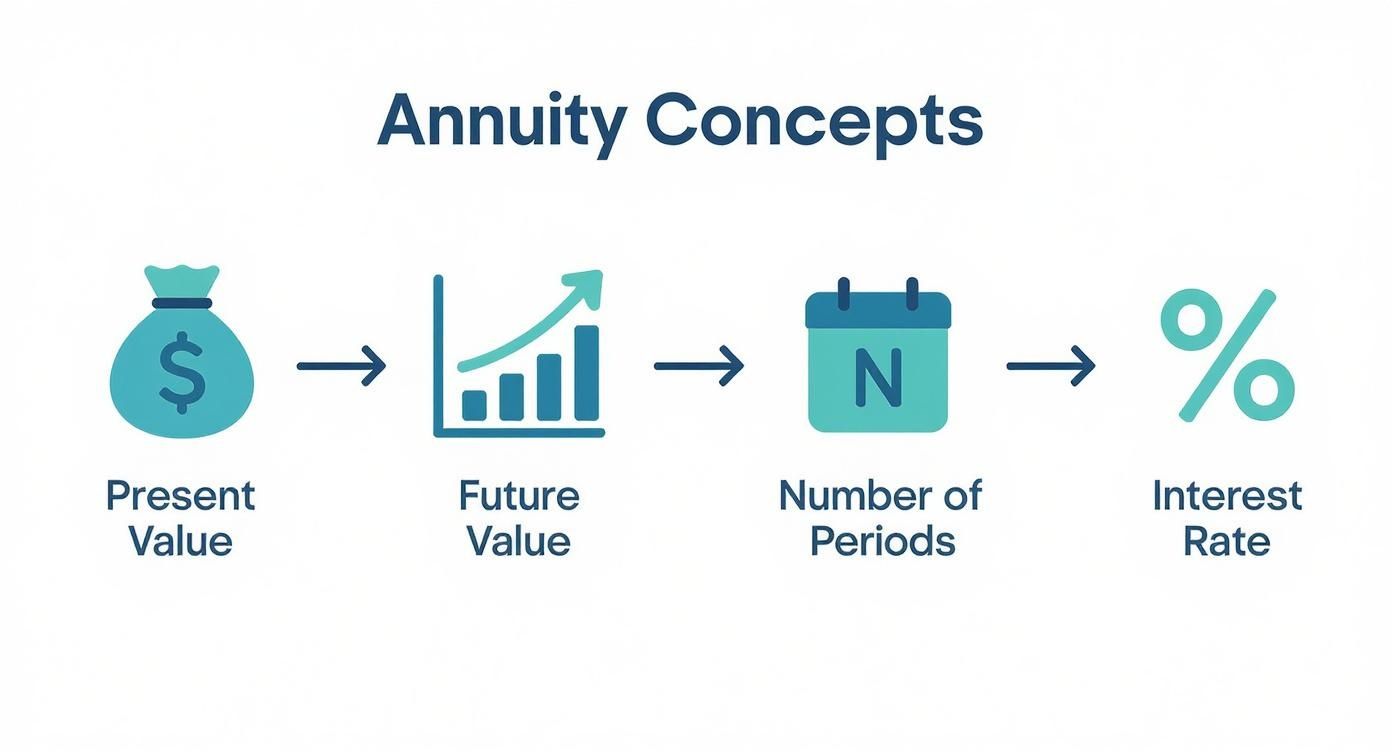
As you can see, these four elements are the fundamental building blocks for figuring out the value of any annuity, whether you’re projecting into the future or calculating its worth in the present.
Putting It All Together
Okay, let's plug in our numbers and see what we get.
First, we calculate (1 + r)^-n. So, (1 + 0.04)^-10 comes out to roughly 0.67556.
Next, we subtract that result from 1: 1 - 0.67556 gives us 0.32444.
Then, we divide that by our interest rate, r: 0.32444 / 0.04 = 8.111.
Finally, we multiply this factor by our annual payment, Pmt: 8.111 * $5,000 = $40,555.
There's our answer. A lump sum of $40,555 invested today at a 4% annual interest rate is what it would take to fund those ten annual payments of $5,000. That's the true present value of your settlement.
This exact calculation is crucial for federal employees weighing their retirement options. For example, if you're deciding between a pension payout and a lump-sum rollover from your Thrift Savings Plan (TSP), knowing the present value helps you make an apples-to-apples comparison of what each option is really worth.
Once you get the hang of this calculation, you gain the confidence to look past the surface numbers of any financial promise. You’re no longer just seeing a series of future payments; you're understanding what that money is truly worth in your pocket today.
Projecting the Future Value of Your Savings

While knowing what your money is worth today is important, the real magic happens when you start looking ahead. Calculating the future value (FV) of an annuity shifts the conversation from what you have to what you could have. This is the number that really matters when you're planning for big goals, like a comfortable retirement.
Think of the future value calculation as a way to see how a stream of regular contributions will grow over time, thanks to the power of compounding interest. It's not just some abstract financial exercise; it’s a tangible way to visualize your financial future and see the real impact of your saving habits.
The Future Value Formula Explained
To map out this growth, we use a specific formula. It might look a little intimidating at first glance, but each piece plays a simple and crucial role in painting a picture of your future wealth.
Here’s the standard formula for the future value of an ordinary annuity:
FV = Pmt * [ ((1 + r)^n - 1) / r ]
Let's walk through it with a real-world example. Say you decide to contribute $200 a month to a retirement account for the next 30 years, and you're anticipating an average annual return of 7%.
Here's how we plug that into the formula:
Pmt (Payment): This is your regular contribution, which is $200.
r (Interest Rate): Your annual rate is 7%, but since you're making monthly payments, we need a monthly rate. So, r = 0.07 / 12 = 0.00583.
n (Number of Periods): You're saving for 30 years with monthly payments. That means n = 30 * 12 = 360 periods.
This structured way of valuing long-term payments isn't new; it has surprisingly deep roots. Back in the late 17th century, a Dutch mathematician named Johan de Witt pioneered one of the first actuarially sound methods for valuing life annuities, a huge step up from the guesswork that came before. His work, along with later refinements by figures like Abraham de Moivre, laid the groundwork for modern financial planning. You can actually dig into the early history of actuarial science to see how these fundamental ideas took shape.
Calculating Your Retirement Nest Egg
Okay, let's get back to our example and run the numbers to see what that $200 a month can become.
First, let's figure out the compounding effect: (1 + r)^n. That’s (1 + 0.00583)^360, which comes out to roughly 8.116.
Next, we subtract 1 from that result: 8.116 - 1 = 7.116.
Now, divide that by our monthly interest rate, r: 7.116 / 0.00583 gives us about 1220.58.
Finally, we multiply this big number by your monthly payment, Pmt: 1220.58 * $200 = $244,116.
After 30 years of consistently putting away just $200 a month, your account could grow to over $244,000. Think about that for a second. Your total contributions were only $72,000 ($200 x 360 months). The other $172,116 is pure growth from your investments working for you.
This is why starting early and staying consistent is so powerful. This simple calculation turns a vague goal into a concrete number, showing exactly how small, regular efforts can build serious wealth over a career.
How Payment Timing Changes the Entire Equation

So far, we've been working with what are called ordinary annuities, where payments hit your account at the end of each period. This setup is pretty standard for things like corporate bond interest. But in the real world, many financial products are structured the opposite way, with payments due right at the beginning of the period.
When that happens, we're dealing with an annuity due. Think about your monthly rent or a car lease—you almost always pay on the first of the month for the month ahead. This might seem like a small detail, but it completely changes the math when you calculate an annuity's total worth.
The Power of an Extra Period
The key difference is surprisingly simple: a payment received at the beginning of a period gets one extra period to earn interest compared to a payment received at the end. When you stretch that out over the life of the annuity, that extra compounding time for every single payment really starts to add up.
Because of this, an annuity due will always have a higher present and future value than an identical ordinary annuity. The payment amounts are the same, the interest rate is the same, and the timeline is the same—the only variable that changes is when the money shows up.
The good news is you don't need to learn a whole new set of complex formulas. You can simply tweak the ordinary annuity formulas we've already walked through.
To find the Future Value of an Annuity Due: First, run the numbers for the FV as if it were an ordinary annuity. Then, just multiply that result by (1 + r).
To find the Present Value of an Annuuity Due: It's the same idea. Calculate the PV for an ordinary annuity, and then multiply that figure by (1 + r).
That one extra multiplication step is all it takes to account for the extra period of interest earned on each and every payment.
This small adjustment is crucial for getting an accurate valuation. For instance, if a structured settlement is set up to pay out on January 1st each year instead of December 31st, its present-day lump-sum value is higher. Overlooking this detail is literally leaving money on the table.
A Practical Comparison
Let's go back to our example of saving $200 per month for 30 years at a 7% annual return. When we treated it as an ordinary annuity (payments at the end of the month), the future value came out to $244,116.
Now, let's see what happens when we treat it as an annuity due, where you invest that $200 on the very first day of each month instead.
First, we take our original ordinary annuity FV of $244,116.
Next, we grab our monthly interest rate (r): 0.07 / 12 = 0.00583.
Finally, we do the simple multiplication: $244,116 * (1 + 0.00583).
The new future value comes out to $245,540.
Just by shifting your payments from the end of the month to the beginning, your retirement savings grew by an extra $1,424. It’s a perfect illustration of how a small change in timing can make a real financial impact over the long haul.
Beyond the Basic Formula: Real-World Factors to Consider
The standard annuity formulas we’ve covered are a great starting point, but the real world is rarely that clean. When financial professionals and large institutions value an annuity, they have to wrestle with complex variables that can completely change the numbers. Knowing what these factors are will help you ask much smarter questions when you're looking at a pension payout or a commercial annuity.
The Power of the Discount Rate
Of all the variables, the discount rate is probably the most powerful. Think of it as more than just an interest rate; it also accounts for risk and what you could be earning elsewhere (opportunity cost). Even a tiny tweak to this number can send the present value of an annuity soaring or plummeting.
While our examples use a single, steady rate for simplicity, that's not how the big players do it. The Pension Benefit Guaranty Corporation (PBGC), for example, doesn't use a flat rate. They use a dynamic yield curve with rates that change over time, starting at 1.54% in the first year and climbing to 2.44% by year 31 when valuing liabilities. This method paints a far more realistic picture. If you're curious about the deep-dive actuarial science, you can discover more about how international pension systems use discount rates and see just how complex it gets.
Let's look at how even a small shift in a flat interest rate can impact the present value of a $10,000 annual annuity paid out over 20 years.
Impact of Interest Rate on Annuity Present Value
Interest RatePresent Value (PV)2%$163,5143%$148,7754%$135,9035%$124,6226%$114,699
As you can see, the higher the interest (or discount) rate, the lower the present value. That's because future payments are worth less today when you have the potential to earn more on your money elsewhere.
The Human Element: Mortality and Longevity Risk
When we start talking about lifetime annuities—like a federal pension—another critical piece enters the puzzle: mortality tables. These are the statistical charts actuaries use to predict life expectancy based on things like age and gender. Insurance companies and pension funds absolutely depend on these tables to estimate how long they'll be on the hook for making payments.
What these providers are really doing is managing "longevity risk"—the financial danger that you'll live longer than their projections. If their mortality data is off, it could put them in a serious financial hole. For you, it just means that the true value of your lifetime income is tied directly to the cold, hard math of actuarial science.
Don't Forget Inflation and COLAs
For any retiree, inflation is the silent killer of wealth. A fixed payment of $2,000 a month might sound great today, but what will its buying power be in 10, 20, or even 30 years? That steady erosion of value is one of the biggest risks you face when relying on a fixed income.
This is exactly why Cost-of-Living Adjustments (COLAs) are so incredibly valuable. Federal employees in the FERS and CSRS systems get a huge leg up with potential COLAs that help their annuity payments keep up with inflation. An annuity without this feature is a promise of a shrinking income, year after year.
So, when you're sizing up an annuity, you have to ask: are the payments fixed, or will they grow? An inflation-adjusted annuity is worth a whole lot more than one with static payments, even if its starting payout is a little lower. These are the kinds of real-world details that turn a simple math problem into a true financial analysis.
Common Calculation Mistakes and How to Avoid Them
Knowing the formulas is one thing, but sidestepping the common traps is what makes your final number trustworthy. It’s surprisingly easy to make a small error that completely torpedoes your calculation, potentially impacting major financial decisions. The good news is these mistakes are just as easy to avoid once you know what to look for.
https://www.youtube.com/embed/INHh_XUeNmI
Mismatching Your Time Periods
One of the most frequent errors I see is a simple mismatch between time periods. People will plug an annual interest rate into a formula that uses monthly payments, and that throws the whole thing off. Your interest rate (r) and the number of periods (n) absolutely have to be on the same page.
If you’re working with monthly payments, you have to adjust your other variables accordingly.
Divide your annual interest rate by 12. This gives you the correct monthly interest rate.
Multiply the number of years by 12. This gets you the total number of payment periods.
This quick conversion is non-negotiable if you want an accurate annuity calculation with monthly contributions or payouts.
Confusing Present Value with Future Value
Another common pitfall is grabbing the wrong formula for your goal. It sounds basic, but it happens more often than you’d think. Before you even start crunching numbers, ask yourself one simple question: Am I trying to figure out what a future stream of payments is worth today, or what my savings will grow into down the road?
Present Value (PV): Use this formula when you need to know the lump-sum value of a future income stream right now.
Future Value (FV): Use this one when you want to see what your regular contributions will accumulate to over time.
Picking the wrong one won’t just give you a slightly off answer; it will give you a number that is wildly irrelevant to the question you’re trying to answer.
A crucial mistake is ignoring the fine print, especially fees and riders. A commercial annuity's stated return rate isn't what you actually earn. Surrender charges, administrative fees, and costs for optional riders silently eat into your principal, drastically reducing your real-world returns.
Think of these charges as a built-in brake to discourage early withdrawals, while also letting the provider cover their costs. For a realistic projection of your annuity's value, you have to subtract these known fees from your expected payments. This ensures your math reflects the real world, not just the marketing brochure.
Tackling Common Annuity Calculation Questions
Once you get a handle on the basic formulas, you’ll find that real-life situations often throw a few curveballs. Let’s walk through some of the questions I hear most often from people trying to figure out their own annuity values.
How Do I Adjust the Formula for Monthly Payments?
This is probably the most common question, and getting it right is essential. The standard formulas are built around annual figures, so you have to make a couple of key adjustments for monthly payments.
First, take your annual interest rate and divide it by 12 to get your monthly interest rate (r). Next, multiply the number of years in the term by 12 to find the total number of monthly payment periods (n).
Once you plug these adjusted numbers into the formula, your calculation will be spot-on for a monthly schedule.
What’s the Difference Between an Annuity and a Perpetuity?
The core difference is the timeline. An annuity is designed with a clear end date—it has a finite number of payments over a specific term. Think of a 20-year retirement payout or a 5-year car loan.
A perpetuity, on the other hand, is an annuity that’s set up to pay out forever. It has no end date. Because the payments are infinite, the formula to find its present value is much simpler:
PV = Payment / Interest Rate
Can I Just Use a Spreadsheet for These Calculations?
Yes, and I absolutely recommend it. Don't feel like you have to do all this with a calculator. Tools like Microsoft Excel or Google Sheets are perfect for this.
They have built-in financial functions that do the heavy lifting for you.
For Present Value, use =PV()
For Future Value, use =FV()
You simply input the rate, number of periods, and payment amount, and the spreadsheet gives you an instant, accurate answer. It’s a great way to avoid simple math errors and run different scenarios quickly.
Getting comfortable with these details is a huge part of planning a secure financial future. At Federal Benefits Sherpa, we specialize in helping federal employees navigate their benefits so they can feel confident about retirement. The first step is simple—schedule your free 15-minute benefit review to get started.
