What Is an SF-50 and Why It Matters for Your Federal Career
If you've spent any time in federal service, you've undoubtedly come across the SF-50, or Notification of Personnel Action. It might seem like just another piece of government paperwork, but in reality, it's the single most important document of your entire federal career.
Think of it as the official transcript of your time with the government. From the day you were hired until the day you separate, every significant event is recorded on an SF-50. This form is the definitive, legally binding proof of your service history.
Your Federal Career's Official Story

If your federal career were a book, each SF-50 would be a new chapter, marking a key milestone. Your agency's Human Resources office issues a new one every time a personnel action takes place. This isn't just bureaucratic box-ticking; it’s the legal evidence that shapes your professional journey within the government.
This document is the source of truth for so many critical parts of your employment. Understanding it is fundamental to successfully navigating your career path. And for those just starting out, a complete guide to landing a public sector role can offer some great insights into the world of government service.
Why Every Federal Employee Must Pay Attention
Ignoring your SF-50s is like trying to plan for retirement with your eyes closed. The details on these forms directly impact your eligibility for a huge range of benefits and, most importantly, the final calculation of your pension. A simple mistake on one form could create significant financial headaches down the road.
Your SF-50s capture all the major moments, including:
- Initial Hiring: Your official start date and entry into federal service.
- Promotions: Proof of your new grade, step, and responsibilities.
- Pay Raises: This includes everything from within-grade increases (WGIs) to annual cost-of-living adjustments (COLAs).
- Retirement: The final action that officially closes out your service record.
The SF-50 is the cornerstone document used to calculate your retirement annuity, verify your years of creditable service for benefits, and confirm your eligibility to carry things like FEHB and FEGLI into retirement.
Each new SF-50 builds on the last, creating a continuous, legally recognized chronicle of your career. That's why learning how to read and manage these forms isn't just a good idea—it's an essential skill for every federal employee.
By taking a little time now to understand your paperwork, you ensure all your years of dedicated public service are properly credited and rewarded. To get a broader overview, check out our Federal Employee Benefits Handbook.
How Your SF-50 Shapes Your Retirement and Benefits
Your collection of SF-50s is so much more than a simple historical record. Think of it as the financial blueprint for your entire federal retirement. Every major benefit you’ve earned—from your pension to your health insurance—is calculated and verified using the data points meticulously recorded on these forms.
When it comes down to it, the SF-50 is the ultimate source of truth for the government. It’s the master key that unlocks your federal retirement benefits. Without a complete and accurate set of these forms, the Office of Personnel Management (OPM) simply cannot calculate what you’re owed after a long career of public service. Even small discrepancies can create big financial headaches down the line.
Your Service Computation Date is a Critical Number
One of the most important fields on any SF-50 is your Service Computation Date (SCD). This isn't just a formality; it’s the official starting line OPM uses to calculate your total years of creditable service. This single date directly determines when you’re eligible to retire and how much your annuity will be.
The SF-50, officially the "Notification of Personnel Action," is the cornerstone of all federal retirement planning. It's especially critical as you get closer to retirement, because it contains the official SCD that dictates your eligibility and benefit amounts. For a deeper dive into its legal significance, Pines Federal has a great article explaining how it's the primary document for employees transitioning into retirement.
Verifying Your Retirement System and Salary
Beyond your years of service, the SF-50 solidifies which retirement system you're in—either the Civil Service Retirement System (CSRS) or the Federal Employees Retirement System (FERS). The difference is massive. Each system has completely different rules for contributions, pension calculations, and eligibility. An error here could literally change your retirement income by tens of thousands of dollars over your lifetime.
Your SF-50s also create the official paper trail of your salary history. This is absolutely crucial for calculating your high-3 average salary, which is the average of your highest 36 consecutive months of basic pay. That high-3 number is one of the main ingredients in your final pension formula.
Your high-3 salary, years of service, and retirement system are the three pillars of your federal pension calculation. Your SF-50 is the document that officially validates all three.
Securing Your Post-Retirement Benefits
Your SF-50 also plays a huge role in determining if you can carry your health and life insurance with you into retirement. To continue your Federal Employees Health Benefits (FEHB) and Federal Employees' Group Life Insurance (FEGLI) coverage, you have to be enrolled for the five years immediately before you retire. Your stack of SF-50s provides the unbroken, official timeline that proves you meet this "5-year rule."
Finally, the form documents your participation in the Thrift Savings Plan (TSP), verifying your contribution history. Once you see how all these pieces connect, you'll stop seeing your SF-50s as dusty old records and start seeing them as active tools for smart retirement planning.
If you're ready to explore this further, check out our comprehensive guide to federal employee retirement benefits for more detailed information.
How to Decode Your SF-50, Box by Box
Staring at a fresh SF-50 can feel like trying to decipher an ancient language. With all its boxes, cryptic codes, and government acronyms, it's easy to get overwhelmed. But learning to read this document is one of the most empowering things you can do for your federal career and retirement planning.
Let's walk through the key sections of your SF-50 together. We'll translate the bureaucratic jargon into plain English, focusing on the data points that truly matter for your pay, your benefits, and your future pension.
Personal and Position Information
The top of the form, roughly Blocks 1 through 17, is all about you and your job. It lists the basics: your name, Social Security Number, and date of birth. Give this a quick scan every single time you get a new SF-50. A simple typo here can snowball into a major administrative headache down the line.
This section also nails down the specifics of your position. You’ll find your official job title, pay plan (like "GS" for General Schedule), your grade and step, and your annual salary. These blocks are the official record of your career journey and salary history, which are the raw ingredients for calculating your high-3 average salary for retirement.
Career Status and Service Dates
Now we're getting to the heart of it. These next boxes contain some of the most powerful information on the entire form, defining your legal standing as a federal employee and the official timeline of your service. When the Office of Personnel Management (OPM) calculates your retirement eligibility, these are the numbers they'll use.
There are a few blocks here you absolutely need to know:
- Block 24 (Tenure): This single number tells a huge part of your story. A '1' means you have full career status and all the protections that come with it. A '2' means you're career-conditional. Hitting career status is a major milestone in any federal career.
- Block 30 (Retirement Plan): This specifies whether you're under FERS (usually coded as K or KR) or CSRS (Code 1). An error here is rare, but it would be catastrophic for your retirement planning, so always double-check it.
- Block 31 (Service Computation Date - SCD): This is arguably the most important date on your SF-50. It’s the official starting line OPM uses to calculate your total years of creditable service for your pension.
Your Service Computation Date isn't always the day you first walked in the door. It can be adjusted for things like prior civilian service or time you've bought back from military service, making it the one true starting point for your retirement clock.
The SF-50 form contains 34 numbered blocks packed with critical employment data, but a few carry extra weight for retirement. As we've seen, Block 31 (Service Computation Date) and Block 24 (Tenure) are heavy hitters, defining your years of service and employment status. Another key field is Block 34 (Position Occupied), which shows whether you're in the competitive service ('1'), excepted service ('2'), or Senior Executive Service ('3' or '4'). For a deeper dive, the government offers its own guidance on how to read the SF-50 form.
This flowchart shows exactly how the data on your SF-50 flows directly into your retirement and benefits calculations.
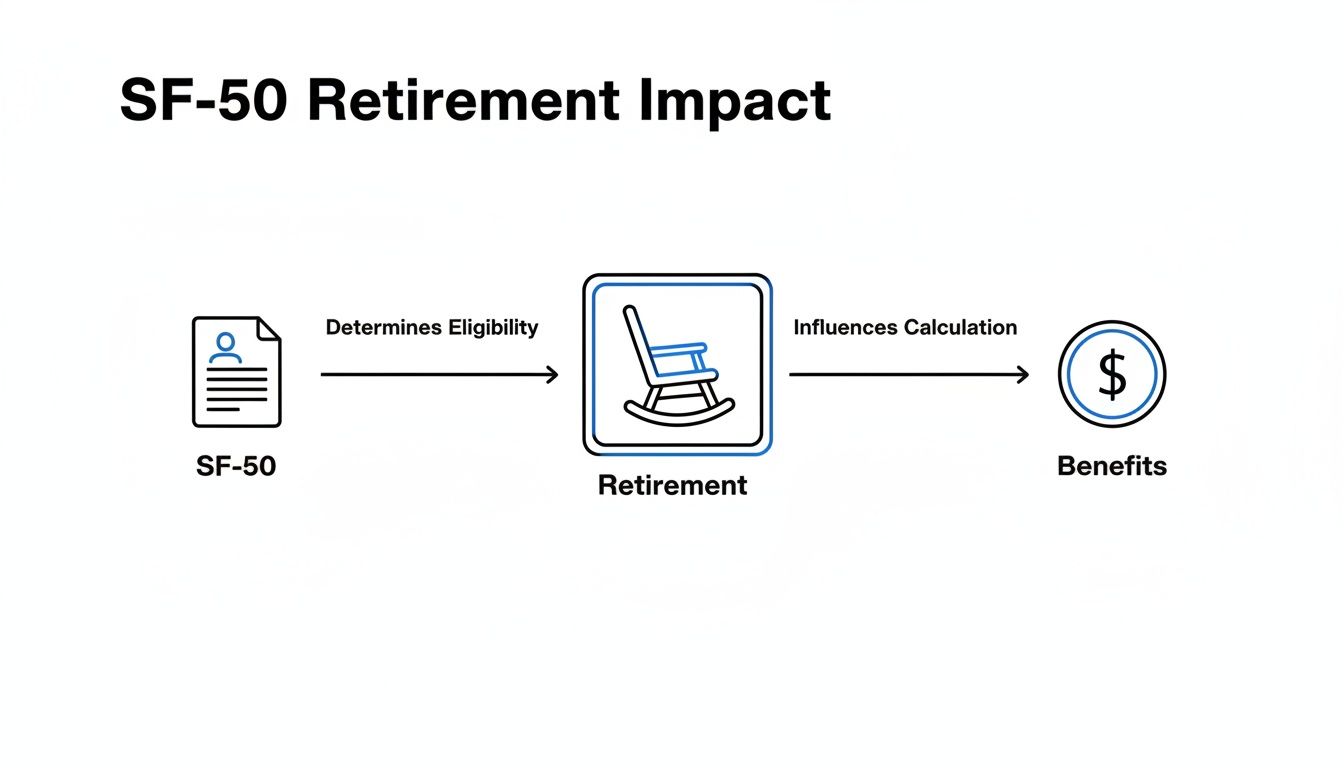
As you can see, the SF-50 isn't just a piece of paper; it's the foundational document that validates your entire service history, which is then used to determine if you're eligible to retire and how much you'll receive.
To make this even clearer, here’s a table breaking down the most important blocks and what they mean for you.
Critical SF-50 Blocks and Their Impact on Your Benefits
This table highlights the blocks on the SF-50 that have the biggest impact on your career, benefits, and retirement. Think of it as your cheat sheet for understanding what really matters.
| Block Number & Name | What It Means | Why It's Critical for You |
|---|---|---|
| Block 12: Salary/Pay Rate | Your official annual salary at the time the action was processed. | This is the primary input for your "high-3" average salary, which is the foundation of your FERS or CSRS pension calculation. |
| Block 24: Tenure | Your employment status (e.g., career, career-conditional, temporary). | Determines your job security, appeal rights, and eligibility for certain benefits. Reaching 'career' status is a key goal. |
| Block 30: Retirement Plan | Indicates your retirement system (FERS, FERS-RAE, FERS-FRAE, CSRS, etc.). | A mistake here could mean you're contributing to the wrong system, jeopardizing your entire retirement. Always verify it. |
| Block 31: Service Comp. Date | The official start date for calculating your creditable service for retirement. | This single date determines your retirement eligibility timeline. It's the most important date for long-term planning. |
| Block 34: Position Occupied | Specifies if your position is in the competitive, excepted, or Senior Executive Service. | Affects hiring, promotion, and firing rules. It defines the set of civil service laws that apply to your employment. |
| Block 36: FEGLI | Shows your enrollment status in the Federal Employees' Group Life Insurance program. | Confirms your life insurance coverage. You must be enrolled for the 5 years before retirement to keep it in retirement. |
| Block 37: FEHB | Shows your enrollment in the Federal Employees Health Benefits program. | Confirms your health insurance coverage. Like FEGLI, you need 5 years of continuous coverage to carry it into retirement. |
Paying close attention to these specific blocks on every SF-50 you receive can help you catch errors early and ensure your federal record accurately reflects your hard-earned career history.
Nature of Action and Remarks
The bottom half of the SF-50 gets into the why. It explains what specific event triggered the creation of this document.
Block 5 (Nature of Action) gives you a code and a plain-language description of the personnel event, like "Promotion," "Appointment," or "Resignation." This is the headline of the story for that particular SF-50.
Finally, always check Block 45 (Remarks). This is where HR specialists add important context that doesn't fit neatly into another box. You might find notes here about pay retention, a specific hiring authority used, or other details that clarify the action. The remarks can contain critical information, so never skip them.
By regularly reviewing these key areas, you can be confident that your official service record is accurate, protecting the benefits you’ve worked so hard to earn.
2. Career Milestones That Generate a New SF-50
Your federal career isn't just one long stretch of time; it's a series of distinct events, and nearly every single one is documented with a new SF-50. Think of these forms as the official chapters in your professional story, creating a detailed and legally binding record of your journey. Many feds are surprised by just how many SF-50s they rack up over a 20 or 30-year career.
Knowing what triggers a new form helps you know when to check your electronic Official Personnel Folder (eOPF). It’s all about being proactive. This way, you can make sure every step, from your first day to your last, is captured correctly.
Starting Out and Moving Up
Your very first day on the job kicks off with an Appointment action, generating your foundational SF-50. This is the cornerstone of your entire federal record. From there, every step forward gets its own paper trail.
A Promotion to a higher grade or even a simple within-grade pay increase will each spit out a new SF-50. These documents are what make your new salary and position official.
Here's a look at some of the most common actions you'll see early on:
- Appointment: This marks your official entry into the federal workforce.
- Promotion: This documents your move to a higher grade level with bigger responsibilities and, of course, better pay.
- Reassignment: This covers a lateral move to a different job at the same grade and pay, maybe in a new office or even a new agency.
- Pay Adjustment: This reflects routine changes like the annual cost-of-living adjustment or other pay changes.
To give you a better idea of how these events translate onto the form, we've put together a quick reference table. It connects common career events to the specific codes you'll find on your SF-50.
Key Events in Your Federal Career and Their SF-50 Codes
| Career Event | Example Action | Typical NOAC |
|---|---|---|
| Hiring | You're hired for your first federal job. | 101 |
| Promotion | You move from a GS-12 to a GS-13 position. | 702 |
| Reassignment | You move from an analyst role to a program manager role at the same grade. | 721 |
| Pay Change | You receive the annual federal pay raise. | 894 |
| Tenure Change | You complete your 3-year probationary period. | 570 |
| Resignation | You leave federal service for a private sector job. | 317 |
| Retirement | You officially retire after 30 years of service. | 302 |
This is just a small sample, but it shows how your personnel file is built one action—and one SF-50—at a time.
Big Changes in Your Employment Status
One of the most important milestones you’ll hit is the Conversion to Career Tenure. This isn't just paperwork; it’s a fundamental shift in your job security and rights.
The tenure code in Block 24 of your SF-50 is a big deal for the roughly 2.3 million federal workers out there. A '1' means you are a career employee with at least three years of service, while a '2' marks you as a career-conditional employee still in your first three years. You can learn more about federal employment service on the official USAJOBS help page.
Your tenure status is not just an administrative detail; it's a critical indicator of your standing within the federal system. Achieving career status, documented by a new SF-50, provides you with full employment protections and appeal rights.
Finally, when it’s time to hang it up, a last set of actions closes out your record. A Resignation generates an SF-50 that officially marks your departure. But the one most people look forward to is Retirement. This creates the final SF-50 of your career, locking in your service history so OPM can calculate that well-earned annuity.
How to Access and Safeguard Your SF-50s

Knowing how to read an SF-50 is one thing, but knowing where to find and protect these documents is just as important. Think of your collection of SF-50s as the official scrapbook of your federal career—it's the absolute proof of your service. Having them handy is crucial for smart career moves and, eventually, a smooth transition into retirement.
For most current federal employees, these records are stored in your electronic Official Personnel Folder (eOPF). Your agency maintains this digital file for you, and it's usually accessible right from your internal employee portal.
Finding Your Official Records
If you're still on the job, grabbing a copy of your SF-50 is typically just a few clicks away. You’ll log into your agency's secure employee self-service system and find the link to your eOPF. From there, you can view and download every single SF-50 you've ever been issued. The exact name of the system might differ between agencies, but the destination is always the same.
Things change once you've left federal service. Your records don't just disappear; they get transferred. After a period of time, your entire personnel file is sent to the National Archives and Records Administration (NARA). To get copies, you'll need to file a request directly with the National Archives.
The Importance of Personal Backups
Here’s a piece of advice I give every federal employee: don't rely solely on your agency's eOPF. The single best habit you can develop is to personally download and save a copy of every new SF-50 the moment it’s generated.
Treat these documents like you would the deed to your house or your birth certificate. They are that important.
Your personal SF-50 file is your ultimate backup. It ensures you always have a complete, verified record of your service, which is invaluable for resolving discrepancies, applying for other federal jobs, and planning your retirement with confidence.
Set up a specific folder on your computer for them. For an extra layer of security, back them up to a secure cloud service or a separate external hard drive. This simple, proactive step puts you in the driver's seat of your own career history.
Taking Charge of Your Federal Retirement Plan
Alright, now that you've got a handle on the power packed into your SF-50, it's time to make that knowledge work for you. Think of this guide as your map—it shows you how to read your career records with confidence. But the real journey begins when you translate that information into a solid retirement strategy.
Your first move? Go find your SF-50s and give them a good, hard look. Use what you've learned here to scan them for accuracy. Do the service dates line up with your memory? Does anything about your service history raise a question about your pension eligibility?
This is where you shift from just being a collector of government forms to becoming the architect of your own future. The goal is to make absolutely certain your years of public service are counted correctly so you get the rewards you've earned.
Turning Records Into a Retirement Roadmap
Think of your SF-50s as the official blueprint for your financial future. Each form is a snapshot that confirms your salary history, which is the bedrock for calculating your pension and has influenced your Thrift Savings Plan (TSP) contributions over the years.
Speaking of the TSP, if you're looking to get the most out of it, our guide to smart federal savings is a great next step. Remember, the small details on those forms really do matter. Getting them right is the first and most important step toward a retirement you can actually relax in.
Your SF-50 Questions, Answered
Even after you get the hang of what an SF-50 is, a few specific questions always seem to pop up. Let's tackle some of the most common ones we hear from federal employees just like you.
What Should I Do If I Find an Error on My SF-50?
Finding a mistake on your SF-50—whether it’s a wrong Service Computation Date, a misspelled name, or an incorrect grade—can be unnerving, but it’s usually fixable if you act fast.
The moment you spot an error, get in touch with your agency's Human Resources office. You'll likely need to provide some documentation to prove the correct information, and from there, your HR specialist will kick off the process to issue a corrected SF-50. Make sure you hang onto copies of both the incorrect form and the new, corrected version for your own records.
How Often Should I Check My SF-50?
Think of it this way: every time you experience a career event, you should expect an SF-50. That means promotions, within-grade increases, or any change to your job series or title. Get in the habit of reviewing the new SF-50 as soon as it hits your eOPF.
This simple habit helps you catch small mistakes before they snowball into big headaches later on. Beyond that, it's smart to do a thorough review of your entire eOPF at least once a year, just to make sure everything is in order and your employment history is accurately documented.
Taking a few minutes to review your SF-50s as they come in is one of the most powerful things you can do to safeguard your career and your retirement. A tiny error you catch today can save you from a massive, complicated problem when it's time to file your retirement papers.
Is My Final SF-50 the Only One That Matters for Retirement?
This is a dangerous and widespread myth. While your final SF-50 (the one showing your separation from service) is critical, it's far from the only one that matters. The Office of Personnel Management (OPM) will look at your entire history of SF-50s to calculate your annuity.
Each SF-50 is a chapter in your federal career story. They prove your total creditable service, especially if you’ve had breaks in service, worked part-time schedules, or bought back military time. For your retirement to be calculated correctly and processed smoothly, every single SF-50 needs to be accurate.
Getting a handle on your SF-50 is a huge step toward a secure federal retirement. At Federal Benefits Sherpa, we can help you navigate the rest of your journey. We offer a free 15-minute benefit review to help ensure your years of dedicated service are properly rewarded. Take control of your future by visiting us at https://www.federalbenefitssherpa.com today.
