The federal employee benefits handbook: A quick, clear guide
You’ve probably searched for the official "federal employee benefits handbook" at some point, only to find it doesn't really exist as a single, neat-and-tidy book. The information is out there, but it's scattered across different U.S. Office of Personnel Management (OPM) websites, dense pamphlets, and official guides.
That’s why we created this guide. We’ve done the legwork of gathering all that crucial information and putting it into one place, translating the government-speak into plain English. Consider this your personal roadmap for making sense of it all.
Your Personal Roadmap to Federal Benefits
Welcome! Think of this guide as a conversation with a seasoned expert who can walk you through your entire federal benefits package. We're not just going to throw a bunch of acronyms at you. Instead, we'll give you a strategic tour of every major decision you'll face, turning complex rules into practical steps you can take right now.
Our whole approach is about building your confidence one piece at a time. We'll start with the basics and work our way up, so you feel empowered, not overwhelmed. You'll see how the different parts of your compensation fit together to support you, from your first day on the job all the way through your retirement years.
What This Guide Covers
We’ll begin with the big ones—the benefits that form the foundation of your long-term financial security. After that, we’ll dive into the plans that protect you and your family’s health and well-being.
This step-by-step method makes sure you have a solid grasp of one concept before moving on to the next. By the end, you'll have a crystal-clear picture of:
Your Retirement Systems: We'll break down the Federal Employees Retirement System (FERS) and its three powerful parts: your pension, Social Security, and the incredible Thrift Savings Plan (TSP).
Your Investment Strategy: You'll discover how to get the most out of your Thrift Savings Plan by making smart fund choices and contribution decisions.
Health and Insurance: We’ll give you straightforward advice for picking the right health (FEHB) and life (FEGLI) insurance plans when Open Season rolls around.
All the Extras: You’ll also learn about other great perks, like dental and vision insurance (FEDVIP) and Flexible Spending Accounts (FSAs).
Seeing how all these pieces connect is the key to building a retirement you can actually look forward to. Each benefit is a tool in your financial toolkit, and this guide will show you exactly how to use each one to build the future you want.
We've put together a quick-reference table to give you a bird's-eye view of the main programs we'll be discussing.
Key Federal Benefit Programs at a Glance
Benefit ProgramPrimary PurposeKey Takeaway for EmployeesFERS/CSRSProvides a defined-benefit pension for a steady, lifelong income stream in retirement.This is the bedrock of your retirement income, calculated based on your salary and years of service.Thrift Savings Plan (TSP)A 401(k)-style investment plan allowing you to save and invest for retirement with tax advantages.Your active participation here is crucial; it's your biggest tool for wealth-building.Social SecurityOffers a supplemental source of retirement, disability, and survivor benefits.It's one of the three legs of the FERS retirement stool, working alongside your pension and TSP.FEHB ProgramProvides comprehensive health insurance options for you and your family.Choosing the right plan during Open Season can save you thousands each year.FEGLI ProgramOffers group term life insurance to protect your family financially.Basic coverage is automatic for many, but you can add more to fit your needs.FEDVIP ProgramA voluntary program for supplemental dental and vision insurance.Fills the gaps left by most health insurance plans for routine and major care.
This table is just a starting point. Now, let's dive into the details of each of these powerful benefits.
Building Your Retirement Foundation with FERS
If you started your federal career anytime after 1983, your retirement plan is built on a robust system called the Federal Employees Retirement System (FERS). I like to think of FERS as a three-legged stool—it's not just one account but a balanced combination designed to keep you steady and secure in retirement. Each leg provides a different stream of income, and understanding how they work together is your first step toward financial peace of mind.
This structure wasn’t an accident; it was designed for resilience. The FERS system, rolled out back in 1987, was created to provide a complete package of retirement, disability, and survivor benefits. Today, it supports roughly 2 million federal employees and retirees by blending a traditional pension with Social Security and a 401(k)-style investment plan. The Bureau of Labor Statistics offers some great background on how this foundational system came to be.
All the nitty-gritty details on enrollment and eligibility are covered in what many of us consider the unofficial federal employee benefits handbook—a collection of resources to guide you.
The Three Legs of Your FERS Retirement Stool
To really get a handle on FERS, you need to know about its three core parts. Each one plays a unique role, and when combined, they create a diversified income stream that helps protect you from the ups and downs of the market.
FERS Basic Benefit (Annuity): This is your pension. It's a defined-benefit plan that guarantees you a set monthly payment for life once you retire. Think of this as the most stable leg of the stool, providing a predictable income you can count on, no matter what.
Social Security: As a FERS employee, you pay into Social Security just like your private-sector friends. This means you’re earning benefits for retirement, disability, and survivors from the Social Security Administration. This forms the second leg of your support system.
Thrift Savings Plan (TSP): This is the third and most flexible leg. The TSP is your government version of a 401(k), where you and your agency contribute to a retirement savings and investment account. The growth of this leg is largely in your hands.
This simple diagram helps visualize how your core benefits fit together, showing where retirement, health, and insurance programs all connect.
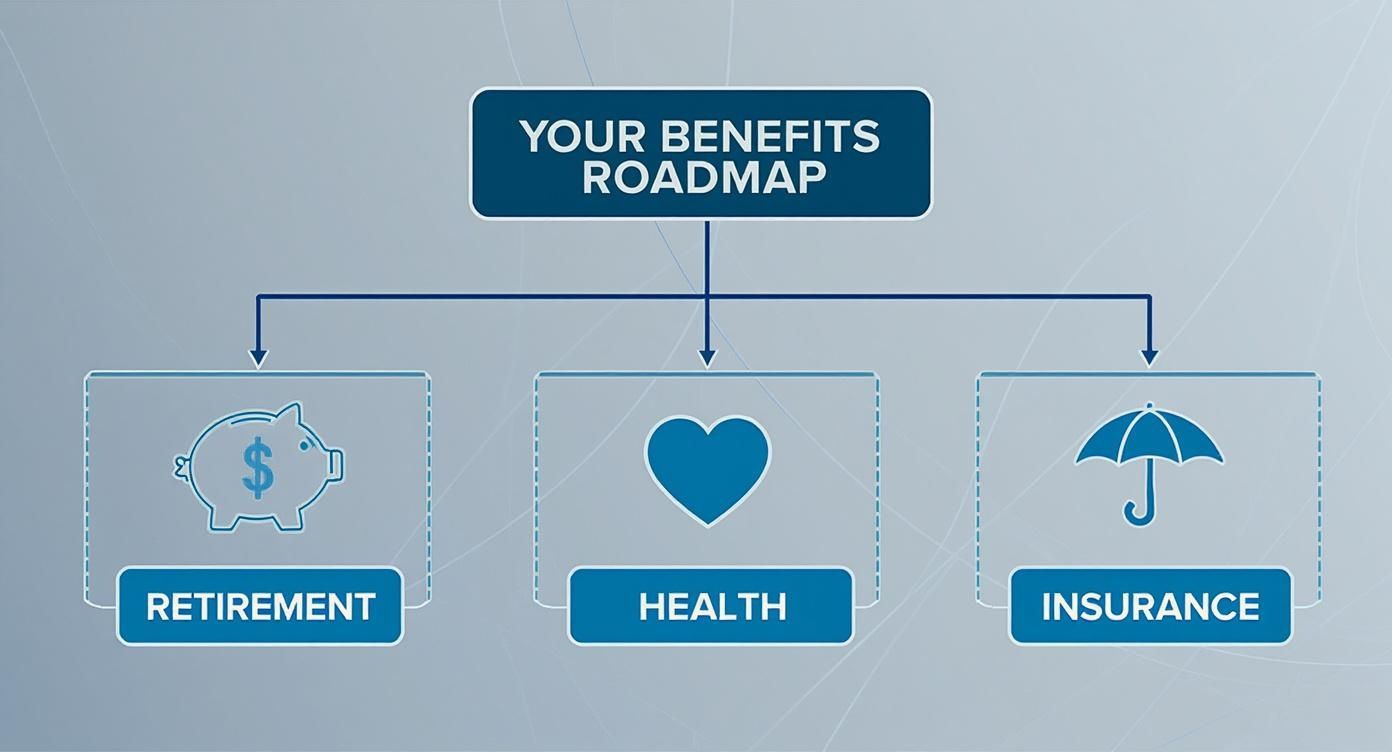
As you can see, retirement is just one piece of a much larger puzzle. It reinforces why you need to understand how every benefit supports your overall financial well-being.
How Your FERS Pension Is Calculated
While Social Security and your TSP can have a lot of variables, your FERS pension—that annuity—is calculated with a precise formula. Its predictability is its greatest strength. The calculation is surprisingly straightforward and comes down to just three numbers.
Your Pension Formula: High-3 Average Salary x Years of Service x Pension Multiplier = Annual Pension
Let's quickly break down what those terms mean:
High-3 Average Salary: This is the average of your highest basic pay during any 36-consecutive-month period of your service. For most federal employees, this will simply be their last three years on the job.
Years of Service: Pretty self-explanatory—it’s your total time in creditable federal service.
Pension Multiplier: This is usually 1%. But there's a nice little bonus: if you retire at age 62 or older with at least 20 years of service, the multiplier gets bumped up to 1.1%. That’s an instant 10% boost to your pension for life.
A Real-World Pension Example
Let’s put this into practice with a real-world scenario. Imagine a federal employee named Alex. He decides to retire at age 62 after putting in 30 years of service. His high-3 average salary is $90,000.
Because he’s retiring at 62 with well over 20 years in, he gets to use that better 1.1% multiplier.
Here’s how we’d run the numbers for his annual pension:
$90,000 (High-3 Salary) x 30 (Years of Service) x 1.1% (Multiplier) = $29,700 per year
That works out to a guaranteed $2,475 every month for the rest of his life. When you combine that stable income with his Social Security checks and what he pulls from his TSP, you can see how FERS was designed to create a secure, multi-layered retirement.
Maximizing Your Growth with the Thrift Savings Plan

While your FERS pension provides a steady, predictable income stream, the Thrift Savings Plan (TSP) is where you really get to take the driver’s seat. Think of the TSP as the federal government's version of a 401(k)—and it's arguably the most powerful wealth-building tool in your entire benefits package. Your active participation is what turns it from a simple savings account into a retirement powerhouse.
One of the best parts? The "free money" your agency kicks in. For FERS employees, your agency automatically contributes an amount equal to 1% of your basic pay each period. This happens whether you contribute a single dollar yourself or not. It's a foundational piece of your retirement savings that requires zero effort on your part.
But the real magic begins when you start contributing from your own paycheck. Your agency will match your contributions dollar-for-dollar on the first 3% you put in. They'll then match 50 cents on the dollar for the next 2% you contribute. So, to get the full 5% agency match, you need to contribute at least 5% of your own pay.
Failing to contribute at least 5% to your TSP is like turning down a 100% return on your investment instantly. It's the single most important step you can take to accelerate your retirement savings from day one.
Understanding Your TSP Investment Options
Think of the TSP funds as ingredients you can use to cook up your ideal retirement portfolio. You can either pick your own ingredients for a custom mix or choose a pre-made meal that handles all the complicated cooking for you. The individual funds give you control, while the Lifecycle funds offer set-it-and-forget-it convenience.
Here are the core individual funds you can choose from:
G Fund (Government Securities): This is the safest bet. It invests in unique U.S. Treasury securities that are guaranteed never to lose value. It offers the lowest risk but, as you'd expect, also the lowest potential for growth.
F Fund (Fixed Income): This is a bond fund tracking a mix of U.S. government, corporate, and mortgage-backed bonds. It carries a bit more risk than the G Fund but offers higher potential returns.
C Fund (Common Stock): This fund mirrors the S&P 500 index, meaning you're invested in 500 of the largest U.S. companies. It comes with high growth potential but also significant market risk.
S Fund (Small Cap Stock): This fund tracks small-to-medium-sized U.S. companies that aren't in the S&P 500. It's generally more volatile than the C Fund but can offer even higher returns over the long haul.
I Fund (International Stock): Looking for global exposure? This fund invests in stocks from more than 20 developed countries outside the U.S., adding valuable international diversification to your portfolio.
For those who'd rather not play portfolio manager, the Lifecycle (L) Funds are a fantastic choice. These are essentially pre-mixed portfolios that automatically adjust their blend of the five core funds over time. They start out aggressive (heavy on stocks) when you're far from retirement and gradually shift to be more conservative (heavy on bonds and the G Fund) as you get closer to your target retirement date.
Traditional vs. Roth TSP: Which Is Right for You?
When you contribute to your TSP, you have a critical choice to make: Traditional or Roth? Your decision boils down to one thing: when you want to pay taxes. Neither option is universally "better"—the right one for you depends entirely on your personal finances and what you think your tax situation will look like in the future.
With a Traditional TSP, your contributions are made with pre-tax dollars. This is great for your budget today, as it lowers your current taxable income and reduces your annual tax bill. The catch is that when you withdraw the money in retirement, both your contributions and all their earnings will be taxed as ordinary income.
On the other hand, a Roth TSP uses after-tax dollars. You don't get an immediate tax break, but the payoff comes later. In retirement, all your qualified withdrawals—both your original contributions and decades of growth—are 100% tax-free.
Let’s put them side-by-side:
FeatureTraditional TSPRoth TSPContributionsPre-tax dollarsAfter-tax dollarsTax Impact NowLowers your current taxable incomeNo immediate tax deductionTax Impact in RetirementWithdrawals are taxed as incomeQualified withdrawals are tax-freeBest ForEmployees who think they'll be in a lower tax bracket in retirement.Employees who think they'll be in a higher tax bracket in retirement.
Figuring this out is a core part of any strategy you’d find in a good federal employee benefits handbook. You don't have to choose just one, either. You can split your contributions between Traditional and Roth, giving you tax diversification and the flexibility to pull from either a taxable or tax-free account in retirement.
Choosing Your Health and Life Insurance with Confidence

Diving into the annual Open Season for health insurance can feel like trying to navigate a dense fog. The sheer number of choices in the Federal Employees Health Benefits (FEHB) Program is enough to make anyone’s head spin. But breaking it down is the key to making a smart, cost-effective decision you can feel good about.
Think of it like choosing a car. An HMO is like a reliable sedan for city driving—predictable costs and a set network of routes. A PPO is more like an SUV built for off-roading, giving you the flexibility to go anywhere, but with potentially higher fuel costs. The right choice really comes down to your personal journey: your health needs, your family, and your budget. This section of our federal employee benefits handbook is designed to be your GPS.
The FEHB program is huge, covering roughly 8.2 million federal employees, retirees, and their families. As you weigh your options, keep an eye on the rising costs. Premiums are projected to jump by an average of 13.5% in 2025, following increases of 7.7% in 2024 and 8.7% in 2023. On the bright side, benefits are also expanding, with better coverage for services like IVF and mental health support. You can discover more insights about these FEHB Open Season changes and what they mean for you.
Decoding the Different FEHB Plan Types
When you get right down to it, your decision revolves around a few main types of health plans. Each one strikes a different balance between cost, flexibility, and how you access care. Let's look at the most common options you'll encounter.
Comparing FEHB Plan Types
To simplify things, here’s a quick breakdown of how the major plan types work and who they’re generally best for.
Plan TypeHow It WorksBest For Employees Who...HMO (Health Maintenance Organization)You use in-network doctors and hospitals and need a referral from your Primary Care Physician (PCP) to see a specialist....want lower premiums and predictable costs, and don't mind staying within a specific provider network.PPO (Preferred Provider Organization)You have the freedom to see both in-network and out-of-network doctors without a referral, but your costs are much lower if you stay in-network....want more flexibility to choose their doctors and specialists and are willing to pay higher premiums for that freedom.HDHP (High-Deductible Health Plan)This plan is paired with a Health Savings Account (HSA). You pay more upfront until you meet the high deductible, but you can save for medical costs tax-free in your HSA....are generally healthy, want lower monthly premiums, and are looking for a tax-advantaged way to save for future healthcare expenses.
Seeing them side-by-side really helps clarify the trade-offs between cost and freedom.
HDHPs are a particularly interesting option because of the Health Savings Account (HSA) they come with. Many federal agencies even kick in a contribution to your HSA, giving you a head start on your savings.
Think of an HSA as a "medical 401(k)." The money you put in is tax-deductible, it grows tax-free, and any withdrawals for qualified medical expenses are also completely tax-free. Best of all, the funds roll over every year, making it an incredible tool for both current health costs and future retirement planning.
Securing Your Family’s Future with FEGLI
Your benefits package isn't just about your health today; it's also about providing a crucial safety net for your loved ones tomorrow. That's where the Federal Employees' Group Life Insurance (FEGLI) program comes in. As the largest group life insurance program in the world, it offers an accessible and affordable way to get essential protection.
It all starts with Basic Insurance. As an eligible employee, you are automatically enrolled unless you go out of your way to waive it. The coverage amount is your annual basic salary, rounded up to the next $1,000, plus an extra $2,000. For example, if your salary is $85,500, your Basic coverage would be $88,000 ($86,000 + $2,000).
This is a solid foundation, but you can build on it with additional layers of protection.
Customizing Your Life Insurance with Optional Coverage
FEGLI gives you the power to increase your coverage through three optional plans. Unlike Basic insurance, these aren't automatic—you have to elect them.
Option A (Standard): This adds a straightforward $10,000 of coverage. It’s a simple, low-cost way to give your policy a little boost.
Option B (Additional): This is where you can really add significant protection. You can choose an amount equal to one, two, three, four, or even five times your annual basic pay. This is a must-consider for primary breadwinners or anyone with big financial responsibilities like a mortgage or kids' college funds.
Option C (Family): This option provides coverage for your spouse and eligible dependent children. You can select up to five "multiples," where each multiple gives $5,000 for your spouse and $2,500 for each eligible child.
Choosing the right mix of FEHB and FEGLI is deeply personal, but it's one of the most important financial decisions you'll make as a federal employee. By understanding how these plans are designed to work, you can build a strong foundation of protection for yourself and your family with real confidence.
Exploring Your Other Valuable Federal Benefits
When we talk about federal benefits, the big three—your pension, TSP, and health insurance—usually steal the show. But if you stop there, you’re leaving a ton of value on the table. Think of those as the foundation of your financial house; the other benefits are the wiring, plumbing, and insulation that make it a comfortable, secure place to live.
These aren't just minor perks. They're powerful tools designed to protect your family’s well-being and keep more money in your pocket. Let's dig into the benefits that often get overlooked but can make a huge difference over your career.
Seeing Clearly with FEDVIP
Your main FEHB health plan is a lifesaver for major medical issues, but it can be surprisingly thin on routine dental and vision coverage. That’s where the Federal Employees Dental and Vision Insurance Program (FEDVIP) comes in. It’s a separate, voluntary program you enroll in during Open Season, and it’s a must-have for most families.
FEDVIP gives you a marketplace of plans from top-tier national and regional insurance carriers, so you can pick what works for you.
Dental Plans: Coverage isn't just for cleanings. These plans help pay for fillings, crowns, root canals, and even orthodontics for your kids.
Vision Plans: This is your ticket to affordable eye exams, glasses, and contacts. The savings on a new pair of frames and lenses alone can often pay for the premiums.
Just remember, choosing your FEDVIP plan is a totally separate step from your FEHB election. You have to sign up for them individually each year.
Saving Money with Flexible Spending Accounts
Here’s one of the smartest ways to lower your tax bill: a Flexible Spending Account (FSA). An FSA lets you divert money from your paycheck before taxes are taken out and use it for specific, predictable expenses. It’s like getting a discount on things you were going to buy anyway.
Federal employees have access to three types of FSAs:
Health Care FSA (HCFSA): Perfect for covering your out-of-pocket medical costs. Think copays, deductibles, prescription drugs, and even dental or vision bills your insurance doesn't fully cover.
Limited Expense Health Care FSA (LEX HCFSA): If you have a high-deductible health plan (HDHP), this is your option. It’s restricted to eligible dental and vision expenses to keep you compatible with a Health Savings Account (HSA).
Dependent Care FSA (DCFSA): A lifesaver for working parents. Use this to pay for childcare for kids under 13 or care for another dependent who can't care for themselves.
The real magic of an FSA is the instant tax savings. When you use pre-tax dollars, you’re reducing your taxable income, which means less money for Uncle Sam and more for you.
Understanding Your Paid Leave Benefits
Finally, don't ever underestimate the value of your paid leave. It’s a core component of your total compensation and essential for a healthy work-life balance. As a federal employee, you earn both annual leave (for vacation and personal time) and sick leave.
Your annual leave accrual rate actually gets better the longer you stay, rewarding your service. And every full-time employee earns 13 days of sick leave a year. Better yet, there's no limit to how much sick leave you can accumulate, and that unused balance can be added to your years of service when you retire, potentially boosting your FERS pension.
On top of that, the Family and Medical Leave Act (FMLA) now provides paid parental leave, giving you crucial time with your family after the birth, adoption, or foster placement of a child.
Your Top Questions About Federal Benefits, Answered
Let's face it, the world of federal benefits can get complicated, especially when life throws you a curveball. This is where we tackle the practical, real-world questions that pop up when you're not in the middle of Open Season but are facing a big decision.
Think of this as your go-to guide for those "what if" moments. Getting these answers right is the key to moving forward with confidence.
What Happens If I Leave Federal Service Before I Can Retire?
This is probably one of the most common questions I hear. If you leave your federal job before you’re eligible to retire, you don't just forfeit everything you've worked for. What you can take with you really boils down to how long you've been in the system.
Your TSP Account: Your Thrift Savings Plan is your money, period. You can leave it right where it is to keep growing, roll it over into an IRA or a new employer's 401(k), or cash it out (though be ready for a hefty tax bill if you do).
Your FERS Pension: If you've put in at least 5 years of creditable civilian service, you're officially "vested." That means you've earned a deferred annuity—a pension you can start collecting later, usually at age 62.
Health and Life Insurance: This is where it gets tricky. Your FEHB and FEGLI coverage ends soon after you leave. You'll likely be offered a Temporary Continuation of Coverage (TCC) for health insurance or the option to convert your life insurance to a private policy, but both of these routes are notoriously expensive.
How Do I Update My Beneficiaries the Right Way?
This is a critically important piece of financial housekeeping that, frankly, too many feds put off. You have to understand that your benefits are all separate buckets—updating one does not automatically update the others.
For your Thrift Savings Plan (TSP), you have to log into your account on the TSP's website and make the change electronically. That’s the only way to control who gets your TSP nest egg.
But for your FERS death benefits and any unpaid salary, you’ll be dealing with good old-fashioned forms. You need to fill out specific PDFs like the SF 2823 (for FERS) and the SF 1152 (for unpaid compensation) and get them to your agency's HR office.
Crucial Takeaway: Please don't assume that updating your TSP beneficiary also takes care of your pension or final paycheck. Each program has its own set of paperwork, and failing to update each one can create a nightmare for the people you love.
Can I Change My Health Plan Outside of Open Season?
While Open Season gets all the attention, certain major life changes give you a special pass to adjust your health coverage mid-year. These are officially called Qualifying Life Events (QLEs).
A QLE opens up a special enrollment window, which typically lasts for 60 days from the date of the event, allowing you to switch your FEHB plan. The most common QLEs are things like:
Getting married or divorced
Having a baby or adopting a child
Your spouse losing their separate health insurance
Moving to a new area where your current plan isn't offered
If you have a QLE, you need to get in touch with your HR office right away to get the ball rolling.
How Do I Decide Between the Roth TSP and Traditional TSP?
Is the Roth TSP automatically better for everyone? Not at all. The "right" choice really comes down to one simple question: do you think your tax rate will be higher now, or will it be higher when you’re retired?
The Traditional TSP gives you your tax break today. Your contributions are pre-tax, which lowers your current taxable income. The trade-off is that every dollar you withdraw in retirement gets taxed as income. This usually makes sense for people who expect to be in a lower tax bracket once they stop working.
On the flip side, the Roth TSP works with after-tax dollars, so you don't get that immediate tax deduction. But here's the magic: all of your qualified withdrawals in retirement—including all the investment earnings you've built up over decades—are 100% tax-free. This is a powerful tool for anyone who thinks their income (and thus their tax bracket) will be higher down the road.
Figuring all this out can feel overwhelming, but you're not in it alone. At Federal Benefits Sherpa, we help federal employees demystify their benefits so they can build a retirement they can count on. Book your free 15-minute benefit review to get clear, personalized guidance and make sure you're heading in the right direction. Find out more at https://www.federalbenefitssherpa.com.
