How to use tsp: A Guide to Smart Federal Savings
Getting the most out of your Thrift Savings Plan (TSP) really boils down to a few simple, powerful actions. You need to contribute at least 5% to snag the full government match, pick an investment mix that makes sense for your stage in life, and check in on your account regularly. If you nail these three things from the start, you’ll be tapping into one of the best retirement tools out there.
Your First Steps with the Thrift Savings Plan
Welcome to the TSP. As a federal employee, you've just been handed the keys to a retirement plan that often puts private-sector 401(k)s to shame, mainly because of its super-low fees and a fantastic employer match. This isn't just another benefit; it's the bedrock of your financial future.
When you begin your federal career under the Federal Employees Retirement System (FERS), the good news is you're already in. The government automatically enrolls you and starts putting 1% of your basic pay into your account. That happens whether you contribute a single penny or not.
But the real magic begins when you start contributing yourself.
Securing Your Full Government Match
Here's the most critical piece of advice for anyone new to the TSP: contribute at least 5% of your basic pay every single paycheck. The moment you do, your agency's contribution jumps to a full 5% to match you (that’s the 1% they give you automatically plus another 4% in matching funds).
Think about that for a second. It's a 100% return on your investment right off the bat, before your money has even had a chance to grow in the market. If you contribute less than 5%, you are literally turning down free money. Don't do it.
Key Takeaway: The single most important first step is to ensure you are contributing at least 5% of your pay to the TSP. This simple action doubles your investment instantly and is the fastest way to accelerate your retirement savings.
To give you a sense of scale, the TSP is a financial giant. By June 2025, it managed over $1.006 trillion in assets for more than 7.2 million people, making it the largest defined contribution plan on the planet. The average FERS participant had an account balance of $196,668—a number built on the foundation of consistent contributions and that powerful government match. You can dig deeper into these TSP statistics and their impact to see the long-term potential.
To help you get started, here’s a quick overview of what you need to do and why it’s so important.
TSP Enrollment and Contribution at a Glance
Action ItemKey DetailWhy It MattersAutomatic EnrollmentYour agency automatically contributes 1% of your pay.This is your baseline. It gets you started, but it's not enough for a secure retirement.Set Your ContributionElect to contribute at least 5% of your pay.This unlocks the full government match, instantly doubling your contribution.Choose Your InvestmentsSelect from the Lifecycle (L) Funds or individual funds (G, F, C, S, I).Your investment choice determines your long-term growth potential.Set Up Online AccessCreate your login at TSP.gov as soon as you get your welcome letter.This is your command center for managing everything in your account.
Taking these initial steps sets you up for success and puts your retirement savings on the right track from day one.
Accessing and Managing Your Account Online
Not long after you're hired, a welcome letter will arrive in the mail with instructions for setting up your online TSP account. Don't let that letter sit in a pile of mail—act on it immediately.
Getting your online account set up is your ticket to taking control. From your dashboard, you can:
Check your balance and see how your investments are performing.
Change where your future contributions are invested.
Move money between funds (this is called an interfund transfer).
Keep your contact info current and name your beneficiaries.
Think of your online account as your personal financial cockpit. The sooner you get familiar with the controls, the more confident you'll feel steering your own retirement journey.
How Much Should I Really Be Putting in My TSP?
Alright, you're enrolled in the TSP. That’s a huge first step. Now for the million-dollar question (literally): how much should you actually be saving? The automatic enrollment gets you started, but that's just dipping your toe in the water. To really build a secure retirement, you need to take control and set a contribution rate that works for you.
Let's get one thing straight right away. The absolute, bare-minimum, non-negotiable starting point is 5% of your basic pay. Why? Because that’s what it takes to get the full government match. If you contribute less than 5%, you are actively turning down a 100% return on your investment before your money even has a chance to grow. It's like saying "no thanks" to a pay raise. Don't leave free money on the table.
The Real Magic Happens Beyond the Match
Getting the full match is just table stakes. The real wealth-building power of the TSP kicks in when you push past that initial 5%. The difference between saving 5%, 10%, or even hitting the annual IRS maximum can be absolutely staggering over a long federal career.
Let's put some real numbers to this. Imagine you're a new federal employee making $60,000 a year.
You save 5%: You put in $3,000, and the government matches it with another $3,000. Your total for the year is $6,000. Not bad.
You bump it to 10%: Now you're putting in $6,000. The government match stays at $3,000 (5% of your salary), but your total savings for the year jumps to $9,000.
You get aggressive at 15%: You contribute $9,000, plus the $3,000 match. Suddenly, you're saving $12,000 a year.
That jump from 5% to 10% doesn't sound like much, but over 30 years, the power of compounding can turn that extra $3,000 a year into hundreds of thousands of additional dollars for your retirement. That's the difference between a comfortable retirement and a truly worry-free one.
"Start now. That’s the most powerful thing you can do. It doesn’t have to be a lot; as long as it’s at least 5% of your basic pay, you’ll get the full matching contribution from your agency or service. You can always contribute more, but if you contribute less than 5%, you miss out on the free money."
— Ravi Deo, Executive Director, FRTIB
The Big Question: Traditional or Roth TSP?
Once you've decided how much to save, you need to decide where it goes. This is the classic Traditional versus Roth debate, and it really boils down to one simple question: do you want to pay taxes now or later?
Traditional TSP Contributions:
The deal: Your contributions are pre-tax, which means they lower your taxable income today. You get a nice little tax break right now.
The catch: You'll pay income taxes on everything you withdraw in retirement—both your contributions and all the earnings.
Who it’s for: This is generally a good fit if you think you'll be in a lower tax bracket in retirement than you are during your peak earning years.
Roth TSP Contributions:
The deal: Your contributions are after-tax, so you don't get an immediate tax break.
The catch: When you take qualified withdrawals in retirement, every single penny—your contributions and all the growth—is 100% tax-free.
Who it’s for: This is often the smarter choice if you expect to be in the same or even a higher tax bracket when you retire.
Here’s a pro tip: you don't have to pick just one. Many savvy feds split their contributions between both Traditional and Roth. This gives you tax diversification in retirement, allowing you to pull from different pots of money to manage your taxable income more effectively.
Making Changes to Your Contributions
Ready to up your savings rate or change your allocation? It's surprisingly easy, but you won't do it on the main TSP website.
Instead, you’ll need to log into your agency’s specific payroll system. This could be MyPay, Employee Express, or another platform depending on where you work. Just find the section for your "Thrift Savings Plan" contributions. From there, you can adjust your percentage or dollar amount, and the change will usually take effect on the next pay cycle.
Here's a great habit to get into: every time you get a step increase or a cost-of-living adjustment, bump up your TSP contribution by 1%. You'll barely notice the difference in your take-home pay, but your future self will be incredibly grateful.
Allocating Your Money Across TSP Funds
Figuring out how much to save is the first big step. The next, and arguably more important decision, is telling that money where to go. How you allocate your contributions across the different TSP funds will have the biggest impact on your long-term growth. This is where you shift from just stashing cash to actually investing it.
The TSP keeps things relatively simple with five core individual funds, along with the Lifecycle (L) Funds, which we’ll get to in a bit. Getting a handle on what these core funds are all about is crucial for building a strategy that fits your goals and, just as importantly, your comfort level with risk.
The Five Core TSP Funds Explained
Think of these funds as the essential tools in your financial toolkit. Each one has a very specific job to do.
To help you get a quick sense of what each fund does, here's a simple breakdown:
TSP Core Fund Comparison
Fund NameWhat It Invests InRisk LevelBest ForG FundSpecial U.S. Treasury securitiesLowestCapital preservation; a safe harbor for your money.F FundU.S. government, corporate, & mortgage bondsLow to ModerateBeating inflation with more stability than stocks.C FundStocks of the 500 largest U.S. companies (S&P 500)HighAggressive, long-term growth from established U.S. firms.S FundSmall and mid-sized U.S. company stocksHighestMaximum long-term growth potential from emerging companies.I FundStocks from 40+ international countriesHighDiversifying outside the U.S. and capturing global growth.
Each fund gives you a piece of a different puzzle. The G Fund is your anchor—it’s guaranteed by the government and will never lose principal. The C, S, and I funds, on the other hand, are your growth engines, investing in stocks both at home and abroad. The F Fund sits somewhere in the middle, offering a blend of safety and modest returns through bonds.
Building an Allocation That Fits You
So, what's the right mix? Honestly, there’s no magic formula. Your ideal allocation really boils down to your age, how long you have until retirement, and your personal stomach for risk.
If you're in your 20s or 30s, you have decades to ride out market waves, so you can afford to take on more risk for higher potential returns. But if you're eyeing retirement in the next few years, your focus will naturally shift toward protecting the nest egg you've worked so hard to build.
For instance, a common approach for an early-career federal employee might be an aggressive growth portfolio: something like 45% C Fund, 35% S Fund, 15% I Fund, and just 5% G Fund. As you hit mid-career (ages 40-50), you might dial back the risk a bit, shifting to a more moderate mix like 35% C Fund, 25% S Fund, 10% I Fund, 15% F Fund, and 15% G Fund. You can see more detailed examples in these TSP allocation strategies for 2025 to get a feel for how these models change over time.
This chart really drives home how powerful your contribution choices are over the long haul.
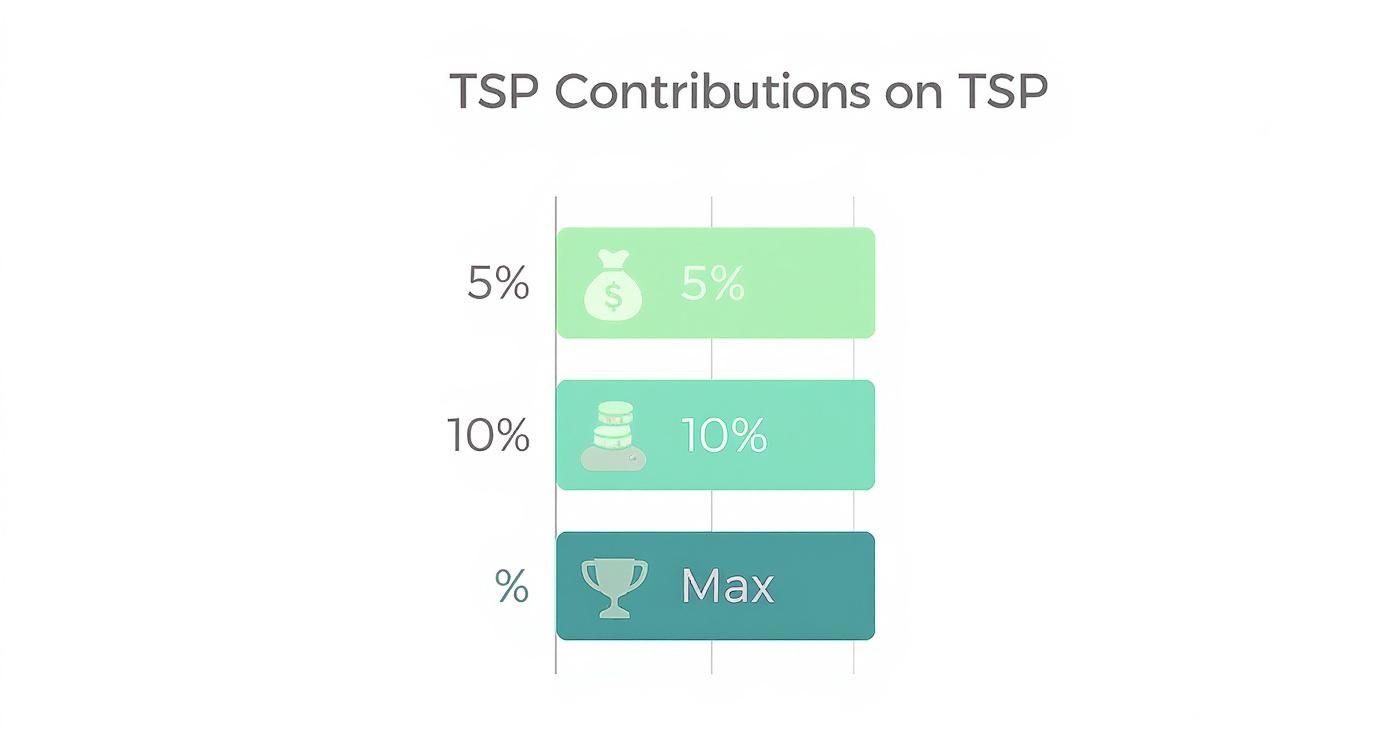
As you can see, pushing beyond that basic 5% match dramatically changes the game for your future savings.
Pro Tip: Don't let the perfect be the enemy of the good. It’s far better to pick a simple, diversified allocation you can stick with than to constantly chase complex strategies or react to every bit of market news. Consistency is your greatest ally in this journey.
The whole point is to build a diversified portfolio. By spreading your money across different asset classes—stocks and bonds, U.S. and international—you can smooth out the ride. Losses in one area are often balanced by gains in another. The goal is to create a mix that lets you sleep at night while still giving your money a real chance to grow.
Using Lifecycle Funds for a Hands-Off Approach

Does the idea of picking and choosing from the five core funds feel a little daunting? If so, you're in good company. For a lot of federal employees, the best way to handle their TSP is also the simplest. This is exactly why the Lifecycle (L) Funds exist—they offer a powerful "set it and forget it" strategy that does the heavy lifting for you.
Think of the L Funds as a pre-built portfolio on autopilot. When you’re young and have decades until retirement, your L Fund will be more aggressive, leaning heavily into stocks (the C, S, and I Funds) to chase growth. But as you get closer to that retirement date, it automatically and gradually shifts your money into the safer G and F Funds to lock in your gains.
This built-in rebalancing is the key. It keeps you from making common mistakes, like being too aggressive when you should be protecting your nest egg or too conservative when you have plenty of time for your money to grow.
Choosing the Right L Fund for You
Picking the right L Fund couldn't be easier. You’ll see funds with years in their names, like L 2045, L 2055, and L 2065. All you have to do is pick the fund with a date closest to when you think you'll need to start drawing from your TSP.
For instance, if you’re planning to retire around 2055, the L 2055 Fund is tailor-made for you. If you're a new hire with a long career ahead, you’d probably look at the L 2065 or even one of the newer, further-out funds. One choice, and all your diversification and rebalancing are handled.
Key Insight: The L Funds are designed to take the emotion and guesswork out of investing. By managing risk for you, they help you sidestep classic blunders like panic-selling during a market dip or forgetting to rebalance your portfolio—mistakes that can really hurt your long-term returns.
This automated approach isn't just about convenience; it often leads to better performance. Since they’re spread across all five core funds, L Funds are built to handle market ups and downs much better than a portfolio that's all-in on a single fund.
Need proof? Just look at 2023. Many were surprised to see the L Funds hold their own and even outperform the very popular C Fund at times. The L 2055 Fund, for example, posted an impressive year-to-date return of 20.1% as of late October that year, proving that a well-balanced, hands-off strategy can be a powerful path to success. You can explore more about L Fund performance and data on TSPfolio to see the numbers for yourself.
How to Monitor and Adjust Your TSP Over Time
Setting up your Thrift Savings Plan is a huge first step, but it’s definitely not a "set it and forget it" kind of deal. Think of your TSP like a garden—you can't just plant the seeds and walk away expecting a great harvest. It needs a little attention now and then to grow into the healthy nest egg you'll need for retirement.
https://www.youtube.com/embed/1PL1WV7-X-4
The good news? This doesn't mean you need to be glued to financial news or obsess over your balance every day. For most of us, a simple annual check-in is plenty to keep things moving in the right direction. This yearly review is your chance to make sure your strategy still makes sense for your life.
What to Look for During Your Annual Review
When you log into your TSP account for this check-up, you're not looking for perfection. You're looking for alignment. Does your investment mix still match your long-term goals and how you feel about risk? Is your savings rate still where it should be?
Here’s what I recommend focusing on:
Contribution Amount: Are you still putting in at least 5% to get that full government match? It’s free money, so don't leave it on the table. If you got a pay raise or a step increase, did you bump up your savings rate?
Overall Performance: Take a peek at your personal rate of return for the past year. Don't sweat the small stuff or panic over short-term dips—the stock market is a rollercoaster. What you're really interested in is the long-term trend.
Fund Allocation: Has your portfolio "drifted"? For example, maybe your target was an 80/20 split between stocks and bonds. If the stock market had a great year, you might find your actual allocation is now closer to 90/10. That means you've taken on more risk than you originally planned for.
This quick annual wellness check helps you stay on top of your plan, letting you make small course corrections before they turn into bigger issues down the road.
Making Strategic Adjustments to Your TSP
Life changes, and your TSP strategy should change with it. You've got two main tools in your toolbox for making these adjustments: changing your contribution allocation and doing an interfund transfer. They sound similar, but they do very different things.
A contribution allocation tells the TSP where to put your future money—the contributions coming out of your upcoming paychecks. You'd change this if you decide you want to be more aggressive (or conservative) from this point forward.
An interfund transfer, on the other hand, moves the money that's already in your account from one fund to another. This is the tool you'll use to rebalance your portfolio and get it back to your target mix. The TSP allows you two unrestricted interfund transfers per month, but honestly, most people only need to do this once a year, if at all.
My Two Cents: Major life events are the perfect trigger to review and adjust your TSP. Getting married, having a child, or landing a big promotion are all fantastic times to take a step back, look at your whole financial picture, and make sure your TSP is still working for your new reality.
For example, as you get within five or ten years of retirement, it's a smart move to start gradually shifting your balance toward the safer G and F Funds. This helps lock in the gains you’ve worked so hard for and protects your savings from a sudden market crash right when you're about to need the money. Knowing how and when to use these tools is what separates a good TSP strategy from a great one.
Got TSP Questions? We've Got Answers
Once you've got your TSP set up, you'll inevitably run into questions along the way. That's completely normal. Getting clear on the common sticking points will help you manage your account with confidence and make smarter moves for your future. Let’s walk through a few of the most frequent questions I hear from federal employees.
Roth TSP vs. Traditional TSP: Which One is Right for Me?
This is the big one: pay taxes now or pay them later? Honestly, there’s no magic answer that fits everyone. The best choice for you really boils down to where you think your tax rate is headed in the future.
Think you'll be in a higher tax bracket when you retire? Maybe you're expecting a solid pension, Social Security, and other income streams. If so, the Roth TSP is probably your best bet. You pay the taxes on your contributions upfront, at your current rate. In return, all your withdrawals in retirement—including decades of investment growth—are 100% tax-free.
On the flip side, if you anticipate your income (and therefore your tax rate) will drop in retirement, the Traditional TSP starts to look more attractive. Your contributions are pre-tax, which lowers your taxable income today and gives you an immediate tax break. The trade-off is that you'll owe income tax on every dollar you withdraw down the road.
My Two Cents: Why not have the best of both worlds? You can contribute to both the Traditional and Roth TSP at the same time. This is a savvy way to create tax diversification for your retirement years. It gives you the flexibility to pull from different tax "buckets" to better manage your income.
How Often Should I Mess with My TSP Fund Allocation?
For most long-term investors, the answer is simple: far less often than you think. It's incredibly tempting to tinker with your funds based on a scary headline or a temporary market dip, but knee-jerk reactions are usually a recipe for disaster. A disciplined, "set it and forget it" mindset is almost always the winning strategy.
A good rhythm is to check in on your allocation about once a year. This annual review is the perfect time to make sure your investment mix still lines up with your long-term goals and how much risk you're comfortable with. If market movements have thrown your portfolio out of whack—say, your stock allocation has ballooned from 60% to 75%—you can use an interfund transfer to rebalance back to your target.
The only other times you should really consider a major shift are after significant life events. Getting married, having a baby, or approaching your retirement date (within 5-10 years) are all valid reasons to reassess your strategy. And if you’d rather not think about it at all, the Lifecycle (L) Funds are designed to handle all this rebalancing for you automatically.
Is It Possible to Lose Money in the TSP?
Yes, you can absolutely lose money in the TSP. It's crucial to understand this from the get-go. Four of the five core funds—the C, S, I, and F funds—are invested in stock and bond markets, which means their value goes up and down every single day. That's just the nature of investing for long-term growth.
The only fund where your principal is completely protected from loss is the G Fund. It’s invested in special U.S. Treasury securities backed by the full faith and credit of the U.S. government. The G Fund will not lose value.
But remember, with higher risk comes the potential for higher reward. History has shown that over long periods, the stock funds (C, S, and I) have delivered returns that crush inflation, which is what you need to build real wealth. The key to managing this risk isn't avoiding it, but diversifying. By spreading your money across different funds, a loss in one area can be balanced out by gains in another. That's the bedrock principle of building a resilient investment portfolio.
Trying to make sense of your federal benefits can feel like a full-time job. You don't have to go it alone. At Federal Benefits Sherpa, we specialize in helping federal employees get clarity on their TSP, retirement planning, and everything in between. Let us help you build a clear roadmap for your financial future.
