How to Read Your SF-50: Tenure, Benefits and Career Progress
For anyone working in the federal government, there's one document that stands above all others: the Standard Form 50 (SF-50). Its official title is Notification of Personnel Action, and it's the single most definitive record of your entire career in public service. From the day you're hired to the day you retire, this form tells your story.
Your Federal Career on a Single Form

Think of your collection of SF-50s as the official biography of your government career. Each time something significant happens—a promotion, a pay raise, a transfer—a new SF-50 is generated, creating a new chapter.
This isn't just bureaucratic paperwork. It's the master key that verifies every critical detail of your employment. This document is the ultimate proof of your service, your salary, and your eligibility for a massive range of benefits, making it a non-negotiable piece of paper to understand.
The Bedrock of Your Employment Record
At its core, the SF-50 is the primary document federal agencies use to validate who you are, what you do, and how you're compensated. It’s packed with vital data that directly impacts your professional and financial life.
To give you a better sense of what's inside, the table below breaks down the key information you'll find on any SF-50.
SF-50 At a Glance Key Information It Contains
Information CategoryWhat It Tells YouWhy It MattersAppointment DetailsYour official start date, type of appointment (e.g., career, temporary), and tenure group.Determines your job security, rights to appeal, and eligibility for certain benefits.Position DetailsYour official job title, occupational series, pay grade, and the agency/department you work for.Defines your role, career ladder, and where you fit in the federal structure.Salary and PayYour official salary, pay plan (e.g., GS, FWS), step, and locality pay adjustments.Serves as the official record for your income, impacting loans, retirement calculations, and future salary negotiations.Service HistoryYour Service Computation Date (SCD), which calculates your total creditable service.This date is critical for calculating your annual leave accrual rate and your eligibility for retirement.
Understanding these fields is essential because they form the foundation of your federal employee record.
The SF-50 is the foundational document that proves your creditable service, verifies your high-3 average salary for pension calculations, and confirms your retirement plan eligibility (FERS, CSRS, etc.). Any error can have long-lasting financial consequences.
The importance of this form is hard to overstate. It feeds into massive government-wide systems. For instance, the Office of Personnel Management's central database uses SF-50 data to manage records for over 2 million federal civilian employees, which is about 96 percent of the entire non-Postal Executive Branch.
This powerful integration makes the SF-50 one of the most comprehensive employment records anywhere. For a broader look at how this all fits together, check out our guide to the federal employee benefits handbook.
Why You Have More Than One SF-50
If you’ve been a federal employee for any length of time, you've probably noticed that SF-50s tend to pile up. It’s a common source of confusion. Unlike your driver's license, which you just renew and update, the SF-50 isn't a single, living document.
A better way to think about it is that each SF-50 is a snapshot in time. You get a brand-new form every single time your agency processes a "personnel action," capturing that specific moment and adding it to the official, chronological history of your federal career.
What Counts as a Personnel Action
So, what exactly is a "personnel action"? It’s really any official event that changes your job status, position, or pay. These are the triggers that legally require your HR department to cut a new SF-50.
Here are the most common personnel actions you'll see:
Appointments and Conversions: This happens when you’re first hired or when your job type changes, like going from a temporary appointment to a permanent one.
Promotions and Grade Increases: Anytime you move up to a higher GS level, you'll get an SF-50 reflecting your new title and salary.
Within-Grade Increases (WGIs): Those periodic pay bumps you get for staying in the same grade and step for a certain amount of time? Each one generates a new SF-50.
Transfers and Reassignments: Moving to a different agency or even just a new position in your current one will trigger a new form.
Separations: This covers everything from resigning and retiring to other forms of leaving federal service.
This is why you end up with a whole stack of them over the years. The more you move around, get promoted, or hit service milestones, the more SF-50s you’ll collect. If you want a deeper dive, you can find more details by reviewing insights on the SF-50 form.
Key Takeaway: That pile of SF-50s isn't just redundant paperwork. It’s the official, stone-cold proof of your career journey. Each form is a vital piece of evidence that verifies your status at a specific moment, which is critical for promotions, benefits, and especially retirement.
Because each SF-50 is a permanent record of a specific event, it's absolutely essential to keep a personal copy of every single one. This collection is your best defense against any future administrative mistakes that could mess with your pay, service time calculations, or even your retirement annuity. Never, ever throw an old SF-50 away—you never know when you'll need it to prove your history.
How to Read Your SF-50: A Block-by-Block Guide
Let’s be honest, the first time you look at an SF-50, it can feel overwhelming. It’s a dense grid of codes, numbers, and government-speak that looks more like a tax form than a career summary. But if you can get past the noise, you'll find it's really just a detailed map of your entire federal career.
Think of each SF-50 as a snapshot in time. Once you learn how to read it, you can unlock a wealth of information that directly impacts your pay, your benefits, and your retirement. This guide will walk you through the most critical blocks, translating the jargon into plain English so you can check your own record with confidence.
Decoding Your Personal and Position Data
The top section of the form lays out the basics—who you are and what you do. While these fields might seem simple, a small error here can snowball into a major headache down the road. It’s a good habit to scan this section every single time you get a new SF-50.
Here’s what to look for:
Block 5 - Name: This sounds obvious, but make sure your legal name is spelled correctly.
Block 18 - Position Title and Series: This confirms your official job title (like "Management Analyst") and the four-digit occupational series code (like 0343).
Block 20 - Pay Plan, Grade, and Step: This is your pay formula: the pay system (like GS for General Schedule), your grade level (e.g., 12), and your step within that grade (e.g., 4).
Block 21 - Salary: This block shows your official annual base salary. Always cross-reference this number with your pay stub, especially after a promotion or annual adjustment.
An error in your grade or step means you're being underpaid. A mistake in your position series could hurt your chances of qualifying for future jobs. These details matter.
This diagram perfectly illustrates how each new SF-50 freezes a moment in your career, capturing key events like promotions and pay changes on a clear timeline.
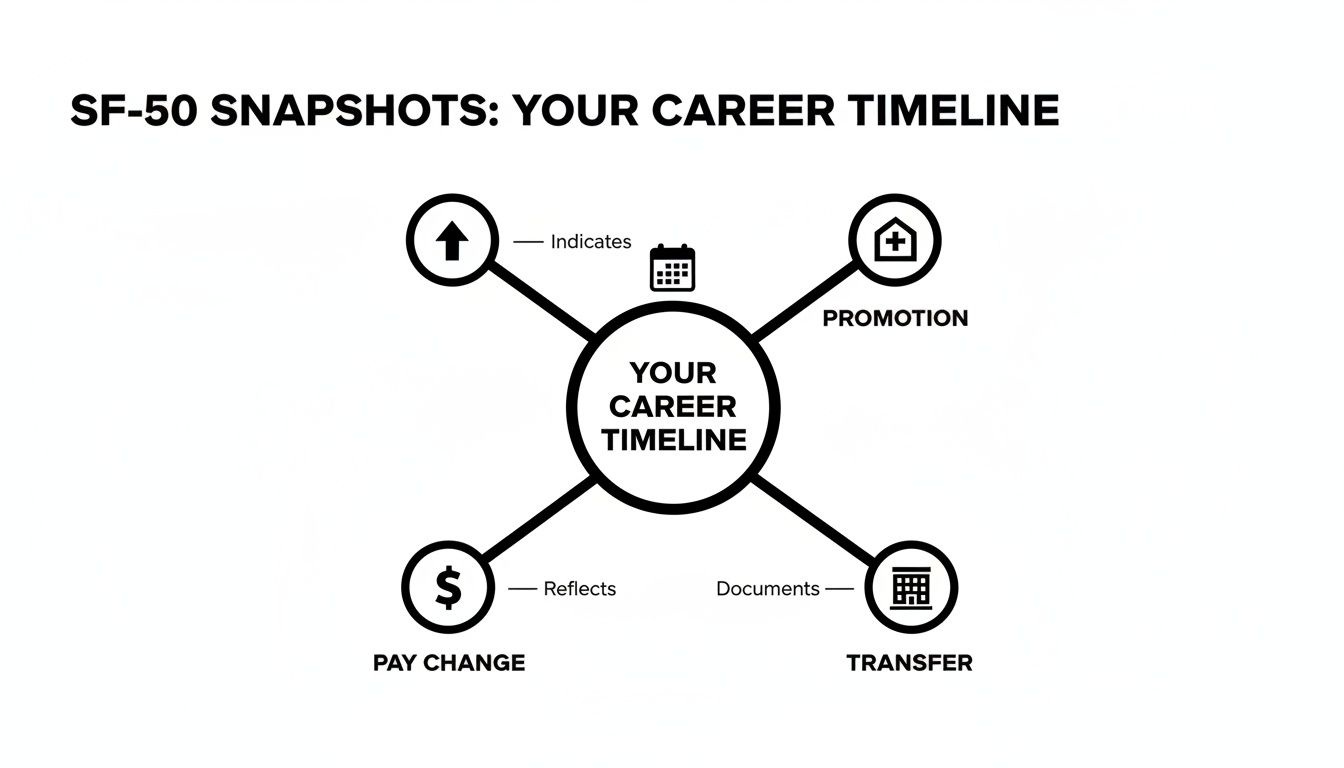
By collecting these "snapshots," you build an undeniable, official record of your entire federal service history.
Verifying Your Service and Retirement Information
This is where your SF-50 becomes your most powerful tool for long-term planning. The data in these blocks is the foundation for how much leave you earn, when you can retire, and what your pension will ultimately look like.
The most important dates on your SF-50 are your Service Computation Dates (SCDs). These aren't just administrative fields; they are the official clocks that measure your years of creditable service for both leave and retirement.
Let's break down the most vital fields in this section:
Block 24 - Tenure: This code shows your employment status (1 = Career, 2 = Career-Conditional, 3 = Temporary). Your tenure group dictates your job security and your rights during a reduction in force (RIF).
Block 30 - Retirement Plan: This block holds your retirement system code (e.g., K for FERS, 1 for CSRS). This is arguably the most important code on the entire form. Being in the wrong system has massive, life-altering financial consequences.
Block 31 - Service Computation Date (SCD) for Leave: This date is what determines your annual leave accrual rate. After 3 years of service, you jump from earning 4 hours per pay period to 6, and after 15 years, you start earning 8. This date confirms when you hit those milestones.
Getting into the habit of checking these blocks is non-negotiable. An incorrect SCD could delay your retirement eligibility by months or even years, and a simple typo in your retirement plan code could lead to a devastating miscalculation of your future pension.
Connecting Your SF-50 to Your Federal Retirement
Your SF-50 isn't just a dusty relic of your career history; it's the official blueprint the Office of Personnel Management (OPM) will use to build your retirement annuity. Each SF-50 in your file is a puzzle piece, coming together to prove your years of service and salary history. A single error on one of these forms can have a ripple effect, causing serious and costly problems down the road.
Think of it this way: when you retire, OPM becomes an auditor. Their job is to verify every single detail of your federal career before they sign off on your pension. Your collection of SF-50s is the official paper trail they will follow, and they treat the data on those forms as gospel.
How OPM Puts Your SF-50 Data to Work
When you finally submit your retirement application, OPM doesn't just trust the numbers you provide. They dive deep into your eOPF, meticulously piecing together your SF-50s to validate the three pillars of your retirement calculation.
Total Creditable Service: OPM starts with the Service Computation Date (SCD) on your most recent SF-50. They then work backward, cross-referencing your entire history of forms to make sure every period of service is accounted for correctly.
High-3 Average Salary: Your pension is calculated based on the average of your highest 36 consecutive months of basic pay. OPM will comb through years of your SF-50s to pinpoint this exact period, verifying the salary figures from every promotion, step increase, or pay adjustment along the way.
Retirement Plan Eligibility: The code in Block 30 is arguably the most important field on the entire form. This little box tells OPM whether you're under FERS or CSRS, which are two completely different systems with their own unique formulas and rules.
Crucial Takeaway: A simple mistake from years ago—like an incorrect SCD or a miskeyed salary—can lead to a major miscalculation of your monthly annuity payment. The best defense is to audit your own records regularly, long before you even think about retiring.
Critical SF-50 Fields for Retirement Planning
To truly understand how your SF-50 shapes your retirement, let's break down the most impactful fields. These blocks contain the raw data that OPM will use to determine the size of your pension and your eligibility for other benefits.
SF-50 Block Number & NameWhat It ShowsDirect Impact on Your RetirementBlock 1: NameYour legal name.A mismatch can cause processing delays. Ensure it's consistent across all records.Block 5: Pay PlanYour pay system (e.g., GS, WG).Verifies your position and pay structure, which is foundational for salary verification.Block 12: GradeYour pay grade (e.g., 13).A key component of your salary history. Errors here directly impact your High-3 calculation.Block 20: SalaryYour official annual basic pay.The most critical number for your High-3. OPM uses these figures to calculate your annuity.Block 30: Retirement PlanYour retirement system (e.g., FERS, CSRS).Determines which calculation formula OPM uses. An error here is catastrophic.Block 31: SCD - Service Comp DateYour official start date for leave and retirement purposes.Directly determines your total years of creditable service, a multiplier in your pension formula.
This table isn't just a list; it's a roadmap. By regularly checking these specific fields on every new SF-50 you receive, you can catch errors early and ensure your retirement calculation is built on a solid, accurate foundation.
The Real-World Impact of SF-50 Errors
This isn't just about administrative nitpicking. Imagine a promotion SF-50 from a decade ago that listed your salary incorrectly. That single typo could drag down your high-3 average, permanently shrinking your pension check for the rest of your life. In the same way, an incorrect retirement code could cause OPM to apply the wrong annuity formula altogether, a mistake that could cost you tens of thousands of dollars over your retirement.
That's why you need to treat your SF-50s with the same care you give your bank statements. They are the financial documents that define your future.
As you map out your federal retirement, don't forget that securing good healthcare is just as important. You can find excellent information in this guide to retirement health insurance. And if you want to see exactly how all these numbers come together, check out our walkthrough on how to calculate FERS retirement like a pro.
How to Get Copies and Correct SF 50 Errors

Knowing your SF-50 is accurate is one thing, but what do you do when you actually need a copy or, worse, you spot a mistake? Don't worry. Taking control of your official record is pretty straightforward once you know the right steps to take.
For current federal employees, it's never been easier. Your entire career history is stored in a system called the electronic Official Personnel Folder (eOPF). Think of it as your digital filing cabinet, accessible from any government computer. You can log in anytime to view, download, and print every SF-50 you've ever received.
If you've already left federal service, the process is a bit different. Since you can't just log into your old agency's network, you'll need to go through the National Personnel Records Center (NPRC), which is part of the National Archives. This is a more formal process that requires a written request.
Steps for Accessing Your SF 50s
So, how do you actually get your hands on these documents? It depends on your employment status.
Current Employees: Simply log into your agency’s eOPF portal. From there, you can browse your entire personnel file and download PDF copies of any SF-50 you need. It's instant access.
Former Employees: You'll need to visit the National Archives website to get the specific instructions for requesting civilian personnel records. Be prepared to provide detailed personal information to prove who you are.
Once you have your digital copies, a great tip is to make your SF 50s searchable. This makes finding specific details—like a particular grade or salary from years ago—much, much easier.
How to Correct an Error
Finding a mistake on your SF-50 can feel like a punch to the gut. An incorrect service date, the wrong retirement code, a typo in your salary—these aren't just minor clerical errors. They can have a real impact on your career and your retirement down the road.
The key is to act quickly and systematically. First, pinpoint the exact error and pull together any proof you have. This could be an offer letter, an old pay stub, or even a previous SF-50 that shows the correct information.
Next, get in touch with your agency’s Human Resources (HR) office. You’re looking for the folks who handle personnel actions and employee relations. They are the only ones with the authority to initiate a correction. For those tricky situations involving benefits, choosing the right employee benefits advisors can give you the expert backup you need.
Pro Tip: Always, always submit your correction request in writing. An email is perfect because it creates a paper trail. Clearly explain the mistake, provide the correct information, and attach copies of your supporting documents. This protects you and gives HR everything they need to fix the problem.
Your SF-50 Action Plan for a Secure Future
Knowing what the SF-50 is all about is a great first step, but the real power comes from turning that knowledge into a routine. This isn't about getting bogged down in administrative tasks; it's a simple, empowering habit that safeguards the federal benefits you've worked so hard for.
Think of it like doing regular maintenance on your car. A quick check-up now can prevent a major breakdown on the road to retirement. By catching small mistakes early, you stop them from snowballing into serious roadblocks down the line.
A Simple Checklist for Managing Your SF-50s
Here's a straightforward plan to take control of your personnel records and make sure every last detail is spot on.
Download and Save Everything. After any personnel action—a promotion, a step increase, anything—log into your eOPF. Download that new SF-50 and save it to a secure personal folder. It’s smart to keep both a digital and a physical copy.
Review It Right Away. Don't just file it and forget it. The moment you get a new SF-50, open it up and check the key blocks. It is infinitely easier to get a fresh mistake corrected than to try and fix an error from five years ago.
Do an Annual Audit. Once a year, make a habit of pulling out your latest SF-50 for a quick once-over. You don’t have to read every line, but zero in on the big stuff: your Service Computation Date, your retirement plan code, and your current salary.
Plan a Pre-Retirement Deep Dive. When you’re within five years of retirement, it's time to get serious. Pull out every SF-50 you've ever saved and trace your career history from start to finish. This is your chance to confirm that the entire timeline is consistent and accurate before you start your retirement paperwork.
A Few Common SF-50 Questions
Even after you get the hang of reading your SF-50, a few specific questions tend to pop up all the time. Let’s tackle some of the most common ones that federal employees run into.
How Long Should I Keep My SF-50 Forms?
Forever. No, really—you should keep every single SF-50 you ever receive, permanently. Think of it less like a suggestion and more like a non-negotiable rule for managing your federal career. This collection is the official, unshakeable story of your time in government service.
It's a smart move to keep both digital and physical copies tucked away somewhere safe. You’ll be glad you did when it’s time to apply for another federal job, prove your high-3 salary for retirement, or fill out your OPM retirement application. These forms are your proof.
What’s the Difference Between EOD and SCD?
It’s easy to mix these two up, but your Entrance on Duty (EOD) and Service Computation Date (SCD) tell very different parts of your career story.
Entrance on Duty (EOD): This one is simple. It's the exact date you started your current job.
Service Computation Date (SCD): This date is a bit more complex. It’s a calculated date that determines how much service you have for things like leave accrual, retirement eligibility, and seniority.
For a brand-new fed, these dates will likely be the same. But if you have prior federal service—maybe from another civilian job or military time that you’ve bought back—your SCD will be an earlier date than your EOD. That earlier date reflects all your creditable service, making it one of the most critical numbers to check on your SF-50.
My SF-50 Isn’t in My eOPF. What Should I Do?
First, don't panic. It's actually pretty common for there to be a lag between when a personnel action happens and when the new SF-50 shows up in your electronic Official Personnel Folder (eOPF). The gears of government HR don't always turn instantly; it often depends on your agency's payroll schedule and processing timelines.
A Good Rule of Thumb: Give it at least one full pay period after the action’s effective date.
If your SF-50 still hasn't appeared by then, it’s time to be proactive. Reach out to your agency’s HR or personnel office. A polite email or call to ask about the status of the action and when you can expect to see the form is all it takes. Keeping an eye on this ensures your official record stays up-to-date.
Navigating your federal benefits can feel complex, but you don't have to do it alone. At Federal Benefits Sherpa, we specialize in helping federal employees like you create a clear roadmap for a secure retirement. Schedule your free 15-minute benefits review today!
