What Is a Roth TSP? A Guide for Federal Employees
A Roth TSP is a retirement savings plan for federal employees where you contribute after-tax dollars. The magic happens later: your investments grow and can be withdrawn completely tax-free in retirement.
Think of it like paying for a vacation rental upfront. You handle the cost now so you can kick back and relax later without a bill waiting for you.
Understanding the Roth TSP for Federal Employees
At its heart, the Roth TSP isn't a separate account; it's just a different way to handle taxes within the same Thrift Savings Plan you're already familiar with. The Traditional TSP gives you an immediate tax break by taking contributions before taxes are calculated, lowering your taxable income for the year.
The Roth TSP flips that script. You pay taxes on your contributions today at your current rate. The huge payoff comes down the road when you take qualified withdrawals in retirement, and every penny—both your contributions and all the earnings—is 100% tax-free.
This "pay taxes now" (Roth) versus "pay taxes later" (Traditional) choice is one of the most important decisions you'll make for your retirement. When you contribute to a Roth TSP, you're essentially making a bet that your tax rate in retirement will be the same or even higher than it is today. This can be a brilliant move if you expect tax rates to rise in the future or if your combined retirement income (from your FERS pension, Social Security, and other investments) pushes you into a higher bracket.
The Power of Tax-Free Growth
The most compelling reason to consider the Roth TSP is the power of tax-free growth. Every single dollar your investments earn over the decades is yours to keep, completely shielded from the IRS, as long as you meet the withdrawal rules.
This creates a predictable and reliable source of retirement income. You won't have to guess how much of your withdrawal will be eaten up by taxes—what you see is what you get.
The Roth option was a game-changer when it was introduced for federal employees around 2012. It mirrors popular private-sector plans and gives federal workers a powerful tool to diversify their tax strategies, complementing their FERS pensions and Social Security benefits.
Roth TSP vs Traditional TSP At a Glance
To make the choice clearer, let's break down the fundamental differences between the two types of TSP accounts. This table offers a simple, side-by-side look to help you quickly see how each one works.
FeatureRoth TSPTraditional TSPContributionsMade with after-tax dollars. No immediate tax deduction.Made with pre-tax dollars. Lowers your current taxable income.Investment GrowthGrows tax-free.Grows tax-deferred.WithdrawalsQualified withdrawals in retirement are 100% tax-free.Withdrawals in retirement are taxed as ordinary income.Best ForThose who expect to be in a similar or higher tax bracket in retirement.Those who expect to be in a lower tax bracket in retirement.
Ultimately, the right choice depends on your personal financial situation and your outlook on future tax rates. Many federal employees even choose to contribute to both, giving them tax flexibility in retirement.
Building a Foundation for Smart Savings
Getting a handle on the Roth TSP is the first step toward building a truly resilient retirement plan. It's not just about how much you save; it's about structuring those savings in the most tax-efficient way for your specific circumstances.
Whether you go with Roth, Traditional, or a mix of both, mastering these tools is crucial. For a deeper look at managing your investments effectively, check out our guide on how to use the TSP for smart federal savings. This knowledge will empower you to make informed decisions that align with your financial goals and set you up for a secure retirement.
How Roth TSP Contributions and Withdrawals Work
When you get down to it, understanding how the Roth TSP works is pretty straightforward. It all boils down to two simple phases: putting money in (contributions) and taking it out (withdrawals). Each step has its own set of rules, but they’re all designed with one goal in mind: helping you get the most tax-free income possible in retirement.
Contributing to your Roth TSP simply means you're investing a piece of your paycheck after taxes have been paid. It’s an upfront investment in your future financial freedom. You can contribute up to the annual limit set by the IRS, and you can always adjust your contribution amount through your agency's payroll system whenever you need to.
One of the best things about the TSP is its flexibility. You can put 100% into your Roth TSP, 100% into your Traditional TSP, or split it any way you like, as long as your total contributions stay under that annual IRS limit.
This timeline gives you a quick look at the history of the TSP and shows exactly when the Roth option came on the scene for federal employees.
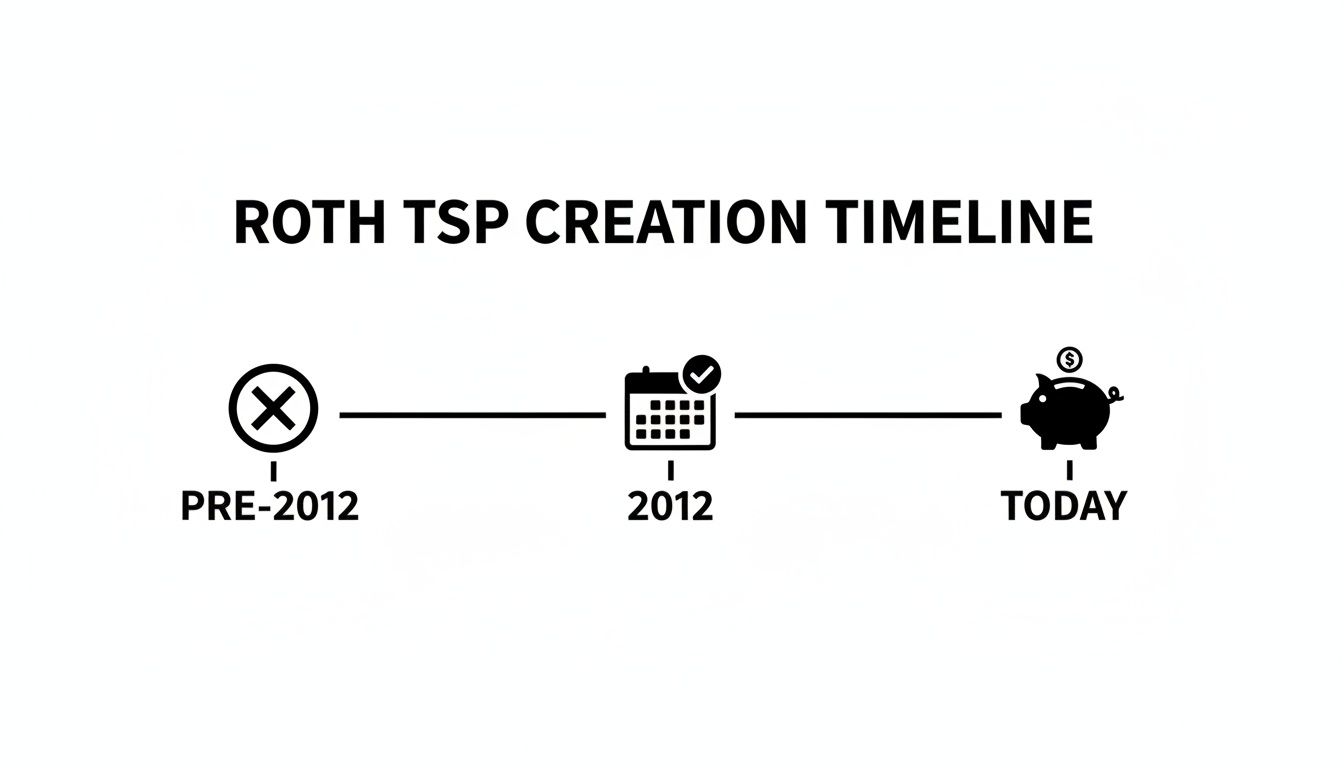
As you can see, the Roth TSP, introduced in 2012, is a fairly new tool. It was created to give federal employees the same powerful tax diversification strategies that have been available in the private sector for years.
Contribution Limits and Agency Matching
Every year, the IRS sets the contribution limits for retirement accounts, and they usually nudge them up every few years to keep pace with inflation. If you’re a federal employee aged 50 or older, you also get to make extra "catch-up contributions" on top of the regular limit.
Keep in mind that the Secure Act 2.0 brought some changes. For instance, high-earners (those with prior-year income over $145,000, adjusted for inflation) will be required to make their catch-up contributions to a Roth account starting in 2026.
Now, here’s a really important detail about agency matching funds. Even if you decide to put 100% of your own money into the Roth TSP, your agency's matching contributions will always go into your Traditional TSP balance.
This means most federal employees will naturally end up with two buckets of money:
Your Roth TSP: This holds your after-tax contributions and all their earnings. In retirement, this money is yours to withdraw completely tax-free.
Your Traditional TSP: This holds the agency's pre-tax matching funds and their earnings. This money will be taxed as regular income when you withdraw it.
The Rules for Tax-Free Withdrawals
To unlock the full tax-free power of your Roth TSP, you need to meet two key conditions for what's called a "qualified distribution." Think of it like needing two keys to open a treasure chest.
Key Takeaway: For your withdrawal to be completely tax-free, you must be at least age 59½ AND at least five years must have passed since January 1st of the year you made your first Roth contribution.
This is commonly known as the "5-Year Rule," and it’s a big one. The good news is the clock starts ticking on January 1st of the calendar year you make that very first contribution, and it doesn't reset, even if you pause contributions later on.
Let's walk through a quick example:
Sarah makes her first Roth TSP contribution on October 15, 2024. Her five-year clock officially starts on January 1, 2024.
She can begin taking qualified, tax-free withdrawals on January 1, 2029, as long as she has also turned 59½ by that date.
Getting a handle on these rules is a critical part of building a solid retirement plan. When you're ready to explore all your options for taking money out, our complete guide to Thrift Savings Plan withdrawal options breaks it all down for you.
Tapping Into the Strategic Power of the Roth TSP
So, you understand the basics of how a Roth TSP works. But knowing the rules is one thing; using it to its full potential is another. The real genius of the Roth TSP comes into play when you look at it as a strategic tool in your overall financial plan.
Think of it this way: your FERS pension and Social Security are going to be your retirement workhorses, but they both come with a tax bill. The Roth TSP is your secret weapon—a pool of money you can tap into completely tax-free.
This is a concept we call tax diversification. You wouldn't put all your money into a single stock, right? You diversify across the C, S, and I Funds to manage risk. The same logic applies to taxes in retirement. If all your income is taxable, you’re at the mercy of whatever tax rates Congress decides on in the future.

Hedging Your Bets Against Future Tax Hikes
Contributing to your Roth TSP today is like locking in today's tax rates for the long haul. It's a powerful hedge against the very real possibility that tax rates will be higher 10, 20, or even 30 years from now when you're ready to use the money. If they go up, your Roth balance won't feel a thing.
This creates incredible flexibility. Let's say you're retired and need $50,000 for a new roof. If you pull that money from your Traditional TSP, it all counts as taxable income. This could easily bump you into a higher tax bracket for the year and might even make your Medicare premiums more expensive.
But if you have that $50,000 in a Roth TSP? You can withdraw it without affecting your taxable income one bit. No surprise tax bill, no problem. This kind of control is a game-changer. Of course, this all works best when you're also capturing your full agency match, which is fundamental, much like the private sector strategies to maximize employer matching in retirement accounts.
Building a Tax-Smart Legacy for Your Heirs
The advantages don't stop with you. The Roth TSP is also a fantastic tool for estate planning, making it much easier to pass on your hard-earned savings to your family.
When your beneficiaries inherit your Roth TSP, they can generally take withdrawals from that account completely tax-free. Think about what a tremendous gift that is. They receive the full value of the money without a surprise tax hit. On the other hand, if they inherit a Traditional TSP, they'll owe income tax on every dollar they take out.
The Roth TSP provides a clear path for wealth transfer. Because you have already paid the income taxes, your heirs won't have to, preserving more of your hard-earned savings for the next generation.
This simple distinction can make a huge difference in the actual amount of money your loved ones get to keep. By planning with the Roth TSP, you ensure your legacy is passed down efficiently, with as little lost to taxes as possible.
Getting Ahead with Conversions and Contributions
The strategic possibilities don't end there. The TSP now allows for in-plan Roth conversions, a powerful feature that lets you move funds from your Traditional balance over to your Roth balance. You'll pay the income tax on the converted amount now, but from that point on, all the growth is tax-free forever.
With contribution limits always on the move—projected to be $24,500 in 2026 (up from $23,500 in 2025), plus an $8,000 catch-up—this gives you options. For those aged 60-63, a higher $11,250 catch-up offers even more room. Many federal employees use conversions to strategically pay taxes now, especially with potential tax bracket changes on the horizon after 2025. It's a way to take control of your future tax burden.
Ultimately, these strategic angles make the Roth TSP far more than just a place to save money. It's a dynamic financial tool that helps you plan for an uncertain tax future, manage major life expenses in retirement, and leave a meaningful legacy for your family.
Is the Roth TSP the Right Move for You?
Choosing between a Roth and a Traditional TSP isn’t a simple math problem. It’s a personal call that really comes down to where you are in your career, what your income looks like today, and how you picture your life in retirement. There’s no magic bullet answer here; the best choice for you depends on your unique situation.
To help you get a clearer picture, let's walk through three common scenarios for federal employees. By looking at how the Roth TSP plays out at different career stages, you can get a better feel for which path makes the most sense for your own financial journey.
The New Federal Employee
If you're just starting out in your federal career, you’re in an incredible position to take advantage of the Roth TSP. Right now, you're likely in a lower income tax bracket than you will be later on, after you've climbed the ladder with promotions and step increases.
This is a golden opportunity. When you contribute to a Roth TSP now, you pay taxes on that money while your rate is relatively low. In return, that money gets to grow for decades, and every single penny you pull out in retirement is 100% tax-free.
Think of it like prepaying your taxes at a discount. You're settling the bill today when it's cheapest. Over a 30-year career, this strategy can result in a much larger pot of spendable money in retirement compared to putting it off until you're in a higher tax bracket.
Key Insight: For new feds, the Roth TSP is often a slam dunk. You lock in today’s lower tax rates and let the power of compounding work its magic in a tax-free account for decades to come.
The Mid-Career Professional
For those of you squarely in the middle of your federal career, the decision gets a bit more complex. You're probably in your peak earning years, which also means you're in a higher tax bracket. That immediate tax deduction from the Traditional TSP starts to look pretty good.
Every dollar you put into a Traditional TSP lowers your taxable income for the year, which can mean saving a nice chunk of change come April 15th. That's money you could use for other pressing goals, like paying down the mortgage or funding a 529 plan for your kids.
But you have to weigh that immediate perk against your long-term vision. Do you think tax rates are going up in the future? Do you want a source of tax-free cash in retirement to supplement your FERS pension and Social Security without bumping you into a higher tax bracket?
Many mid-career feds find that a blended approach is the sweet spot:
Do both: Split your contributions between the Roth and Traditional TSP. This way, you get some tax savings now while also building that tax-free nest egg for later.
Look ahead: If you're expecting a hefty pension or other taxable income in retirement, leaning more heavily into the Roth can give you incredibly valuable tax diversification down the road.
This doesn’t have to be an all-or-nothing decision. It's about building in flexibility for whatever your financial future holds.
The Pre-Retiree
If you're within five to ten years of hanging up your hat, your focus naturally shifts to protecting what you've built and creating a reliable income stream. This is where the Roth TSP offers a powerful strategic advantage by giving you a tax-free reserve of cash.
Let's face it: your FERS pension and most of your Social Security benefits will be taxable. On top of that, withdrawals from your Traditional TSP balance—which is likely full of decades of your pre-tax contributions and all that agency matching money—are also fully taxable. This can create a "tax torpedo" in retirement, where your combined income pushes you into a much higher tax bracket than you anticipated.
Having a healthy Roth TSP balance is your secret weapon for managing taxes in retirement. Need a big chunk of money for a new roof, a car, or that trip to Italy you've always dreamed of? You can pull it from your Roth TSP without adding a single dollar to your taxable income for the year. A one-time expense won't suddenly cause your other income sources to be taxed at a higher rate.
For those nearing retirement, the name of the game is control. Building up your Roth balance, even in these final few years, gives you the power to manage your taxable income and shield your retirement funds from whatever happens with tax rates in the future. It's one last, powerful move to secure the stable retirement you've worked so hard for.
Navigating In-Plan Roth TSP Conversions
For years, federal employees have watched their private-sector counterparts use a powerful tool to manage their retirement taxes: converting pre-tax savings into Roth funds. The good news? This strategic option is finally coming to the Thrift Savings Plan.
An in-plan Roth conversion is simply the process of moving money from your Traditional TSP balance over to your Roth TSP balance. Think of it as a deliberate choice to settle the tax bill on a portion of your retirement savings now, at today's rates, in exchange for tax-free growth and withdrawals on that money forever. It's a way to get ahead of your future tax liability.

Understanding the Tax Implications
Here's the deal: the amount you convert gets added to your taxable income for that year. You’re essentially prepaying the taxes on that money, locking in your current tax rate instead of rolling the dice on what rates might be when you retire.
It's a major financial decision. While there are no administrative fees for the conversion itself, the tax bill is very real. You'll need to have cash on hand outside of your TSP to cover it, as you can't use the converted funds to pay the associated taxes.
Mark your calendars. Starting January 28, 2026, the TSP will officially launch in-plan Roth conversions. This means you can move your Traditional TSP money—including your pre-tax contributions, all agency matching funds, and their earnings—directly into your Roth TSP.
A Practical Conversion Example
Let's walk through how this plays out in the real world.
Meet Jessica, a federal employee. On February 10, 2026, she decides to convert $30,000 from her Traditional TSP to her Roth TSP. She's a single filer in the 22% federal tax bracket and has a 7% state income tax.
Federal Tax Bill: $30,000 x 22% = $6,600
State Tax Bill: $30,000 x 7% = $2,100
Total Upfront Tax Cost: $6,600 + $2,100 = $8,700
When Jessica files her 2026 taxes, she'll owe that extra $8,700. But here's the payoff: from that day forward, the entire $30,000—plus all its future investment growth—is on track to be 100% tax-free in retirement (once she meets the 5-year rule and is over 59½).
Should You Convert to a Roth TSP?
Deciding whether a Roth conversion is the right move for you involves some strategic thinking about your income, tax situation, and retirement timeline. This isn't a one-size-fits-all strategy. The table below can help you weigh the factors.
ConsiderationFavors ConversionMay Not Favor ConversionFuture Tax ProjectionsYou expect tax rates (or your income) to be higher in retirement.You expect to be in a lower tax bracket during retirement.Current IncomeYou're having a lower-than-usual income year.You're currently in your peak earning years and a high tax bracket.Cash ReservesYou have money outside your TSP to pay the conversion tax bill.Paying the taxes would require you to sell investments or take a loan.Time HorizonYou have many years until retirement for tax-free growth to compound.You are close to or already in retirement.Estate Planning GoalsYou want to leave tax-free assets to your heirs (Roth accounts have no RMDs for original owners).Estate planning is not a primary concern for you.
Ultimately, a Roth conversion is a bet on your future self. If you believe your financial situation or the country's tax landscape will lead to higher taxes down the road, paying the bill now could save you a fortune later.
When Does a Roth Conversion Make Sense?
With a Roth conversion, timing is everything. The whole point is to pay the tax when your rate is lowest, so certain windows of opportunity are better than others.
Key Insight: A Roth TSP conversion is most powerful when you anticipate being in a higher tax bracket in retirement than you are today, or when you have a temporary dip in your annual income.
Here are a few scenarios where pulling the trigger might be a brilliant move:
During a Lower-Income Year: If you take a leave of absence, have a gap in employment, or your income drops for any reason, your marginal tax rate falls with it. That's a golden opportunity to convert.
Before Anticipated Tax Increases: Many financial experts believe that today's relatively low tax rates won't last forever. Converting now lets you lock in current rates before they potentially climb.
Early in Your Career: If you're at a lower pay grade but have already built up a nice Traditional balance, converting now can be incredibly effective, as your income and tax bracket will likely rise throughout your career.
Deciding to convert is a big step, and it's certainly not for everyone. If you're exploring different ways to get your money into a Roth account, our detailed post offers a complete guide to the TSP to Roth IRA rollover, which is another fantastic strategy to consider.
Putting Your Roth TSP Strategy into Action
Alright, we've covered the nuts and bolts of the Roth TSP. You know what it is, how it works, and where it can really make a difference. But theory only gets you so far—the real magic happens when you turn that knowledge into a concrete action plan.
Think of the Roth TSP less as a separate account and more as a powerful lever for controlling your future tax bill.
Deciding between Roth and Traditional contributions isn't a simple coin toss. It’s a decision that has to be made by looking at your entire financial world, not just your TSP in isolation. For federal employees, a truly smart strategy looks at how your TSP withdrawals will play with your other income streams.
The real goal here is to get your FERS pension, Social Security benefits, and TSP withdrawals all working together in harmony. That integration is the secret sauce that separates a decent retirement from a truly comfortable one.
This is where generic, one-size-fits-all advice falls apart. Your career path, your current salary, and what you want your retirement to look like are unique to you, and your plan should reflect that.
Building Your Custom Retirement Blueprint
The only Roth TSP strategy that works is one built specifically for you. This isn't about guesswork; it's about running the numbers to project your future income and see what your tax situation might look like down the road. This kind of planning helps you avoid nasty surprises, like accidentally bumping yourself into a higher tax bracket in retirement.
A well-crafted plan goes way beyond just picking a contribution type. A specialist can map out a strategy for in-plan Roth conversions, fine-tune your tax withholding, and make sure your TSP, healthcare, and Social Security all line up without leaving gaps.
This personalized math can also show you the incredible legacy you can leave with a Roth account, giving your heirs tax-free money and more flexibility than the strict Required Minimum Distributions of a Traditional TSP. You can learn more about how to empower your TSP for a seamless retirement on Fedweek.com.
Ultimately, getting smart about your Roth TSP gives you the confidence to master the complexities of your federal benefits. By taking action now, you're not just saving for retirement—you're actively designing the secure and fulfilling future you've worked so hard to earn.
Got Questions? We've Got Answers
Even after you've got the basics down, a few questions about the Roth TSP usually pop up. It's completely normal. This section is all about giving you quick, straightforward answers to the things federal employees wonder about most.
Think of it as the final piece of the puzzle. Nailing down these details helps you move forward confidently with your retirement plan. Let's jump right in.
Can I Contribute to Both a Roth and a Traditional TSP at the Same Time?
You sure can. In fact, splitting your contributions is a pretty common strategy. You have the freedom to decide exactly how you want to divide your money between the Roth and Traditional TSP, whether it's 50/50, 80/20, or any other mix you like.
Just remember, your total contributions to both accounts combined can't go over the annual IRS limit. This "have it both ways" approach lets you hedge your bets—you get some tax savings now from the Traditional side and build up a pot of tax-free money for later with the Roth.
Do I Still Get the Agency Match if I Contribute to the Roth TSP?
Yes, and this is a big one. You will always get your full agency match, no matter where you put your own money. Choosing the Roth TSP will never cause you to miss out on those matching funds.
Here’s the catch, though: all matching money from your agency—both the automatic 1% and the matching dollars—goes directly into your Traditional TSP balance. It doesn't go into your Roth account. This means the match money grows tax-deferred and will be taxed as regular income when you eventually pull it out.
Fun fact: this is how most feds end up with a mix of tax-deferred and tax-free money without even trying. Your Roth contributions build your tax-free bucket, while the agency match automatically builds your tax-deferred one.
What Happens to My Roth TSP if I Leave the Government?
When you leave federal service, your Roth TSP money is still your money. You’ve got a few choices for what to do with it, which is great because your financial strategy can continue right along with you, wherever you go next.
Here are your main options:
Keep it in the TSP: You can simply leave your account where it is and continue to benefit from the TSP's low fees.
Roll it over to a Roth IRA: This is a popular move. You can transfer your Roth TSP balance into a Roth IRA at a bank or brokerage firm, which often gives you more investment choices.
Move it to your new job's plan: If your new employer offers a Roth 401(k) or a similar plan, you can usually roll your Roth TSP funds directly into that new account.
Are There Income Limits for Putting Money into a Roth TSP?
Nope! This is a huge advantage the Roth TSP has over a Roth IRA. With a Roth IRA, if you earn too much, the IRS won't let you contribute.
The Roth TSP has no income restrictions at all. Whether you're just starting your federal career or you're a senior executive, you can contribute right up to the annual limit. This makes it an incredibly powerful and accessible tool for every single person in the federal workforce.
Trying to make sense of all your federal benefits can feel like a heavy lift, but you're not on your own. The experts at Federal Benefits Sherpa live and breathe this stuff, helping federal employees just like you create a retirement strategy that actually makes sense. Grab a free 15-minute benefit review today and make sure you're truly on the right track. https://www.federalbenefitssherpa.com
