Your Guide to the TSP to Roth IRA Rollover
So, you're thinking about moving your Thrift Savings Plan (TSP) money into a Roth IRA. Let's get right into what that actually means for your retirement savings.
A TSP to Roth IRA rollover is simply the process of transferring your retirement funds from your government-sponsored TSP account to a personal Roth IRA. The key part of this move is that you'll pay income taxes on the money now, allowing it to grow and be withdrawn completely tax-free down the road.
What a TSP to Roth IRA Rollover Really Means
Think of it this way: a TSP to Roth IRA rollover is, first and foremost, a tax strategy. You’re making a calculated decision to pay your tax bill on that retirement money today, so you can enjoy tax-free financial freedom later in life. This is the complete opposite of a traditional TSP, where you get a tax break on contributions now, but every dollar you pull out in retirement gets taxed as regular income.
It really comes down to one big question: do you think your tax rate will be higher now or in the future? If you're in a lower tax bracket today than you expect to be in retirement, paying those taxes now through a rollover can be an incredibly smart move for building long-term wealth.
TSP vs Roth IRA Key Differences at a Glance
To really see why this move can be so powerful, it helps to put the two accounts side-by-side. The biggest difference is how they're taxed, which has a massive impact on your take-home pay both during your career and after you retire.
FeatureTraditional TSPRoth IRATax on ContributionsPre-tax (lowers your current income)Post-tax (no immediate tax break)Tax on GrowthTax-deferred100% Tax-freeTax on WithdrawalsTaxed as ordinary income100% Tax-free (qualified)Investment ChoicesLimited (a handful of core funds)Nearly unlimited (stocks, bonds, ETFs, etc.)
Seeing them laid out like this makes the trade-off clear. You're giving up a small tax break now for a huge one later.
The real magic of a TSP to Roth IRA rollover is turning an unknown, future tax bill into a fixed, predictable payment today. That move secures tax-free growth and, more importantly, tax-free withdrawals for the rest of your life.
Why Now Might Be the Time to Act
The current tax landscape has created a unique opportunity for people considering a Roth conversion. Recent tax laws have locked in some historically low federal tax brackets, at least for now.
With 2025 rates set between 10% and 37%, we're in a window of relative tax certainty. Many financial experts believe it makes sense to handle a TSP to Roth IRA rollover while rates are favorable. Paying the tax on that conversion now, especially if you’re in a lower bracket, could save you a fortune compared to facing potentially much higher tax rates in the future. For more on this, you can find some great insights on Roth conversion strategies and how the current environment impacts them.
How to Complete the Rollover Process
Alright, let's walk through the actual mechanics of getting your money from the Thrift Savings Plan into a new Roth IRA. This isn't a one-click process, but if you follow the right steps, you can make it a smooth transition for your retirement savings. It's all about preparation, choosing the right transfer method, and following through.
First, Open Your Roth IRA
Before you even think about touching your TSP funds, you need to have a destination for them. Your first move is to open a Roth IRA at a brokerage firm. Think of big names like Vanguard, Fidelity, or Charles Schwab.
The key is to pick a provider that feels right for you. Consider their investment options, look at their fee structures, and get a feel for their customer service. The account must be fully open and ready to receive funds before you start the rollover from the TSP.
This simple infographic shows the basic flow: your money leaves the traditional TSP, a taxable event occurs, and then the funds land in your new Roth IRA.
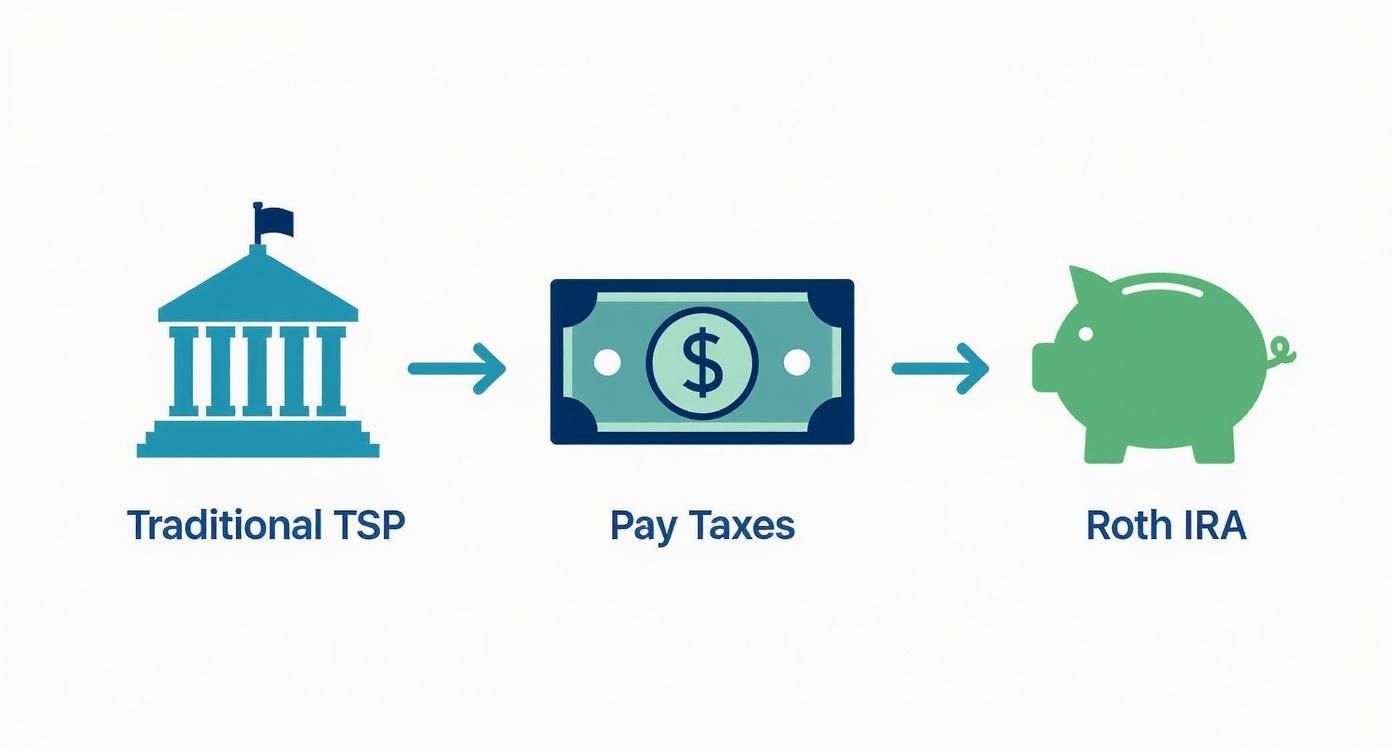
Think of that tax payment as the crucial bridge connecting your pre-tax government plan to your post-tax personal retirement account.
Initiating the Transfer from Your TSP
With your new Roth IRA set up, it's time to head over to the TSP website. Thankfully, what used to be a paper-heavy process is now almost entirely digital, which makes things much easier. You'll log into your account and navigate to the withdrawal or rollover section.
The official TSP portal is your command center for this entire operation.
As you go through the online prompts, you’ll face a critical choice: a direct rollover or an indirect rollover. This is one of the most important decisions you'll make in the process.
Always choose a direct rollover. This is non-negotiable for a smooth transfer. With a direct rollover, the TSP sends the money straight to your new brokerage. The funds never pass through your personal bank account, which is exactly what you want. It's the cleanest, safest way to avoid major tax headaches.
Why is the other option so bad? An indirect rollover, where the TSP mails you a check, is a minefield of potential problems. For starters, it automatically triggers a 20% federal tax withholding. Worse, you have only 60 days to deposit the full amount (including that 20% you never received) into the new IRA. If you miss that deadline, it's considered a withdrawal, and you could face steep penalties. A direct rollover neatly sidesteps all that drama.
To complete the direct rollover request, have this information from your new brokerage handy:
The brokerage firm's name (e.g., Fidelity, Schwab).
Your new Roth IRA account number.
The brokerage's instructions for receiving the funds—either electronically or via a check made payable to them "for the benefit of" (FBO) you.
After the Funds Arrive
Once you hit "submit" on the TSP website, the job isn't quite finished. It can take several business days, sometimes even a couple of weeks, for the funds to actually show up in your Roth IRA. Keep an eye on both accounts during this time.
The moment the money lands, your work begins. First, confirm the amount is correct. Then, and this is crucial, you need to invest it. One of the biggest mistakes I see people make is letting that cash sit uninvested in the new account, where it's not growing. Your new brokerage will have plenty of options—work with them or your financial advisor to get that money invested based on your retirement goals.
Finally, keep an eye out for tax time. Early next year, the TSP will send you a Form 1099-R. This document reports the distribution from your account. You'll use it to report the rollover as taxable income on your tax return. Since this is a significant financial event, getting some expert guidance from a team like Federal Benefits Sherpa can be invaluable to make sure you handle the tax implications correctly and keep your entire retirement plan on the right track.
Let's Talk About Taxes: The Real Cost of a TSP to Roth IRA Rollover
Okay, let's get down to brass tacks. Moving your traditional TSP money into a Roth IRA isn't just a simple transfer—it's a taxable event. This is probably the single most important detail to wrap your head around, because getting it wrong can be a costly mistake.
When you make this move, you're essentially taking pre-tax money and converting it to post-tax money. The IRS views the entire amount you roll over as ordinary income for that year.

Think about it this way: if you decide to roll over $100,000, your taxable income for the year just went up by $100,000. That kind of jump can easily shove you into a higher tax bracket, which means a bigger-than-expected tax bill come April.
Figuring Out if the Math Works for You
The whole game is about planning for that tax hit. A big rollover could bump you from the 22% bracket clear into the 24% or even 32% bracket. Suddenly, a chunk of that money you're moving is being taxed at a much higher rate.
A helpful concept here is the Breakeven Effective Tax Rate (BETR). It’s a fancy term for a simple idea: figuring out if paying the taxes now is a better deal than paying them on withdrawals in retirement. It's really an educated guess about where your tax rates are headed in the future.
Let's look at an example. Some detailed modeling shows that converting $300,000 might leave you with around $230,000 after you've paid the tax bill. The analysis calculates a BETR of roughly 23.3%. So, if you're pretty sure your tax rate in retirement will be higher than 23.3%, the conversion is a smart financial play. It could mean more money in your pocket, after taxes, when you actually need it. If you want to dive into the nitty-gritty, you can read more about these fascinating Roth conversion calculations and see the numbers yourself.
Crucial Tip: This is non-negotiable. Never use the money from your rollover to pay the conversion tax. You absolutely must have cash set aside in a separate, non-retirement account to cover the bill. If you pull from the retirement funds, you’re not only shrinking your nest egg but also likely facing early withdrawal penalties.
Smarter Ways to Manage the Tax Bill
Here's the good news: you don't have to do it all at once. In fact, for most people, rolling over the entire TSP balance in one year is a terrible idea. A much better approach is to think strategically and spread it out.
Make it a multi-year project. You can perform partial rollovers, moving smaller amounts over several years. This lets you "fill up" your current tax bracket without spilling over into a higher one. For instance, if you see you have $40,000 of room left in the 24% tax bracket, you might just roll over that amount for the year and stop there.
Timing is everything. Look for opportunities. A rollover makes the most sense in a year when your income is lower than usual. Maybe you're between jobs, or you have unusually large deductions one year. Early retirement, before you start taking Social Security or other pensions, can also be a golden window.
By spreading your TSP to Roth IRA rollover over time, you can methodically build a source of tax-free retirement income without getting hammered by a huge, unexpected tax bill. It’s a thoughtful approach that helps you win the long game.
Long-Term Benefits of a Roth IRA in Retirement

Rolling over your TSP into a Roth IRA means taking a tax hit now, so it's natural to wonder if it's worth it. What’s the real payoff down the road? The answer lies in the incredible financial control and flexibility you gain in retirement—advantages your TSP just can't offer.
The most celebrated perk is, of course, tax-free withdrawals. But the benefits run much deeper.
One of the most powerful advantages is waving goodbye to Required Minimum Distributions (RMDs). Your traditional TSP makes you start taking taxable withdrawals at age 73 or 75, whether you need the money or not. A Roth IRA, on the other hand, has no RMDs for the original owner.
This is a game-changer. It means your money can keep growing, tax-free, for your entire life. You and you alone decide when—or even if—you want to take a distribution. This lets your nest egg compound for potentially decades longer, all on your own terms.
A Powerful Tool for Your Heirs
That freedom from RMDs also makes a Roth IRA one of the best estate planning tools available. Since you're never forced to draw down the account, you can preserve the full balance to pass on to your beneficiaries as a completely tax-free inheritance.
Think about that for a moment. Your children or grandchildren could inherit a substantial sum of money and not owe a single penny of income tax on it. This is a massive advantage compared to a traditional TSP or IRA, where your heirs get stuck with a tax bill on every dollar they withdraw. A Roth IRA ensures the wealth you built stays in the family.
Unlocking True Investment Freedom
Beyond the tax perks, moving from a TSP to a Roth IRA blows the doors wide open on your investment choices. While the Thrift Savings Plan is praised for its simplicity and low costs, its limited menu of just a handful of funds can feel incredibly restrictive if you want to build a portfolio that truly reflects your goals.
The real power of a Roth IRA is the freedom it gives you. You move from a limited, government-curated menu of investments to a universe of options, allowing you to build wealth on your own terms.
Once your money is in a brokerage-held IRA, you can invest in almost anything:
Individual Stocks: Pick and choose the companies you believe in for the long haul.
Exchange-Traded Funds (ETFs): Easily diversify across specific market sectors, industries, or even international markets.
Mutual Funds: Access thousands of professionally managed funds with different strategies.
Bonds and Other Securities: Fine-tune your portfolio to balance risk and generate income.
This kind of flexibility lets you pivot and adapt your strategy as your life and financial goals evolve—something that’s nearly impossible within the rigid structure of the TSP.
Financial models bear this out. One analysis suggested a Roth conversion could create a long-term benefit of around 6.1%, thanks largely to the power of tax-free growth and the absence of RMDs. You can dive deeper into the long-term financial modeling of Roth benefits to see the numbers for yourself. This is precisely why so many savvy federal employees make a rollover the cornerstone of their retirement strategy.
Common Rollover Mistakes You Need to Avoid
Getting a TSP to Roth IRA rollover right is just as much about dodging the common pitfalls as it is about following the correct procedure. A few small missteps can create some pretty big headaches, from unexpected tax bills to missed growth. Let's walk through the traps to make sure you steer clear of them.
The single biggest mistake I see people make is the indirect rollover. This is where the TSP cuts you a check directly, instead of sending the money straight to your new brokerage. It sounds simple enough, but here's the catch: the government requires them to automatically withhold 20% for federal taxes.
You then have a tight 60-day window to get the entire original amount—including that 20% you never actually got—into your new Roth IRA. If you miss that deadline or can't make up the 20% from your own pocket, the whole thing is treated as a taxable distribution. That can mean a 10% early withdrawal penalty on top of the income tax. It's an easily avoidable mess.
Underestimating the Tax Bill
Another common blind spot is failing to truly grasp the tax implications. Remember, every dollar you roll from a traditional TSP to a Roth IRA is considered taxable income for that year. That can be a serious shock to your system if you haven't planned for it.
For instance, rolling over $80,000 could easily bump you from the 22% tax bracket into the 24% bracket. That doesn't just mean a bigger tax bill; it means a portion of your regular income is now being taxed at a higher rate, too. You absolutely have to run the numbers beforehand.
The golden rule here is to never use the retirement money itself to pay the conversion taxes. Always, always have a separate cash fund ready to cover what you'll owe the IRS. Dipping into the rollover funds defeats the whole purpose of the account and can create even more taxes and penalties.
The Problem of Inaction After the Rollover
Once the money finally hits your new Roth IRA, your job isn't done. It's surprising how often people transfer a huge sum of money and then just let it sit there as cash, totally uninvested. Your money can't work for you if it's sitting on the sidelines. Have an investment plan ready to execute the moment the funds clear.
Finally, don't let simple administrative details slip through the cracks. They seem small, but they have huge consequences.
Update Your Beneficiaries: This is critical. The beneficiary you named on your TSP account does not automatically transfer to your new Roth IRA. You have to designate them again with your new financial institution.
Confirm Your Investments: You're moving from the limited TSP fund options to a whole universe of choices. Make sure the investments you select in your new account actually line up with your retirement timeline and how much risk you're comfortable with.
Sidestepping these common errors is what turns a rollover from a potential source of stress into a smart, strategic move for your financial future.
Common Questions on TSP Rollovers
As you start planning your TSP to Roth IRA rollover, you're bound to run into a few specific questions. I see the same ones pop up all the time with federal employees, and getting the details right is crucial. Let's walk through the most common queries to make sure you can navigate this process without any expensive hiccups.
Can I Move My Roth TSP to a Roth IRA?
This is easily the most frequent question I get, and the answer is a simple, straightforward "yes." Since the money sitting in your Roth TSP has already had taxes paid on it, moving it to a Roth IRA is a non-taxable event.
It’s one of the cleanest, simplest transfers you can make in the retirement world. You're essentially just moving money from one tax-advantaged pocket to another. This is a go-to strategy for feds looking to consolidate accounts and get access to a much wider universe of investment choices without triggering a tax bill.
Do I Have to Roll Over the Whole Thing at Once?
Not at all. You have a lot of control here. The TSP allows for partial rollovers, which is a fantastic feature for anyone trying to be strategic about their retirement and tax planning.
Many people I work with choose to move smaller chunks over several years. For instance, you could convert just enough from a traditional TSP to "top off" your current tax bracket without bumping yourself into a higher one. Spreading the tax impact out like this can make a big conversion much more manageable and affordable over the long haul.
The bottom line is that you're in control. A full or partial rollover should be based entirely on your personal financial picture, your income for the year, and what makes the most sense for your tax strategy.
What if I Have an Outstanding TSP Loan?
This is a big one, and it's a potential landmine if you're not paying attention. You absolutely cannot roll over your TSP account if you have an active loan. That loan has to be completely paid off before you can even start the rollover process.
If you separate from federal service with that loan still outstanding, things get serious fast. The IRS will treat the entire unpaid balance as a "taxable distribution." Not only will that amount be taxed as regular income, but if you're younger than 59½, you'll also get hit with a 10% early withdrawal penalty. Ouch.
To avoid that nasty surprise, make paying off your TSP loan your number one priority before you even think about filling out rollover forms. It's a critical first step for a smooth, penalty-free transfer of your hard-earned retirement money.
Trying to make sense of your federal benefits can feel overwhelming, but you don't have to figure it all out on your own. The team at Federal Benefits Sherpa focuses exclusively on helping federal employees build a clear roadmap for a confident retirement. Get a personalized gap analysis to see exactly where you stand. Schedule your free 15-minute benefit review today.
