How to Calculate Social Security Benefits in 2026
You open your Social Security statement, find a monthly estimate, and wonder what it represents. It may be a useful starting point, but it isn't necessarily the amount that will land in your bank account. To understand how to calculate Social Security benefits, follow the math from your earnings record to your estimated payment, then account for the choices and adjustments that change it.
The calculation has three stages: determine your average indexed monthly earnings (AIME), use AIME to calculate your primary insurance amount (PIA), and adjust the PIA for the age you claim. Each stage has its own inputs, so a mismatch in the final estimate may come from your earnings history, the formula year, or your claiming age.
The Three-Stage Formula and the 2026 Bend Points
A statement estimate can look like a single answer, but Social Security builds it through a sequence. First, the agency calculates AIME from your covered earnings. Then it applies the PIA formula. Finally, it adjusts the PIA for your claiming age and other payment factors.
- Build AIME. Social Security indexes covered earnings for wage growth, selects your highest 35 years, and averages those earnings across 420 months.
- Calculate PIA. The formula applies different percentages to separate portions of AIME. These portions are called bend-point bands.
- Adjust for claiming age. Claiming before full retirement age reduces the benefit, while delaying beyond full retirement age can increase it.
For workers first eligible in 2026, the bend points are $1,286 and $7,749. The percentages apply in layers, not as a single rate on all your earnings.
| AIME band | Percentage applied | Maximum PIA from this band |
|---|---|---|
| Up to $1,286 | 90% | $1,157.40 |
| $1,286 to $7,749 | 32% | $2,068.16, bringing cumulative PIA to $3,225.56 |
| Above $7,749 | 15% | No cap; 15% of the amount above $7,749 |
The first band contributes a maximum of $1,157.40 to the PIA. The second band covers $6,463 of AIME, so it can add up to $2,068.16. Above the second bend point, each additional dollar of AIME contributes 15 cents to the PIA. Because the rate steps down as AIME rises, higher earners generally replace a smaller share of their previous earnings.
The bend points change over time. The applicable formula is tied to the year you reach age 62, not the year you file for benefits. The Social Security Administration's benefit formula information provides the bend points and explains how the earnings average leads to a PIA.
Gather your SSA earnings record, birth year, and the claiming age you're considering before you calculate. The PIA is not your monthly check, because claiming age, cost-of-living adjustments, and deductions come later.
How to Build Your Average Indexed Monthly Earnings
AIME starts with your record of covered earnings, not every dollar you earned. Check the Social Security earnings record first, then work through the calculation in order.
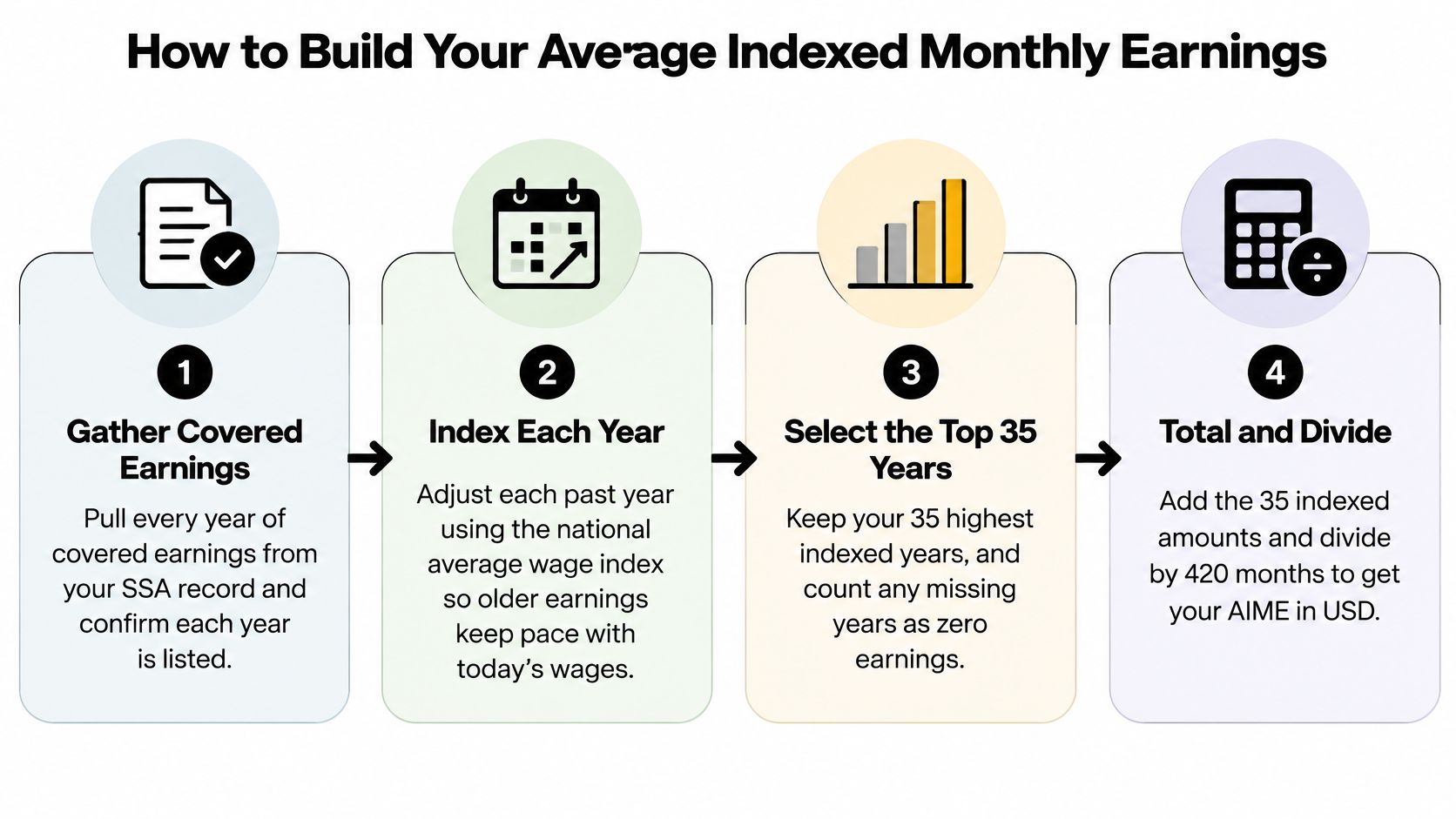
Gather every year of covered earnings. Review your SSA earnings record and check that each year you worked in covered employment appears. An omitted or understated year can lower the average used in your benefit calculation.
Index each year for wage growth. Social Security adjusts earlier earnings so that wages from different points in your career can be compared on a common basis. This prevents an early-career dollar from being treated as if it had the same wage value as a dollar earned much later.
Select your highest 35 indexed years. The agency uses the 35 years with the highest indexed earnings, not necessarily your last 35 years. A strong late-career year can replace an earlier low-earning year and lift your average.
Add the selected years and divide by 420. The total of the 35 indexed annual earnings is divided by the number of months in 35 years. This converts the annual earnings history into an average monthly amount.
Round down to the next lower dollar. AIME is rounded down, rather than rounded to the nearest dollar.
The Social Security Administration's benefit calculation explanation describes this process: index covered earnings, select the highest 35 years, total them, divide by 420, and round down. A missing year matters because an earnings year that doesn't exist in the record can't contribute to the total.
The zero-year trap
Suppose a worker has 30 years of covered earnings. The calculation still uses 35 years, so five years effectively contribute zero earnings. Even if the worker's 30 earning years were strong, those five zeros pull down the average.
That doesn't mean every year without a high salary is permanently locked into the calculation. If you continue working and have a year of earnings high enough to enter your top 35, it can replace a lower year and increase AIME. The important question is whether that additional work changes the 35 years Social Security uses.
Before you file: Count your covered-work years. If you have fewer than 35, note how many zero years are included, then check whether projected future earnings are realistic.
Don't assume a small record discrepancy is harmless. A single understated year can lower the calculation, and it's easier to ask for a correction before you file than to discover the gap afterward.
Turning Your AIME Into a PIA With Worked Examples
Suppose your AIME is $6,000 and you're using the 2026 bend points. The first $1,286 earns 90%, which contributes $1,157.40. The remaining $4,714, from $1,286 through $6,000, earns 32%, adding $1,508.48. Together, those amounts produce an estimated PIA of $2,665.88.

The lower band contributes a fixed amount once AIME reaches its upper limit. After that, the second band adds 32 cents for each additional dollar of AIME until the next bend point. For an AIME of $6,000, no earnings enter the third band.
| AIME | Bend-point math | Approximate PIA |
|---|---|---|
| $3,000 | ($1,286 × 90%) + ($1,714 × 32%) | $1,705.88 |
| $6,000 | ($1,286 × 90%) + ($4,714 × 32%) | $2,665.88 |
| $9,000 | ($1,286 × 90%) + ($6,463 × 32%) + ($1,251 × 15%) | $3,413.21 |
The $9,000 example crosses the second bend point. The first $1,286 receives the 90% rate, the next $6,463 receives 32%, and the remaining $1,251 receives 15%. This is why the calculation must be applied band by band rather than by multiplying all of AIME by one percentage.
The formula is simple enough to check with a calculator, but your hand result might differ by a few cents because Social Security applies its own rounding rules.
A short self-check can catch a wrong input:
- Confirm AIME. Use the amount calculated from your record, rounded down to the next lower dollar.
- Use the right bend-point year. The formula depends on when you reach age 62.
- Compare the result. If your hand-built PIA and statement estimate differ by more than rounding, check the earnings record and AIME assumption.
A statement estimate can also reflect different projected earnings assumptions, so check those before treating a mismatch as a formula error. The video below provides another explanation of Social Security benefit calculations.
How Your Claiming Age Changes the Monthly Check
For anyone born in 1960 or later, full retirement age is 67. Your PIA is the full retirement benefit at that age. Claiming sooner reduces the monthly amount; waiting beyond full retirement age increases it, up to age 70.
| Claiming age | Percentage of PIA |
|---|---|
| 62 | 70% |
| 65 | 86⅔% |
| 67 | 100% |
| 70 | 124% |
The reduction for claiming at 62 is about 30% for someone whose full retirement age is 67. The increase for delaying comes from monthly delayed retirement credits after full retirement age, reaching 24% by age 70. These percentages describe the age adjustment to PIA, not the effect of cost-of-living adjustments or deductions.
Using the $2,665.88 PIA from the worked example, claiming at 62 gives an estimated monthly amount of $1,866.12 before later adjustments. Claiming at 70 gives an estimated $3,305.69, also before cost-of-living adjustments.
Those numbers make the trade-off visible: an earlier claim pays less each month, while delaying can raise the monthly benefit. But the highest monthly amount isn't automatically the right choice for every household. Health, marital status, survivor-benefit planning, cash needs, and continued work all matter.
For a fuller comparison of possible strategies, use guidance on how to maximize Social Security as one planning resource. Treat the claiming-age table as a starting point for comparing options, not as a decision by itself.
Calculating Benefits When You Keep Working After Claiming
A federal retiree claims at 64, then accepts consulting work. The initial benefit is only one part of the cash-flow picture. If the retiree's earnings trigger the Social Security earnings test, some benefits may be withheld temporarily, and additional covered earnings can affect the future calculation.
In 2026, beneficiaries below full retirement age can earn $24,480 before the earnings test applies. Social Security withholds $1 in benefits for every $2 earned above that threshold, according to the Social Security Administration's 2026 COLA fact sheet. If this consultant earns $44,480, that's $20,000 above the threshold, so $10,000 in benefits would be withheld during the year.
Think about the result in three stages:
- Initial benefit: Start with the monthly amount based on the person's PIA and claiming age.
- Temporary withholding: Account for the earnings-test amount withheld while the person is below full retirement age. The withheld money isn't necessarily a permanent loss; withheld months can be reflected in a later benefit adjustment at full retirement age.
- Later recalculation: Check whether additional high-earning years replace lower years in the 35-year record. A revised earnings average can change the benefit as well.
This distinction matters for federal employees who retire from government service but continue consulting, working part time, or earning federal wages. Don't treat the withholding as a tax or assume the original monthly amount will stay unchanged.
The 2026 cost-of-living adjustment is 2.8%, which changes nominal payment comparisons but doesn't set a claiming breakeven age. Before deciding that early claiming plus work makes sense, estimate all three stages together: the initial benefit, temporary withholding, and the adjusted payment after full retirement age.
Federal Employees Under CSRS and the 2025 Fairness Act
Older benefit calculators may still show reductions from the Windfall Elimination Provision (WEP) or Government Pension Offset (GPO). The Social Security Fairness Act, signed on January 5, 2025, repealed both provisions for benefits payable from January 2024 onward. The Social Security Administration says more than 2.8 million people had been affected by WEP or GPO, including some federal employees covered by CSRS, teachers, firefighters, police officers, and people with foreign-covered employment. The agency's Social Security Fairness Act information explains the repeal.
The repeal doesn't mean every federal employee qualifies for Social Security. Eligibility still depends on covered earnings and the usual qualification rules. It's also important to distinguish CSRS from FERS: FERS employees generally pay Social Security taxes on their federal earnings, while a CSRS pension may be based on service that wasn't covered by Social Security.
| Component | What it covers | What to check |
|---|---|---|
| Regular retirement benefit | Your PIA-based benefit on your own covered record | Confirm the earnings record and claiming-age adjustment |
| Former WEP-reduced amount | The benefit once cut by WEP | Recompute without WEP, which no longer applies to benefits from January 2024 |
| Spouse or survivor benefit | The benefit once reduced by GPO | Recheck without GPO, which no longer applies to benefits from January 2024 |
| Retroactive adjustment | Back pay for months from January 2024 onward | Confirm with SSA whether a retroactive payment applies to your case |
For a CSRS employee, compare the regular retirement estimate with any amount previously calculated using WEP. If you may qualify for a spouse or survivor benefit, check whether an earlier estimate included a GPO reduction. Then ask Social Security whether a retroactive adjustment applies to your case; don't assume a statement has already accounted for every change.
FERS employees should still verify their Social Security record and claiming-age estimate, but their federal wages generally count as covered earnings. To review how the former provisions fit into older estimates, see this explanation of the Windfall Elimination Provision and Government Pension Offset. Run the comparison before choosing a claiming date, because the claiming-age adjustment still applies to the regular benefit.
Confirm Your Numbers Before You Claim
An estimate can be wrong even when it looks precise. A GAO review of Social Security statement estimates found that estimates tend to be less accurate for younger workers, women, non-insured workers, and lower earners, which makes checking your own earnings history worthwhile before you file.
Start with your official Social Security earnings record rather than a third-party calculator's default assumptions. Download the record, look for missing or understated years, and confirm that any projected future earnings are realistic. Then calculate AIME from your highest 35 years, apply the bend points for the year you reach age 62, and compare your hand-built PIA with the estimate on your statement. If the statement was produced under an older claiming plan, its monthly figure may also assume a different filing age than the one you now intend.
A gap between the two numbers usually traces to one of three causes: an earnings-record error, an incorrect AIME, or a bend-point formula that does not match your eligibility year. Younger workers face an extra wrinkle. A statement may apply current bend points rather than the ones that will govern their first year of eligibility, and projected earnings can overstate or understate what gets indexed. Treat every estimate as a planning input, not the amount that will arrive on the first check.
If you are weighing how Social Security fits alongside home equity or other retirement income, the California Freedom reverse mortgage guide offers another perspective as you compare your options. Federal or other income can also reduce how much of the benefit you keep, so review the key rules for Social Security benefits taxation before assuming the gross figure is your spendable income.
A CSRS pension adds one more layer, because older estimates may reflect provisions that no longer apply. Federal Benefits Sherpa offers a free 15-minute benefit review to help federal employees compare a Social Security estimate with their federal retirement benefits and model the pension interaction; book a review before you claim so a second set of eyes checks the arithmetic.
Federal Benefits Sherpa provides personalized retirement planning and benefit reviews for federal employees, including help comparing Social Security estimates with federal retirement benefits. Visit Federal Benefits Sherpa to request a free 15-minute benefit review and check your numbers before choosing when to claim.
