Health Care Options Enrollment: FEHB Guide for 2026
Doing nothing during Open Season isn't a neutral choice, and it isn't always the safe one. FEHB coverage generally continues if you make no change, but that can carry forward a higher premium, a narrower provider network, or a plan that no longer serves your area. For federal employees, health care options enrollment is an annual financial decision, not just paperwork completed when you start a job.
Understanding Health Care Options Enrollment for Federal Employees
Ask what goes wrong during Open Season, and "picking the wrong plan" rarely tops the list. The bigger losses come from elections that lapsed without anyone noticing, or rolled forward on terms nobody rechecked.
For the 2026 plan year, OPM reported an expanded FEHB and PSHB lineup, a double-digit average premium increase, and plans that changed benefits, service areas, or availability. Last year's election is a starting point for review, not evidence that the same plan still fits.
Enrollment decisions arise at three points: when you become newly eligible for federal benefits, during annual Open Season, or after a qualifying life event. Each window operates under different rules and deadlines, so identify which one applies before comparing anything.
Then separate two kinds of continuity. FEHB coverage generally continues if you do nothing, but FSAFEDS requires a fresh election every year, and a plan can stay administratively active while its premium, network, or service area shifts underneath you. I've counseled employees who found in January that an "unchanged" plan no longer fit, and their FSAFEDS money was gone.
New OPM verification rules for family members add a second layer. Covering a spouse or dependent can require proof of eligibility, which turns enrollment into a documentation task as much as a deadline task. Gather records before the window opens, not after.
Federal employees aren't the only ones weighing employer-sponsored coverage against other arrangements. Employers exploring alternatives can understand ICHRA options for employers, while employees nearing retirement should assess what coverage follows them off the payroll.
Practical rule: Treat every Open Season notice as a prompt to verify your plan's current terms and your family's eligibility documentation, even if you expect to keep the same election.
Eligibility Rules and Enrollment Windows That Control Your Choices
Before comparing plans, establish whether you're eligible to enroll or make the change you want. The enrollment window controls both the timing and, in some situations, what changes you can make.
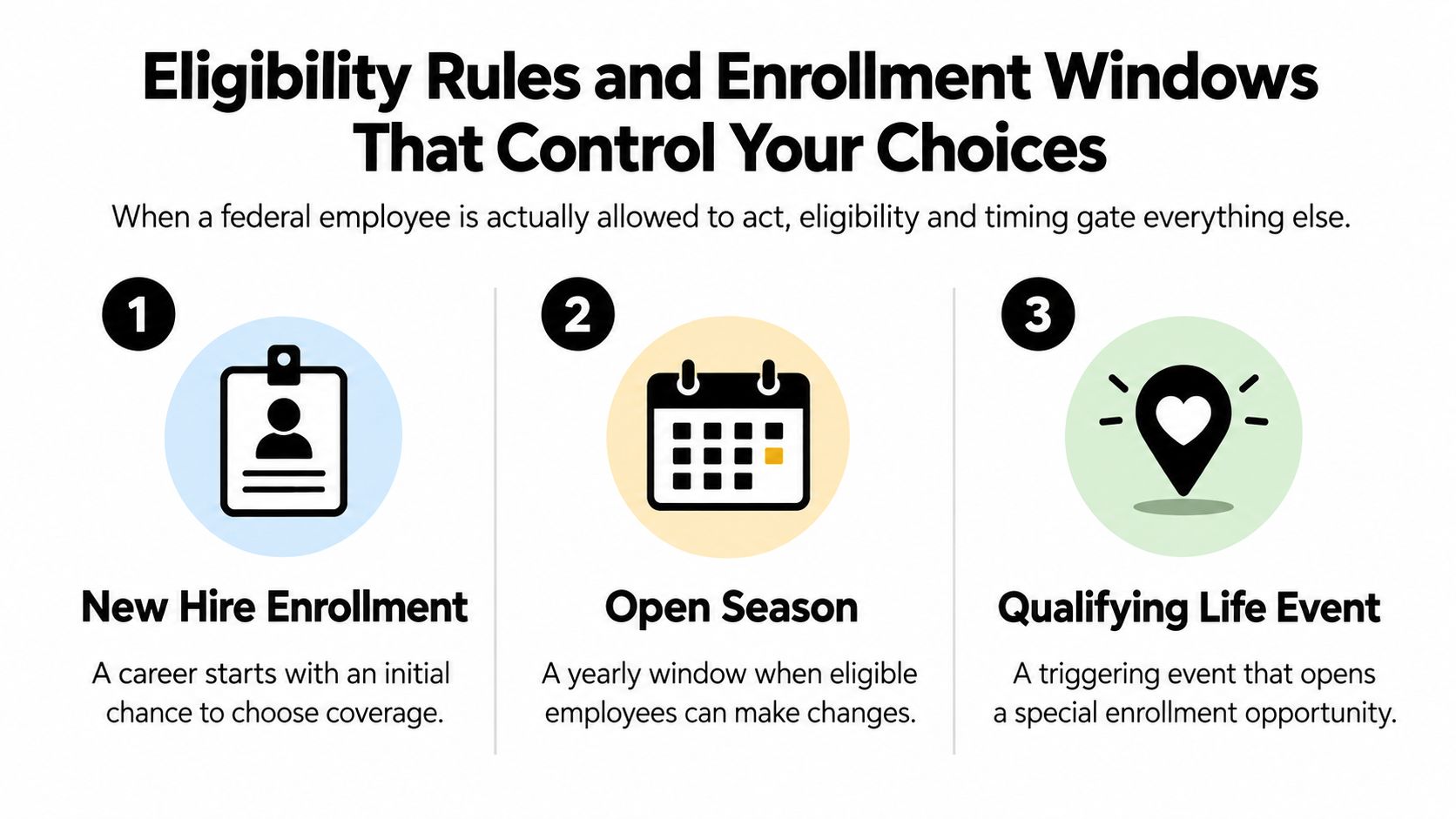
Start with your new-hire opportunity
When you begin federal service and become eligible for FEHB, review the enrollment instructions and deadline provided by your agency. Don't assume that an enrollment choice will wait until the next Open Season. Gather the information you'll need to choose a plan, including who needs coverage, preferred doctors, current prescriptions, and the plan's service area.
Use Open Season for a change that can't wait
During Open Season, eligible employees may enroll, change plans or options, cancel coverage, or change premium-conversion participation without a qualifying life event. It's the regular opportunity to make a deliberate adjustment when your needs or a plan's terms have changed.
If your choice involves family coverage, check eligibility before submitting the election. Your household's circumstances determine which enrollment type can cover the intended people. Choosing a category without verifying who qualifies can lead to payroll costs that don't provide coverage to the person you meant to add.
Confirm the qualifying event and the evidence
A qualifying life event, or QLE, can open a midyear enrollment opportunity. Events such as marriage, divorce, a birth, or a spouse losing coverage may change who needs insurance or whether you can make a change. Confirm the event and the applicable submission period with your agency rather than assuming every personal change qualifies.
Family documentation now requires particular care. New federal rules require OPM to verify qualifying life events and confirm that added family members are eligible; proof may be required both at the initial enrollment opportunity and after another qualifying life event (the federal rule on OPM verification). Depending on the relationship and circumstances, you may be asked for records establishing a marriage, birth, adoption, or other basis for a child's eligibility. Blended families may need to show the relationship and the child's eligibility, rather than relying on household membership alone.
Gather documents before you submit, and ask your benefits office what it accepts. Missing or incomplete proof can complicate verification, delay processing, and create uncertainty about when coverage applies. For a closer look at who may qualify and what to confirm, consult this guide to federal employee health benefits eligibility.
How to Enroll in FEHB the Right Way
FEHB enrollment is a controlled process, not a single online transaction. An election can be submitted and still need follow-up before you can rely on it. Use three checkpoints: confirm that you can act, compare the available coverage, and verify that the election took effect.
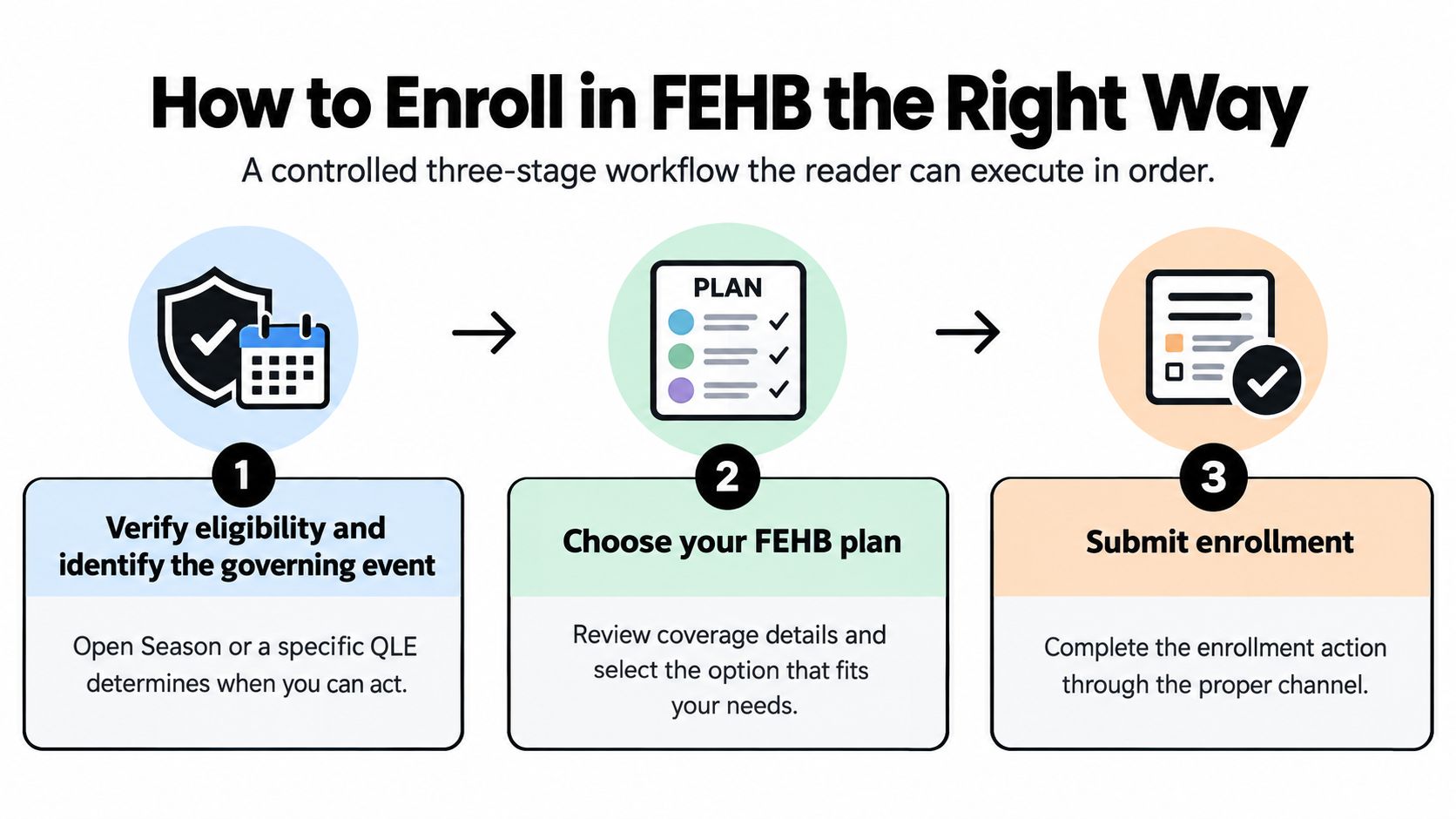
Verify eligibility and the event
Identify whether you're acting during Open Season or because of a specific QLE. Check the deadline and the process your agency requires. The wrong assumption at this stage can lead to a technically complete election that the agency can't accept for the event or period you intended.
Compare before you elect
Use the plan's Summary of Benefits and Coverage, then check details that affect real access and cost:
- Provider network and service area: Confirm that your doctors, hospitals, and other preferred providers are available where you live or receive care.
- Prescription formulary: Check coverage for the medicines you currently use, including any relevant restrictions or cost-sharing.
- Premium and cost-sharing: Compare premiums alongside deductibles and the out-of-pocket maximum. A lower premium can come with higher costs when you use care.
- Enrollment type: Verify that the category matches the family members you intend to cover.
Don't choose based on a brochure summary alone. Read the relevant plan terms and check that the network and formulary apply to your actual circumstances.
Submit, then verify the effective election
Submit the choice through your agency's authorized enrollment channel and keep the confirmation. OPM explains that a new enrollment generally takes effect on the first day of the first pay period beginning on or after January 1 that follows a pay period in which you were in pay status. A change generally takes effect on the first day of the first full pay period beginning on or after January 1 (OPM's FEHB enrollment guidance).
The practical risk is assuming “submitted” means “effective.” Before the first claim, reconcile the confirmation with the first affected pay-period deduction, enrollment code, covered family members, and the plan's service area. You want 100% agreement between your election and those records. If anything differs, contact your agency benefits officer and the carrier before you rely on the coverage.
How to Compare FEHB Plans Before You Commit
Start with the people to be covered, not the premium. FEHB enrollment types include Self Only, Self Plus One, and Self and Family. The right choice depends on who is eligible and needs coverage. The wrong one can leave an intended family member uninsured or create payroll costs for a category that doesn't match your household.
| Enrollment Type | Who Is Covered | When It Typically Fits |
|---|---|---|
| Self Only | The enrollee | When coverage is needed only for the employee |
| Self Plus One | The enrollee and one eligible family member | When the employee needs coverage with one eligible family member |
| Self and Family | The enrollee and eligible family members | When coverage is needed for multiple eligible family members |
Next, compare total exposure, not premium in isolation. Consider the premium alongside the deductible and out-of-pocket maximum, and think about the care your household expects to use. A household expecting a procedure may place more weight on the out-of-pocket limit; an enrollee who expects little care may focus more on premiums, while still checking access and prescription coverage.
Network and formulary checks are not optional details. A plan with a lower premium may be a poor fit if your doctors aren't in-network or your medicines aren't covered on acceptable terms. Check the service area against where you get care, not just your home address.
A near-retiree couple considering Self Plus One might compare a lower-premium plan with a narrower network against a higher-premium plan that includes their established providers. The lower premium may be attractive, but if the couple would need to change doctors or travel farther for care, the trade-off could outweigh the savings. The better choice depends on their providers, prescriptions, expected care, and comfort with those changes.
For employees leaving federal service, comparing options may mean looking beyond FEHB. During the 2025 Open Enrollment Period, 24,166,491 consumers selected ACA Marketplace coverage, including 17,128,890 through HealthCare.gov and 7,037,601 through state-based Marketplaces (CMS's 2025 Marketplace enrollment release). Employees approaching retirement or losing employer coverage should compare available premiums, networks, cost-sharing, and eligibility for financial assistance across the options that apply to them.
If you want another set of eyes on an FEHB comparison, Federal Benefits Sherpa offers a free benefit review and gap analysis. Its FEHB plan comparison guide can also help structure the questions to ask before choosing.
Coordinating FEHB With Medicare as You Near Retirement
Medicare coordination is a deadline problem as much as a plan comparison. Start early enough to determine how your current employment status affects your options, and don't assume that FEHB coverage automatically resolves Medicare timing.
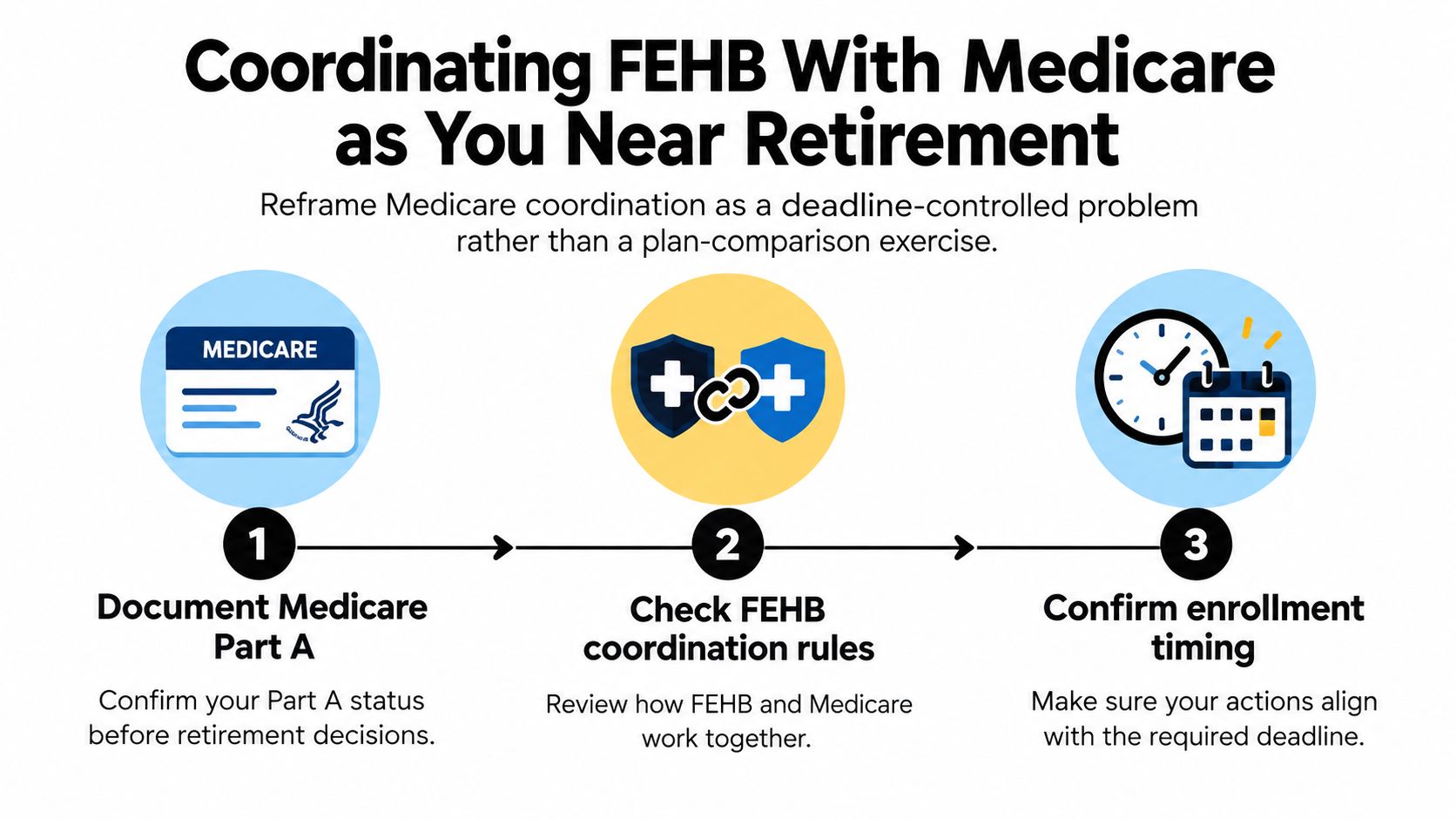
First, document when you're eligible for Medicare Part A and establish whether your existing coverage is based on active employment. Retiree coverage and active-employer coverage aren't interchangeable assumptions when you're deciding when to enroll. Confirm your situation with your employer benefits office and Medicare.
Then evaluate Part B against your FEHB coverage. Compare the Part B premium with FEHB cost-sharing, provider access, prescription coverage, and the applicable coordination rules. Whether Part B makes sense depends on those details and your circumstances. Don't decline or delay it based solely on a general belief that FEHB takes its place.
Calendar the enrollment period and protect your record
The seven-month Initial Enrollment Period surrounds the month you turn 65. Delaying Part B without an applicable exception can lead to a permanent surcharge of 10% of the Part B premium for each full 12-month period of delay. A Congressional Research Service analysis found that about 1.4% of Part B enrollees, approximately 764,000 people in 2019, paid this penalty; their combined standard premium and penalty averaged about 28% above the amount paid by beneficiaries without the penalty (the CRS analysis of Medicare Part B late-enrollment penalties).
That risk is avoidable if you verify your enrollment window instead of guessing. Common trouble spots include treating FEHB retiree coverage as though it were active-employer coverage, assuming FEHB substitutes for Medicare, or relying on a spouse's employment coverage without confirming whether it supports a Special Enrollment Period.
Write down your Part A status, Part B decision, relevant enrollment dates, and any employer-coverage evidence you'll need. Complete an FEHB–Medicare coordination checklist at least six months before your intended retirement date, then seek written confirmation from your benefits office and Medicare before terminating or declining coverage. For more on the coordination questions, see this guide to FEHB and Medicare for federal retirees.
Health Care Options Enrollment Mistakes to Avoid
Enrollment damage is usually administrative, not medical. After years of walking employees through Open Season, I can say the people who lose coverage almost never picked the wrong plan. They assumed something rolled over that did not, or trusted a confirmation nobody checked against the carrier's records.
The confirmation that never matched the carrier file. An employee submits a change and assumes the work is finished. At the pharmacy, the carrier cannot find the updated enrollment. Compare the confirmation with payroll and carrier records before using the plan, not after a claim gets denied.
The familiar plan that changed underneath the enrollee. Someone keeps last year's election without reviewing the new premium, service area, network, or benefits. Premiums climbed again for the 2026 plan year, as noted earlier, and individual plans shifted cost sharing and networks at the same time. Administrative continuity is not benefit continuity. Read the current plan terms even when you intend to stay put.
The FSAFEDS lapse. FEHB carries forward on its own, so employees assume every benefit does the same. FSAFEDS requires a fresh annual election, and participation ends if you skip it. Put it on the same Open Season checklist, but track it separately from FEHB.
The family category or proof mismatch. An employee picks Self and Family when Self Plus One fits, or adds a family member without gathering eligibility documents. OPM's verification rules have turned enrollment into an eligibility-and-proof problem, not just a deadline problem. Verify both the enrollment type and the required documentation before submitting.
The retirement date mistaken for an enrollment exception. A retiree treats FEHB retiree coverage as active-employment coverage for Medicare timing. That assumption can carry real penalty exposure. Confirm which rules apply to your specific employment history before deciding.
The election date confused with the effective date. An employee watches the submission date and misses that coverage timing depends on pay-period status. Check the effective date against the agency's confirmation and the first affected payroll deduction.
Every one of these has the same remedy: keep the paperwork, verify the records, and resolve discrepancies before you need care.
Locking In Your Decision and Planning Your Next Step
Use this checklist before your enrollment window closes:
- Confirm which enrollment window applies to you and mark its deadline.
- Pull the Summary of Benefits and Coverage for your top plan choices.
- Verify that each intended family member is eligible and gather the required documentation.
- Submit through your agency's authorized channel and save the confirmation.
- Reconcile the confirmation with your first payroll deduction before filing a claim.
- If you're nearing retirement, add an FEHB–Medicare timing review before making a coverage decision.
A plan is only a good fit if the election is valid, the people you intended to cover qualify, and the recorded coverage matches what you chose. For employees approaching retirement, the health plan also needs to fit the larger transition, including retirement income, TSP decisions, and Medicare timing.
Federal Benefits Sherpa offers a free 15-minute benefit review and a gap analysis customized to your situation to help federal employees check how an FEHB election fits that broader picture. You can use that review as a practical second look before the window closes.
Federal Benefits Sherpa offers a free 15-minute benefit review and a customized gap analysis to help you assess your FEHB choice alongside retirement income, TSP, and Medicare timing. If you want a personalized check before you submit or confirm your election, visit Federal Benefits Sherpa.
