FEHB Plan Comparison Tool A Guide to Better Benefits
Navigating the sprawling, often confusing world of federal health insurance can feel like a full-time job. An FEHB plan comparison tool is your secret weapon in this fight, designed to cut through the noise and help you find the best value without overpaying for coverage you don't need.
Why You Can't Afford to Skip Using an FEHB Plan Comparison Tool

Choosing a plan in the Federal Employees Health Benefits (FEHB) program without a proper comparison tool isn't just inconvenient anymore—it's a serious financial risk. With healthcare costs climbing faster than ever, what used to be a helpful shortcut has become a non-negotiable part of smart financial planning.
The sheer number of options is enough to make anyone's head spin. You’re faced with dozens of carriers offering literally hundreds of different plans. Trying to manually sort through brochures and websites to find the perfect fit is a recipe for frustration and, frankly, it’s nearly impossible to do well.
This is where a good FEHB plan comparison tool changes the game. It takes that mountain of data—premiums, deductibles, copays, out-of-pocket maximums, and provider networks—and distills it into a straightforward, side-by-side analysis built around your needs. This isn't just about saving a few hours of research; it's about making an informed decision that could easily save you thousands of dollars every single year.
The Financial Stakes Are Higher Than Ever
The plan you choose has a massive impact on your budget, and that impact is growing. In 2025, the enrollee's share of FEHB premiums shot up by an average of 13.5%—the biggest jump we’ve seen in a long time. This came on the heels of other recent increases, putting a real strain on the budgets of federal families. You can dig into the specifics of these rising FEHB premium costs to see just how significant the trend is.
This kind of volatility means the plan that was a great deal last year might be a financial drain this year. Sticking with what you know without re-running the numbers is a surefire way to overspend.
A comparison tool takes the guesswork out of the equation. It gives you the hard data you need to adapt to the shifting premium landscape and protect your family’s bottom line.
Turning Data Overload into Decision Clarity
At its core, a quality FEHB plan comparison tool is designed to create order out of chaos. By plugging in a few key pieces of personal information, you can instantly see how different plans stack up based on your family's actual or expected healthcare usage.
Key Inputs for an Accurate Comparison
To get a truly personalized and useful comparison, you need to provide some basic information. The tool then does the heavy lifting for you.
| Data Input | Why It Matters | Example |
|---|---|---|
| Zip Code | Plan availability and pricing are location-specific. This filters out all the plans you can't actually sign up for. | Entering "20004" for Washington, D.C., shows local options. |
| Enrollee Type | Premiums are calculated differently for Self Only, Self Plus One, or Self and Family coverage. | Selecting "Self and Family" for a household of four. |
| Health Needs | This generates a personalized cost estimate based on your expected medical usage, from routine visits to specific prescriptions. | Estimating 10 specialist visits and 4 prescriptions per year. |
When you use these inputs, the tool delivers a clear, actionable comparison. It ensures your final choice is built on a solid foundation of evidence, not just a familiar plan name or a low-looking premium. It's a critical first step toward truly mastering your federal benefits.
Understanding the Scale of FEHB Choices
To really get why a comparison tool is so critical for FEHB plans, you have to appreciate the sheer size of the federal benefits world. If you’re a federal employee or postal worker, you’re looking at a marketplace so big that trying to compare your options by hand isn’t just hard—it’s next to impossible.
This isn't an overstatement. The program involves dozens of insurance carriers, and each one offers several different plans. Every plan has its own premiums, doctor networks, and benefit structures, creating a dizzying array of choices that can overwhelm anyone.
The numbers alone paint a clear picture. For 2025, the Office of Personnel Management (OPM) announced there are 42 carriers offering 64 FEHB plans, which breaks down into 130 total options. On top of that, the new Postal Service Health Benefits (PSHB) program adds another 17 carriers, 30 plans, and 69 options. That’s a combined total of nearly 200 distinct choices. Trying to lay all that out on paper to compare is simply not a realistic goal. You can see the full scope by checking out the 2025 Open Season highlights from OPM.
The growth in complexity over the years is staggering. Just look at how the numbers have evolved:
FEHB Program Scale at a Glance
| Year/Program | Carriers | Plan Options |
|---|---|---|
| 2023 FEHB | 27 | 104 |
| 2024 FEHB | 35 | 120 |
| 2025 FEHB | 42 | 130 |
| 2025 PSHB | 17 | 69 |
This table makes it obvious why a digital tool isn't just a convenience—it's a necessity for making an informed decision in this crowded marketplace.
Defining Your Coverage Level
Before you can even start comparing plans, you need to know which coverage tier you fall into. The FEHB program sorts plans into three main enrollment types. This choice is your first, and most important, filter.
- Self Only: This is the simplest option. It covers just you, the federal employee or annuitant.
- Self Plus One: This tier covers you and one eligible family member, like your spouse or one of your children.
- Self and Family: This is the broadest coverage, insuring you and all of your eligible family members, no matter how many there are.
Getting this right is crucial because your enrollment type directly sets your premium rates and your potential out-of-pocket costs. If you pick the wrong one, you could end up paying for coverage you don’t need or, worse, leaving a family member uninsured. Our comprehensive guide to the Federal Employees Health Benefits program dives deeper into who qualifies for each type.
The goal isn't just to pick a plan. It's to find the most cost-effective option within the correct enrollment type that actually fits your family's health needs and your budget. Knowing this makes the results you get from a comparison tool much more powerful.
Why Manual Comparison Falls Short
Can you imagine trying to create a spreadsheet to compare nearly 200 plans? You'd have to track variables like deductibles, specialist copays, prescription costs for different drug tiers, and out-of-pocket maximums for each one. The time it would take is one thing, but the risk of making a mistake is huge.
That’s exactly the problem a comparison tool solves. It handles all that massive data-crunching for you, letting you focus on the handful of plans that are actually a good fit for your life. Without a tool, you’re trying to navigate a complex system with only a fraction of the information you need, which could easily lead to a decision that costs you thousands in extra premiums or surprise medical bills.
A Step-by-Step Guide to the OPM Comparison Tool
If you want to cut through the Open Season noise and make a smart decision, the official OPM FEHB plan comparison tool is your best friend. At first glance, it might seem a bit clunky, but I promise it's straightforward once you know the steps. Let's walk through it together, from the first click to the final comparison screen, so you can find the right plan for your budget and your family's health needs.
Your journey starts on the OPM website. The tool first needs to know where you live and a little about your employment status to get the ball rolling.
This is the landing page you'll see. Pretty simple, right?
It uses your zip code to show you plans available in your area and your pay frequency to calculate your premium costs correctly.
Step 1: Plug in Your Basic Info
First things first, you'll need to enter a few key details. This initial step is just to make sure the tool shows you plans that you're actually eligible for.
- Enter Your Zip Code: Premiums and even which plans are available can change drastically based on where you live. Your zip code is what filters the massive list down to your local options.
- Select Your Pay Frequency: Are you paid biweekly or monthly? Or are you an annuitant? This choice tells the tool how to display your premium deductions, so you see what will actually come out of your check.
- Choose Your Enrollee Type: This one is critical. Pick Self Only, Self Plus One, or Self and Family, depending on who needs coverage.
Once you hit submit, you'll see a list of every plan available in your neck of the woods.
Step 2: Estimate Your Healthcare Use for the Year
This is where the magic happens. The real value of this tool isn't just showing you premiums; it's estimating your total annual healthcare costs. But to do that, you have to give it some good information.
Take a few minutes to think about the past year. Did you have a lot of doctor visits? Any planned surgeries coming up? Be honest with yourself and make your best guess for the following:
- Doctor Visits: How many times will you or your family see a primary care doctor? What about specialists?
- Hospital Stays: Do you anticipate any hospitalizations or have a procedure scheduled?
- Prescriptions: This is a big one. You'll want to list every recurring medication for everyone on your plan, including the exact names and dosages. The tool uses this to check costs against each plan's specific formulary.
The accuracy of your comparison hinges entirely on this step. If you lowball your expected usage, you might be tempted by a low-premium plan that ends up costing you a fortune in out-of-pocket expenses. Garbage in, garbage out.
Step 3: Compare Your Top Plans Side-by-Side
After you've entered your medical and prescription estimates, the tool crunches the numbers. It will calculate a projected annual cost for every single plan, combining your premiums with your expected out-of-pocket spending. Now you can select up to four plans to see how they stack up against each other.
The comparison screen lays everything out cleanly, allowing you to quickly evaluate:
- Total Estimated Yearly Cost: Look at this number first. It’s the bottom line—what you'll likely spend over the entire year.
- Plan Details: You'll see a quick summary of deductibles, copayments for common services, and the all-important out-of-pocket maximums.
- Catastrophic Protection: This shows you the absolute most you would pay in a worst-case scenario.
This final screen takes a really complex decision and boils it down to a personalized, data-driven choice. It's why the FEHB plan comparison tool is such a powerful resource you shouldn't skip.
Putting The Tool To Work: Real-World Scenarios
Theory is one thing, but the real magic of an FEHB plan comparison tool happens when you plug in your own life circumstances. There's no single "best" plan for everyone; the right choice hinges entirely on your health, your family's needs, and your budget. A plan with a temptingly low premium might look great at first glance, but it could quickly turn into a financial headache if you have high medical expenses.
To show you what I mean, let's walk through three common federal employee profiles. Each one shows how the tool uncovers critical details that a simple premium-to-premium comparison would completely miss. By inputting some educated guesses about healthcare use, we can get a much more realistic estimate of total annual costs.
Persona 1: The Young And Healthy Individual
First up is Alex, a 28-year-old federal employee who's single and in great health. Alex doesn't expect to use his insurance much—maybe an annual check-up, one sick visit, and no maintenance prescriptions. For someone like him, the main goal is usually finding the lowest possible premium that still provides a solid safety net for emergencies.
When Alex runs his numbers through the FEHB plan comparison tool, the results will almost certainly point toward High Deductible Health Plans (HDHPs) or basic HMOs. The tool's "total estimated annual cost" will be very close to the plan's annual premium because his out-of-pocket spending is expected to be minimal. An HDHP is especially appealing here, as the lower premiums can be paired with a Health Savings Account (HSA), letting Alex build up tax-free savings for future medical needs.
Persona 2: The Family Managing A Chronic Condition
Now let's look at the Miller family. They're on a "Self and Family" plan with two adults and two kids. One of their children has asthma, which means regular trips to a specialist and a few daily medications. They know they'll have frequent visits to the pediatrician, those consistent specialist appointments, and a predictable, significant monthly prescription bill.
Their needs are a world away from Alex's. They need a plan with a deep network of doctors, low copays for specialists, and great prescription drug coverage. When the Millers use the comparison tool, the plans with the lowest premiums will not be the cheapest for them overall. Not even close.
Instead, the tool will likely recommend PPO or HMO plans that have higher premiums but much better cost-sharing. It calculates the total annual cost by adding that higher premium to all the predictable copays and drug costs. This often reveals that a more "expensive" plan could actually save them thousands of dollars a year compared to a "cheaper" plan with a high deductible and weak prescription benefits. For a deeper dive into these kinds of trade-offs, check out our guide on how to compare federal employee health plans wisely.
Persona 3: The Employee Approaching Retirement
Finally, let's meet Brenda. She’s 62 and plans to retire in the next couple of years. She and her spouse are covered under a "Self Plus One" plan. They're both in good health, but they’re starting to plan for potential age-related issues, including a possible knee surgery for her spouse next year. Their priority is finding a plan with predictable costs and excellent coverage that will coordinate smoothly with Medicare down the road.
The flowchart below shows the simple, yet powerful, starting points for the OPM tool that get you to these personalized comparisons.
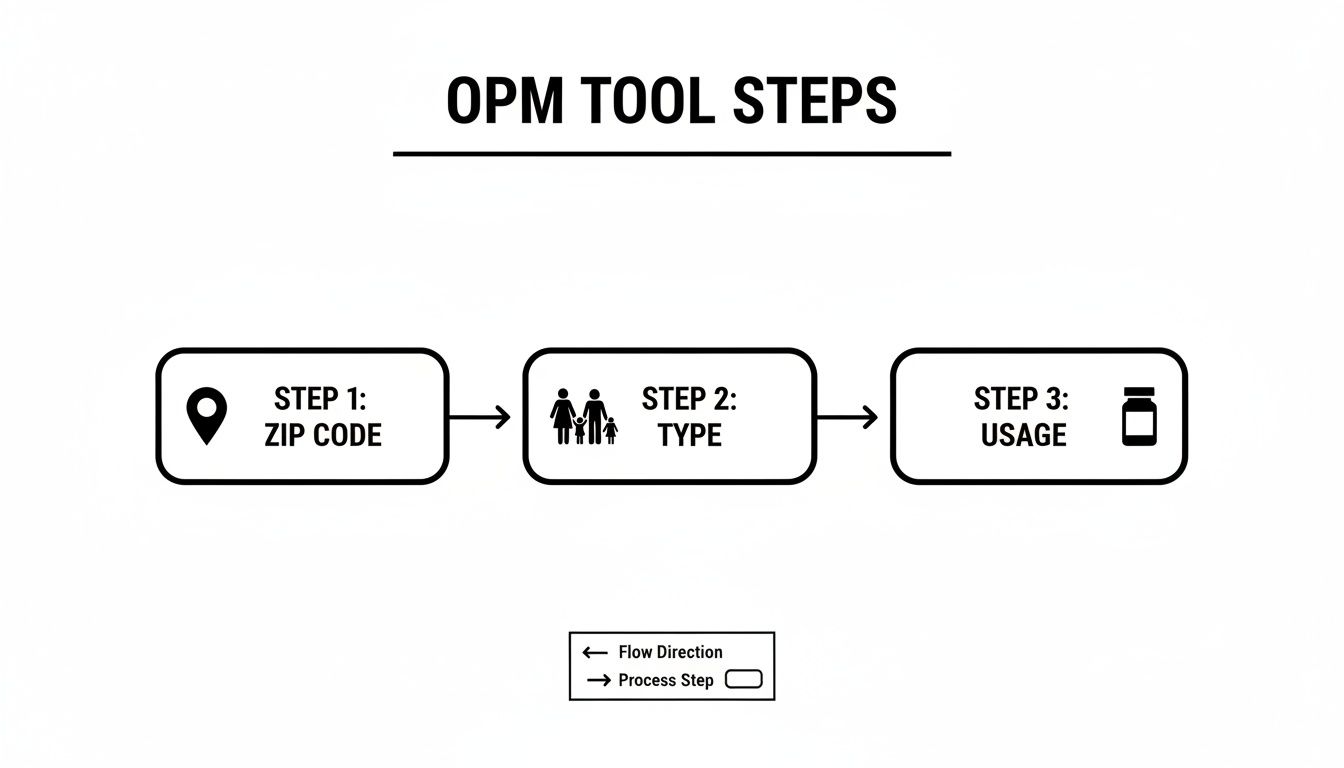
It really is that straightforward—just plug in your location, family size, and expected health usage, and the tool starts generating results tailored specifically for you.
For Brenda, this tool is a game-changer for modeling that "what-if" surgery scenario. By adding the estimated costs for hospitalization and specialist visits, she can see exactly how different plans would handle a major medical event.
The tool will likely steer her toward a plan with a lower out-of-pocket maximum, even if it means paying higher premiums. This provides a crucial financial safety net, capping her potential expenses in a year with big medical bills and giving her peace of mind as she heads into retirement.
Sample Plan Comparison for Different Federal Employee Profiles
To bring it all together, here’s a snapshot of how the tool's output might look for our three personas. Notice how the "best" plan changes dramatically based on individual circumstances.
| Comparison Point | Persona 1 (Young & Healthy) | Persona 2 (Family with Chronic Condition) | Persona 3 (Nearing Retirement) |
|---|---|---|---|
| Top Plan Recommendation | Low-Premium HDHP | Mid-Tier PPO | High-Option PPO/HMO |
| Key Factor | Lowest possible premium + HSA eligibility | Low specialist copays & robust Rx coverage | Low out-of-pocket maximum |
| Estimated Annual Premium | $1,800 | $6,500 | $7,200 |
| Estimated Out-of-Pocket | $300 (routine visits) | $2,500 (copays, Rx) | $4,000 (surgery scenario) |
| Total Estimated Annual Cost | $2,100 | $9,000 | $11,200 |
This table makes it crystal clear: the lowest premium plan is only the most cost-effective option for Alex, whose healthcare needs are minimal. For the Millers and Brenda, choosing a plan based on premium alone would have been a costly mistake.
Looking Beyond the Numbers with Expert Insights

An FEHB plan comparison tool is a fantastic starting point. It takes a bewildering number of options and narrows them down to a handful that make sense for you financially. But it’s important to remember what the tool is doing: it’s running the numbers. The output is based purely on quantitative data—premiums, deductibles, and your best guess at future medical usage.
The numbers alone can't tell the whole story. If you rely only on the tool's output, you risk overlooking the real-world details that make a plan either a perfect fit or a source of constant frustration. Think of the tool as your first step, never your last.
What the Comparison Tool Misses
The tool gives you the skeleton of a comparison, but you need an expert to help put the meat on the bones. Several critical factors just can't be captured by an algorithm and require a more human look.
- Provider Network Quality: Sure, the tool can check if your doctor is in-network. But it can’t tell you if that network is actually any good in your specific area. Are there enough specialists? How long is the wait for a new patient appointment?
- Customer Service Reputation: A plan can look amazing on paper, but if its customer service is a nightmare, you'll feel it every time you need to sort out a claim or get a pre-authorization.
- Prescription Formulary Complexity: The tool might confirm your medication is on the formulary, but it won’t flag potential hurdles like step therapy (forcing you to try cheaper drugs first) or cumbersome prior authorization requirements that can delay your care.
An automated comparison tool gives you the "what"—the costs and basic coverage. Expert analysis reveals the "how"—how you will actually experience that plan day-to-day, from booking an appointment to getting a prescription filled.
Why Sticking with Your Old Plan Is Risky
Simply rolling over last year’s plan has become an incredibly risky strategy, mainly due to wild swings in premium costs. After jumping 8.7% in 2023, the average premium share paid by enrollees is set to surge another 13.5% in 2025 and a projected 12.3% for 2026. That's a potential 25% hike in just two years.
This volatility has understandably shaken federal employees' confidence. Recent surveys show that only 50% plan to stick with their 2026 plan, a 30% drop from the previous year, underscoring why comparing plans is more critical than ever. You can read more about the impact of these premium surges on federal employees.
This is exactly why the raw data from an FEHB plan comparison tool needs to be paired with experienced guidance. A benefits professional adds the missing context, helping you understand what the numbers mean for your life and ensuring the plan you choose works just as well in practice as it does on paper.
Taking Action with a Personalized Benefits Review
You’ve done the hard work of running the numbers. Now you know why an FEHB plan comparison tool is a must-have for getting a handle on rising premiums and the hundreds of plan options out there. Inputting your family’s real-world needs is the only way to turn a mountain of data into a manageable shortlist.
But the tool’s output isn’t the finish line—it’s the starting point. The numbers give you a solid foundation, but the best choice also depends on things the data can't always capture, like network quality, customer service headaches, and whether the plan will be stable in the long run. This is where you shift from analyzing data to making a final, confident decision that protects your family's health and your wallet.
The most logical next step is to run your findings by a professional. A personalized benefits review adds a crucial layer of expert insight to the raw data, making sure the plan you choose works just as well in practice as it does on paper.
Secure Your Financial Future
Going through this process puts you squarely in the driver's seat. You’re no longer just rolling over last year's plan out of habit; you're actively selecting the best possible coverage for your specific circumstances. That kind of proactive approach is exactly how you build a secure financial future where your benefits actually support your life goals.
A benefits review is like a final inspection. It confirms your chosen plan aligns not just with your health needs, but with your bigger financial and retirement strategy, helping you sidestep costly errors down the road.
This final check is what our team at Federal Benefits Sherpa does best. We specialize in helping federal employees translate comparison tool results into a smart, cohesive benefits strategy.
By scheduling a free 15-minute benefits review, you get a chance to talk through your options, get answers to those nagging questions, and feel confident you’ve made a fully vetted decision. You can learn more in our guide to navigating the complexities of the federal health insurance open season.
Frequently Asked Questions
When you're sorting through your federal benefits, questions are bound to come up. This is especially true when you're using a new tool to make big decisions. Here are a few common questions we hear about the FEHB plan comparison tool.
How Accurate Is The FEHB Plan Comparison Tool?
The tool’s accuracy really comes down to the quality of information you feed it. Its cost projections can be incredibly precise, but only if you provide realistic estimates for your family's medical needs—things like doctor visits, potential hospital stays, and the exact prescription drugs you take.
Essentially, think of it like a powerful calculator. The results it gives you are a direct reflection of the numbers you punch in. Garbage in, garbage out, as they say.
When Is The Best Time To Compare Plans?
The absolute best time to dive in and compare plans is during the yearly Federal Benefits Open Season. This window, which usually runs from mid-November to mid-December, is your main opportunity to make changes.
Of course, life happens. You can also use the tool if you experience a Qualifying Life Event (QLE) like getting married or having a baby. These events open up a special enrollment period, allowing you to adjust your coverage outside of the usual Open Season.
Your health insurance isn't just a safety net; it's a fundamental piece of your entire financial plan. Even a small shift in premiums or out-of-pocket expenses can ripple through your retirement savings and monthly budget. Keeping a sharp eye on your plan options ensures your coverage is always working for you, not against your long-term goals.
A benefits review with Federal Benefits Sherpa can give you the confidence that your health plan choice fits perfectly with the rest of your financial picture. Schedule your free 15-minute consultation today.
