Federal Employee Health Benefits Eligibility: 2026 Guide
A new federal employee opens a benefits portal, sees a deadline approaching, and assumes the health plan will still be there whenever they're ready. A few months later, they discover that being eligible for FEHB and enrolling are two different things. Near retirement, a similar misunderstanding can affect whether coverage continues after the last day at work.
Federal employee health benefits eligibility depends on your position, employment status, enrollment history, family relationships, and retirement path. The rules can also turn on dates and documents that are easy to overlook. This guide connects those pieces so you can identify the traps before they become enrollment or retirement problems.
What FEHB Eligibility Actually Means
The new hire had read the benefits packet twice. It listed plan choices, family tiers, and payroll deductions, but no one had clearly explained the most important question: “Am I eligible, and what happens if I wait?” The portal showed time remaining, yet the employee assumed coverage would begin automatically.
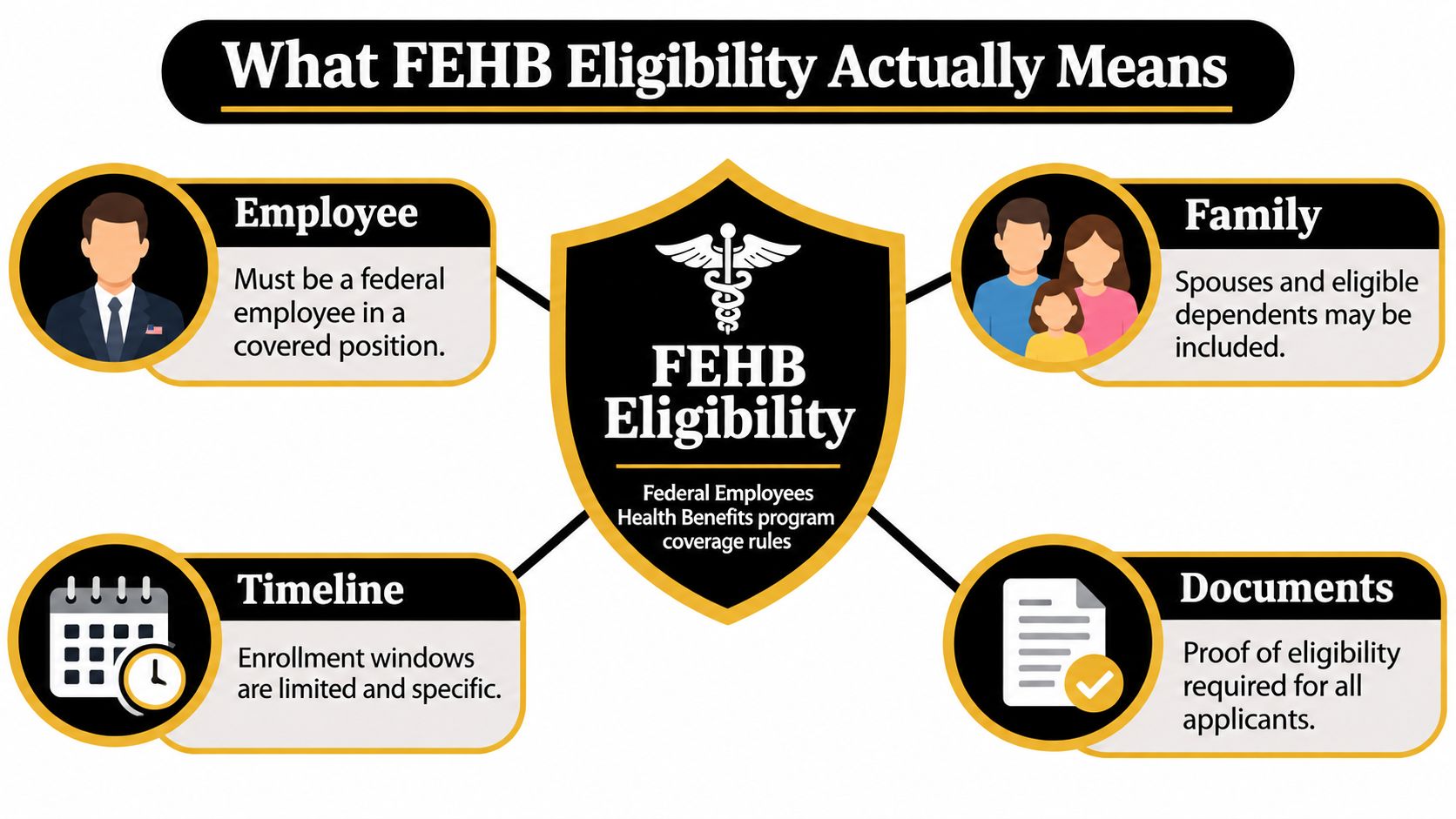
That assumption is risky. Federal civilian employees whose positions aren't excluded by law or regulation are generally eligible to elect coverage through the Federal Employees Health Benefits Program, commonly called FEHB. Eligibility gives you the right to make an election. It doesn't mean you're enrolled, and it doesn't mean coverage has already started. OPM's enrollment guidance explains that a newly eligible employee has a 60-day enrollment window and that an employee who doesn't elect a plan or formally decline coverage is treated as having declined it.
The rule follows the position
OPM rules, not informal office custom, determine whether a position is covered. Employment category, appointment conditions, position type, and retirement-system status all matter. Two people working in the same agency, or even in the same office, may have different FEHB rights because their appointments aren't structured the same way.
That status can change. A move from a covered position to an excluded position, or a shift from a regular tour of duty to an intermittent arrangement, may change access to FEHB. Treat every personnel change as a benefits checkpoint, not merely an administrative update.
For a plain-language orientation, compare the guide to the Federal Employees Health Benefits Program, then confirm your individual status with your employing office. Keep your own records rather than relying only on what appears in a benefits portal.
Practical rule: Eligibility is the doorway. Enrollment is the action that gets you through it.
Coverage normally becomes effective on the first day of the first pay period that begins after the enrollment request is received and follows a pay period in which you're in pay status. That means the effective date may not match the day you submit the form. If you're also comparing federal coverage with Medicare-related equipment needs, a separate resource on how to rent portable oxygen equipment through Medicare may help clarify that Medicare and FEHB answer different coverage questions.
Employee Categories That Qualify for Coverage
A job title rarely tells the whole story. The appointment and tour of duty recorded in your personnel documents matter more than the name of your office or the fact that a coworker has FEHB.
Start with your SF-50, the personnel action document that records important employment details. This explanation of what an SF-50 form means can help you locate the information you need before asking HR to confirm your category.
| Employee Category | Generally Eligible? | Key Condition |
|---|---|---|
| Full-time employee | Generally yes | The position must be covered and the employee must meet applicable eligibility rules |
| Part-time employee | Generally yes | Coverage and the employee share of premiums are affected by the scheduled hours |
| Temporary employee | Sometimes | The appointment and expectation of continued employment must satisfy applicable conditions |
| Intermittent employee | Generally no | The employee usually lacks a regular tour of duty |
| Seasonal employee | Depends | Eligibility follows the appointment and covered-position conditions, including periods of work |
A full-time employee in a covered position usually has the clearest path. The important step is still to elect coverage during the applicable enrollment period. Full-time status doesn't enroll you by itself.
A part-time employee may also qualify, but the premium arrangement differs from the arrangement for a full-time employee. The number of scheduled hours affects how the government contribution and employee share are calculated. Don't assume that a part-time appointment means “no FEHB,” and don't assume it costs the same as coverage for a full-time coworker.
Temporary and seasonal appointments need closer review
Temporary employment requires more than a quick look at the word “temporary.” The appointment's expected duration, scheduled hours, and likelihood of continuation can affect eligibility. Ask HR to explain how the appointment is classified and whether the position is treated as eligible under the applicable FEHB rules.
Seasonal employees face a similar issue. A recurring work pattern doesn't automatically answer whether coverage is available during active service or what happens during a nonwork period. Get the answer in writing before declining coverage or assuming a later enrollment opportunity will fix the decision.
Intermittent employees are the category that catches people by surprise. Because they generally don't have a regular tour of duty, they're usually not eligible in the same way as employees with scheduled work. If your status changes from intermittent to scheduled, or the reverse, ask HR to review FEHB eligibility immediately.
The practical lesson is simple: position category determines whether FEHB is on the table at all. Your enrollment decision comes after that determination.
The Three Windows When You Can Enroll
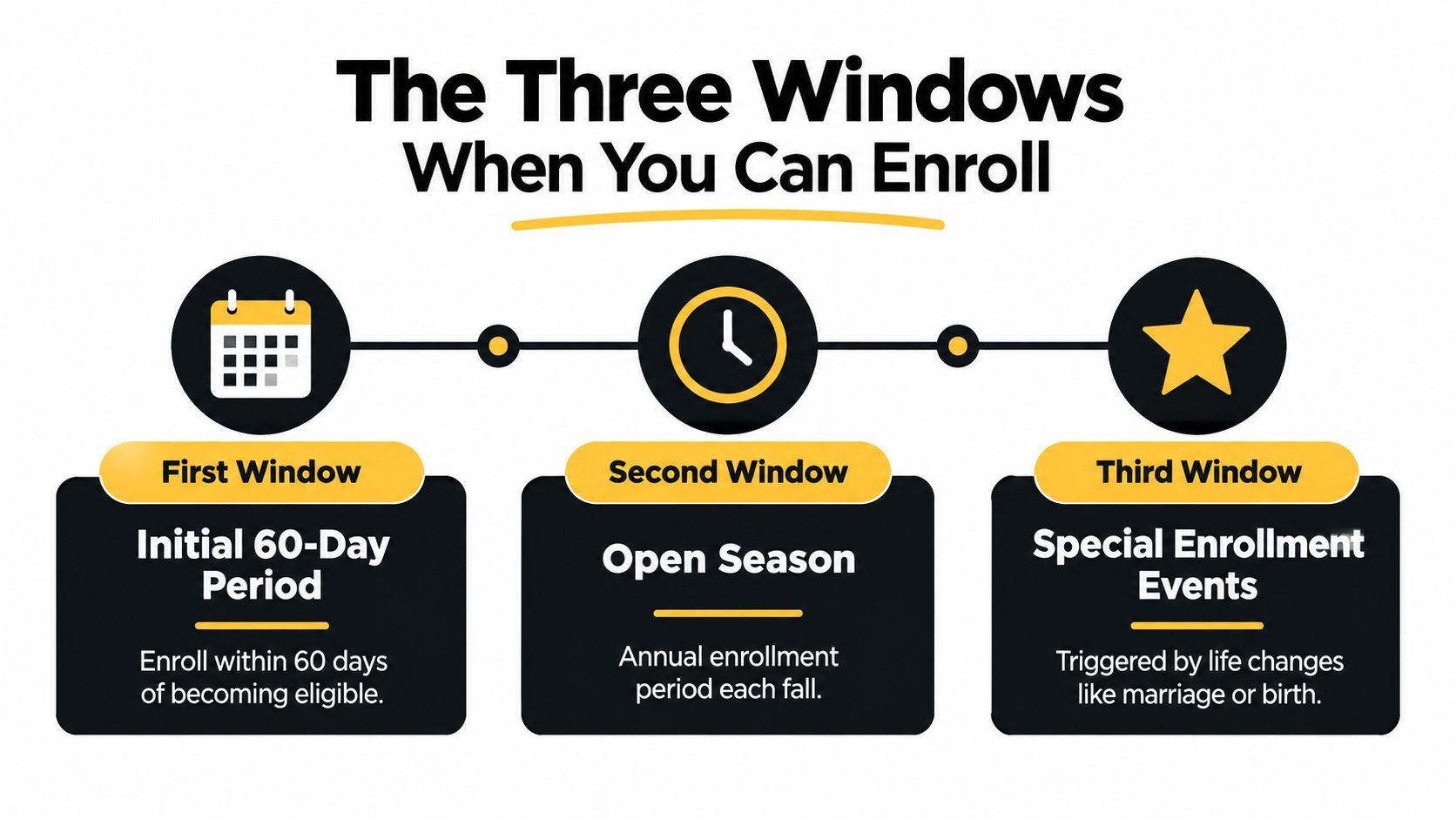
FEHB enrollment isn't continuously open. Most employees reach coverage through one of three paths, and each path has its own trigger date and effective-date rules.
The first path is the initial enrollment opportunity. A newly eligible employee generally has 60 days after becoming eligible to elect coverage. The employing office must remind the employee about the deadline and ensure that an election is made on time, but you shouldn't treat the reminder as a substitute for tracking your own deadline.
If you don't elect a plan or formally decline coverage during that period, you're treated as having declined FEHB. Your next opportunity will generally be Open Season or a qualifying life event, not an informal request to HR whenever you happen to remember.
Open Season is the recurring route
The annual Federal Benefits Open Season generally runs from mid-November through mid-December, as described by OPM's enrollment reference. It gives eligible employees an opportunity to enroll or change coverage after the initial window has closed.
Open Season elections generally take effect on the first day of the first full pay period beginning in January of the following year. That effective date isn't the same as the date you submit an election, so check the confirmation carefully. A current guide to FEHB Open Season dates can help with calendar planning, but your agency's instructions control the action you need to take.
Qualifying events create a special window
A qualifying life event, or QLE, can open a special enrollment period. Common examples include marriage, divorce, birth, adoption, acquisition of a foster child or stepchild, death of a spouse or dependent, and loss of a child's eligibility.
You generally have 60 days from the qualifying event to act. The clock is tied to the event, not to the date you finally locate the paperwork. Agencies, carriers, or OPM may ask for proof of both the event and the family member's eligibility.
Use a personal QLE calendar. Save the event date, submission date, supporting documents, and confirmed effective date. Coverage changes aren't necessarily automatic, and the date a family member becomes eligible may differ from the date the new election becomes effective.
Family Members Who Can Be Covered
A family election isn't a blank check. FEHB defines which relatives may be covered, and the relationship alone may not settle the question. Documentation, age, dependency, timing, and the type of enrollment all matter.
A spouse generally qualifies, but common-law marriage has a specific limitation. The marriage must have been initiated in a state that recognizes common-law marriage. Moving later to a state that doesn't recognize that form of marriage doesn't automatically answer every documentation question, so keep the records showing where and how the marriage was established.
Eligible children generally include children under age 26. Eligibility usually isn't defeated merely because a child is married or attends school. A birth certificate, adoption record, or other acceptable documentation may be requested when the child is added.
The less obvious family categories
A disabled child over age 26 may remain eligible only when the disabling condition began before age 26 and the child is incapable of self-support. The practical difficulty is often proof of onset. Medical records that establish the current condition may not establish when it began, so organize historical records before a carrier or agency asks for them.
Foster children require their own documentation. The employee generally must show regular and substantial support and provide the required certification. A caregiving relationship that feels like family may still need formal evidence before FEHB will recognize it.
Stepchildren can also create timing and proof issues. Adding a child after a marriage may require documentation of the marriage and the child's relationship to the spouse. Don't assume that selecting “family” in an enrollment system completes the eligibility review.
Choosing the enrollment tier
Self Plus One covers the enrollee and one eligible family member. Self and Family covers the enrollee and eligible family members. The appropriate choice depends on who qualifies and who needs coverage, not on whether the employee has a spouse or children.
Surviving family members face another test. They generally need qualifying FEHB coverage at the employee's death and entitlement to a survivor annuity to continue enrollment. That's why family eligibility should be reviewed alongside survivor-benefit planning, rather than left to the claims process.
OPM's family-member eligibility guidance is the right reference point for unusual relationships. Keep copies of marriage, birth, adoption, foster-care, and medical records in a secure benefits file.
Keeping FEHB Coverage Into Retirement
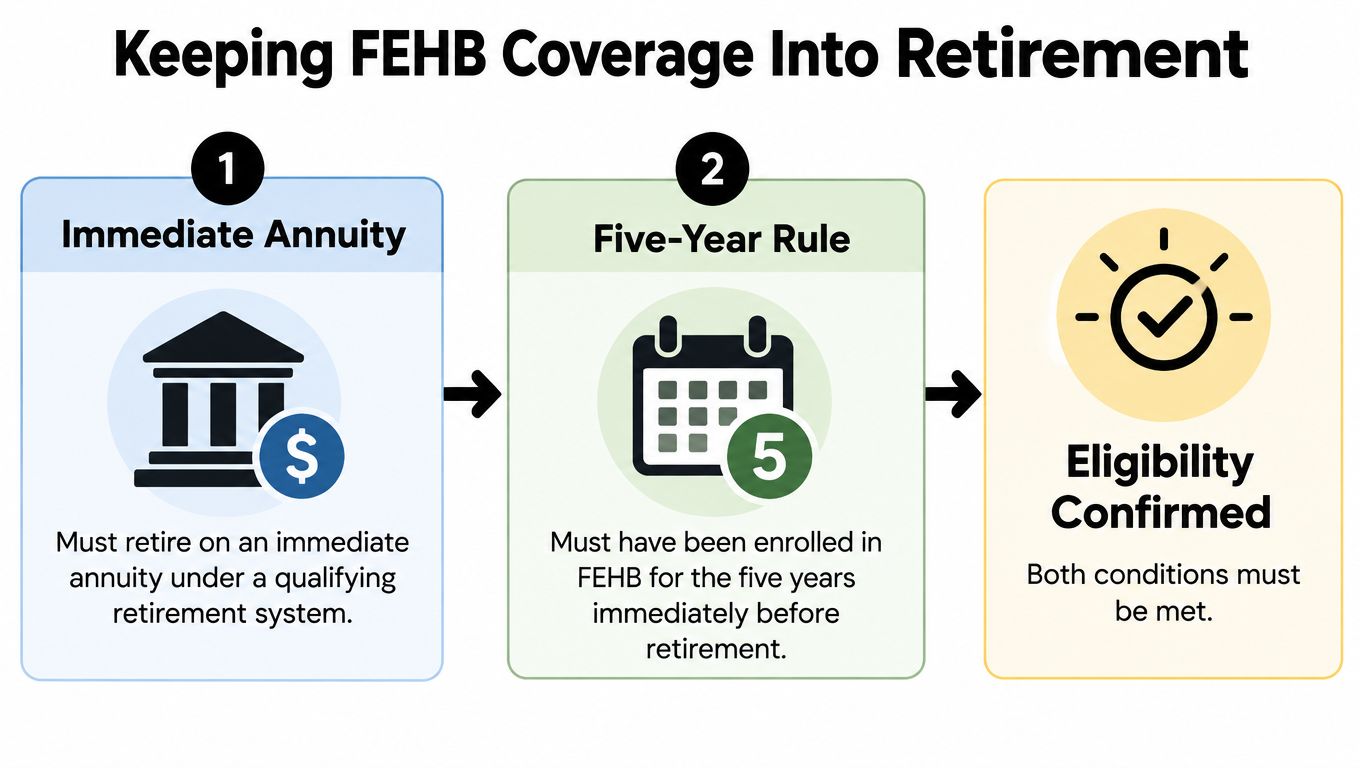
Retirement eligibility is not an automatic extension of active-employee coverage. An employee generally needs to satisfy two connected requirements: retirement under a federal civilian retirement system on an immediate annuity, and the required FEHB enrollment history.
The coverage-history test usually looks at the five years of service immediately before retirement. You must have been enrolled in FEHB or covered as an eligible family member during that period. The relevant measurement runs backward from the date your annuity entitlement begins, not from your last day in the office.
That distinction matters. A person may stop working on one date, have an annuity begin on another date, and need to evaluate the coverage history against the annuity date. A break in enrollment, a temporary appointment, or a switch to non-FEHB coverage can become important when the record is reviewed.
The continuous-service alternative
Employees with fewer than five years of federal service may use an alternative test. Instead of five years immediately before retirement, the employee generally must have remained enrolled in or covered by FEHB for the entire period since the first opportunity to enroll.
Coverage doesn't have to stay in the same plan. The central issue is whether the employee remained continuously enrolled in FEHB or covered as an eligible family member. Qualifying TRICARE coverage may count toward the participation requirement, but the employee still must be enrolled in an FEHB plan when retiring.
That last condition is easy to miss. TRICARE may help with the participation history, but it doesn't replace the requirement to have FEHB enrollment at retirement.
Retirement review question: “What was my coverage status on every relevant date, and when did my annuity entitlement begin?”
OPM explains that when an eligible employee retires, the retirement system transfers the enrollment and coverage continues automatically. The process protects an existing eligible enrollment. It doesn't create enrollment for someone who retired without FEHB coverage.
Build the record before retirement paperwork
A pre-retirement review should verify the retirement system, immediate-annuity eligibility, current FEHB enrollment, prior coverage as a family member, and any gaps or category changes. Ask HR or OPM to address discrepancies while you still have time to investigate them.
Start earlier than the retirement application. A review well before your planned retirement date gives you time to locate records and understand whether a personnel change affected eligibility. Don't wait until the final forms are in front of you.
Edge Cases That Trigger Real Disputes
The clean examples are easy. Disputes usually begin with a relationship that sounds valid but lacks the required proof, or with a retirement category the employee assumed would work like every other federal appointment.
Consider a common-law spouse. The couple may regard themselves as married, but FEHB recognition depends on whether the marriage was initiated in a state that recognizes common-law marriage. A later move doesn't erase the history, but the employee may need records that establish where the marriage began and under what law.
A disabled adult child presents a different problem. The family may have extensive recent medical documentation, yet the key question is whether the disabling condition began before age 26 and prevents self-support. If the records don't establish onset, the dispute may focus on evidence rather than the family's lived experience.
A tribal employee or retiree can face an especially important category distinction. OPM states that individuals retiring from tribal employment cannot continue FEHB coverage. Someone who assumes that every federal-related retirement carries the same insurance option may discover the problem only when retirement is already underway.
Surviving family members must satisfy both sides of their rule. They need qualifying coverage when the employee dies and entitlement to a survivor annuity. A family relationship by itself doesn't guarantee continuation.
These situations require careful reading of dates, documents, and statutory language. For broader context on understanding ambiguous statutes, remember that an agency or carrier may apply a specific definition even when ordinary language seems clear.
Keep a dispute file with:
- Relationship records: Marriage, birth, adoption, foster-care, or guardianship documents.
- Medical evidence: Records addressing both the condition and its onset when disabled-child eligibility is involved.
- Employment records: SF-50 documents, appointment changes, enrollment confirmations, and retirement-system information.
- Date history: The event date, election date, effective date, retirement date, and annuity start date.
Common Misconceptions and Final Checks
“I can enroll whenever I want.” You generally can't. The initial enrollment window, Open Season, and qualifying life events each have their own rules.
“Retirees get FEHB for free.” Continued coverage requires eligibility, and premiums don't disappear because employment ends.
“Every family member transfers automatically.” Each covered person must fit an eligible category, and documentation may be required.
“Tribal employees have the same retirement coverage options.” OPM states that individuals retiring from tribal employment can't continue FEHB coverage.
Before acting, confirm your enrollment status, review coverage gaps, document life events promptly, and check that your family records support each person's eligibility. If retirement timing, blended-family documentation, disabled-child eligibility, or tribal employment is involved, get a personalized review rather than relying on a portal label.
Federal Benefits Sherpa offers personalized federal-benefits guidance, including benefit reviews and gap analysis focused on retirement income and health coverage. Visit Federal Benefits Sherpa to request a review of your FEHB enrollment history, family eligibility questions, or retirement coverage plan.
