
Blogs

Blog title place here
We understand that every federal employee's situation is unique. Our solutions are designed to fit your specific needs.

Blog title place here
We understand that every federal employee's situation is unique. Our solutions are designed to fit your specific needs.

Blog title place here
We understand that every federal employee's situation is unique. Our solutions are designed to fit your specific needs.
What Is VERA? a Guide to Voluntary Early Retirement
VERA is a temporary OPM authority that lets agencies lower age and service requirements so eligible federal employees can retire early during restructuring or downsizing. It isn't an automatic cash bonus, and accepting it changes the timing of your annuity, healthcare coverage, TSP access, Social Security income, and survivor benefits.
You may be hearing about VERA because your agency issued a restructuring memo, announced a workforce-reduction plan, or started circulating RIF rumors. In that moment, the offer can look like an obvious escape route. It isn't. VERA can open a retirement door that would otherwise remain closed, but walking through it may permanently reduce the income and protections you would've built by staying.
The right question isn't, “Am I eligible?” It's “What does retiring now cost compared with waiting?”
What VERA Is and What It Isn't
Your agency offers VERA after identifying a restructuring or downsizing need, and the offer can make retirement possible before you meet the standard age and service combination. The decision still comes down to your numbers, not the appeal of leaving sooner.
Voluntary Early Retirement Authority, or VERA, is a temporary authority approved through the Office of Personnel Management. It lets an agency lower normal age and service requirements for designated employees. OPM describes VERA as a workforce-restructuring tool, not a universal retirement program. Review the OPM explanation of Voluntary Early Retirement Authority for the governing framework.
VERA changes eligibility. It does not improve the pension formula, create an automatic cash payment, preserve every benefit, or guarantee future federal employment. Your high-3 salary and creditable service remain the foundation of your annuity calculation. Leaving earlier can also shorten your saving period and change when you draw from TSP or claim other income.
The agency controls the offer
You cannot create a VERA opportunity simply by asking to retire early. Your agency identifies the organization, position, geographic area, or employee group covered by its approved authority, then sends eligible employees a written offer. The offer should state the retirement window and the deadline for making an election.
The choice is voluntary. Declining generally leaves you under the agency's regular workforce actions and retirement rules. It does not turn the offer into a mandatory separation, although the larger restructuring could still involve a RIF or another employment action.
Practical rule: Treat the offer as a decision window, not evidence that your retirement income is ready.
VERA is separate from a RIF
A reduction in force, or RIF, is an involuntary workforce action with different rules. A discontinued service retirement may follow an involuntary separation or another qualifying separation. VERA is an agency-approved opportunity for the employee to elect retirement.
The route you take can affect the retirement authority, annuity reductions, reemployment rules, health coverage, and supplement eligibility. Compare VERA with standard retirement, VSIP, and any involuntary separation option before signing.
Run three calculations:
- Income: What annuity will your high-3 salary and service history produce now, and what income will you give up by leaving?
- Insurance: Do you meet the continuation requirements for FEHB and FEGLI?
- Timing: How will the decision affect TSP withdrawals, the FERS Special Retirement Supplement, Social Security, and survivor income?
VERA can be a sensible exit when the offer fits your service record, cash-flow needs, healthcare plans, and survivor-benefit goals. It can also be an expensive timing shift presented as an opportunity.
Who Qualifies Under VERA Rules
Your agency's written offer sets the threshold you must meet, typically age 50 with 20 years of creditable service or any age with 25 years of service. Certain law enforcement officers, firefighters, and other covered special-category employees may qualify under a separate 25-and-out provision, depending on the authority and position coverage.
Use those combinations as the first screen, then verify the conditions behind them. The agency must have approved VERA authority, your position must fall within the offer, and your service must count under the retirement system that covers you. For a plain-English explanation of the broader rules, review this guide to federal retirement eligibility.
Compare the basic combinations
| Retirement System | Age | Service Required | Notes |
|---|---|---|---|
| FERS or CSRS | 50 | 20 years | Must be covered by the agency's VERA offer |
| FERS or CSRS | Any age | 25 years | Must be covered by the agency's VERA offer |
| Covered law enforcement or firefighter position | As specified by the authority | 25 years | Special-category rules and position coverage must be confirmed |
The age and service test answers only one question. A FERS employee still needs to confirm how the offer interacts with the Minimum Retirement Age plus 10-year rule and the standard 60-and-20 pathway. Read the agency's documentation carefully before assuming either route applies to your election.
CSRS employees need a formal service review as well. A CSRS Offset calculation follows the applicable CSRS rules, while the connection to Social Security requires separate examination. Ask payroll or your retirement counselor to identify deposits, redeposits, military service, temporary service, and breaks in service. An estimate that skips those items can produce the wrong answer.
Verify before you sign
Check your service computation date, SF-50 records, retirement system coverage, and every period that may require a deposit or redeposit. Service that appears on a personnel record may not be creditable for the specific retirement purpose being tested.
Read the election deadline twice. Your agency's plan may provide an active registered letter and a 60-day period after the offer to make an election, but the written offer controls. Missing that deadline can end the opportunity even if your age and service otherwise qualify.
Run a high-3 and service-history estimate before deciding. Compare the annuity you would receive now with the income you would give up by leaving, then check FEHB and FEGLI continuation requirements, TSP timing, the FERS Special Retirement Supplement, Social Security, and survivor income.
Your final self-screen should identify your age, creditable service, retirement system, position coverage, and offer deadline. If those facts align, proceed to the financial analysis. Eligibility opens the review. It does not settle the decision.
How VERA Compares to VSIP and Standard Retirement
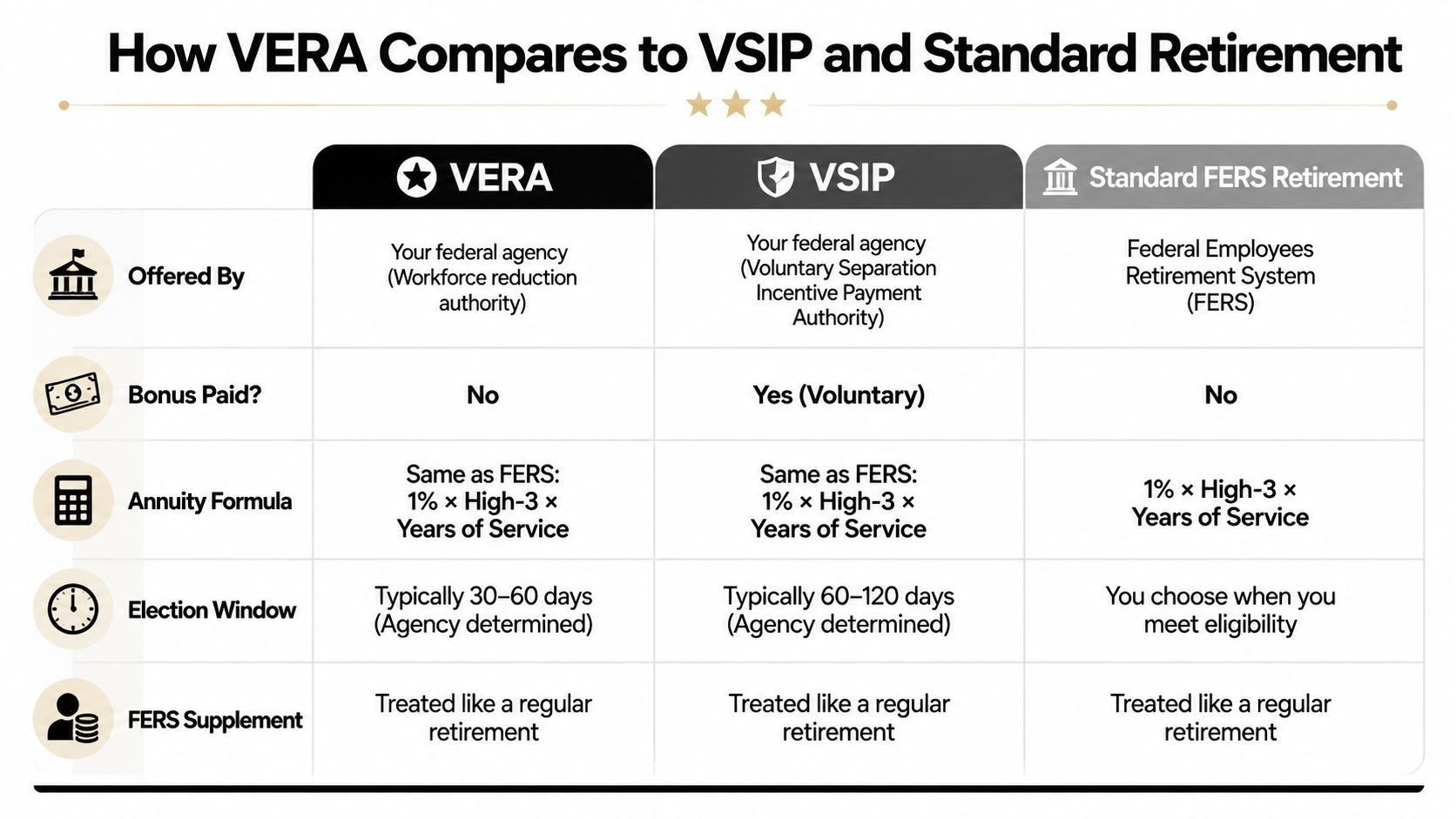
VERA and VSIP often appear together, which is why employees confuse them. The key distinction is that VERA can lower an applicable age and service threshold, while VSIP may add a taxable separation payment. Standard retirement uses the ordinary eligibility rules without an agency waiver.
| Decision factor | VERA | VSIP | Standard retirement |
|---|---|---|---|
| Offered by | Agency using OPM-approved authority | Agency under an approved separation incentive | Employee under regular retirement rules |
| Bonus paid | No automatic bonus | Voluntary separation payment may apply | No agency buyout |
| Main function | Lowers an applicable age and service barrier | Encourages an employee to separate | Applies normal eligibility rules |
| Annuity formula | Regular retirement formula | Regular retirement formula if separately eligible | Regular retirement formula |
| Election timing | Written agency deadline | Written agency deadline | Employee chooses when eligible |
| FERS supplement | Depends on qualifying retirement conditions | Depends on the retirement path | Depends on qualifying retirement conditions |
A VSIP payment is taxable income. It does not enter your high-3 salary or raise the percentage used to calculate your basic annuity. Treat it as transition cash, not as a substitute for retirement income. Compare the payment with the annuity you give up by leaving earlier, along with the value of continued salary, TSP contributions, and employer benefits.
The offer can contain more than one authority
An agency may include VERA and VSIP in the same workforce package. Eligibility for one does not automatically provide the other. Read the offer language, agency eligibility list, repayment terms, and reemployment conditions together before signing.
The 31-day lockout tied to a VSIP affects federal health insurance and reemployment. Account for those restrictions, as well as the payment's tax treatment, before counting the incentive as available retirement capital.
VERA permits an earlier retirement. VSIP is compensation the agency may attach to that decision. Value each separately.
Standard retirement is your benchmark. Calculate the annuity available under VERA, then compare it with the amount available at your normal unreduced retirement point. Use your high-3 salary and creditable service history in both estimates. A buyout can improve first-year cash while leaving you with a smaller lifetime annuity, a shorter supplement window, or a more difficult healthcare transition. The right decision rests on the full income and benefit tradeoff, not the payment alone.
Effects on FERS Annuity, TSP, FEHB, FEGLI, and Social Security
VERA changes the timing of your retirement income stack. It doesn't replace the underlying FERS formula. For most FERS employees, the basic annuity uses 1% of the high-3 average salary multiplied by creditable years and months of service. The 1.1% multiplier can apply when the employee retires at age 62 or later with at least the required service. VERA doesn't add a special bonus multiplier.
That creates the central math problem. Leaving earlier usually means fewer months of service and a lower high-3, while waiting can increase both. The correct comparison is not “annuity now versus no annuity.” It's the value of immediate payments compared with a potentially larger joint benefit later.
Map every benefit separately
| Benefit | Effect under VERA | Key condition |
|---|---|---|
| FERS annuity | Calculated under the applicable regular formula | Depends on high-3, creditable service, multiplier, and retirement path |
| Special Retirement Supplement | May provide a bridge before Social Security eligibility | Requires the applicable age and service conditions |
| TSP | Separation date affects withdrawal taxation and penalty exposure | Rule of 55 depends on the calendar year of separation and age |
| FEHB | Can continue into retirement if the coverage test is met | Continuous qualifying coverage for the five years immediately before retirement |
| FEGLI | Basic and optional coverage may continue under retirement rules | Same five-year qualifying coverage test applies |
| Social Security | VERA doesn't change the earnings record or full retirement age | Claiming decision remains separate from the federal annuity |
The FERS Special Retirement Supplement can be available when the employee retires under qualifying age and service conditions. It isn't a permanent Social Security payment, and it can be affected by earnings before full retirement age. That means a retiree who immediately takes substantial outside employment needs to model the earnings test rather than assume the supplement will remain unchanged.
TSP timing deserves its own analysis. The rule of 55 can help when separation occurs in or after the calendar year the employee reaches 55. If you separate earlier, withdrawals from traditional TSP balances may face ordinary income tax and the 10% early withdrawal penalty, unless an exception applies or the withdrawal comes from a Roth balance under the applicable rules. Use this TSP withdrawal options guide to organize the account and tax questions before separating.
Protect insurance eligibility
FEHB continuation depends on being covered continuously by FEHB for the five years immediately before retirement, subject to the governing rules and qualifying coverage exceptions. The final portion of that period also matters, so review whether your coverage was held in a qualifying position rather than assuming every federal enrollment period counts.
FEGLI has a similar five-year qualifying coverage requirement for continuation into retirement. The 31-day free coverage period after separation is not the same thing as permanent continuation. If you haven't met the test, you may have limited conversion options rather than the retiree coverage you expected.
Social Security remains independent. VERA doesn't alter your earnings record or change the calculation of your full retirement age. It does change the number of years your FERS annuity and, where available, your supplement must carry you before Social Security becomes part of the plan.
Survivor elections make the decision even more personal. A smaller annuity generally produces a smaller survivor benefit when the survivor election is based on that annuity. Compare the reduced income you receive while alive with the joint income your spouse or other eligible survivor would receive if you wait.
Two Real Federal Employee VERA Scenarios
The same VERA authority can produce two completely different decisions. The difference usually comes from service history, age, insurance records, and the employee's ability to fund the gap between separation and later retirement milestones.
Maria has a strong eligibility case
Maria is 55, a GS-12 step 7 employee with 30 years of FERS service. Her age and service place her above the common VERA threshold, although she's still below the point at which she would otherwise reach an unreduced FERS retirement based on her age and service combination.
Using the illustrative multiplier in her planning model, 30 years multiplied by 1.1% equals 33% of her high-3. That calculation is only an illustration of the formula, not a promise of her final annuity. Her official estimate must account for months of service, high-3 timing, survivor election, and the exact retirement authority.
Because she meets the applicable age and service conditions, Maria may qualify for the Special Retirement Supplement until Social Security eligibility at 62. She has also maintained continuous FEHB coverage, so she appears positioned to satisfy the five-year continuation test.
Her decision is still not automatic. Working longer could add service, raise her high-3, and produce a larger lifetime annuity. Maria should compare the value of immediate payments and the supplement against five more years of salary, TSP contributions, agency benefits, and a stronger survivor-income base.
David has a hidden insurance problem
David is 48, a GS-13 step 4 employee with 18 years of FERS service. His agency's VERA offer covers his position and he meets the age and service trigger specified by the agency, but his FEHB record contains a break five years ago while he was serving in a temporary appointment.
That break may prevent him from satisfying the five-year qualifying coverage test. If so, FEHB continuation ends at separation, and David must arrange private coverage through another source. His VERA eligibility doesn't repair the insurance gap.
David also doesn't qualify for the FERS Special Retirement Supplement because he's below the applicable Minimum Retirement Age. His illustrative annuity calculation is 18 years multiplied by 1%, or 18% of high-3. Traditional TSP withdrawals before age 59½ may also face the 10% early withdrawal penalty unless an exception applies.
David should treat VERA as an insurance and cash-flow decision, not a retirement offer. His service computation date, coverage history, TSP tax buckets, and private healthcare options could outweigh the attraction of leaving federal service now.
Your Pre-Decision VERA Checklist
Before signing the election form, make sure each risk has a documented answer backed by your records, not a coworker's estimate or an online calculator. A sound decision connects your service history, high-3 salary, cash flow, healthcare, and survivor income.
Confirm the offer. Verify that your position, organization, and competitive area are covered. Keep the written agency notice and identify the exact age and service trigger that supports your eligibility.
Rebuild your service record. Gather your SF-50 documents and service computation date. Confirm retirement system coverage, deposits, redeposits, military credit, temporary service, and breaks in service.
Run three annuity comparisons. Calculate VERA now, retirement at your normal Minimum Retirement Age or MRA plus 30 where applicable, and a later full-retirement milestone. Apply the appropriate 1% or 1.1% multiplier, then test how each high-3 assumption changes the lifetime annuity.
Audit FEHB and FEGLI. Review the last five years of enrollment and confirm qualifying coverage. A recent change, temporary appointment, leave period, or break can affect continuation after separation.
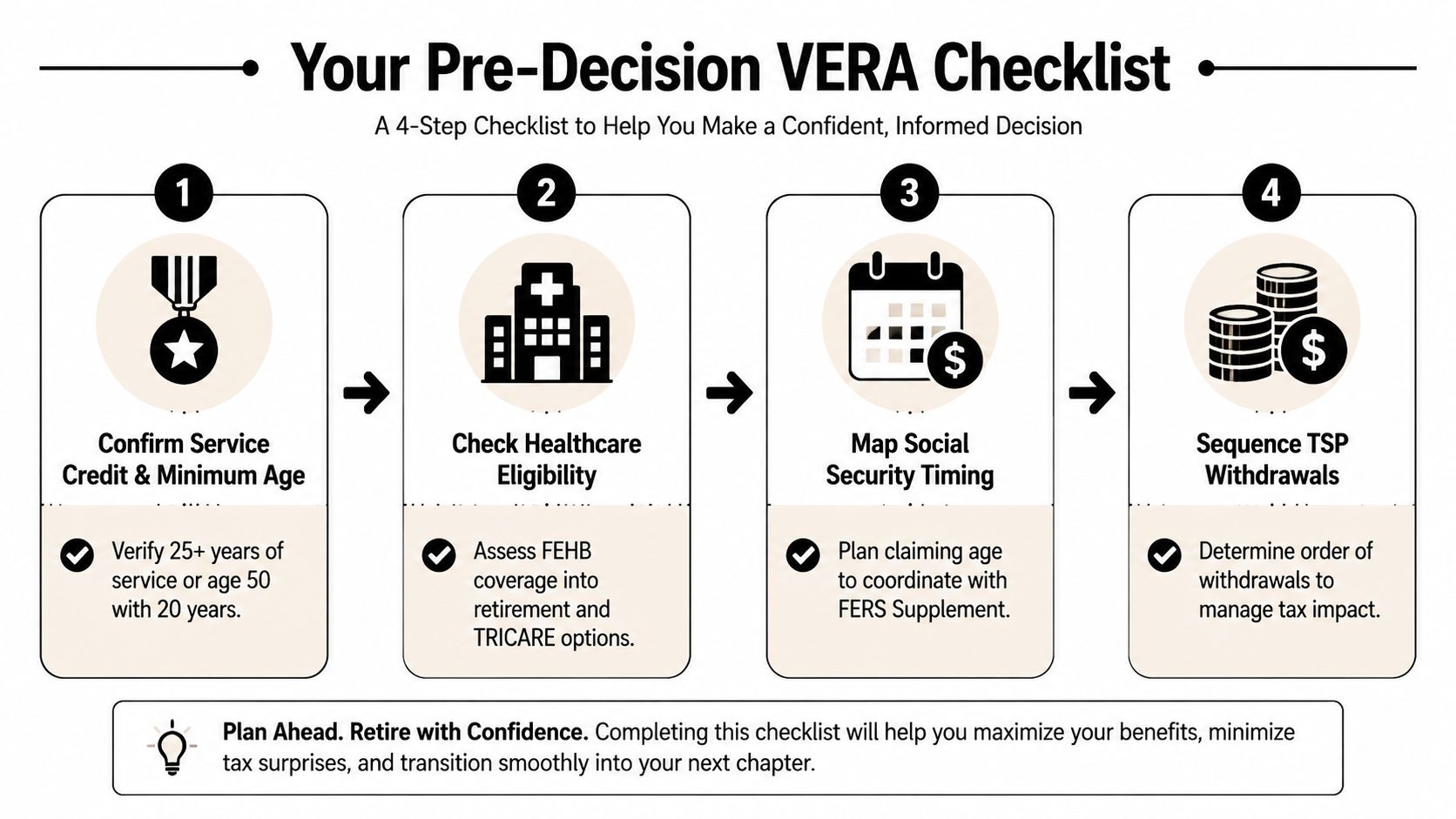
Sequence TSP withdrawals. Separate traditional and Roth balances. Check whether separation occurs in the calendar year you reach 55, then build a tax-aware withdrawal plan. Account type and withdrawal method can change the early-withdrawal treatment.
Model Social Security and the supplement. Compare claiming at 62, full retirement age, and 70. Include the supplement's earnings-test exposure, plus any Windfall Elimination Provision or Government Pension Offset issue affecting your household.
Stress-test healthcare and survivor income. Price spouse coverage, an Affordable Care Act plan, TRICARE where applicable, or another bridge. Compare survivor elections before deciding whether the projected monthly income can support your household.
Use this federal employee retirement planning checklist to organize the review. Mark an item complete only when supporting documents and a written estimate are in hand.
How Federal Benefits Sherpa Helps You Decide
A useful VERA review should be a working session, not a generic eligibility quiz. Federal Benefits Sherpa offers a free 15-minute benefit review that can organize your service history, high-3 salary, TSP balance, FEHB enrollment, and FEGLI coverage into a VERA-specific comparison.
The important deliverable is the gap analysis. It should show what happens if you accept VERA now versus waiting for standard retirement, including the estimated annuity difference, the period in which a Special Retirement Supplement may be available, insurance eligibility, and survivor-benefit consequences.
What to bring to the review
Bring your latest SF-50, service computation date, retirement estimate, TSP statement, FEHB enrollment history, FEGLI election information, and the agency's written VERA offer. Without those records, any recommendation is just a rough conversation.
A structured review should also flag the traps that cause the most damage:
- FEHB coverage gaps: A retirement offer doesn't override the five-year coverage test.
- Supplement earnings: Outside work can affect the Special Retirement Supplement before full retirement age.
- TSP sequencing: Separation age and account type can affect the 10% early withdrawal penalty.
- Survivor elections: A smaller starting annuity can create a smaller survivor-income base.
- Agency deadlines: The offer's written election deadline controls your decision window.
Common VERA questions
Does VERA guarantee reemployment rights? No. VERA is a retirement authority, not a promise of future federal employment. Review the specific reemployment and incentive terms before separating.
What happens if my agency makes multiple offers in a year? Treat each offer as a separate authority with its own covered positions, deadlines, and conditions. Don't assume an earlier election automatically carries into a later offer.
What happens to a probationary period? VERA doesn't erase the employment rules that apply to a new appointment. If you return to federal service, review the appointment and probation terms before accepting.
Can VERA coordinate with discontinued service retirement after a RIF? The retirement path depends on the facts and the separation authority. If a RIF follows or overlaps with a VERA offer, preserve every notice and have the agency identify which authority governs your separation.
Federal Benefits Sherpa can help you compare a VERA offer with waiting, test your FEHB, FEGLI, TSP, supplement, and survivor-income assumptions, and build a practical retirement sequence. Visit Federal Benefits Sherpa to request the free 15-minute review before you submit your election.


Dedicated to helping Federal employees nationwide.
“Sherpa” - Someone who guides others through complex challenges, helping them navigate difficult decisions and achieve their goals, much like a trusted advisor in the business world.
Federal Benefits Sherpa, LLC
12724 Gran Bay Parkway West, Suite 410, Jacksonville, FL 32225
Email: [email protected]
Phone: (833) 753-1825
© 2024 Federalbenefitssherpa. All rights reserved
Federal Benefits Sherpa is an independent organization and is not affiliated with or endorsed by the U.S. government or any federal agency.