
Blogs

Blog title place here
We understand that every federal employee's situation is unique. Our solutions are designed to fit your specific needs.

Blog title place here
We understand that every federal employee's situation is unique. Our solutions are designed to fit your specific needs.

Blog title place here
We understand that every federal employee's situation is unique. Our solutions are designed to fit your specific needs.
TSP Withdrawal Tax Rate: Rules and Worked Examples
You've spent years building a TSP balance, and now your first retirement distribution is about to arrive. The account statement shows the amount you requested, but your checking account receives less. That gap usually comes from federal withholding, and sometimes from an early distribution penalty that applies separately from your final tax bill.
The practical question isn't, “What is the TSP withdrawal tax rate?” It's, “How much cash will I receive, what will the IRS ultimately tax, and which withdrawal choice protects my income?” Traditional TSP distributions generally count as ordinary income, while qualified Roth TSP distributions can be tax-free. The answer changes with your account type, age, separation date, distribution method, and whether you take cash or complete a rollover.
The Reality of Your First TSP Payout
A federal employee named Mark retires and requests a $40,000 traditional TSP distribution. He expects the account administrator to send the full amount and assumes his regular income tax rate will be handled when he files his return. Instead, the TSP withholds 20%, or $8,000, from an eligible rollover distribution or many single payments. His immediate payment is $32,000, before considering any state withholding or other tax consequences. The federal withholding rule is described in IRS Publication 721.
Mark hasn't necessarily paid his final tax. The TSP has made a withholding payment toward his federal tax obligation. His eventual liability depends on the full distribution and his other taxable income for the year. The distribution itself is generally reported as ordinary income, so his FERS annuity, wages, Social Security, and other taxable income can affect the result.
That's why I tell clients to plan around net retirement income, not the balance printed on the TSP statement. A request for $40,000 doesn't mean $40,000 will reach the bank. A request made before age 59½ may also face a separate 10% early distribution penalty, unless an exception applies, as outlined in the TSP tax treatment booklet.
The account balance isn't the payout
Your TSP balance is an asset. Your distribution is a cash-flow event. Those are different planning questions.
Before submitting a request, identify:
- The account source: Traditional TSP withdrawals generally create taxable income. Qualified Roth TSP withdrawals can be tax-free.
- The payment method: A direct cash payment can trigger mandatory withholding, while a properly completed direct rollover can preserve tax deferral.
- Your age and separation date: These facts can determine whether the separate early distribution penalty applies.
- Your other income: A distribution can stack on top of pension income and other taxable receipts.
The TSP's withdrawal choices also affect withholding, timing, and rollover treatment. Review the complete guide to TSP withdrawal options before you decide whether the money should be paid to you or transferred directly.
Advisor rule: Never approve a TSP distribution until you've calculated the amount that will land in your account and identified the tax source that will cover the rest.
Mandatory Withholding Versus Actual Tax Liability
The 20% federal withholding rule is not the same as a 20% TSP withdrawal tax rate. It's an amount the TSP must withhold from eligible rollover distributions and many single payments or monthly payment series lasting less than 10 years, according to IRS guidance on retirement income.
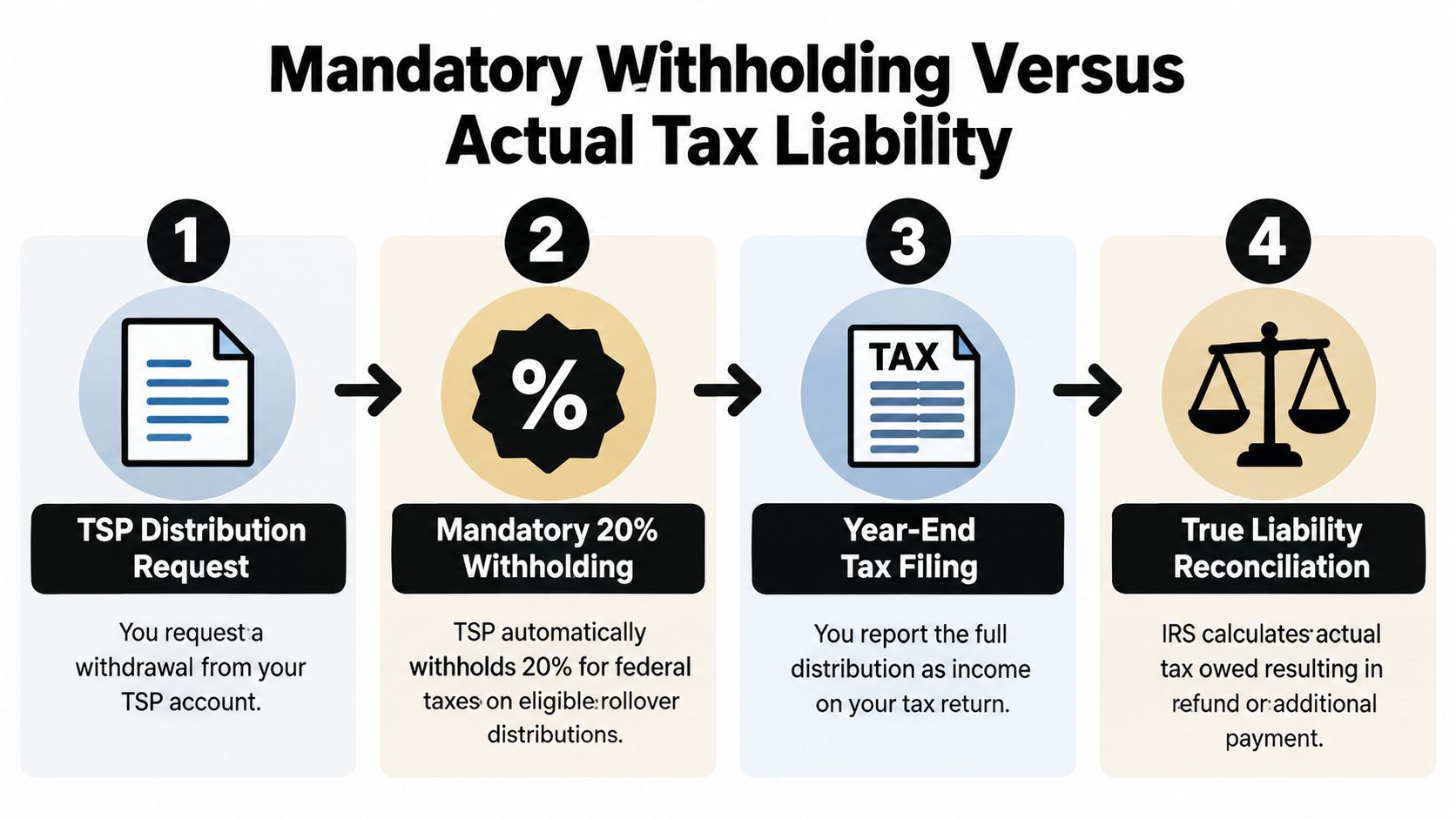
Use this four-step process to separate the cash event from the tax return:
- Start with the gross request. If you request a traditional TSP distribution, the full amount is generally included in income for tax reporting purposes.
- Subtract mandatory withholding. On a $40,000 payment subject to the rule, the TSP withholds $8,000 and sends $32,000 to you before other deductions.
- Report the full distribution. You don't report only the $32,000 you received. The gross distribution is the relevant income figure, while the withheld amount is credited toward your federal tax.
- Reconcile at filing. Your total income, deductions, credits, filing status, and other tax items determine whether withholding was enough, too high, or too low.
Why payment duration matters
A payment series lasting 10 or more years, or payments based on life expectancy, follows a different withholding approach. The IRS says withholding is determined using tax tables and your elections on Form W-4P, rather than automatically applying the same mandatory rule to the payment series.
That distinction matters for budgeting. A retiree who submits a short payment series may receive less cash immediately than expected. Another retiree receiving a longer-term series may need to make a deliberate W-4P election so withholding better matches the household's actual tax position.
Don't treat a refund as proof that your distribution was tax-free. A refund may mean the TSP withheld more than you ultimately owed. Conversely, a large balance due means the withholding didn't cover the final liability.
A practical review before filing
Check the gross amount, federal withholding, state withholding election, payment duration, and whether the distribution is traditional or Roth. Then add the distribution to your projected pension and other taxable income for the year. If you're reviewing investment losses elsewhere in the portfolio, a resource such as this guide to tax loss harvesting can help you understand a separate planning technique, but it doesn't erase ordinary income created by a TSP distribution.
For a broader federal benefits explanation, use this guide to TSP taxes for federal employees. The central point remains simple: withholding is a prepayment, not your final tax rate.
Navigating the Early Withdrawal Penalty Exceptions
The age 55 separation rule is one of the most valuable TSP planning rules for federal employees who retire before 59½. It can waive the separate 10% early distribution penalty when the participant separates from service in or after the year they turn 55, according to the TSP tax treatment booklet.
That rule doesn't make the distribution tax-free. A taxable traditional TSP payment can still be included in ordinary income, and mandatory withholding may still reduce the initial check. The rule removes the additional penalty when the timing and separation requirements are satisfied.
Timing controls eligibility
Suppose an employee separates from federal service at age 56 and begins taking distributions from the TSP account left in the plan. The age 55 exception can apply because separation occurred in or after the year the employee reached 55. The employee still needs to account for ordinary income tax, but the separate 10% penalty doesn't apply under that exception.
Now change one fact. The employee leaves service before the applicable age threshold and takes a taxable distribution before 59½. The 10% penalty may apply unless another exception covers the payment. That difference can materially change the cash value of the same gross distribution.
Qualified public safety employees may have an earlier separation exception at age 50, as described in the same TSP guidance. This provision is especially relevant to eligible federal public safety personnel, but eligibility depends on the worker's role and the applicable statutory requirements.
Don't destroy the exception with a rollover
A direct rollover can preserve tax deferral, but moving funds out of the TSP can change which withdrawal rules apply to the money later. An IRA generally doesn't provide the same age 55 separation treatment tied to the employer plan. If you need access to TSP funds after separating at the qualifying age, rolling the entire balance into an IRA before planning those withdrawals may remove a useful path.
That doesn't mean an IRA rollover is always wrong. It means the sequence matters. Decide whether you need penalty-free access to the TSP before transferring funds away, and document the separation date and intended withdrawal strategy.
Timing matters more than account labels: The age 55 exception is tied to separation from service and the plan holding the money. Don't roll first and investigate later.
A qualified rollover transfer can avoid current taxation, but a cash distribution creates a different result. Before requesting money, compare the need for immediate liquidity against the value of preserving tax deferral and keeping the TSP-specific exception available.
Traditional Versus Roth TSP Tax Treatment
Traditional and Roth TSP balances may sit in the same retirement plan, but they don't create the same tax result. A traditional withdrawal generally enters taxable income as ordinary income. A qualified Roth withdrawal can be tax-free, including the earnings, when the distribution meets the applicable requirements.
That difference makes account location a planning tool. If you need additional spending money during a year when your pension and other income already fill your preferred tax range, a qualified Roth distribution may protect taxable-income flexibility. If your taxable income is lower, a traditional distribution may be easier to absorb.
| Feature | Traditional TSP | Roth TSP |
|---|---|---|
| Contributions | Generally made before current income tax | Made with after-tax money |
| Withdrawals | Generally taxed as ordinary income | Qualified withdrawals can be tax-free |
| Effect on taxable income | Usually increases taxable income | Qualified withdrawals generally don't increase taxable income |
| Withholding planning | Mandatory withholding can apply to many eligible distributions | Treatment depends on the distribution and whether it is qualified |
| Best planning use | Income in lower-tax years or controlled annual withdrawals | Flexibility during higher-income years |
State residency changes the calculation
Federal tax is only one part of the decision. A traditional TSP withdrawal may also be subject to state income tax depending on where you live. The same gross distribution can therefore produce different net income for a retiree living in a state with an income tax than for someone living in a state without one.
Don't move solely for a TSP withdrawal. Do include state residency in a retirement-income projection, especially if you're considering a large distribution, a relocation, or a Roth conversion. State rules can also treat pension income and retirement-account income differently, so verify the rules for the state where you'll be a resident when the withdrawal occurs.
Sequence withdrawals intentionally
Use traditional TSP funds when your projected taxable income gives you room to absorb them. Use qualified Roth funds when keeping taxable income lower has a clear benefit. That may include funding an unusually expensive year, avoiding an unnecessary jump in taxable income, or preserving flexibility around other retirement income.
For a focused explanation of Roth TSP mechanics, review what a TSP Roth account is and how it supports tax-free growth. The recommendation is not “always withdraw Roth first” or “always withdraw traditional first.” The recommendation is to model the next tax year before choosing the source.
Required Minimum Distributions and SECURE 2.0
Retirement doesn't end the tax conversation. Required minimum distributions can force money out of the TSP even when you don't need the cash for living expenses. The TSP explains that failing to take the full required distribution can create an IRS excise tax, and SECURE 2.0 reduced that penalty from 50% to 25%. See the TSP's SECURE 2.0 RMD guidance.
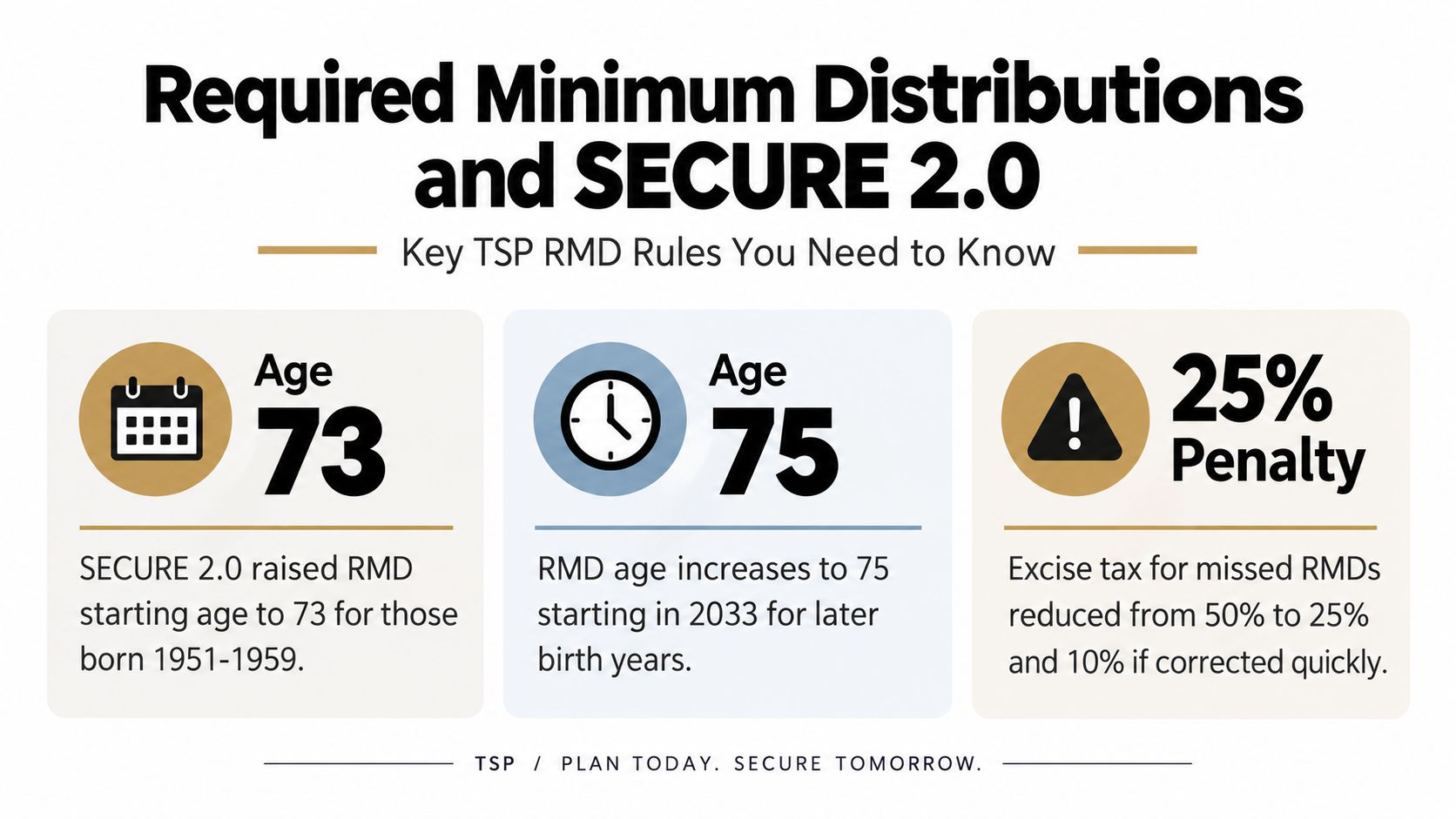
The reduction is meaningful, but a missed RMD is still expensive. More important, an RMD isn't optional because your FERS pension covers your expenses or because you don't want to sell investments in a particular market environment.
The calculation begins with the prior year
Congressional Research Service material explains that an RMD is calculated using the prior year-end account balance divided by an IRS life-expectancy factor. That creates a timing issue many retirees overlook. A large balance at the end of a year can influence the required distribution in the following year, even if the retiree's spending needs haven't changed.
Partial withdrawals can satisfy some of the requirement, but they don't automatically satisfy the full amount. A retiree must compare cumulative distributions with the required amount and confirm that the TSP has recorded the payment correctly.
Coordinate RMDs with other income
An RMD generally adds taxable income when it comes from taxable retirement money. Coordinate it with your FERS annuity, any wages, Social Security, and planned discretionary withdrawals. Taking an extra traditional distribution in the same year as an RMD may create a larger taxable-income spike than expected, while taking too little can leave an unmet requirement.
Planning question: Don't ask only whether you need the RMD. Ask how the required amount fits with every other taxable payment scheduled for the year.
Near-retirees should build an RMD calendar before the first required year. Review the prior year-end balance, identify the applicable IRS factor, estimate withholding, and determine whether the TSP payment will be enough. SECURE 2.0 lowered the penalty, but it didn't turn compliance into an optional exercise.
Worked Scenarios for Common Withdrawal Types
The following examples isolate the mechanics using a $40,000 gross traditional TSP distribution. They show withholding and penalty calculations, not a final federal tax return. The actual tax liability depends on the recipient's full income and filing circumstances.

Scenario one, age 52 and no qualifying exception
A 52-year-old takes a taxable lump-sum distribution after leaving federal service. Assuming the payment is subject to mandatory withholding, the TSP withholds $8,000, calculated as 20% of $40,000. The immediate cash is therefore $32,000 before any state withholding.
Because the employee is under 59½ and hasn't met an applicable exception in this example, the separate early distribution penalty is $4,000, calculated as 10% of $40,000. The final federal tax liability still must be calculated on the tax return, so the economic cost isn't $8,000 plus $4,000. The $8,000 is a prepayment, while the $4,000 penalty is a separate charge.
Scenario two, age 56 and separation in the qualifying period
A 56-year-old separates from federal service in or after the year they turn 55 and takes the same gross distribution from the TSP. The withholding remains $8,000, leaving $32,000 initially, assuming no other deductions.
The age 55 separation exception can eliminate the separate $4,000 penalty that would otherwise be calculated at 10% of the distribution. Ordinary income tax still applies to the taxable traditional distribution, and the final liability may be higher or lower than the amount withheld.
Scenario three, age 74 and an RMD
A 74-year-old takes a first RMD while also receiving a FERS pension. The amount of the RMD must be calculated from the prior year-end TSP balance and the applicable IRS life-expectancy factor. It isn't safe to assume that a convenient partial withdrawal satisfies the full requirement.
If the retiree takes a $40,000 distribution subject to the withholding rule, $8,000 is withheld and $32,000 is paid before other deductions. The retiree must then coordinate the taxable distribution with the pension and other income. If the full RMD wasn't taken, the missed amount can face the SECURE 2.0 excise tax framework, where the reduced penalty is 25% under the applicable rule.
These examples deliver the key lesson: the gross request, immediate cash, withholding, ordinary income tax, penalty exposure, and RMD compliance are separate calculations.
Optimizing Your TSP Distribution Strategy
A good withdrawal decision starts before you click “submit.” Use this checklist:
- Verify withholding: Confirm whether the payment falls under mandatory federal withholding and review your state election.
- Plan timing: Project pension and other taxable income before choosing the distribution year.
- Protect exceptions: If you separated in or after the year you turned 55, confirm that a TSP withdrawal won't be unnecessarily moved into an account with different access rules.
- Review Roth and traditional sources: Choose the account bucket that fits the year's income needs.
- Check RMD compliance: Compare planned payments with the required amount based on the prior year-end balance.
- Evaluate a direct rollover: If you don't need cash, a properly completed direct rollover can preserve tax deferral and avoid treating the payment as money paid to you.
A benefits review should include the TSP, FERS income, Social Security timing, withholding elections, and RMD schedule together. Federal Benefits Sherpa offers benefit reviews, retirement planning, gap analysis reports, and educational resources for federal employees evaluating these decisions.
Federal Benefits Sherpa can help you review TSP withdrawal choices, withholding, RMD timing, and the interaction with your federal retirement income before you request a distribution. Visit Federal Benefits Sherpa to arrange a benefits review and build a clearer plan for preserving your retirement cash flow.


Dedicated to helping Federal employees nationwide.
“Sherpa” - Someone who guides others through complex challenges, helping them navigate difficult decisions and achieve their goals, much like a trusted advisor in the business world.
Federal Benefits Sherpa, LLC
12724 Gran Bay Parkway West, Suite 410, Jacksonville, FL 32225
Email: [email protected]
Phone: (833) 753-1825
© 2024 Federalbenefitssherpa. All rights reserved
Federal Benefits Sherpa is an independent organization and is not affiliated with or endorsed by the U.S. government or any federal agency.