
Blogs

Blog title place here
We understand that every federal employee's situation is unique. Our solutions are designed to fit your specific needs.

Blog title place here
We understand that every federal employee's situation is unique. Our solutions are designed to fit your specific needs.

Blog title place here
We understand that every federal employee's situation is unique. Our solutions are designed to fit your specific needs.
Govt Employee Health Insurance Explained Simply
You're a federal employee reviewing your health plan during Open Season, and the premium on your current option has jumped. The coverage still works, but you're also thinking about retirement, a spouse's insurance, Medicare, or whether a different plan would leave more money in your paycheck. The difficult part isn't finding plan names. It's understanding how govt employee health insurance affects both today's household budget and tomorrow's retirement income.
The Federal Employees Health Benefits Program, or FEHB, gives eligible federal workers and retirees access to a broad selection of plans with substantial government cost sharing. Yet the program's rules can still create expensive surprises. Your enrollment tier, plan premium, out-of-pocket design, Medicare decision, and enrollment history all matter.
This guide starts with the basic structure, then moves through eligibility, plan comparisons, retirement continuity, coordination with other coverage, and practical next steps. New employees can use it to establish good habits early. Mid-career workers can use it to check whether their current plan still fits. Employees approaching retirement can use it to test whether coverage costs will leave enough of their annuity available for housing, food, taxes, and other needs. For a broader overview of federal benefits, see this Federal Government Employee Benefits 2026 Guide.
Introduction to Govt Employee Health Insurance and Why It Matters
A new employee may focus on the amount deducted from each paycheck. A long-serving employee may focus on whether a familiar plan will remain available after retirement. Both are asking the same underlying question: what will this coverage cost me over the full course of my career?
That question matters because FEHB is more than an annual insurance purchase. While you're working, the government generally pays a large share of the premium. After retirement, FEHB can continue, but the premium still comes out of your annuity. A plan that feels manageable in a full paycheck may feel very different when income becomes fixed.
The timing of your decisions matters, too. A new hire who delays enrollment may create an avoidable coverage gap. A mid-career employee who changes plans without checking provider networks may discover that a preferred doctor is no longer in-network. Someone close to retirement may learn that coverage continuity affects whether FEHB can continue after leaving federal service.
Practical rule: Treat health insurance as both a medical protection decision and a retirement-income decision.
The right choice won't always be the plan with the lowest premium. A lower premium may come with a higher deductible, different copays, narrower provider access, or less favorable cost sharing for recurring care. A higher-premium plan may be sensible for a family that expects significant medical use, but it can also reduce the annuity available for other expenses.
You don't need to memorize every insurance term at once. Start by identifying your eligibility, current enrollment tier, plan type, annual premium, deductible, copays, and retirement timeline. Then evaluate how those pieces fit together instead of judging a plan by one number.
What FEHB Is and How It Works for Federal Employees
The Federal Employees Health Benefits Program is the main health insurance system for federal civilian employees, retirees, and eligible family members. Congress created FEHB through the Federal Employees Health Benefits Act of 1959, and coverage for federal workers began on July 1, 1960. The Congressional Research Service describes FEHB as the largest employer-sponsored health benefits program in the United States, covering about 8.2 million enrollees each year, with about 85% of federal employees and about 90% of retirees participating. The program provides more than $40 billion in health care benefits annually, according to the Congressional Research Service overview of FEHB.
A useful analogy is a curated marketplace. The government doesn't operate one single medical plan for every employee. Instead, the Office of Personnel Management, or OPM, negotiates and administers a marketplace of participating insurance carriers. You choose among available plan options, and the government contributes toward the premium.
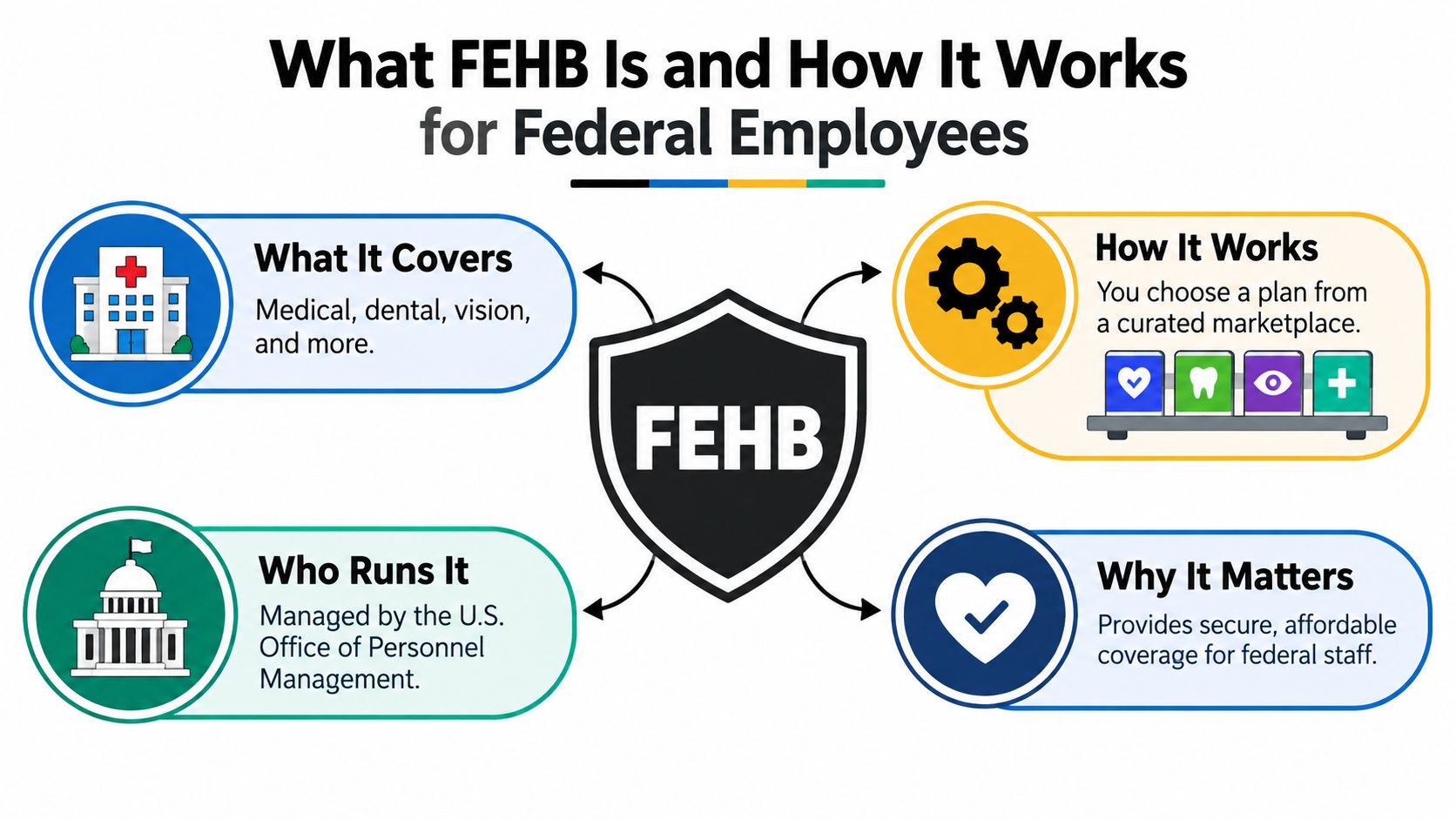
The four parts of the system
OPM manages the program. OPM sets program requirements, administers enrollment rules, and publishes premium information. It doesn't make every medical decision for you, and it doesn't replace the insurance carrier's role in processing claims.
Carriers provide the plans. A carrier's plan documents define its provider network, covered services, deductibles, copays, coinsurance, and exclusions. Two FEHB plans can both provide medical coverage while producing very different bills for the same treatment.
You select the coverage level. FEHB generally offers Self Only, Self Plus One, and Self and Family enrollment options. The correct tier depends on who needs coverage, not on whether you're married or have children.
You share the cost with the government. Your payroll deduction represents your portion of the premium. The government contribution helps make coverage more affordable than buying a comparable policy entirely on your own, but your share can still change when premiums rise or when you choose a more expensive plan.
The marketplace analogy also explains why comparison matters. A plan's name or carrier reputation doesn't tell you whether its provider network includes your doctors, whether its drug coverage fits your prescriptions, or whether its deductible works for your emergency savings. Read the plan brochure and benefit summary before treating a familiar option as the automatic choice.
FEHB also differs from a standard individual-market purchase because the government contribution follows program rules and the employee usually chooses from an organized group of employer-sponsored options. That combination of choice and employer support is the foundation of govt employee health insurance.
Who Qualifies and When You Can Enroll
Eligibility and enrollment are related, but they aren't the same. You may qualify for FEHB, yet still need to act during a specific enrollment window to select coverage or change an existing election.
A new federal employee usually receives an initial opportunity to enroll after becoming eligible. Check your agency's human resources office or benefits system for the exact deadline that applies to your appointment and start date. Don't assume that waiting for Open Season is harmless, because a missed initial window can leave you without the plan you intended to choose.
A practical enrollment timeline
Eligibility begins. Eligible federal employees can review available FEHB options for themselves and eligible family members. Retiree eligibility involves additional continuation requirements, discussed later.
Initial enrollment opens. New employees should use the enrollment opportunity connected to their hiring or eligibility date. Keep confirmation records, including the plan selected, effective date, and enrollment code.
Open Season arrives. OPM provides an annual period during which eligible employees and annuitants can make permitted changes. Review the official dates each year rather than relying on a calendar from a prior plan year.
Qualifying life events create special opportunities. Marriage, birth, adoption, loss of other coverage, or another recognized event may allow a change outside Open Season. The event usually must be reported within the applicable time limit, and the change must match the event.
The consequences of delay vary. A new employee might remain uninsured until a later opportunity. An enrolled employee might be unable to move to a different option immediately. A worker nearing retirement might also discover that a late change affects the enrollment history needed for continued coverage.
The retirement continuity checkpoint
The five-year requirement deserves attention from the beginning of your career. To carry FEHB into retirement, a federal employee generally must have been enrolled for the five years immediately before retirement, or for all service since the first opportunity to enroll if that period is shorter. OPM explains the waiver standard and continuity rule in its guidance on continuing health insurance coverage after leaving government service.
Don't treat this as a rule to investigate only when you submit retirement paperwork. Review your enrollment history well before your planned retirement date, especially if you declined FEHB, had a break in coverage, changed employment status, or relied on another person's plan.
Understanding Plan Types and How Costs Are Shared
FEHB choices become easier when you separate three questions:
- Who needs coverage?
- How does the plan deliver care?
- How are costs divided?
The first question determines your enrollment tier. Self Only covers one person. Self Plus One covers the enrollee and one eligible family member. Self and Family covers the enrollee and eligible family members under the plan's rules. Choosing a broader tier can be sensible when more people need coverage, but it can waste money if the added eligibility isn't needed.
The second question concerns plan design. Fee-for-service plans generally give members access to a network while allowing broader flexibility under plan rules. Health maintenance organization plans typically place greater emphasis on a defined service area and coordinated network care. High-deductible plans generally trade a lower premium structure for more responsibility before the plan begins paying many covered expenses. The exact terms vary by plan, so the brochure matters more than the label alone.
The third question is cost sharing. Premiums are paid to keep coverage active. A deductible is the amount you may pay for covered services before certain plan benefits begin. Copays are set amounts for services such as office visits or prescriptions, while coinsurance is a percentage of the allowed cost. A plan with a low premium may still be expensive for someone who uses frequent care.
The government contribution has a ceiling
For most federal employees and annuitants, the government contribution equals the lesser of 72% of the program-wide weighted average premium or 75% of the premium for the specific plan selected, according to OPM's premium information. In 2026, OPM set the monthly maximum government contribution at $703.65 for Self Only, $1,540.87 for Self Plus One, and $1,685.73 for Self and Family, using the same OPM source.
| Enrollment Tier | Maximum Government Contribution | How Cost Sharing Works |
|---|---|---|
| Self Only | $703.65 per month | The government pays up to the applicable cap. You pay the remaining premium. |
| Self Plus One | $1,540.87 per month | A higher contribution is available, but you still pay any premium above the plan's supported amount. |
| Self and Family | $1,685.73 per month | The government share is substantial, but a higher-premium choice can increase your deduction. |
These figures are maximum government contributions, not guarantees that every plan receives the listed amount. If you choose a plan priced above the contribution ceiling, you absorb the full marginal premium difference. That makes plan selection price-sensitive even when the government pays a large share.
Compare total exposure, not just payroll deductions
Suppose Plan A has a lower premium but a higher deductible, while Plan B costs more each pay period but has lower cost sharing for predictable treatment. The better choice depends on expected medical use, prescriptions, family needs, provider access, and available cash reserves.
Review the plan's annual premium, deductible, copays, coinsurance, out-of-pocket maximum, prescription tiers, and network rules together. A plan comparison tool can organize those variables, but the final decision should still be checked against the official plan brochure.
Keeping Health Coverage When You Retire
FEHB can continue into retirement, but continuation isn't automatic for every departing employee. The central requirement is enrollment continuity. In general, you must have been enrolled in FEHB for the five years immediately before retirement, or for all of your service since your first opportunity to enroll if that period is shorter. OPM can waive the requirement only in limited circumstances, so employees shouldn't plan around a waiver.
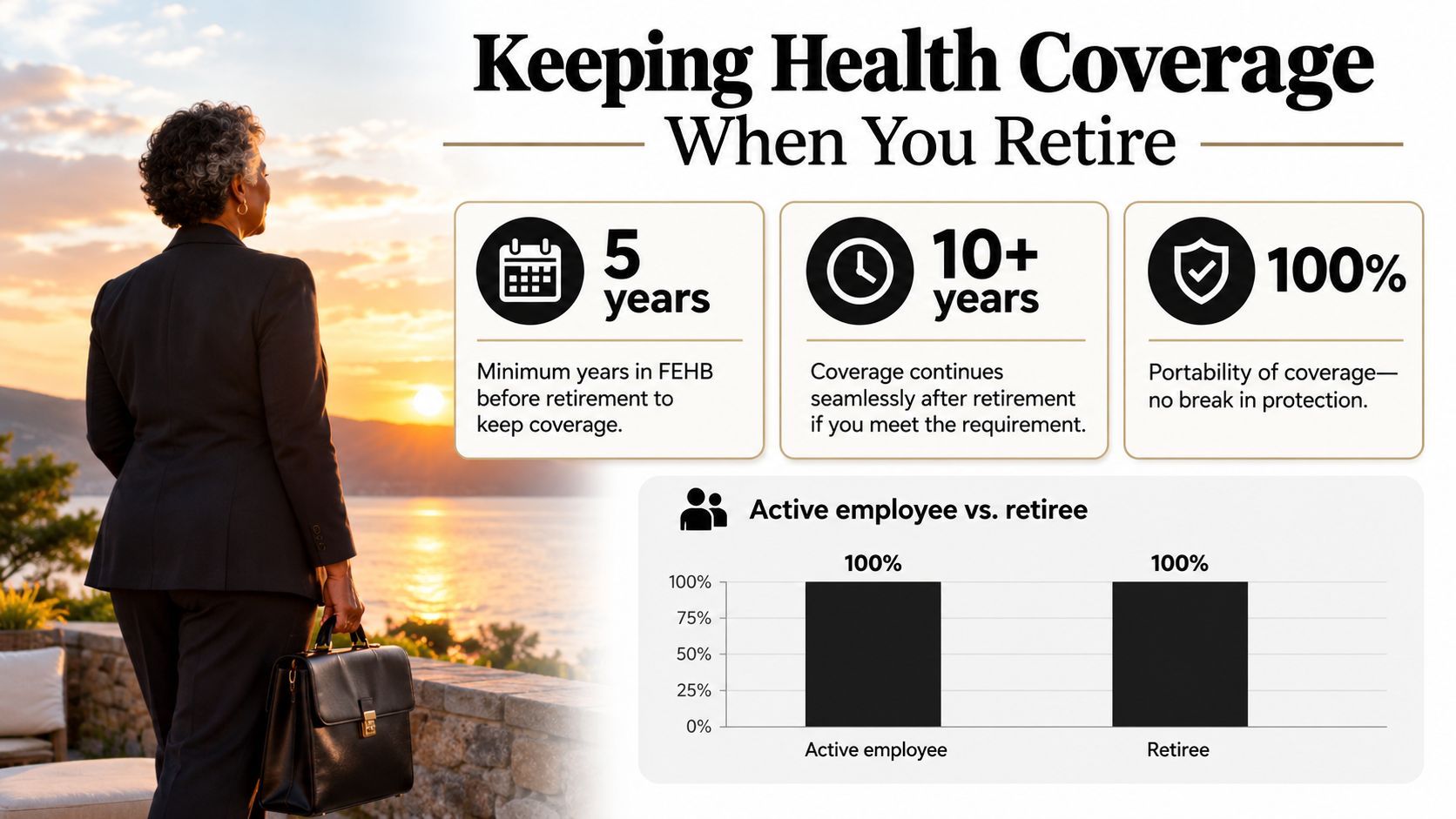
The practical meaning is simple. Your final years of enrollment aren't just a recordkeeping detail. They protect access to the same employer-style premium-sharing arrangement after retirement. If you lose eligibility for continued FEHB, you may have to seek individual-market coverage instead, where the pricing structure is different.
Coverage can continue while affordability changes
Retirement doesn't erase the premium. Instead, the cost is generally deducted from your annuity rather than your paycheck. That change can affect how the deduction feels because an annuity usually provides less flexibility than salary income, and payroll deductions may have different tax treatment from retirement deductions.
Premium growth adds another layer. Federal employees and retirees faced an average 12.3% premium increase in 2026, following a 13.5% increase in 2025, according to reported 2026 FEHB rate information from the National Treasury Employees Union. OPM's 2026 program-wide weighted average premiums were $451.05 biweekly for Self Only and $1,080.60 for Self and Family, as reported in that same source.
Those are program-wide averages, not the amount every retiree pays. Your actual deduction depends on the plan and enrollment tier you select. Still, the figures illustrate why retirement planning must include a premium stress test. If your annuity is fixed while premiums rise, healthcare can consume a larger share of monthly income even when your coverage remains intact.
Retirement planning insight: FEHB continuation answers whether you can keep coverage. A premium projection answers whether you can comfortably afford it.
Build a retirement health-cost record
Several years before retirement, collect your current enrollment history and verify that it supports the five-year rule. Then compare your current plan with alternatives during Open Season, focusing on total annual exposure rather than only the paycheck deduction.
A useful review includes:
- Enrollment continuity: Confirm dates, plan changes, and any periods when you waived coverage.
- Retirement tier: Determine whether you'll need Self Only, Self Plus One, or Self and Family coverage.
- Premium sensitivity: Model what a higher deduction would do to your expected annuity budget.
- Medical usage: Account for recurring specialists, prescriptions, procedures, and preferred providers.
- Medicare coordination: Review how Medicare may interact with FEHB before making an election.
For a more detailed retirement-focused discussion, consult this complete FEHB retiree health insurance guide. The key point is to make plan changes while you still have time to observe how they affect both care access and household cash flow.
How FEHB Works With Medicare and Other Coverage
People often ask whether FEHB replaces Medicare, whether Medicare replaces FEHB, or whether carrying both means paying twice for the same protection. The answer depends on enrollment status, the type of Medicare coverage, the plan's coordination rules, and whether another source of insurance is primary.
For many retirees, FEHB and Medicare can work together. Medicare may pay first for covered services, while FEHB provides additional benefits or cost sharing under the selected plan. That doesn't mean every FEHB enrollee should make the same Medicare decision. Premiums, provider access, prescription coverage, and personal medical needs all belong in the comparison.
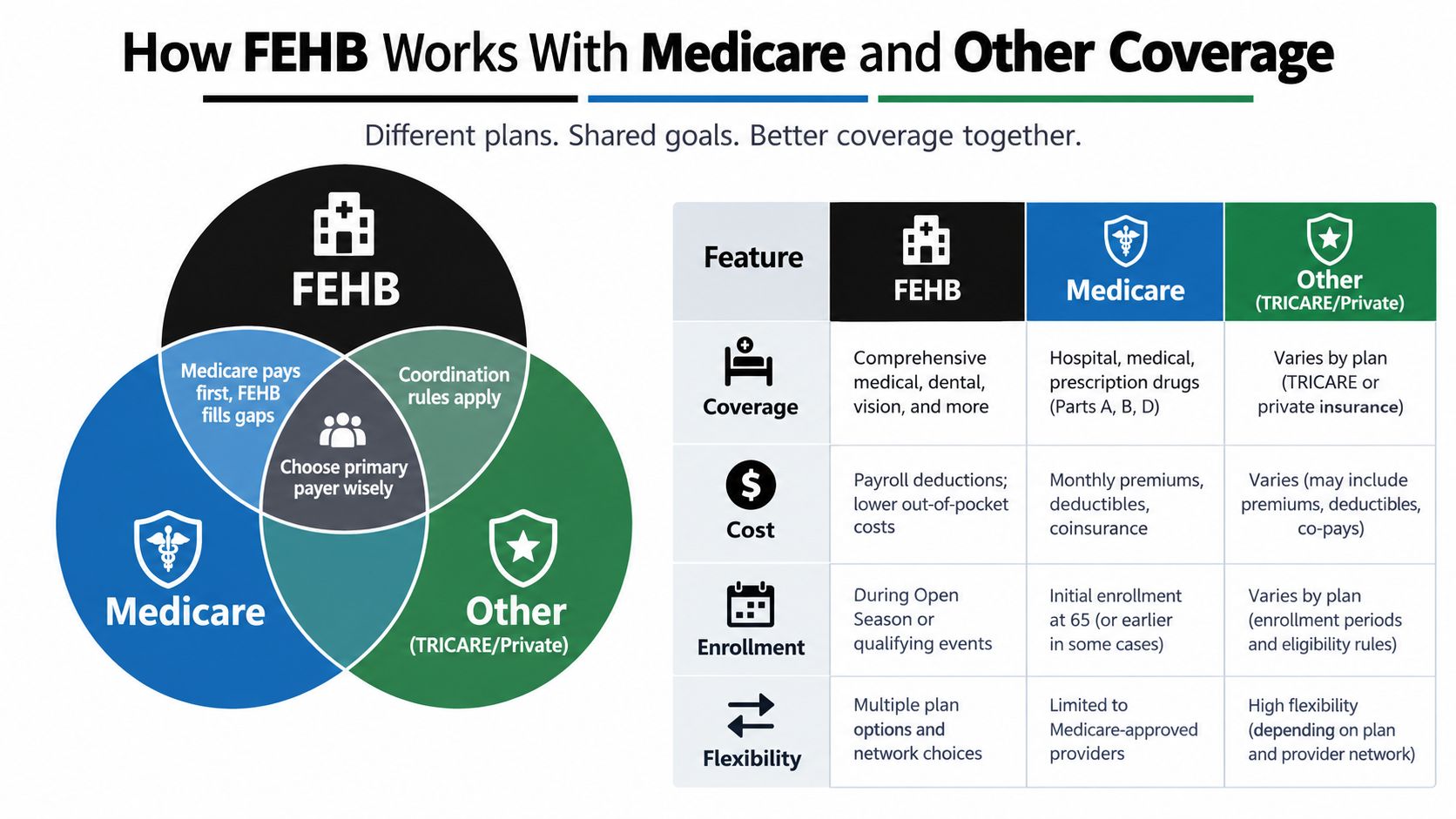
Think in terms of primary and secondary payment
The primary payer processes a claim first. A secondary plan may then consider remaining eligible costs according to its rules. Coordination can reduce deductibles or coinsurance, but it can also introduce premiums or administrative complexity.
Medicare Part A generally relates to hospital coverage. Part B covers outpatient medical services and has its own premium. Part D concerns prescription drug coverage, although FEHB plans already include prescription benefits. Whether adding separate Medicare coverage is useful depends on the specific FEHB plan, your expected care, and the cost of duplicate or overlapping benefits.
TRICARE and private employer coverage require their own coordination review. A spouse's plan may offer a lower premium but a different network. TRICARE eligibility can create valuable options, yet the primary-payer rules must be confirmed before dropping or changing FEHB. State and local government coverage also varies by employer and plan design, so the label “public-sector insurance” doesn't establish identical benefits.
Put cost and flexibility on the same worksheet
Public-sector coverage is part of a wider affordability challenge. In a 2026 survey of public-sector employees, 73.5% said their health insurance cost increased somewhat or significantly for 2026, and median out-of-pocket costs were $1,250, according to survey reporting on public-sector health benefits. Separate employer data cited by the same source reported 2025 family premiums of $26,993, workers' average contribution of $6,850 toward family coverage, and 67% of covered workers in self-funded plans.
These figures shouldn't be used to predict your personal bill. They provide context: government coverage can have strong employer premium support while members still face deductibles, copays, and plan-design tradeoffs.
Before combining coverage, compare:
- Primary payer: Identify which plan processes claims first.
- Premium cost: Include every monthly or payroll deduction.
- Out-of-pocket exposure: Review deductibles, copays, coinsurance, and maximums.
- Provider access: Confirm that your doctors, hospitals, and pharmacies participate.
- Enrollment consequences: Understand whether dropping FEHB could affect future eligibility.
For a focused explanation of the federal retiree decision, see this FEHB and Medicare retiree guide.
This video offers another way to review the coordination questions:
Your Next Steps and Retirement Transition Checklist
Use your next benefits review to create a record, not just to pick a plan. Start with the official plan brochure, your current enrollment information, recent claims experience, and your expected retirement timeline.
- Confirm your tier: Verify whether Self Only, Self Plus One, or Self and Family matches the people who need coverage.
- Review total cost: Compare premium, deductible, copays, coinsurance, prescription costs, and the out-of-pocket maximum.
- Check your providers: Confirm network participation for doctors, hospitals, specialists, and pharmacies.
- Protect continuity: Verify your FEHB enrollment history and identify any gap that could affect the five-year requirement.
- Test retirement affordability: Estimate how the premium deduction would fit within your projected annuity, especially if you're considering a higher-premium plan.
- Coordinate Medicare carefully: Compare the cost and practical value of Parts A, B, and D with your FEHB plan before enrolling, delaying, or dropping coverage.
- Document decisions: Save confirmation notices, plan brochures, enrollment codes, and questions sent to your agency or carrier.
Employees with complicated family coverage, recent employment changes, chronic medical needs, or an approaching retirement date may benefit from individualized guidance. Federal Benefits Sherpa offers educational classes, a free 15-minute benefit review, retirement planning, and gap analysis reports that connect health coverage with broader retirement income decisions.
Don't wait until your retirement application is underway. Review your enrollment record now, compare your plan during the next available window, and ask your human resources office or plan carrier to confirm any rule that could affect your eligibility.
Federal Benefits Sherpa helps federal employees connect FEHB choices, Medicare coordination, and retirement income planning through benefit reviews, educational classes, and personalized gap analysis. Visit Federal Benefits Sherpa to request a review and turn your health insurance questions into a practical retirement plan.


Dedicated to helping Federal employees nationwide.
“Sherpa” - Someone who guides others through complex challenges, helping them navigate difficult decisions and achieve their goals, much like a trusted advisor in the business world.
Federal Benefits Sherpa, LLC
12724 Gran Bay Parkway West, Suite 410, Jacksonville, FL 32225
Email: [email protected]
Phone: (833) 753-1825
© 2024 Federalbenefitssherpa. All rights reserved
Federal Benefits Sherpa is an independent organization and is not affiliated with or endorsed by the U.S. government or any federal agency.