
Learning Center
What Is the TSP G Fund and How Federal Employees Use It
The TSP G Fund is the government-securities investment option inside the Thrift Savings Plan, backed by the U.S. government and designed to earn interest tied to Treasury yields. Created with the TSP under the Federal Employees' Retirement System Act of 1986, it began accepting contributions on April 1, 1987.
You may be looking at your TSP allocation screen right now and seeing five letters that don't immediately explain much: G, F, C, S, and I. The G Fund often looks like the obvious “safe” choice, but safety doesn't mean it plays the same role as cash, a money market fund, or a traditional bond fund.
That distinction matters most when you approach retirement. During your working years, the G Fund can reduce the effect of market swings. During retirement, however, the TSP's withdrawal mechanics can prevent you from using it as a completely separate cash bucket. You may think you're drawing only from the G Fund, while the TSP is selling portions of your other investments too.
Introduction
The G Fund holds nonmarketable U.S. Treasury securities issued specifically to the TSP. Nonmarketable means they aren't bought and sold on the public market like ordinary Treasury bills, notes, or bonds. The U.S. government guarantees both the principal and the interest, and the G Fund's structure is designed to prevent the account value from falling because of daily market pricing.
The interest rate is not just an overnight cash rate. The official TSP description says the G Fund rate is recalculated monthly using the market yields of U.S. Treasury securities with more than four years to maturity. In practical terms, the fund combines the stability of specially issued Treasury securities with an interest formula connected to longer-term Treasury markets. You get a rate linked to government bond yields without owning a regular bond fund whose share price can decline when rates rise. The TSP's official G Fund explanation describes the securities, guarantee, and rate structure in detail.
Why federal employees pay attention to it
The G Fund is the lowest-risk core investment option in the TSP for protecting nominal principal. That makes it useful for money you can't afford to see fluctuate sharply, especially as retirement draws closer. It doesn't, however, provide stock-market growth, eliminate inflation risk, or automatically solve the problem of generating retirement income.
The TSP's scale also gives the fund context. By December 31, 2025, the TSP had about $1.07 trillion in assets and about 7.3 million participants, according to the official fund information. The G Fund operates inside that exceptionally large defined contribution system, but its purpose remains straightforward: preserve principal while crediting interest.
This article breaks the decision into practical pieces. You'll see how the securities work, why the historical returns look different from those of ordinary bond funds, how the G Fund compares with the other TSP choices, and why the pro rata withdrawal rule changes its usefulness once distributions begin.
How the G Fund Actually Works
Think of the G Fund as a locked cabinet of Treasury promises created for the TSP. You can't trade those securities on an exchange, and outside investors can't buy them. The Treasury issues them to the TSP, and the TSP credits participants with the interest those securities generate under the fund's statutory formula.
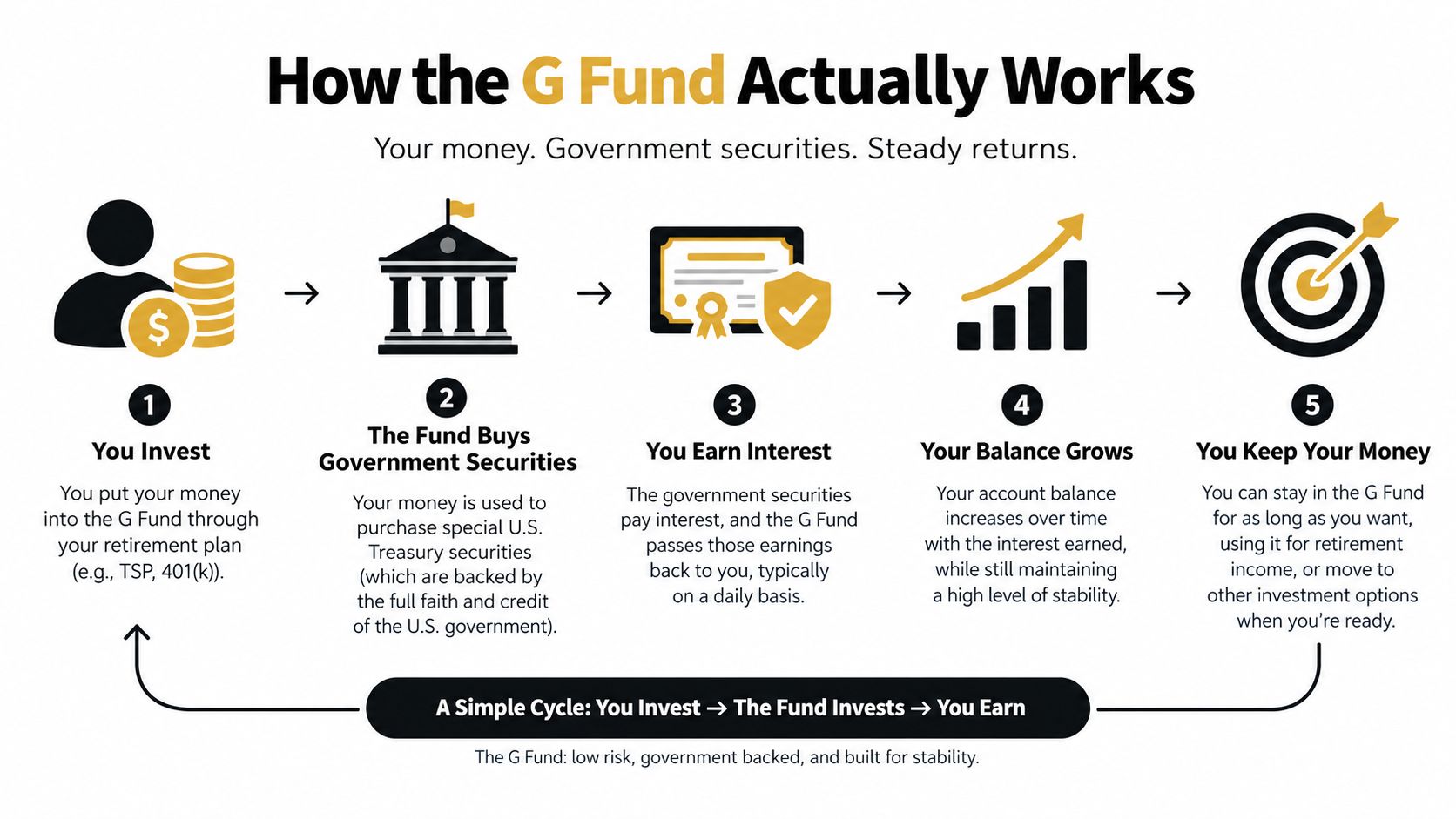
The process looks like this:
- Your contribution enters the TSP. You direct new money into the G Fund through your contribution election or move an existing balance through an interfund transfer.
- The TSP invests in special-issue Treasury securities. These securities aren't marketable, so their value doesn't change because investors bid their prices up or down during the trading day.
- The interest formula uses longer-term Treasury yields. The official TSP description bases the rate on market yields for Treasury securities with more than four years to maturity.
- The rate is recalculated monthly. The underlying securities remain specially issued and nonmarketable, while the credited rate responds to the relevant Treasury market yields.
- Interest is credited to participants. The balance can grow through credited interest without the share-price declines associated with publicly traded bond funds.
Why the structure is unusual
A regular bond fund owns securities that are priced in the open market. If new bonds begin offering higher yields, older bonds with lower yields become less attractive, so their market prices generally fall. The bond fund's share price reflects that decline even if the issuer remains highly creditworthy.
The G Fund avoids that mark-to-market experience because its securities aren't traded publicly. The TSP can give participants access to their money while maintaining the special Treasury structure. That creates an unusual combination: short-term access with an interest formula tied to longer-term Treasury yields.
A money market account typically focuses on short-term instruments and short-term rates. A traditional bond fund accepts price movement in exchange for exposure to bonds that can rise or fall in value. The G Fund sits between those familiar categories. It behaves like a stable account for principal purposes, but its rate is connected to a broader Treasury yield environment.
For another explanation of the rate mechanics and how to interpret the credited yield, review this guide to the TSP G Fund rate. The important practical point is that the G Fund's stable value doesn't mean its interest rate stays fixed. Your balance is protected from market-price losses, while the rate can change as Treasury yields change.
G Fund Returns and Historical Performance
The G Fund's record shows why federal employees often describe it as steady rather than spectacular. One independent historical summary reports a 4.7% compound annualized return since launch in 1987, with returns of 9.0% in 1989, 9.0% in 1990, and 8.3% in 1991. It also reports 4.4% in 2024 and 4.4% in 2025, while a 2026 snapshot lists a current monthly rate of 5.375%. These figures come from the TSP G Fund historical summary.
Those numbers reflect changing Treasury yields, not stock-market appreciation. Earlier periods with higher Treasury yields produced stronger credited rates. Later periods produced lower, but still positive, returns. The G Fund's appeal comes from that combination of interest-driven growth and protection from market-price volatility.
Representative return pattern
| Year | G Fund return | Rate environment |
|---|---|---|
| 1989 | 9.0% | Higher Treasury yields |
| 1990 | 9.0% | Higher Treasury yields |
| 1991 | 8.3% | Elevated yield environment |
| 2024 | 4.4% | Moderate credited rate |
| 2025 | 4.4% | Moderate credited rate |
| 2026 snapshot | 5.375% monthly rate | Current rate snapshot |
The table shows why you shouldn't treat the G Fund as a fixed-rate certificate of deposit. Its return can change over time because the TSP recalculates the interest rate using Treasury yields. At the same time, its return pattern isn't the same as an equity fund. Stocks can produce large gains and losses from changing expectations about companies and the economy. The G Fund primarily rewards you through credited interest.
The long record is useful, but it doesn't answer the allocation question by itself. A positive return can still provide less growth than a diversified stock allocation over a long career, and an account that rises in dollars can lose purchasing power if inflation outpaces its credited rate. The historical record tells you what the G Fund is designed to deliver, not what your entire retirement portfolio should earn.
For broader context on how the TSP's investment choices developed, see this history of the Thrift Savings Plan and the G Fund.
How the G Fund Compares With Other TSP Funds
The G Fund makes more sense when you compare it with the job performed by each alternative. The question isn't whether one fund is universally better. The question is which risk you're willing to accept and what the money needs to do.
| Fund | Asset class | Risk level | Return potential | Portfolio role |
|---|---|---|---|---|
| G | Special-issue U.S. Treasury securities | Lowest core-fund market risk | Interest-driven, modest | Principal stability and portfolio ballast |
| F | U.S. bond index | Bond-market risk | Interest income and bond-price movement | Diversified fixed-income exposure |
| C | Large U.S. company stocks | High market risk | Higher long-term growth potential, with drawdowns | Core U.S. equity growth |
| S | Small and midsize U.S. company stocks | High market risk | Higher growth potential with substantial volatility | Additional U.S. equity diversification |
| I | International developed-market stocks | High market and currency risk | International equity growth | Exposure outside the U.S. |
The C, S, and I Funds are equity choices. They can lose significant value during a stock-market decline, but they also provide the growth engine many long-term retirement portfolios need. The F Fund is a bond investment, so it can provide diversification from stocks while still experiencing changes in value when interest rates and bond prices move.
The G Fund is different from all three. It isn't a stock substitute, because it doesn't participate in company earnings or stock-price growth. It isn't a traditional bond substitute either, because it doesn't expose you to the same publicly traded bond-price movements. Its defining role is stability backed by the U.S. government, not maximum return.
Practical rule: Choose the G Fund because you need stability for a specific part of your plan, not because a temporary market decline has made every other fund feel uncomfortable.
A younger employee with a long accumulation period may need meaningful exposure to growth assets. Someone approaching withdrawals may place greater value on protecting money needed soon. Neither decision can be made from the fund label alone. Your pension, other savings, expected Social Security income, and tolerance for losses all affect the proper balance.
The Pro Rata Withdrawal Rule Most People Overlook
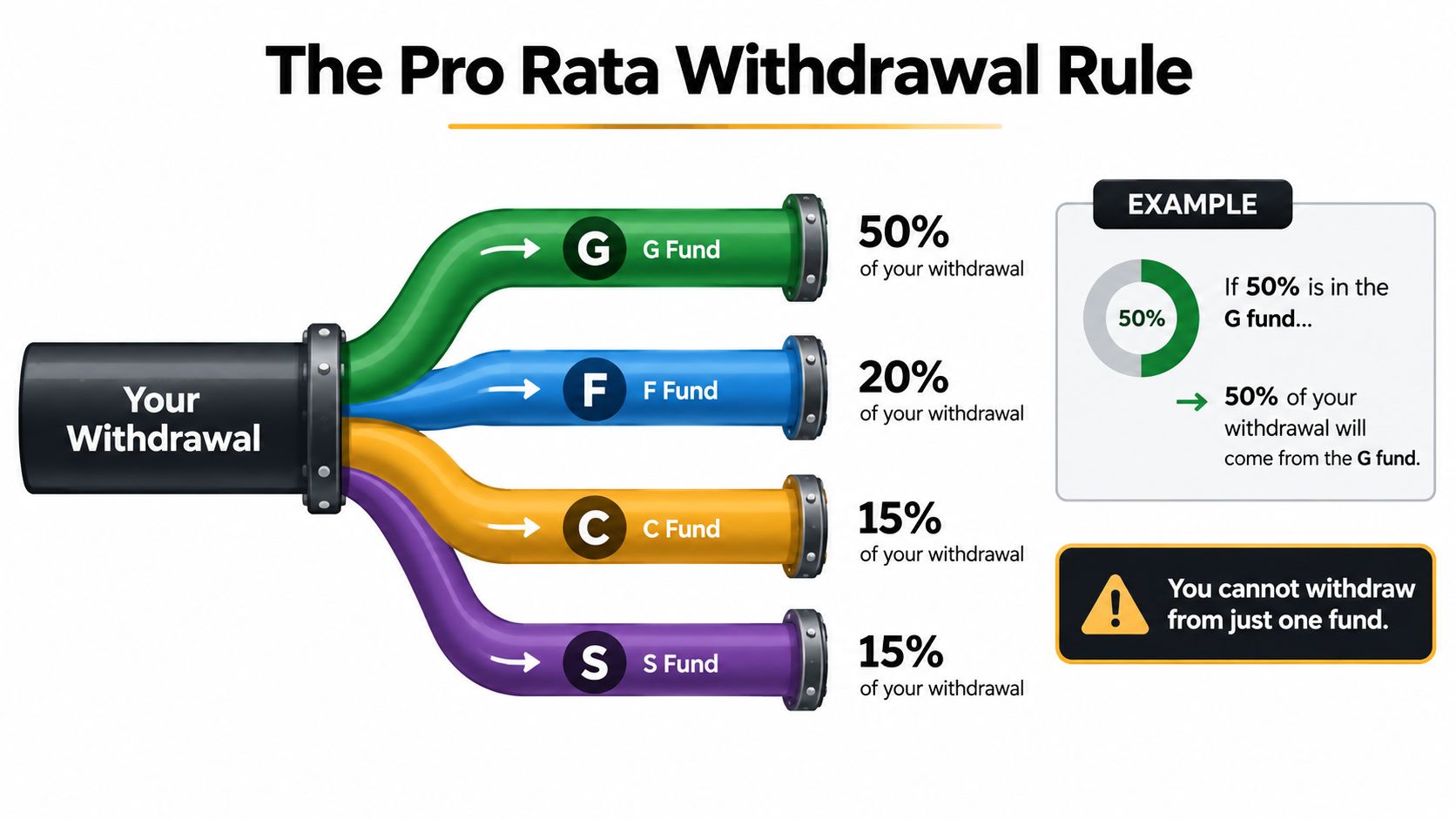
The G Fund can protect its own balance from market-price losses, but the TSP doesn't automatically let you spend only that balance. When you take a withdrawal, the TSP generally distributes the money proportionally from the funds in your current allocation. The payment isn't pulled from whichever fund feels safest or whichever fund you mentally designated as your cash reserve.
Consider a hypothetical account allocated 60% to equity funds and 40% to the G Fund. If you request a withdrawal while that allocation remains unchanged, the TSP's pro rata process would draw 40% of the payment from the G Fund and 60% from the equity funds. If stocks are down, the equity portion of the distribution may require selling shares at depressed prices.
That doesn't mean the G Fund failed. The G Fund did what it was designed to do. The problem is that the account owner expected to use it as a separate withdrawal bucket without first changing the account's allocation.
Accumulation and distribution are different jobs
During accumulation, you can use the G Fund as a stabilizing allocation while continuing to contribute to other funds. During distribution, the TSP's payment method becomes part of the investment decision. A defensive allocation only works as a cash reserve if the withdrawal process allows you to access that reserve independently.
Before beginning withdrawals, some participants may rebalance toward the G Fund so that a larger share of each payment comes from the stable investment. Others may coordinate installment payments with a broader income plan, including money held outside the TSP. The right approach depends on the withdrawal amount, tax treatment, pension income, and whether you can tolerate selling equity funds during a decline.
The TSP's detailed rules and examples are available in its withdrawal payments and distributions booklet. You can also review this practical guide to TSP withdrawal rules before selecting a payment method.
Watch the following explanation for a visual walkthrough of how proportional distributions can affect the funds in an account.
The central planning question is simple: Will your current allocation and withdrawal method sell the assets you intended to protect? Check that answer before retirement income begins, not after a market decline has already changed the account balance.
How to Think About G Fund Allocation
There isn't a universal G Fund percentage that works for every federal employee. Allocation should reflect the distance to retirement, the amount of volatility you can tolerate, and how much income you expect from your pension and other sources.
Early career
Someone with many years before retirement can usually tolerate more short-term market movement than someone who needs the account for near-term income. A small G Fund allocation, or none at all, may be consistent with a plan focused on long-term growth through the C, S, and I Funds. The key is whether you can continue contributing during market declines without abandoning the plan.
That approach isn't a promise of higher returns. It accepts equity risk in pursuit of greater growth potential. A long time horizon gives you more opportunity to recover from downturns, but it doesn't remove the risk of loss.
Mid-career
Mid-career employees often use the G Fund as a stabilizing slice rather than an all-or-nothing decision. It can give you a portion of the account that doesn't experience ordinary market-price swings, which may make it easier to keep the rest invested through volatility.
Ask what the stable allocation is supposed to accomplish. It might support a planned purchase, reduce the temptation to sell stocks, or provide a rebalancing source after an equity decline. If you can't name the job, the allocation may be based more on fear than on planning.
Near retirement and retirement
As withdrawals approach, protecting money needed for near-term spending becomes more important. A larger G Fund allocation may fit that objective, but only if you account for the pro rata rule. Leaving a large balance in the G Fund while assuming you can withdraw exclusively from it creates a plan mismatch.
The right allocation isn't the one that feels safest on a statement. It's the one that matches when you'll need the money and how the TSP will actually pay it to you.
Review the allocation alongside your retirement date, expected fixed income, tax bracket, health coverage costs, and assets outside the TSP. A federal benefits planner can help you test the withdrawal mechanics rather than treating the G Fund as an isolated investment choice.
Common Misconceptions About the G Fund
The G Fund's unusual structure creates several understandable but misleading shortcuts.
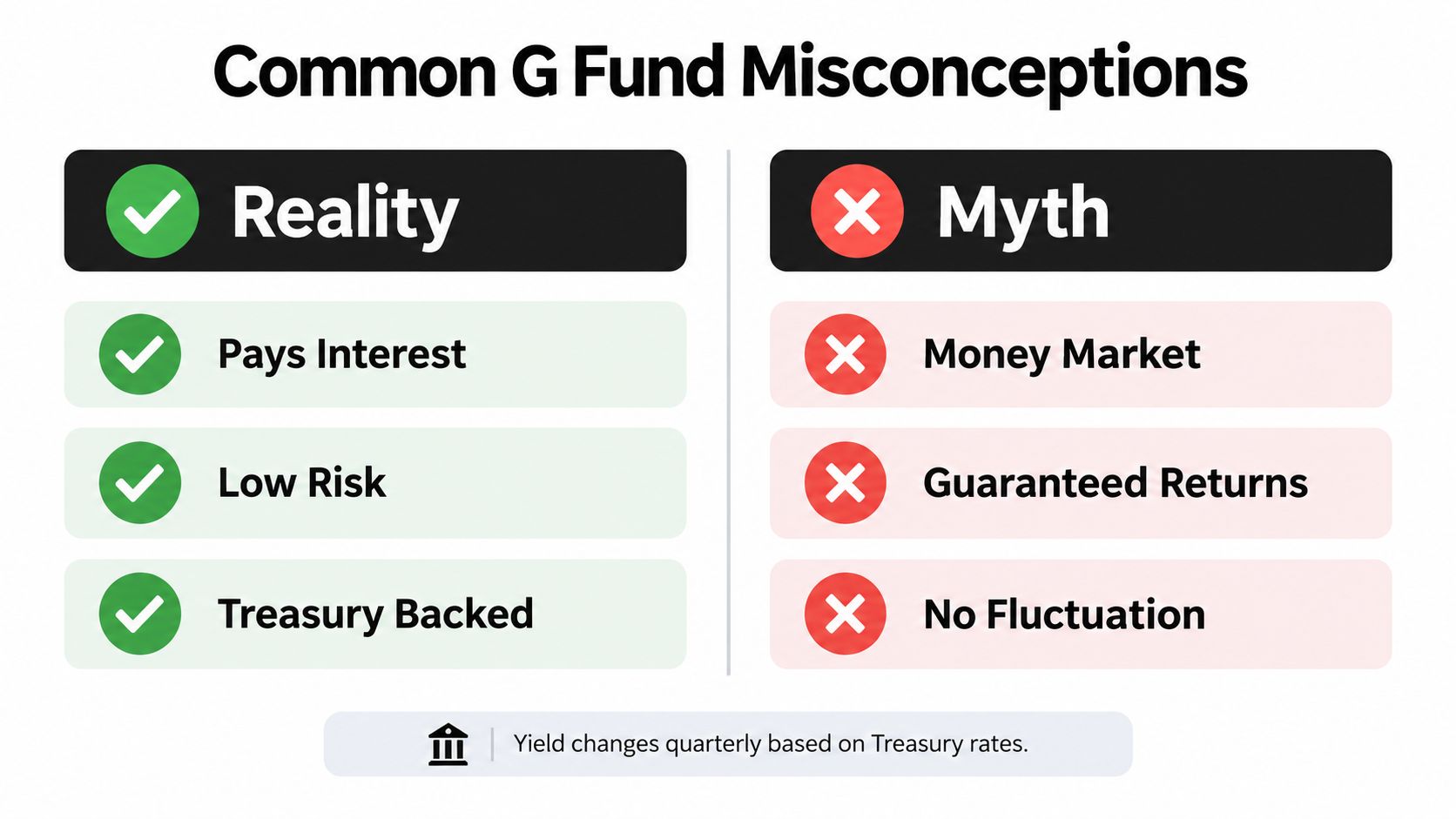
Myth one, the G Fund is just a money market fund
It isn't. The G Fund uses special-issue Treasury securities, and its rate is tied to Treasury yields for securities with more than four years to maturity. A money market fund generally focuses on short-term instruments and can respond differently to changes in short-term rates.
The practical distinction is important. The G Fund is not just a cash account with an ordinary bank or money market formula. It offers a Treasury-based interest structure that is unusual within a retirement plan.
Myth two, the G Fund can never lose purchasing power
The government guarantee protects the principal and interest in nominal terms. It doesn't guarantee what that money will buy in the future. If living costs rise faster than the credited interest over an extended period, your account can increase while your purchasing power weakens.
That is inflation risk, not a failure of the principal guarantee. The G Fund protects against a particular problem, market-price loss, while leaving other retirement risks in place.
Myth three, I can live only from my G Fund balance
The pro rata rule makes this assumption unsafe. If your TSP contains several funds, a withdrawal generally draws proportionally from those holdings. The G Fund can be part of a withdrawal strategy, but it isn't automatically a separate account within the TSP.
Myth four, avoiding losses means avoiding risk
A stable account value removes market volatility, but it introduces opportunity cost. Money held in the G Fund doesn't participate in stock-market gains, and it may lag a growth-oriented portfolio over a long career. That tradeoff can be sensible for money needed soon, but expensive for money that won't be touched for many years.
The accurate model is more balanced: the G Fund is a defensive allocation tool, not a complete retirement portfolio and not a spendable account that operates independently of your other TSP holdings.
Putting It All Together
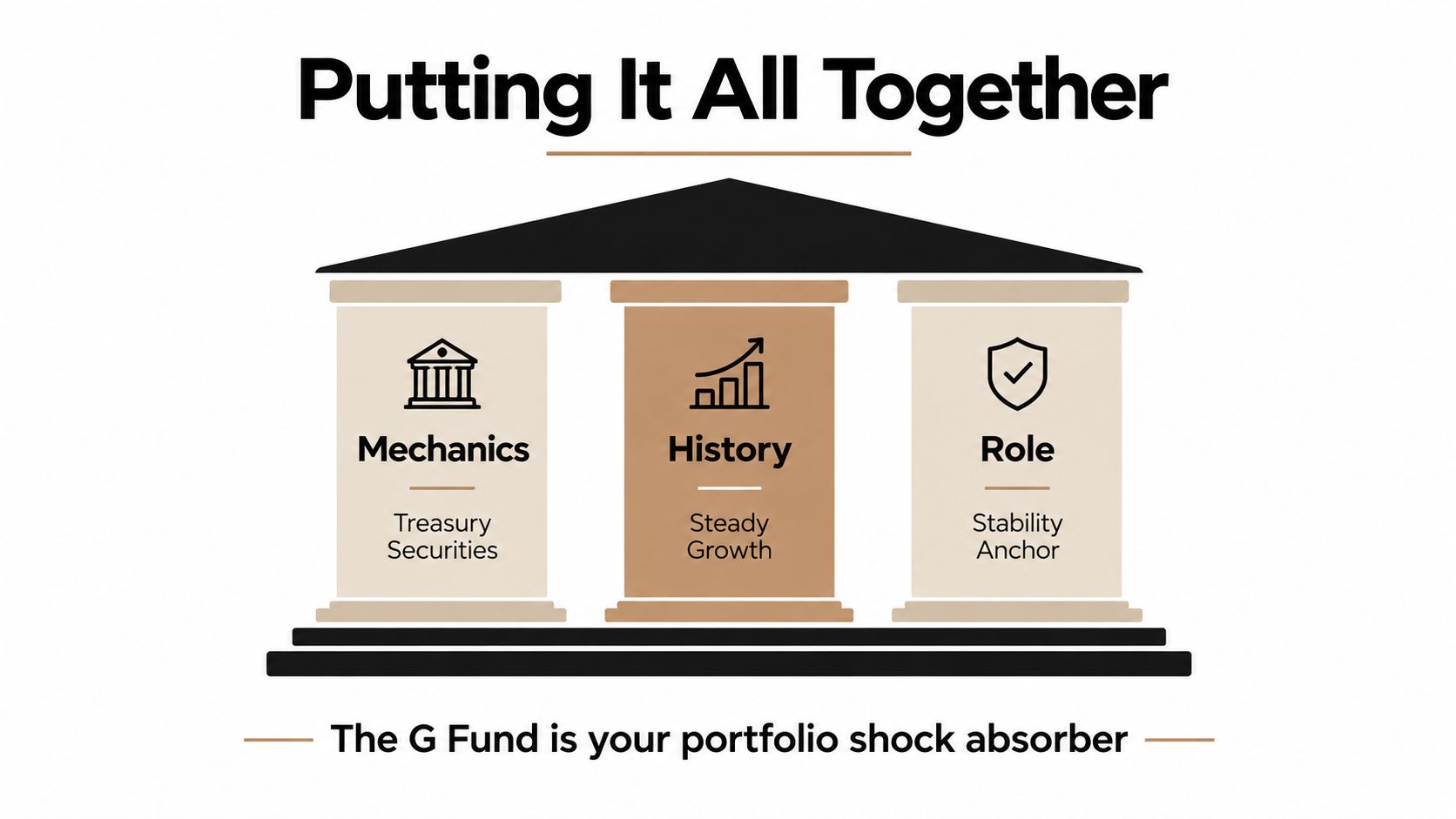
Three ideas should guide your decision.
Mechanics: The G Fund uses special, nonmarketable Treasury securities. Its interest formula is connected to Treasury yields, while its structure protects participants from ordinary market-price declines.
History: The available historical summary reports positive returns across the cited record, including a 4.7% compound annualized return since launch and 4.4% returns in both 2024 and 2025. That is steady interest-driven growth, not a substitute for equity appreciation.
Role: The G Fund can serve as a stability anchor, but its usefulness during retirement depends on how withdrawals are taken. The TSP's proportional distribution process can sell portions of your other funds even when your intention is to draw from the conservative allocation.
Use a practical filter. If you're early in your career, decide how much stability you need without sacrificing the growth potential required for a long accumulation period. If you're mid-career, define the job of the G Fund before adding it. If you're near retirement, coordinate the allocation with your withdrawal method and with liquid assets outside the TSP.
Federal Benefits Sherpa offers personalized benefit reviews, retirement planning, gap analysis reports, and educational guidance on TSP, healthcare coverage, and Social Security decisions. Visit Federal Benefits Sherpa to connect your G Fund allocation with the broader income plan you'll actually use in retirement.

Dedicated to helping Federal employees nationwide.
“Sherpa” - Someone who guides others through complex challenges, helping them navigate difficult decisions and achieve their goals, much like a trusted advisor in the business world.
Federal Benefits Sherpa, LLC
12724 Gran Bay Parkway West, Suite 410, Jacksonville, FL 32225
Email: [email protected]
Phone: (833) 753-1825
© 2024 Federalbenefitssherpa. All rights reserved
Federal Benefits Sherpa is an independent organization and is not affiliated with or endorsed by the U.S. government or any federal agency.