
Learning Center
What Is Income Gap in Retirement? a Clear Guide
A lot of federal employees reach the same point at roughly the same time. They've spent years contributing to the TSP, they have a pension coming, Social Security is on the horizon, and they assume retirement will work because all the major boxes appear checked.
Then they sit down and put the numbers on one page.
That's when question shows up. Not “Do I have a pension?” Not “How much is in my TSP?” question is whether all of your retirement income sources, working together, will cover the life you expect to pay for. That difference is what people mean when they ask, what is income gap in retirement.
Why Federal Employees Are Asking About the Income Gap
Maria is a good example of how this sneaks up on people.
She's 58, a GS-12 step 5, with three decades of federal service. She's done what responsible employees are supposed to do. She stayed in the system, built a TSP balance, checked her pension estimate, and looked at her Social Security statement. On the surface, everything looked solid.
Then she tried a real retirement projection.
She added up what she expected from her FERS pension, a future Social Security benefit, and monthly income she thought she could draw from the TSP. The total came out near $6,200 per month. Then she listed what retirement would cost. Housing, food, insurance, taxes, travel to see grandkids, car replacement, and health costs pushed expected spending to about $8,500 per month. The result was a shortfall of roughly $2,300 each month.
Why this catches federal workers off guard
Federal employees often assume three income streams automatically equal security. That's understandable. FERS, Social Security, and the TSP sound like a complete package.
But those pieces don't all behave the same way.
- The pension is steady, but limited. It usually covers part of retirement spending, not all of it.
- Social Security has timing decisions. Claiming earlier or later changes the monthly amount.
- The TSP is flexible, but it's still your savings. Every withdrawal has to be weighed against longevity, taxes, and market risk.
For some employees, there's another layer. If you have non-covered earnings or a pension tied to other government work, the rules around Social Security can get more complicated. If that applies to you, this explanation of the Windfall Elimination Provision and Government Pension Offset is worth reviewing before you trust your estimate.
The retirement decision usually isn't ruined by one giant mistake. It's more often weakened by several small assumptions that all lean optimistic.
Why the question feels more urgent now
Federal workers are paying closer attention because retirement lasts longer than many older estimates assumed, bridge income can disappear at key ages, and health coverage choices become more consequential after leaving payroll. A plan that looks fine at retirement can feel tighter later if one temporary income source ends or expenses rise faster than expected.
That's why the income gap has become the central planning question. Before you submit retirement paperwork, you need to know one thing clearly. Will your combined retirement income meet your target spending, or is there a gap you still need to close?
Defining the Retirement Income Gap in Plain English
Start with a household budget, not a financial formula.
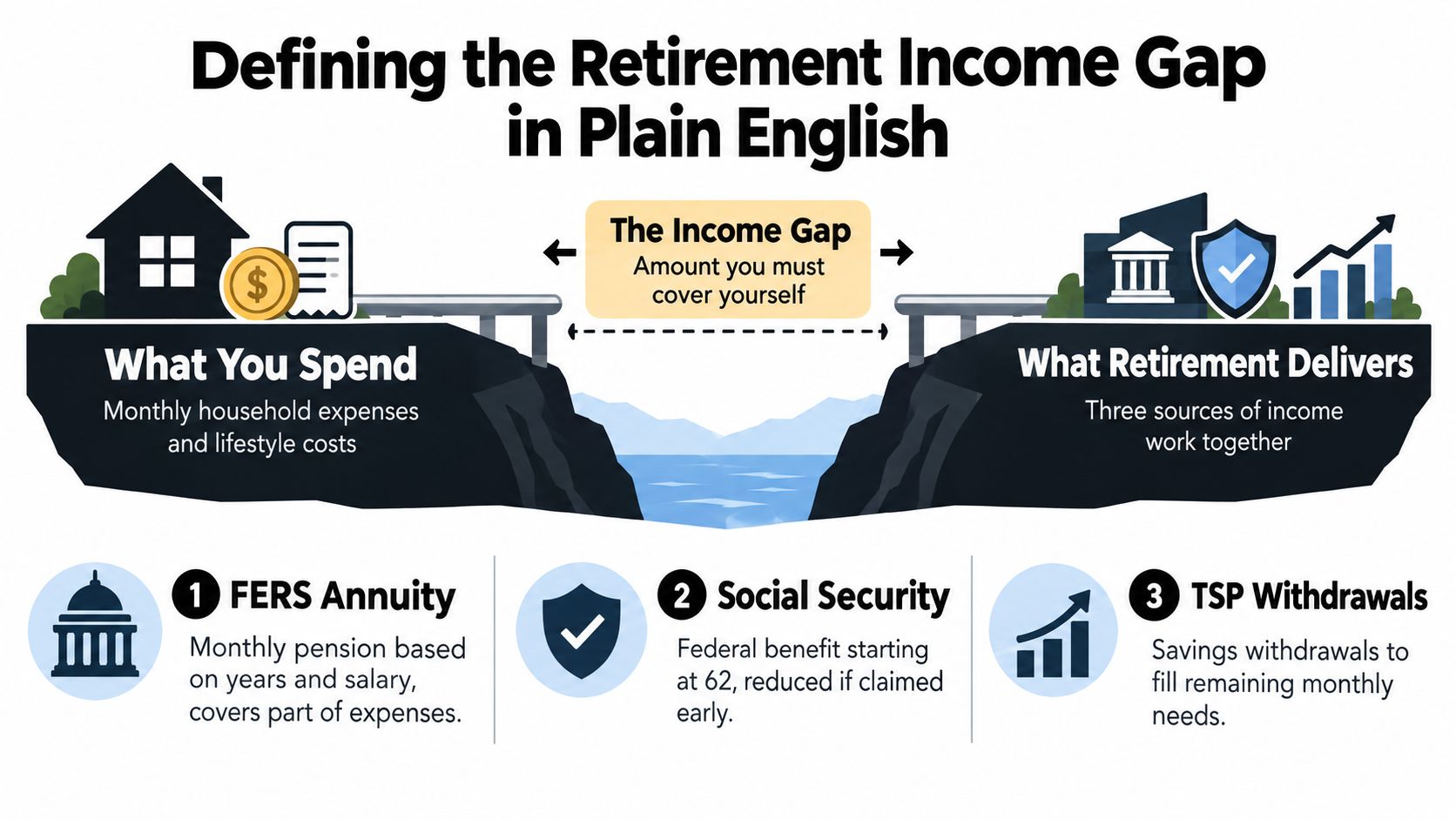
If your monthly spending is one side of a bridge, and your retirement income is the other side, the retirement income gap is the open space in the middle. It's the amount your income doesn't cover. In working years, a paycheck usually fills that space. In retirement, the job of filling it shifts to your pension, Social Security, TSP withdrawals, and any other income you may have.
The plain-English version
Here's the simplest way to say it:
If retirement costs more than retirement income, the difference is your income gap.
That gap can be measured monthly or annually. It can also be measured as a replacement-rate problem. In pension analysis, the key benchmark is the replacement rate, which means pension entitlement divided by pre-retirement earnings. OECD data show average gross replacement rates around 50.7% for men and 50.1% for women, with net replacement rates averaging 61.4% across member countries in Pensions at a Glance 2023.
That matters because many people intuitively expect retirement income to feel close to their working income. In practice, systems often replace only part of it.
Why federal employees misread this
Federal employees sometimes check each account separately and feel reassured.
They think, “I have a pension.” Then, “I'll get Social Security.” Then, “I also have the TSP.” But retirement planning doesn't happen in separate boxes. It happens in one monthly cash-flow reality.
A good beginner explanation of pension mechanics helps here, especially if you want to understand what your annuity does and doesn't cover. This primer on what a pension is and how it works gives that foundation.
If your household is also balancing higher earnings, taxes, and more complex saving decisions, a broader guide for high income earners can be useful because the income gap often shows up differently when more of your retirement lifestyle is self-funded.
A planning number, not a moral judgment
The phrase sounds negative, but it shouldn't.
An income gap isn't proof that you failed. It's a measurement. It tells you how much needs to change, whether that means saving more, retiring later, spending less, changing your claiming strategy, or combining several small adjustments.
That's why asking what is income gap in retirement is a smart move. You're not looking for bad news. You're looking for a clear target.
How to Calculate Your Own Income Gap Step by Step
The fastest way to make this real is to run the math on one sample case.
Use a federal employee earning $112,000, with 28 years of service, planning to retire at 62. We'll estimate spending first, then add each income source, then compare the totals.
Step 1: Estimate retirement spending
A simple first-pass estimate is to start at about 80 percent of pre-retirement income.
For a salary of $112,000, that gives projected annual retirement spending of about $89,600. Don't stop there, though. Break that total into categories so you can pressure-test it. Essentials usually include housing, food, insurance, utilities, taxes, and healthcare. Discretionary spending often includes travel, gifts, hobbies, and support for family.
Practical rule: Your retirement budget should reflect what you'll actually keep paying, not what you hope will disappear.
Step 2: Estimate the FERS pension
For someone retiring at 62 with enough service, the common FERS multiplier is 1.1 percent.
A rough formula looks like this:
High-3 salary × years of service × 1.1%
Using a high-3 close to the current salary:
$112,000 × 28 × 0.011 = about $34,500 annually
That gives you a starting pension estimate.
Step 3: Add Social Security and TSP income
Next, layer in projected Social Security. In this example, the estimate is $28,000 annually at age 67.
Then estimate a TSP withdrawal stream. Using a 4 percent withdrawal rate on the assumed balance in this example produces about $18,000 annually.
This gives you three working income sources:
- FERS pension: about $34,500
- Social Security: about $28,000
- TSP withdrawals: about $18,000
Step 4: Compare income to spending
Add the income sources:
$34,500 + $28,000 + $18,000 = $80,500
Now subtract that from projected spending:
$89,600 - $80,500 = $9,100 annual gap
That equals roughly $760 per month.
| Category | Annual Amount | Notes |
|---|---|---|
| Estimated retirement spending | $89,600 | Based on roughly 80% of $112,000 salary |
| FERS pension | $34,500 | Using high-3 × 28 years × 1.1% |
| Social Security | $28,000 | Estimated at age 67 |
| TSP withdrawals | $18,000 | Based on a 4% withdrawal approach |
| Total retirement income | $80,500 | Combined projected income |
| Annual income gap | $9,100 | Spending minus projected income |
| Monthly income gap | About $760 | Annual gap divided by 12 |
What this example teaches
This employee isn't in terrible shape. But they're also not “done” just because all three federal pillars are present.
That's the key lesson. A person can have a pension, have Social Security coming, and have meaningful TSP savings, yet still face a gap. If you want help organizing the inputs, this walkthrough on calculating retirement income needs for federal employees is a practical next step.
Where Federal Income Sources Actually Come From
Federal retirement income is easier to judge when you stop treating it as one big lump and instead look at the three separate engines producing it.
The FERS pension
The FERS annuity is the closest thing many employees have to a traditional paycheck replacement. The formula is straightforward:
High-3 salary × years of service × 1%
or
High-3 salary × years of service × 1.1% for those who qualify for the higher factor.
Take a high-3 of $90,000 and 25 years of service.
At 1%, that produces about $22,500 annually.
At 1.1%, that produces about $24,750 annually.
That's helpful income, but it also shows why many retirees can't expect the pension alone to carry the whole budget.
For employees who retire at Minimum Retirement Age with enough service, the FERS Special Retirement Supplement can temporarily help bridge the years before age 62. That can smooth cash flow, but it shouldn't be confused with permanent lifetime income.
Social Security
Social Security is the second layer, and it often changes the retirement math more than people expect.
Claiming age matters. A benefit started earlier looks different from one started later. Some employees also face special rules if they have non-covered earnings history or another pension arrangement connected to government work. In those cases, the estimate on a statement may not tell the whole story.
Recent U.S. survey reporting also shows why replacement planning needs to be realistic. Americans think they need about $5,094 per month to retire comfortably, yet only 57% plan to replace even half their income in retirement, while projected workplace balances may cover only 50% to 60% of expected retirement income, according to InvestmentNews reporting on recent survey data.
TSP withdrawals
The TSP is the flexible layer.
You can shape it through installment withdrawals, partial distributions, rollover strategies, or a mix of methods. That flexibility is useful, but it also puts more responsibility on you. The TSP isn't just a balance to admire. It's the pool that often has to absorb the difference between what the pension and Social Security replace and what your life costs.
The account also creates tax decisions. Withdrawals from traditional balances are generally taxed as ordinary income, and required minimum distributions begin at 73.
| Income Source | Typical Replacement Rate | Key Lever |
|---|---|---|
| FERS pension | Partial income replacement | Years of service and high-3 salary |
| Social Security | Partial income replacement | Claiming age and earnings history |
| TSP withdrawals | Flexible gap-filling income | Contribution level, investment growth, withdrawal strategy |
The combined view matters most
A federal retirement plan works when these three layers fit together.
One source provides a base. Another adds inflation-sensitive lifetime income. The third gives flexibility and risk. The mistake is asking whether each piece looks “good” in isolation. The better question is whether their combined monthly total supports your spending without forcing uncomfortable cuts later.
Common Causes That Quietly Widen the Gap
The retirement income gap usually widens through ordinary decisions, not dramatic errors. Most of them feel reasonable in the moment.
Timing choices that reduce income
Retiring at the first moment you're eligible can create pressure that doesn't show up until a few years later. A smaller annuity, a temporary bridge benefit ending, or early Social Security claiming can all compress income.
Ask yourself this: If I wait longer, does my permanent income improve enough to matter every single month afterward?
TSP decisions that weaken the backstop
Some employees treat the TSP too casually at separation. They withdraw too much too soon, keep no withdrawal plan, or avoid looking at tax consequences until the money is already moving.
Use this prompt: Do I know how much monthly income my TSP is expected to provide, or am I just assuming the account will be there when I need it?
Healthcare and housing costs often grow faster than headline inflation, which can erode the real value of retirement income over time, as discussed in this explanation of the retirement income gap and inflation stress testing.
Expenses that retirees routinely undercount
The biggest blind spots are often familiar expenses, not exotic ones.
- Healthcare costs: FEHB premiums in retirement, Medicare decisions, and higher-income premium surcharges can change the budget more than expected.
- Survivor benefit costs: Electing a survivor annuity protects a spouse, but it also affects net pension income.
- Lifestyle carryover: Travel, gifts, home repairs, and help for adult children don't automatically vanish in retirement.
- Inflation pressure: A budget built on a flat inflation assumption may miss the categories that rise faster in real life.
A better diagnostic question
Instead of asking, “Can I retire?”
Ask, “Which line items in my plan am I probably understating?”
That question usually produces better answers. It moves you from optimism to testing, and testing is how gaps get fixed before retirement rather than discovered after it.
Strategies That Close the Gap Before You Retire
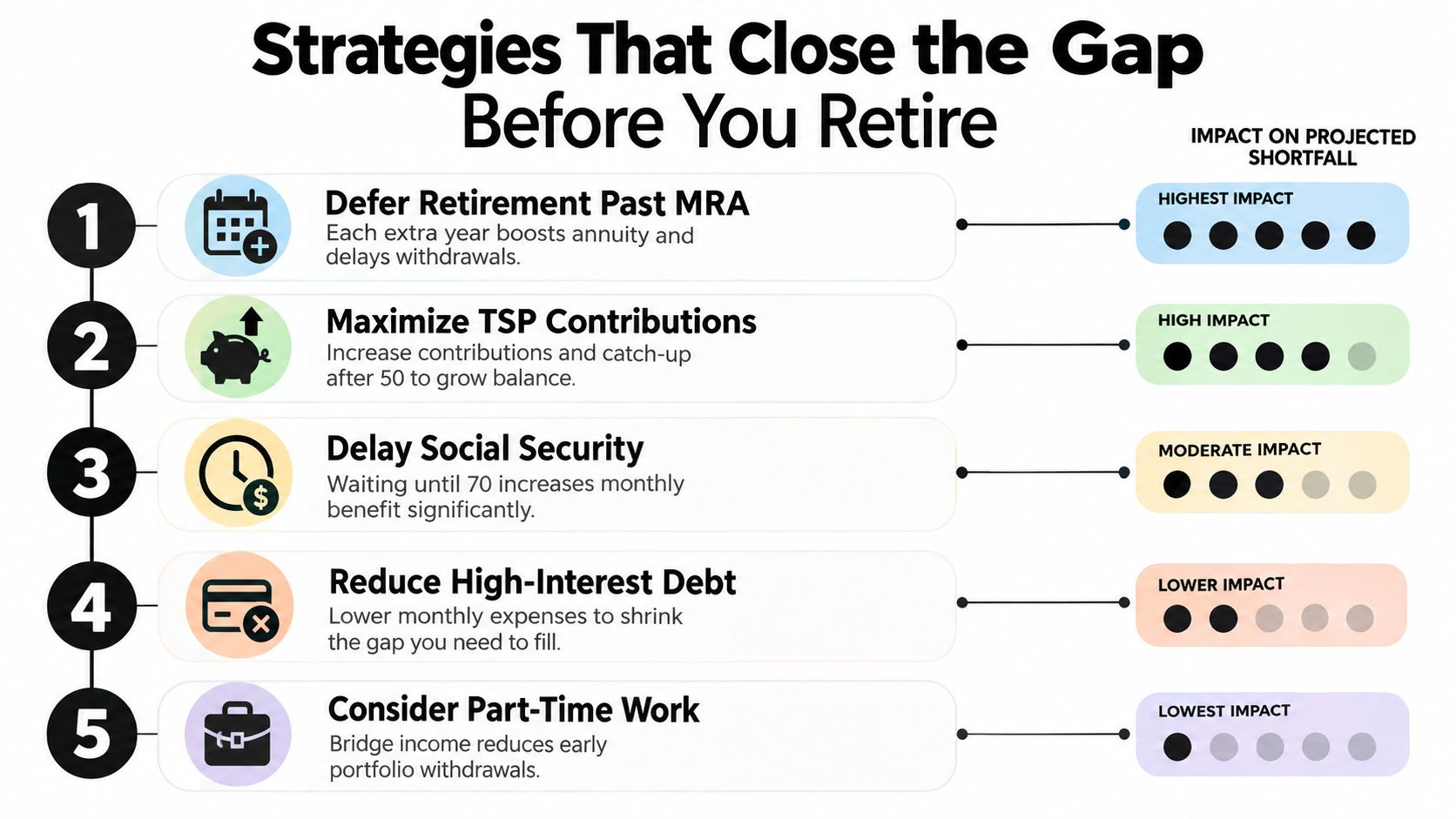
Some changes barely move the needle. Others reshape the whole projection. The highest-impact moves usually affect permanent income, withdrawal pressure, or both.
Delay retirement if the numbers are close
For many federal employees, working longer improves several lines at once. It can raise the pension formula, reduce the years your TSP must support, and give Social Security more room to grow if you also delay claiming.
If your projection is only slightly short, this is often the cleanest lever because it strengthens income and shortens the retirement funding period at the same time.
Raise TSP contributions while you still have payroll
The years just before retirement carry outsized importance. Contributions are still flowing, matching is still active, and you still have wage income to support higher savings rates.
Look at contribution rate, fund mix, and whether your current allocation still fits your time horizon. The TSP isn't just an accumulation tool. It's the source that often decides whether the gap stays manageable or becomes stressful.
Consider delaying Social Security
A larger guaranteed monthly benefit can reduce pressure on the TSP later. That matters because every extra dollar of lifetime income you lock in is one less dollar your savings have to produce repeatedly.
This is one of the decisions that often looks painful in the short run and powerful in the long run.
A short video can help if you want to think through tradeoffs before you choose a claiming strategy.
Use a real withdrawal plan
Many retirees don't have an income problem first. They have a withdrawal-structure problem.
A plan for sequencing withdrawals, managing taxes, and controlling bracket creep can help the same dollars last longer. In some cases, people also explore Roth conversions during lower-income years to reduce future tax pressure from required distributions.
Shrink the spending side before retirement starts
This lever gets less attention because it's not glamorous, but it works.
- Pay off expensive debt: Lower fixed costs reduce the income your portfolio must generate.
- Trim recurring lifestyle costs: Subscriptions, second vehicles, and habitual discretionary spending matter more once paychecks stop.
- Use phased work if available: Even temporary part-time income can reduce early withdrawals from savings.
Federal employees who want a formal side-by-side projection sometimes use tools from planners who model pension, TSP, health costs, and Social Security together. Federal Benefits Sherpa offers a gap analysis built around that combined view, which is useful if your numbers are close and you need to test different retirement dates.
Mistakes Federal Employees Make and When to Get Help
Three myths cause a lot of unnecessary trouble.
Myth one says the pension should be enough
That's the old mental model. Under FERS, the pension is usually one layer, not the entire structure.
The correction is simple. Run the pension as part of the plan, not as the plan.
Myth two says claiming Social Security at 62 solves the problem
Starting earlier can bring cash flow sooner, but it can also lock in a smaller monthly benefit for life. That's not automatically wrong, but it is arithmetic, not magic.
Ask whether early claiming closes the gap permanently or just patches it temporarily.
Myth three says the TSP is untouchable until some later milestone
That belief confuses tax rules, age rules, and distribution strategy. The TSP is a retirement income tool. It needs a plan, not a pedestal.
Recognizing a planning mistake early is itself a strategy, because it gives you time to correct the math while you still have options.
When paying for guidance starts making sense
Some situations deserve outside help sooner than others.
- A meaningful projected gap: If your shortfall is material relative to your expected lifestyle, second opinions become valuable.
- A survivor benefit election: That choice affects both protection and monthly income.
- A divorce or remarriage: Benefit coordination gets more complicated fast.
- RMD or tax questions: Withdrawal timing can change after-tax income more than many people expect.
- Supplement eligibility questions: The FERS Special Retirement Supplement often deserves closer modeling.
If you want another practical resource for avoiding avoidable mistakes, this checklist for pre-retirees is a useful companion read.
If you want help turning your estimates into a real retirement income map, Federal Benefits Sherpa works with federal employees to compare expected spending against pension income, TSP withdrawals, healthcare costs, and Social Security timing. If that's the question you're trying to answer right now, visit Federal Benefits Sherpa and review the planning resources available there.


Dedicated to helping Federal employees nationwide.
“Sherpa” - Someone who guides others through complex challenges, helping them navigate difficult decisions and achieve their goals, much like a trusted advisor in the business world.
Federal Benefits Sherpa, LLC
12724 Gran Bay Parkway West, Suite 410, Jacksonville, FL 32225
Email: [email protected]
Phone: (833) 753-1825
© 2024 Federalbenefitssherpa. All rights reserved
Federal Benefits Sherpa is an independent organization and is not affiliated with or endorsed by the U.S. government or any federal agency.