
Blogs

Blog title place here
We understand that every federal employee's situation is unique. Our solutions are designed to fit your specific needs.

Blog title place here
We understand that every federal employee's situation is unique. Our solutions are designed to fit your specific needs.

Blog title place here
We understand that every federal employee's situation is unique. Our solutions are designed to fit your specific needs.
TSP Lifecycle 2040 Fund: A Federal Employee Guide
You log into your TSP account, see the G, F, C, S, and I Funds, then notice the L 2040 Fund sitting among them. Your retirement date feels close enough to require a decision, but not close enough to make the answer obvious. The practical question isn't which fund has the most impressive recent performance. It's whether the fund's built-in transition matches the year you'll need your TSP money.
The TSP Lifecycle 2040 Fund can be a sensible default for a federal employee planning withdrawals between 2038 and 2042. It can also be the wrong choice if you plan to use your TSP earlier, leave it untouched for much longer, or coordinate it with substantial pension income in a way the fund can't recognize. The fund handles allocation changes for you, but it doesn't create a complete retirement plan.
Understanding the TSP Lifecycle 2040 Fund
A federal employee may retire in the 2038 to 2042 range but delay TSP withdrawals for years. Another employee may leave federal service earlier and need the account soon afterward. Those decisions can produce very different investment needs, even when both workers choose L 2040. The fund should match the date you expect to use the money, not just your planned retirement date.
The TSP Lifecycle 2040 Fund is a target-date lifecycle fund that combines the five core TSP funds, G, F, C, S, and I. Its allocation changes over time as the target window approaches. The official TSP description identifies it for participants planning to begin withdrawals during the 2038 to 2042 window. (TSP L 2040 Fund)
What the fund does for you
L 2040 is a managed transition portfolio, not one stock or bond holding. You do not set the mix among the C Fund, G Fund, or other core funds yourself, and you do not schedule the rebalancing. The TSP follows the fund's glidepath automatically.
That automation solves an operational problem, but it does not remove investment risk. The TSP classifies L 2040 as a medium-risk option and lists its inception date as July 1, 2020. (TSP lifecycle fund overview) The classification describes the intended role of the fund, not a floor under your account value. Market-based holdings can decline, particularly while the fund still carries meaningful stock exposure.
The larger risk appears when your withdrawal timing and the glidepath do not match. A market decline near the start of withdrawals can force you to sell depressed holdings, while the fund continues its scheduled transition regardless of your personal cash needs. After the target period, the lifecycle structure also moves assets automatically toward the L Income Fund. That rollover can reduce volatility, but it may occur while you still need more growth or before your broader retirement income plan is ready.
For a new federal employee, the appeal is simple: select a fund that fits the expected withdrawal period and direct contributions there. Experienced investors trade precise control for a scheduled process.
Practical rule: Choose L 2040 because your expected withdrawal window fits its glidepath, not because the number resembles your retirement age.
The life cycle funds guide for federal employees explains how TSP lifecycle funds change their investment mix. Use that background, then compare the fund's automatic path with your pension, other assets, and actual withdrawal schedule.
How the Glidepath and Asset Allocation Shift Over Time
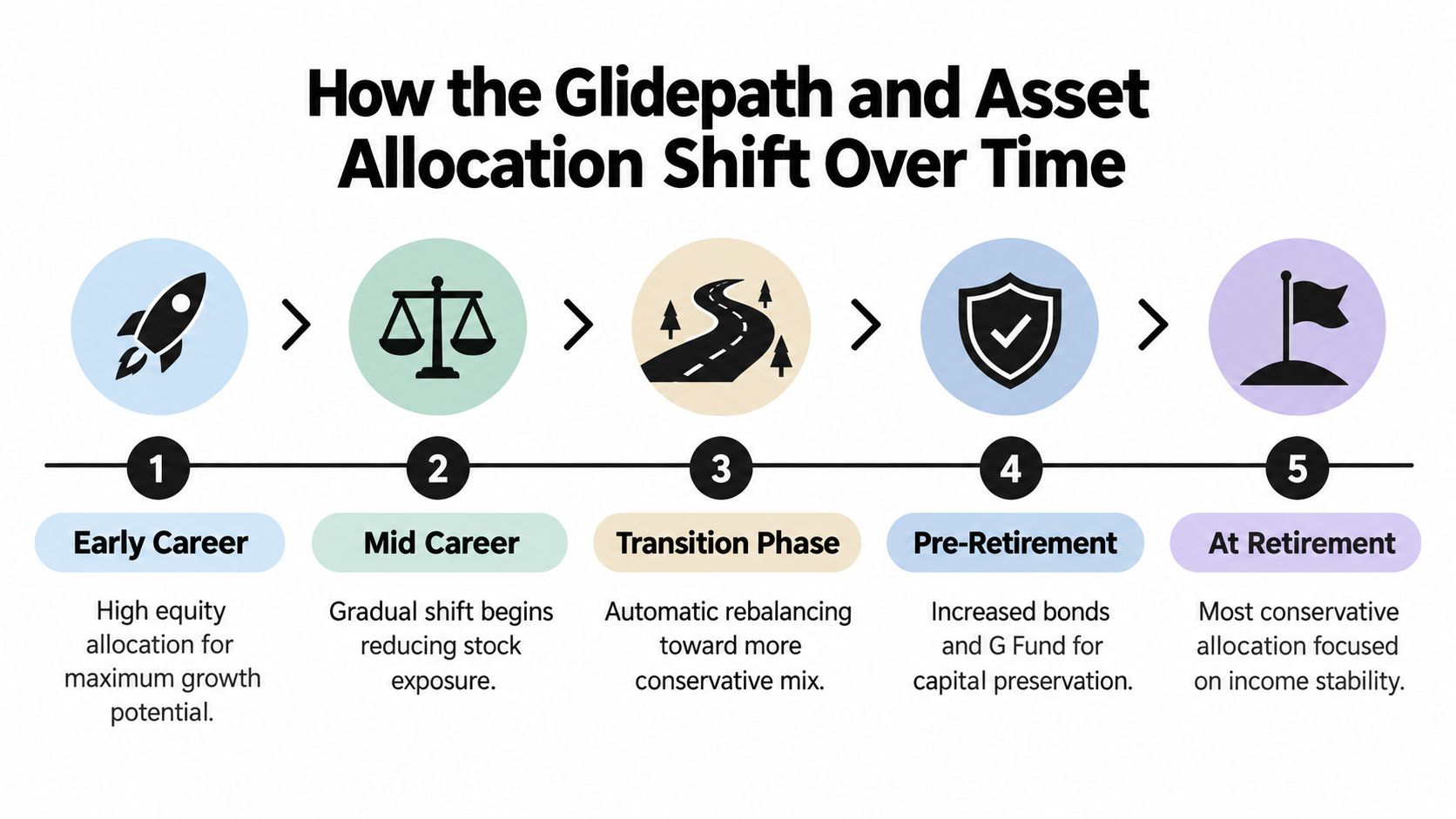
If you select L 2040 and ignore it, the TSP still changes the account for you. Its glidepath adjusts the mix quarterly across the G, F, C, S, and I Funds, reducing equity exposure as the target date approaches. That automation is useful, but it also means the account can become more conservative without matching your actual work, spending, or withdrawal plans.
The early allocation prioritizes growth while retirement remains years away. A March 2023 allocation cited in an independent investment analysis held 20.93% in the G Fund, 7.32% in the F Fund, 36.84% in the C Fund, 9.80% in the S Fund, and 25.11% in the I Fund. (Independent analysis of TSP funds)
That allocation represented approximately 72% combined equities across the C, S, and I Funds. You do not need to memorize those percentages. You do need to understand that L 2040 can experience significant stock-market volatility well before its target date.
Why the mix becomes more defensive
As the target date nears, the fund shifts toward holdings intended to provide greater stability. At the target allocation, the G Fund becomes the dominant holding, while exposure to the C, S, and I Funds becomes much smaller. The target-date mix is expected to match the L Income Fund in July 2040, with 72% G, 6% F, 11% C, 3% S, and 8% I. (TSP L 2040 Fund)
This schedule addresses sequence-of-returns risk, the risk that poor returns occur just before or after withdrawals start. A market decline is more damaging when you must sell investments to pay living expenses. Lower equity exposure reduces dependence on stock performance, but it does not prevent losses or guarantee that the portfolio will meet your income needs.
The trade-off is lower future growth potential. A conservative allocation can be easier to hold during a market decline, yet it will not behave like the earlier growth-oriented mix. The glidepath gives up some return potential to reduce the chance that a severe decline controls your first retirement years.
The rollover is automatic
L 2040 does not stop at its target year. It is scheduled to automatically roll into the L Income Fund in July 2040. (TSP lifecycle fund overview)
That operational detail requires a calendar reminder. If you continue contributing to L 2040 without reviewing the account, the balance will eventually move into the more conservative L Income structure. This may suit someone entering withdrawals, but it may be too cautious if you keep working or expect to leave the balance invested for many more years.
The rollover removes a task from your calendar. It does not confirm that L Income fits your pension, Social Security timing, other assets, or spending plan. Review the destination before the rollover, especially if a market decline has already reduced the account. Selling or reallocating after that decline can lock in losses and leave less capital available for recovery.
The right process is simple: monitor the scheduled transition, compare it with your income strategy, and change course before the automatic move if the allocation no longer fits.
Comparing L 2040 to Individual Core TSP Funds
You have two broad choices inside the TSP. You can use L 2040 as one coordinated portfolio, or you can select individual positions in the G, F, C, S, and I Funds and manage the allocation yourself.
The DIY route gives you more control. You can hold a higher stock allocation, keep more in the G Fund, or design a mix around your pension and other assets. But control creates responsibility. You must decide when to rebalance, how to react during a market decline, and whether your allocation still fits your withdrawal date.
| Feature | TSP L 2040 Fund | DIY Core Funds, G, F, C, S, I |
|---|---|---|
| Allocation management | The fund changes its mix along an automatic glidepath | You choose and maintain the mix |
| Rebalancing | Built into the lifecycle structure | You must perform it yourself |
| Retirement timing | Designed for withdrawals between 2038 and 2042 | You set the timeline and risk level |
| Customization | Limited to choosing among lifecycle options or moving elsewhere | Full control over each core fund |
| Behavioral discipline | Reduces the temptation to trade during market stress | Requires you to follow your written plan |
| Main risk | The glidepath may not fit your personal income needs | You may delay de-risking or panic-sell |
The case for the hands-off approach
L 2040 works best when you want a repeatable process and know you won't reliably manage one yourself. The fund reduces the chance that you leave an old allocation untouched for years or make a major change after a frightening market headline. It also keeps the account moving toward a more conservative posture without requiring a separate calendar reminder.
That behavioral benefit is substantial, but don't confuse simplicity with personalization. The fund doesn't know whether your FERS pension will cover most basic expenses, whether you have other investments, or whether you'll need a large TSP withdrawal immediately after retirement.
The case for building your own mix
DIY investing makes sense when you understand the five core funds, have a written allocation policy, and will follow it during both strong and weak markets. It can also make sense when the standard glidepath is materially different from your broader household balance sheet.
For example, a participant with dependable retirement income from other sources may accept more equity exposure than L 2040 provides. Another participant with limited guaranteed income may want a more conservative approach sooner. Neither decision should be made by chasing returns or reacting to a single market period.
Review the core TSP fund comparison before abandoning the lifecycle structure. If you can't explain your intended allocation, rebalancing rule, and response to a major decline, stay with the automated option while you build that knowledge.
Who Should Actually Use the L 2040 Fund
The ideal L 2040 participant is a federal employee who expects to begin using TSP assets between 2038 and 2042. That means the account may support an initial retirement income strategy during that period, even if the employee leaves federal service earlier or remains employed longer.
Your first task is to identify the account's job. Is it meant to fund expenses immediately after separation? Will it supplement a FERS pension? Will you leave it untouched while other income sources cover your bills? The answer determines whether the L 2040 timeline fits.
Match the fund to withdrawals, not a label
A target date is a spending date, not necessarily a separation date. Someone could leave federal service before the target window, use a pension and other resources for a period, then start TSP withdrawals in the intended range. In that case, L 2040 may still align with the account's purpose.
The reverse situation creates a problem. If you plan to withdraw heavily before the target window, L 2040 may retain more growth exposure than your near-term cash-flow needs can tolerate. If you retire around the target date but expect to leave the TSP invested for another decade, the automatic move into L Income may become conservative too soon.
The right lifecycle fund follows the date you need the money, not the date printed on your personnel paperwork.
Three situations that deserve a closer review
Early separation with delayed withdrawals: If you leave federal employment early but plan to draw from other resources, assess the date when TSP withdrawals will begin.
A strong FERS income floor: If your pension and other predictable income cover essential expenses, the TSP may serve as a long-term growth asset. L 2040's standard de-risking path might not match that role.
A TSP-dependent retirement: If the account must provide a large share of your spending, the glidepath's reduction in equity exposure can help limit late-stage volatility. You still need a withdrawal plan, cash-flow forecast, and review of other benefits.
Do not select L 2040 just because your career timeline feels close to 2040. Write down the expected start of withdrawals, the amount of income you need, and the role of your pension. Then decide whether the fund's automatic path supports those needs.
Hidden Risks and Real Benefits of Target-Date Investing
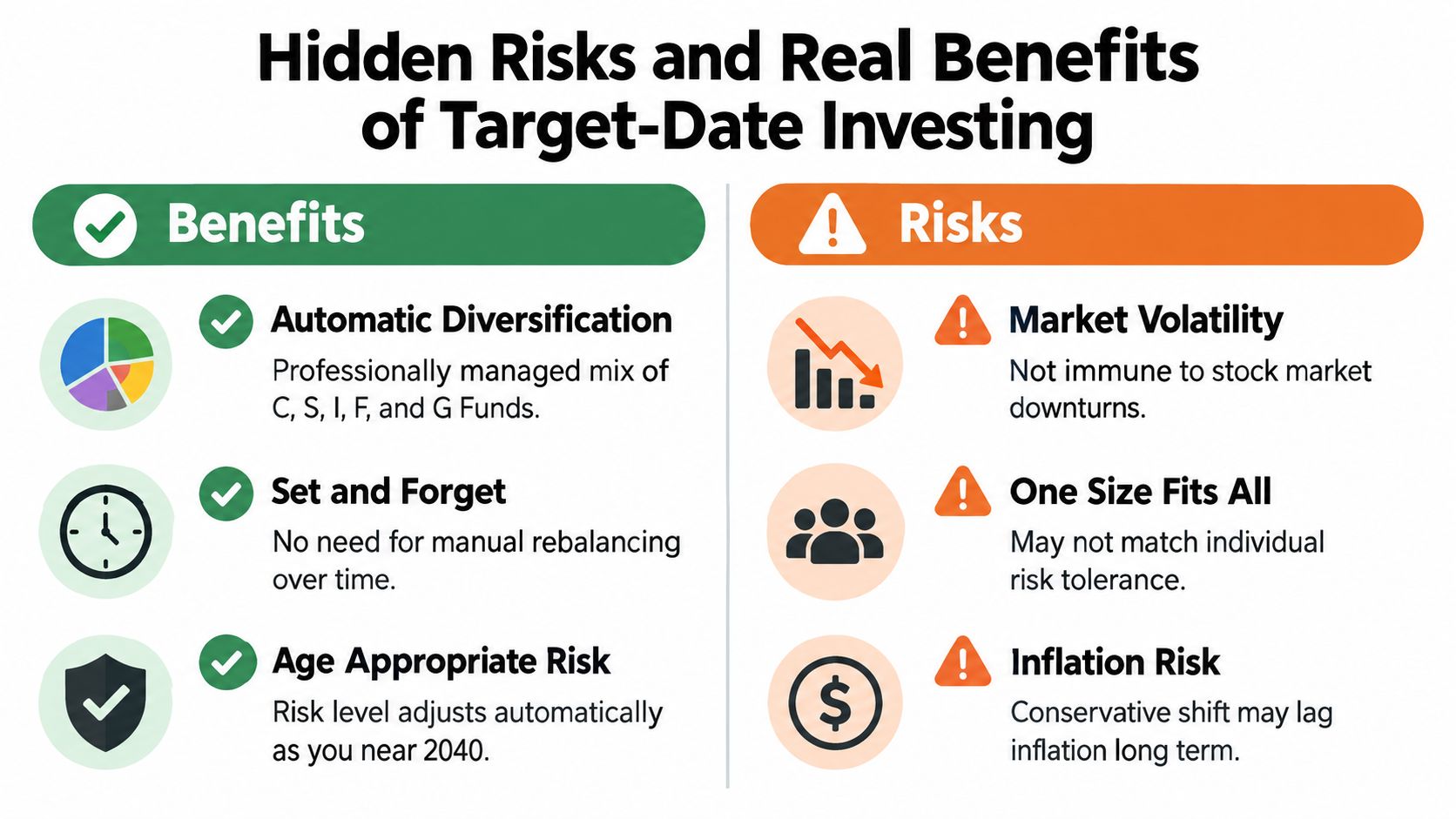
A lifecycle fund reduces allocation decisions, not investment risk. The L 2040 Fund keeps meaningful equity exposure during its glidepath, so a market decline can shrink your balance before the portfolio reaches its more defensive allocation.
The danger increases when the decline occurs near your first withdrawals. Selling after a fall locks in losses and leaves fewer assets to recover later. The glidepath reduces exposure on schedule, but it cannot know whether a downturn will arrive before or after you need the money.
What L 2040 handles well
The fund's strongest feature is operational discipline. It spreads assets across the five core TSP funds and changes that mix without requiring repeated allocation instructions. The TSP L 2040 Fund materials report an expense ratio of 0.039%, plus an additional 0.003% net administrative expense. (TSP L 2040 Fund)
Those low costs support long-term compounding. They do not prevent market losses, but they avoid adding unnecessary investment expenses while the fund performs ongoing allocation work.
The automatic process also limits emotional decisions. You do not have to decide whether a falling stock market means abandoning the plan. The allocation follows its scheduled path unless you move the money elsewhere.
What L 2040 can't solve
Market declines: The fund remains exposed to equity markets during its growth and transition stages.
Personal risk tolerance: A standard glidepath cannot determine whether you can tolerate its current allocation.
Inflation: Safer assets can reduce volatility, but a highly conservative portfolio may struggle to keep pace with rising living costs over a long retirement.
Withdrawal sequencing: The fund does not decide which assets to sell, how much income to take, or how to coordinate withdrawals with pension and Social Security income.
The automatic rollover to L Income creates a separate planning risk. If markets fall near that transition, the account may suffer sequence-of-returns damage just as the allocation becomes more conservative. A later rebound may then occur after you have sold assets or reduced growth exposure. Review the rollover date against your expected withdrawals, rather than assuming the target year makes the decision for you.
L 2040 is a disciplined allocation mechanism, not a guarantee, insurance policy, or retirement-income plan. Use it when its automatic path matches your withdrawal timing and risk capacity. Otherwise, choose an allocation you can maintain through both market declines and retirement withdrawals.
Integrating the L 2040 Fund Into Your Federal Retirement Plan
Your TSP is one part of the FERS structure. The Basic Benefit, Social Security, and TSP work together, while FEHB decisions can affect the amount of retirement income available for everyday spending. A good TSP allocation must fit that entire arrangement.
Treat L 2040 as the investment engine, not the complete vehicle. Your pension can provide a predictable income floor, while the TSP supplies flexibility for travel, large expenses, tax management, or gaps between retirement and other income sources. The right balance depends on how much of your required spending the pension covers.
Put the account on an annual review schedule
Review the fund when a major planning assumption changes, not because the market produces a dramatic headline. Check your expected retirement date, the first year you may need withdrawals, your pension estimate, and your projected healthcare costs.
Use this short review list:
Confirm the timeline: Make sure the expected start of TSP withdrawals still fits the L 2040 window.
Check the allocation: Verify that you still want the fund's current risk level rather than assuming it remains appropriate.
Coordinate income sources: Map TSP withdrawals against your FERS pension and Social Security decisions.
Review beneficiaries: Keep TSP beneficiary designations consistent with your estate and survivor-benefit intentions.
Test the gap: Identify expenses that guaranteed income won't cover and determine whether the TSP can support them.
The TSP maximization guide can help you review contributions and broader account decisions. Don't let contribution choices distract from the larger issue: a well-funded TSP still needs a withdrawal strategy.
Plan for the automatic destination
Because L 2040 is scheduled to become the L Income mix in July 2040, decide in advance whether that destination fits your plan. If it does, the automatic transition supports a clean handoff into the income phase. If it doesn't, you need a deliberate alternative before the target date arrives.
Federal Benefits Sherpa offers benefit reviews, retirement planning, and gap analysis reports that can connect TSP decisions with pension, healthcare, and Social Security planning. That kind of review is most useful when you bring a clear withdrawal timeline and current beneficiary information.
Next Steps for Securing Your Federal Retirement
A federal employee targeting the 2038 to 2042 withdrawal window shouldn't leave the L 2040 decision at “the fund will handle it.” The fund will handle its allocation process. You still have to decide whether the timeline, risk level, and eventual L Income transition fit your life.
Start with the date you expect to need the money. Then work outward to contributions, allocation, beneficiaries, and income planning.
Use this practical checklist
Confirm your withdrawal timeline. Verify that your expected TSP withdrawals fall between 2038 and 2042, the period the L 2040 Fund is designed to serve.
Review your contributions. Confirm that your contribution rate and agency matching strategy support your retirement-income target.
Assess the full allocation. Decide whether the L 2040 glidepath complements your FERS pension, Social Security expectations, and other assets.
Update beneficiaries. Check the TSP designation after marriage, divorce, remarriage, a death in the family, or another major estate change.
Prepare the withdrawal strategy. Decide how the TSP will support spending, taxes, healthcare costs, and irregular expenses once withdrawals begin.
Don't ignore the automatic move into L Income. If your retirement plan requires a different mix after 2040, identify that issue before the transition rather than treating it as an administrative detail.
The strongest next step is a benefits gap analysis. It should show how your pension, Social Security, FEHB costs, and TSP withdrawals interact, where income may fall short, and which decisions require action before retirement.
Federal Benefits Sherpa provides personalized federal benefit reviews, retirement planning, and gap analysis reports for employees evaluating TSP choices such as the L 2040 Fund. Visit Federal Benefits Sherpa to request a review and connect your TSP allocation with the rest of your federal retirement strategy.


Dedicated to helping Federal employees nationwide.
“Sherpa” - Someone who guides others through complex challenges, helping them navigate difficult decisions and achieve their goals, much like a trusted advisor in the business world.
Federal Benefits Sherpa, LLC
12724 Gran Bay Parkway West, Suite 410, Jacksonville, FL 32225
Email: [email protected]
Phone: (833) 753-1825
© 2024 Federalbenefitssherpa. All rights reserved
Federal Benefits Sherpa is an independent organization and is not affiliated with or endorsed by the U.S. government or any federal agency.