
Learning Center
Retirement Income Distribution Planning for FERS Employees
You've saved for decades, your retirement date is getting close, and now the question changes. It isn't how much you've accumulated. It's which account pays you first, how much tax that payment creates, and what happens if the market drops in year one. For a FERS employee, that decision touches your annuity, your supplement, Social Security, and two differently taxed TSP balances at once. Retirement income distribution planning is the operating system that ties them together. Set the withdrawal order and tax bracket before the first payment starts, and you control both your tax bill and how long the money lasts. Leave it to default settings, and the order gets set for you.
Map Every Income Source and Its Tax Treatment
Say you withdraw $50,000 to cover a year of spending. If it comes from your traditional TSP balance, the full amount is taxed as ordinary income. Take the same $50,000 from a qualified Roth TSP balance and there's no federal income tax. Take it from a taxable brokerage account and only the gain is taxed, at capital gains rates. Same spending, three different tax bills. That's why inventory comes before any withdrawal decision.
Most retirees don't live on one source anyway. In 2023, 77% of U.S. retirees received Social Security income, while 56% received pension income and 48% received interest, dividend, or rental income, according to the Federal Reserve Board report on retirement and investments. A federal household typically stacks even more layers than that.
Tax Treatment of Common Federal Retirement Income Sources
| Income source | Tax treatment | Role in the plan |
|---|---|---|
| FERS annuity | Fully taxable as ordinary income | Base layer of guaranteed lifetime income |
| FERS supplement to age 62 | Taxable as ordinary income, and it stops at 62 | Bridge income before Social Security starts |
| Social Security benefits | Up to 85 percent can be taxable, depending on combined income | Inflation-adjusted lifetime base |
| TSP traditional balance | Withdrawals taxed as ordinary income | Flexible investment withdrawals |
| TSP Roth balance | Qualified withdrawals tax-free | Tax-free layer for managing brackets |
| Traditional IRA | Withdrawals taxed as ordinary income; RMDs apply | Rollover savings with required distributions |
| Taxable brokerage account | Gains taxed at capital gains rates | Liquidity reserve and bracket control |
Notice the pattern. Your guaranteed layers, the FERS annuity and the supplement, arrive fully taxable and you can't pause them. Your flexible layers give you choices, but each choice moves your taxable income. I would treat the Roth balance as your pressure valve, not your everyday spending account, because it's the only layer you can tap hard in a bad year without raising your tax bill.
Build the Worksheet From Real Documents
Estimates from memory produce a plan that looks fine but fails. To make the Gap Report most accurate, clients provide their SF-50, a recent pay stub (LES), their TSP statement and their Social Security statement. Those four documents pin down your service history, current salary, TSP balances by tax type, and your projected Social Security benefit at different claiming ages.
Create one line for each source with four columns.
- Annual amount: What it pays in a full year, before tax
- Start age: When it begins, and when it stops if it does
- Tax treatment: Ordinary income, partially taxable, capital gains, or tax-free
- Survivor feature: What your spouse keeps if you die first
Add the guaranteed lines together at the bottom. That total is your floor. Everything else in the plan exists to fill the space between that floor and what you spend.
How to Build Your Withdrawal Plan Step by Step
Think in three layers. The TSP guidance on withdrawals in retirement supports dividing the plan into guaranteed income such as a FERS annuity and Social Security, a liquidity reserve for near-term spending, and investment withdrawals from the TSP. Build them in that order, because each layer determines what the next one has to do.
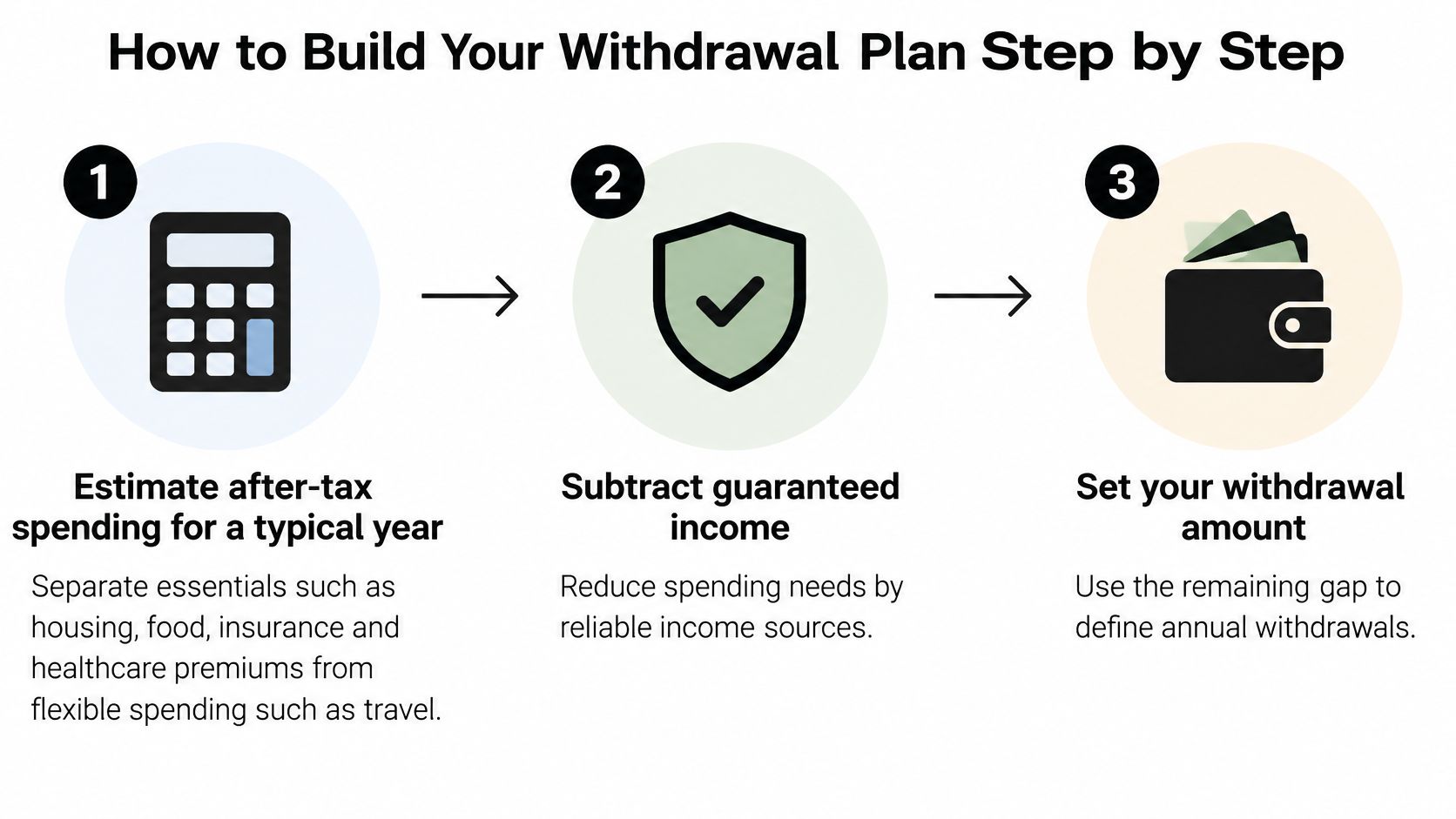
Here's the sequence, with the slip that usually undoes each step.
The Six Steps
Estimate after-tax spending for a typical year. Separate essentials such as housing, food, insurance and healthcare premiums from flexible spending such as travel. The classic slip is using gross spending, which understates the gap because you'll pay tax on much of what you withdraw. If you need help building that number, start by calculating retirement income needs for federal employees from your actual bills rather than a replacement-rate rule of thumb.
Subtract guaranteed income. Take off the FERS annuity, the FERS supplement while it lasts, and Social Security at your chosen claiming age. The slip here is forgetting the supplement ends at 62. Households build a comfortable plan around it, then watch the gap jump overnight when it stops.
Set a liquidity reserve of one to two years of the gap. Hold it in cash or short-term funds, separate from your invested TSP balance. Skip this and you're forced to sell investments at whatever price the market offers in a bad year, which is exactly how sequence-of-returns risk does its damage.
Calculate your portfolio withdrawal rate. Divide the remaining annual gap by your combined TSP and IRA balances. Treat any result above roughly 4 to 5 percent as a signal to stress-test hard, adjust spending, or reconsider your retirement date. The benchmark that matters isn't a generic percentage, it's the percentage left after your annuity and Social Security have done their work.
Choose a payment schedule for the TSP layer. Model monthly, quarterly, annual, partial distributions, annuitization, or combinations rather than defaulting to a lump sum. The TSP permits all of these post-employment options, including automatic installments at monthly, quarterly, or annual intervals.
Review the plan every year. Recalculate after any major change such as a spouse's death, a move, or a large medical bill. A withdrawal plan built at 60 and never touched again is a guess, not a plan.
Practical rule: Your balance is not spendable income. Large withdrawals during an early market decline permanently reduce the capital available for recovery, so the reserve exists to keep you from selling low.
A Worked Example
Say your household needs $4,000 a month after tax. Your FERS annuity and Social Security together provide $2,600 a month. That leaves a $1,400 monthly gap, or $16,800 a year, to fund from the TSP and other accounts.
Now the questions get concrete. Divided by a $420,000 combined balance, $16,800 is a 4 percent withdrawal rate, workable but worth stress-testing. Your reserve target becomes $16,800 to $33,600. And your payment schedule has one job, delivering roughly $1,400 a month after tax without forcing sales in a downturn. Every decision that follows flows from those three numbers.
TSP Payment Options and How to Choose
Choosing a payment method is where planning becomes mechanics, and mechanics are where many households stall. Only 22% of employees had seriously considered how to draw down workplace retirement accounts, and respondents answered just 25% of withdrawal-mechanics questions correctly, in survey evidence summarized by ASPPA on decumulation planning. Vanguard research in the same summary found only 8% of surveyed mass-affluent clients made regular withdrawals for everyday spending, while 39% avoided withdrawals until required minimum distributions began. Fear of spending and confusion about process are as costly as a wrong fund choice.
TSP Payment Options Compared
| Option | How money arrives | Flexibility | Main trade-off |
|---|---|---|---|
| Monthly installments | Fixed payment every month | Moderate; schedule can be changed | Steady cash flow, but the balance keeps market exposure |
| Quarterly installments | Fixed payment every three months | Moderate | Larger lumps between payments need planning |
| Annual installments | One fixed payment each year | Moderate | Cash must be held in reserve between payments |
| Partial withdrawal | Amount you request as needed | High | Requires discipline to avoid overspending |
| Annuitization | Lifetime payments from an insurer | Low | Certainty for life, but less access to the balance |
| Full lump sum | One payment for the whole balance | High | Largest sequence-of-returns exposure on the remainder |
Monthly installments work like a paycheck, which suits most households because expenses arrive monthly too. Quarterly and annual installments deliver the same money in bigger lumps, so you need the discipline and the reserve to stretch each payment. Partial withdrawals give you maximum control for irregular costs, but nothing stops you from taking too much in a good-feeling year.
Annuitization converts part of your balance into a lifetime payment from an insurer. You trade access and flexibility for certainty that the check keeps coming. A full lump sum maximizes your control over the money, but the entire balance now sits exposed wherever you reinvest it, and a large taxable distribution in one year can be brutal. A fuller walk-through of your TSP withdrawal options in retirement helps before you file anything.
The Operating Checklist
The right payment option still fails without the setup work behind it.
- Set the schedule: Pick the frequency and amount that match your monthly gap
- Confirm withholding: Elect tax withholding that matches your projected bracket, so April doesn't bring a surprise bill
- Assign each account a job: Decide which account pays which month before the year starts
- Rebalance once a year: Withdrawals distort your allocation, so reset it on a fixed date
One warning belongs here. In-service withdrawals permanently reduce your retirement savings and eliminate future earnings on the amount withdrawn. Don't use them to patch a gap that a proper post-retirement payment schedule could cover.
Sequence Withdrawals to Control Your Tax Bracket
Once you know the gap, decide which account pays it each year. I would run this in three phases, because your income mix changes at 62 and again when Social Security and RMDs begin.
Before 62, the FERS supplement is taxable ordinary income and it stops at 62. Build a bridge that covers your gap until it ends, and know exactly which account takes over the month it disappears. Households that skip this step often reach for the TSP in a panic and take more taxable income than they needed.
From 62 until Social Security and RMDs begin, you often have your lowest-income years. Fill your chosen lower tax brackets with planned traditional TSP or IRA withdrawals up to a ceiling you set in advance. Cover spending above that ceiling from your taxable brokerage account, where only gains are taxed and at capital gains rates. Qualified guidance on retirement tax planning strategies for federal employees helps you pick that ceiling deliberately rather than by habit.
After Social Security starts, test your combined income every year, because up to 85 percent of benefits can become taxable. Keep Roth TSP funds as your tax-free layer for spikes such as a large medical bill or a roof replacement.
Take the $1,400 monthly gap example. The household draws traditional TSP up to its bracket ceiling, uses the brokerage account for the remainder, and leaves Roth untouched as reserve. The common slip is draining Roth first because it feels painless. It is, until a bad year arrives and your only tax-free buffer is gone. Bracket thresholds change each year, so check your sequence with a qualified tax professional before retiring.
Required Minimum Distributions and Annual Checks
RMDs aren't a compliance errand bolted onto your plan. They're forced taxable income, so they belong inside your cash-flow and tax sequence from the start.
RMD Starting Ages by Birth Year
| Birth year | RMD start age | First RMD due |
|---|---|---|
| Born before 1951 | 72 or earlier under prior rules | Check prior-year RMD history with the plan administrator |
| Born 1951 to 1959 | 73 | April 1 of the year after reaching age 73 |
| Born 1960 or later | 75 | April 1 of the year after reaching age 75 |
The calculation itself is mechanical. Per IRS guidance on required minimum distributions, you generally divide the account balance on the preceding December 31 by an applicable life-expectancy factor from the IRS tables. The Uniform Lifetime Table applies to most owners. The Joint and Last Survivor Table generally applies when the sole spouse beneficiary is more than 10 years younger, and the Single Life Table generally applies to beneficiaries.
Run These Six Steps Every Year
- Inventory balances: List every traditional TSP, IRA, and eligible plan balance
- Classify beneficiaries: Confirm who is named on each account, since beneficiary status drives which table applies
- Select the correct IRS table for each account
- Calculate each account's RMD using the prior December 31 balance
- Aggregate where permitted, and never assume aggregation rules match across account types
- Assign the distribution a job: spending, tax withholding, or reinvestment
Then compare the RMD against your actual spending gap and projected tax bracket. If the RMD exceeds what you need, direct the excess to taxable savings or charitable strategies where eligible, and watch your withholding so you don't underpay through the year. If you've named a trust as beneficiary, the mechanics get more intricate, and a resource on Texas trustee IRA distribution choices from Law Office of Bryan Fagan, PLLC explains how conduit and accumulation structures change what beneficiaries must take and when.
Owners are responsible for taking the correct amount on time each year, and a missed RMD can carry substantial penalties. Clean beneficiary records and an annual recalculation are your controls against that.
Two pitfalls account for most of the trouble. The first is assuming one withdrawal rule applies to every account and beneficiary arrangement. The second is waiting until December to discover the RMD will shove you into a bracket you could have planned around in February. Our educational content is not tax, legal, investment or securities advice, and it's based on rules in effect as of October 2026, and benefit rules change, so confirm your position with a qualified tax professional before changing your withdrawal sequence.
Stress Test Your Plan for Bad Markets and Age 80
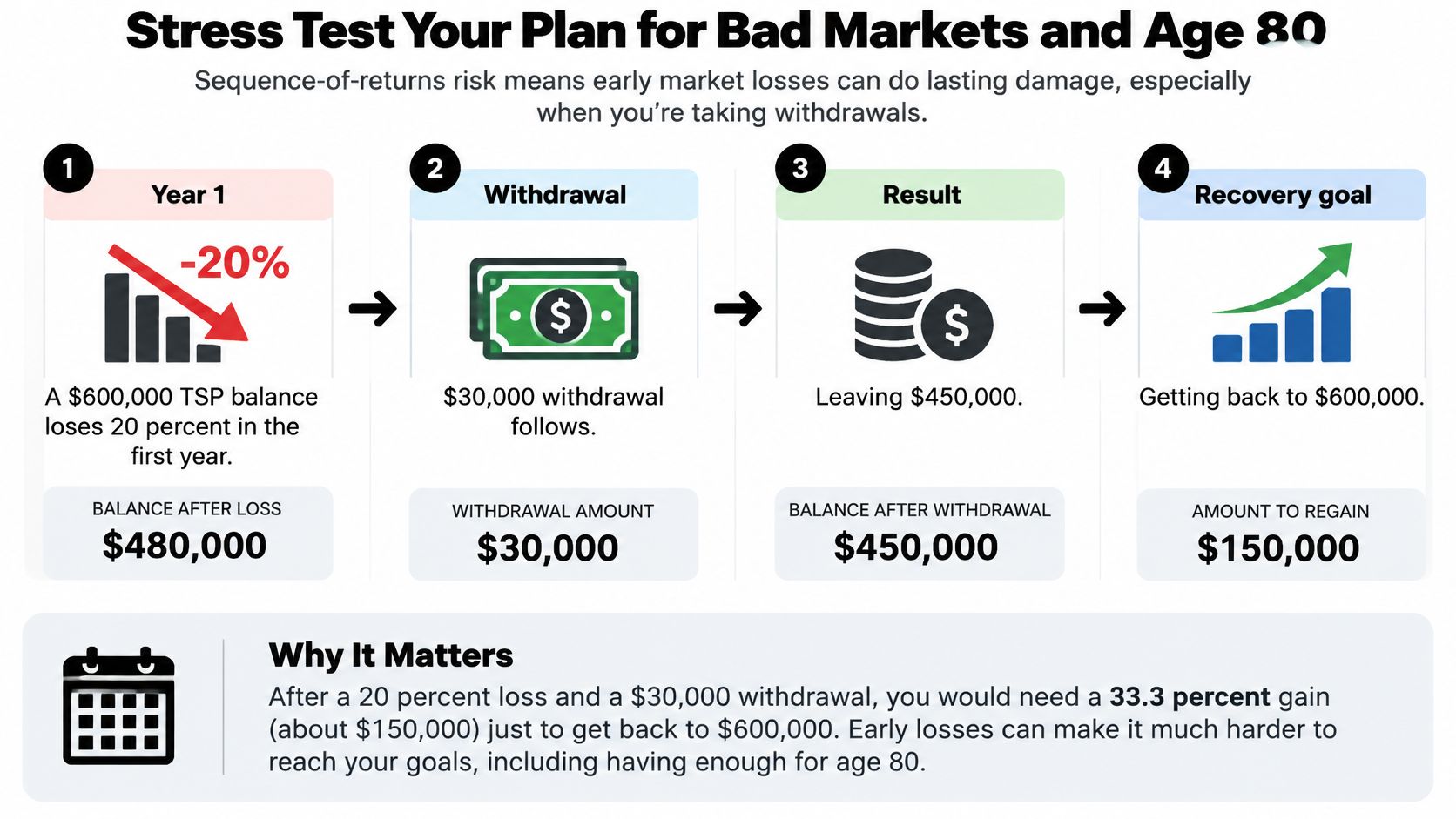
Early losses matter more than average returns. Say your TSP balance is $600,000 and it loses 20 percent in your first year of retirement. That's $480,000. You still need to live, so a $30,000 withdrawal follows, leaving $450,000. Getting back to $600,000 from there requires a 33 percent gain, not 20 percent, because you're compounding off a smaller base with money already spent.
The diagram below traces that sequence step by step.
Write Your Guardrails Before You Need Them
A single safe withdrawal rate hides this risk. A flexible income policy handles it with rules you set while you're calm.
- Skip the inflation raise: After a year with a large market drop, hold withdrawals flat instead of increasing them
- Spend the reserve first: Draw from your liquidity reserve rather than selling investments at depressed prices, then refill it in recovery years
- Cap the recovery spending: In strong years, bank the surplus instead of permanently raising your lifestyle
Plan Your 60s, 70s, and 80s Separately
Only 34% of surveyed U.S. adults reported planning how they would receive income at age 80 and beyond, compared with 48% who had planned for income during their 60s, according to the PlanAdviser report on retirement income options. That gap is dangerous for federal employees because your income mix keeps changing. Your 60s run on the annuity, the supplement, and a Social Security claiming decision. Your 70s add RMDs and higher healthcare costs. Your 80s may bring long-term care expenses and a surviving spouse living on reduced income.
Decide now which sources you're preserving for later life rather than spending first. Roth balances and annuitized income often fit that late-life role because one is tax-free and the other can't be outlived.
This video walks through the stress-testing mindset in more detail.
Run the Survivor Test
Model the income your surviving spouse would have after a death, not the income you have together. Include the effect of survivor annuity elections on the FERS annuity and the health coverage that changes with it. A client's spouse can join the call, and we encourage it because survivor benefits and health coverage decisions affect both spouses.
Run four scenarios before you retire.
- Market shock: A 20 percent drop in year one
- Health shock: A large medical or long-term care bill
- Inflation shock: Costs rising faster than your plan assumes
- Survivor shock: A spouse's death at 85
If the plan survives all four on paper, it's a plan. If it only works in average markets, it's a hope.
Confirm Your Withdrawal Numbers Before You Retire
Your withdrawal order is the operating system for your FERS annuity, TSP, Social Security and taxes. Confirm it before your last pay period ends, not after your first TSP payment clears. Put four numbers on one page: guaranteed income, reserve, TSP withdrawal rate, and RMD timing. They have to agree. A plan that works only when you read each number in isolation is not a plan.
Two findings should change your retirement date, payment option, or spending target while you still have choices. If your annual gap exceeds what two years of reserve can cover, one bad market stretch forces you to sell TSP shares at low prices. If your withdrawal rate runs above the range your stress tests survived, change the payment option, spending target, or retirement date before you file.
The Gap Report puts those numbers in front of you. The Free Gap Report is built after a short intake call, using your own service history and salary to project retirement income and flag possible shortfalls. It shows your projected income and every shortfall based on your own numbers, not national averages or a generic replacement rate.
How the Process Works
The process has four steps.
- Learn the basics with the free class or Learning Center
- Talk with Joe for 15 minutes about your situation
- Get your Gap Report with your projected income and gaps
- Decide what's next, at your pace
Bring your spouse to that conversation if you are married. Survivor elections and health coverage changes shape the withdrawal order for both of you, and those decisions are hard to undo once retirement paperwork is filed.
Bring three numbers to your first planning conversation: your monthly after-tax gap, your reserve in months of that gap, and the payment option you are leaning toward. If one is missing, you know which decision to settle before your last day at work.
Your withdrawal order decides your tax bill and how long your savings last, so do not let default TSP settings make that choice for you. Federal Benefits Sherpa helps FERS employees turn their annuity, supplement, TSP, and Social Security into one coordinated income plan, starting with a free Gap Report built on your own service history and salary. Visit federalbenefitssherpa.com to take the free class, book your 15-minute call with Joe, and see your projected income and every shortfall before you retire.


Dedicated to helping Federal employees nationwide.
“Sherpa” - Someone who guides others through complex challenges, helping them navigate difficult decisions and achieve their goals, much like a trusted advisor in the business world.
Federal Benefits Sherpa, LLC
12724 Gran Bay Parkway West, Suite 410, Jacksonville, FL 32225
Email: [email protected]
Phone: (833) 753-1825
© 2024 Federalbenefitssherpa. All rights reserved
Federal Benefits Sherpa is an independent organization and is not affiliated with or endorsed by the U.S. government or any federal agency.