Blogs

Blog title place here
We understand that every federal employee's situation is unique. Our solutions are designed to fit your specific needs.

Blog title place here
We understand that every federal employee's situation is unique. Our solutions are designed to fit your specific needs.

Blog title place here
We understand that every federal employee's situation is unique. Our solutions are designed to fit your specific needs.
Open Season Federal Health Insurance: open season federal health insurance
Every year, federal employees get a specific, limited window of time to make critical decisions about their health, dental, and vision coverage. This period is known as Open Season. Think of it as your annual benefits check-up—it’s really the only time most feds can enroll in a new plan, switch their current one, or cancel coverage for the year ahead.
What Is Federal Open Season and Why It Matters Now
Imagine trying to budget for your family for an entire year using last year's grocery and utility bills, without checking for any price increases. You'd almost certainly end up with a nasty surprise down the road. The same exact logic applies to your federal benefits.
Open Season is your dedicated time to pull out your current plans, see what’s changing, and make sure your coverage still makes sense for your family's health and your wallet.
Ignoring this period isn't a neutral choice. If you don't take any action, your current health, dental, and vision plans will simply roll over and renew for another year. While that sounds easy, it can be a surprisingly expensive mistake. Carriers are constantly tweaking things—premiums go up, doctor networks change, and prescription formularies get updated. Letting your plan auto-renew means you're accepting all those changes, sight unseen.
The Financial Impact of Inaction
Being passive during Open Season can take a real bite out of your paycheck. With premiums for the Federal Employees Health Benefits (FEHB) program often rising each year, failing to shop around could mean you're overpaying by hundreds, or even thousands, of dollars over the next 12 months.
This annual review is one of the most important things you can do to manage your financial health. It’s your chance to make sure your benefits are aligned with your life, especially if you’ve had a major change, developed a new health concern, or just want to find a better deal.
Taking an active role during Open Season transforms it from a passive renewal into a powerful financial planning tool. It’s your chance to be the architect of your healthcare coverage, not just a passenger.
Understanding the Key Programs
The choices you make will affect three separate benefits programs, and you have to make a decision for each one. It's crucial to know what each one does:
FEHB Program: This is your main medical insurance, covering everything from doctor visits and hospital stays to your prescription drugs. As we cover in our guide to the Federal Employee Health Benefits program, this is usually the biggest and most important benefits decision you'll make.
FEDVIP Program: This program is for your dental and vision coverage, and you have to enroll in it separately. Unlike many private-sector jobs, these benefits aren't usually bundled with your primary health plan.
FSAFEDS Program: This program lets you set aside pre-tax money into a Flexible Spending Account to pay for out-of-pocket health, dental, and vision expenses. Here's the key thing to remember: you must re-enroll in your FSA every single year. It never, ever renews automatically.
How to Compare FEHB Plans Beyond the Premium
Picking a Federal Employees Health Benefits (FEHB) plan just by looking at the bi-weekly premium is a classic mistake. It’s like buying a car based on its shiny paint job—it tells you nothing about what’s under the hood or how it will perform when you actually need it. Often, the plan with the lowest premium is hiding some seriously high out-of-pocket costs that only show up after you’ve already received care.
To make a truly informed decision during open season federal health insurance, you have to look at the whole financial picture. That means rolling up your sleeves and digging into the real cost drivers that determine what you'll actually pay for healthcare all year long.
This diagram helps visualize how Open Season works for your core benefits. It's not just one decision; you have to evaluate your health, dental, and vision coverage separately.
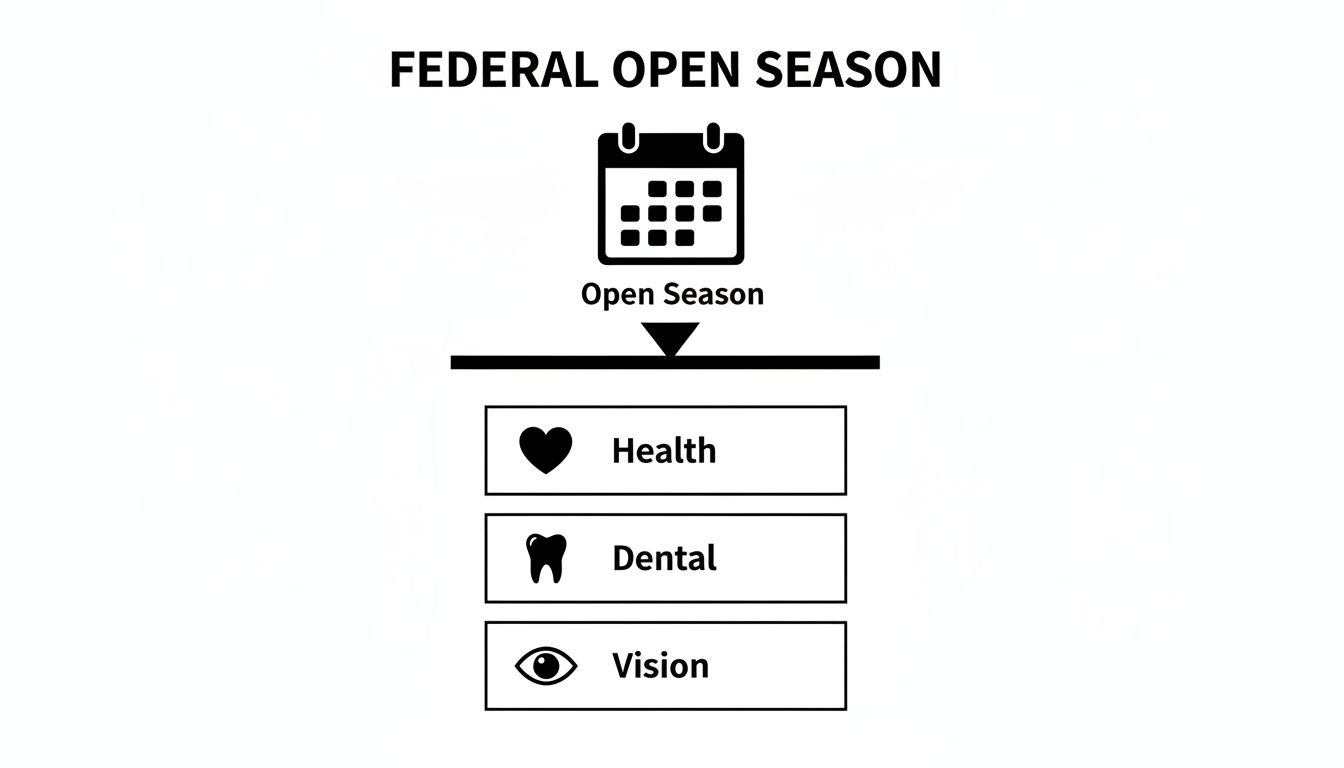
As you can see, your main FEHB health plan is a major piece of the puzzle, but it's just one part of your overall benefits package you need to lock in during this critical window.
Looking Past the Premium at Total Costs
Think of the premium as just the price of admission. The real cost of your health insurance is a mix of a few key numbers that you absolutely have to understand.
Deductible: This is the amount you have to pay yourself for covered services before your insurance plan even starts to kick in. It’s the initial hurdle you have to clear each year.
Copayments and Coinsurance: A copayment is that flat fee (like $30) you pay for a doctor’s visit. Coinsurance is a bit different—it’s a percentage of the cost (like 20%) you pay for a service after you've met your deductible.
Out-of-Pocket Maximum (OOPM): This is your financial safety net. It’s the absolute most you will have to pay for covered services in a single year. Once you hit this limit through your deductibles, copays, and coinsurance, the plan pays 100% for everything else.
The Out-of-Pocket Maximum is arguably the most important number in your plan. It's the ultimate protection against catastrophic medical bills and gives you a clear ceiling on your financial risk for the year.
This deep dive is more critical now than ever. The average FEHB premium is set to jump by 12.3% in 2026, hot on the heels of a 13.5% hike in 2025. That's a nearly 25% increase in just two years, forcing many feds to seriously rethink their plan choices.
Choosing Between Network Types: HMO vs. PPO
Just as important as the cost is the plan's structure. This usually comes down to two main types: Health Maintenance Organizations (HMOs) and Preferred Provider Organizations (PPOs). The one you choose dictates who you can see and how you can see them.
Here's a quick rundown to help you see the difference.
FEHB Plan Types At a Glance
| Plan Type | Typical Premium Cost | Provider Choice | Referral Requirement | Best For |
|---|---|---|---|---|
| HMO | Lower | Restricted to a specific network of doctors and hospitals. | Yes, a referral from a Primary Care Physician (PCP) is usually needed to see a specialist. | Individuals who want lower premiums and don't mind staying within a set network. |
| PPO | Higher | More flexibility; you can see both in-network and out-of-network providers (but pay more for out-of-network). | No, you can typically see a specialist without a referral. | Families that want more choice, especially if they have doctors they want to keep who might be out-of-network. |
| HDHP | Lowest | Varies, but often has a broad PPO-style network. | Usually no referrals are needed. | Healthy individuals who want the lowest premiums and a way to save for future medical costs via a Health Savings Account (HSA). |
The right choice really boils down to your personal situation. If you already have doctors you trust and don’t want to change, a PPO’s flexibility might be worth the extra cost. But if you're looking to keep premiums low and are fine working within a defined network, an HMO could be the smarter financial move. For a more detailed breakdown, check out our guide to the Federal Employees Health Benefits program.
Diving Deeper Into Coverage Details
Okay, you've compared the costs and the network types. Now it's time to get into the nitty-gritty details that can make or break a plan for your family.
Check the Prescription Drug Formulary: Don't just assume your medications are covered. The formulary is the official list of drugs the plan pays for. You need to find your specific prescriptions on that list and see which "tier" they fall into—that will determine your copay. A plan with a low premium can become very expensive if it doesn't cover a vital medication you take.
Verify Your Providers Are In-Network: This is a big one. Never assume. Go to the insurance plan’s official website and use their provider search tool to confirm that your primary doctor, your kids' pediatrician, any specialists you see, and your local hospital are all in-network.
Assess Specialized Coverage: If you know you'll need specific types of care—like physical therapy, mental health services, or fertility treatments—you have to read the fine print in the plan brochure. See what's covered, what the limits are, and what you'll have to pay.
These plan brochures are notoriously long and dense. To get through them without losing your mind, an AI PDF Summarizer can be a huge help in pulling out the key details you need to make an effective comparison.
Navigating the Enrollment and Plan Change Process
Making a change during the federal health insurance open season might feel a little daunting, but it’s actually pretty straightforward once you know the steps. It's not much different from updating your profile on any other website—the trick is simply knowing which system to use.
Your enrollment portal is tied directly to your agency and whether you're still working or retired. Most active federal employees will log into a system like the GRB Platform, Employee Express, or another portal specific to your agency. If you’re an annuitant or retiree, you'll almost always use OPM’s MyFP (My Federal Pension) website.
Before you even start, do yourself a favor and have your login information handy. Knowing your employee ID and having your two-factor authentication ready will save you a lot of headache.
Your Step-by-Step Enrollment Checklist
Once you’re logged in, the process looks pretty similar no matter which platform you’re on. Here’s a simple checklist to walk you through it.
Find Your Benefits Section: On the main dashboard, look for a link that says "Open Season" or "Health Benefits Enrollment." This is where you need to go.
Select Your New Plan: Look through the available FEHB plans. When you've found the one you want, you'll need its unique enrollment code (you can find this in the plan's official brochure). Pop that code into the system to make your selection.
Choose Your Enrollment Type: This part is critical. You’ll need to choose the coverage level that matches your needs: Self Only, Self Plus One, or Self and Family. Think carefully about who you need to cover and what the corresponding premium will be.
Review and Confirm: The system will give you a final summary showing your new plan and the bi-weekly premium deduction. Triple-check everything here, especially the plan code and coverage type.
Save Your Confirmation: I can't stress this enough—this is the most important step. Once you submit the change, save a digital copy (like a PDF) of the confirmation page or print a hard copy. This is your only official record of the change.
That confirmation receipt is your proof. If something goes wrong in January and your new plan isn't reflected correctly, that document and your SF-50 (Notification of Personnel Action) are what you'll need to get it fixed.
What Happens If You Do Nothing?
It's easy to think that not taking action is a neutral choice, but it's not. If you don't make any changes during Open Season, your current FEHB plan just rolls over into the next year.
By not acting, you are actively choosing to accept your plan's new premium, its updated provider network, and any changes to its coverage for the entire next year. In a year with significant cost increases, this passive choice can be an expensive one.
Is Self Plus One or Self and Family Better?
This is a common source of confusion, especially for couples or an employee with one child. You’d think that Self Plus One would automatically be cheaper than Self and Family, right? Not always.
Because of the way premiums are structured, some FEHB plans actually charge less for full Self and Family coverage than they do for Self Plus One. Don't just assume—always compare the bi-weekly premium costs for both options. You might discover that you can get more coverage for less money.
Open Season Planning for Federal Retirement
As retirement gets closer, your annual Open Season choices suddenly carry a lot more weight. The decisions you make now aren't just for the next year; they can shape your financial and physical well-being for decades. This isn't just another benefits review—it's a crucial step in building a secure retirement.
Your focus has to shift. Instead of just thinking about next year’s check-ups or prescription costs, you need to look at the long game. How will your FEHB plan work with Medicare? Will it be affordable and effective for the rest of your life?
The Unbreakable Five-Year Rule
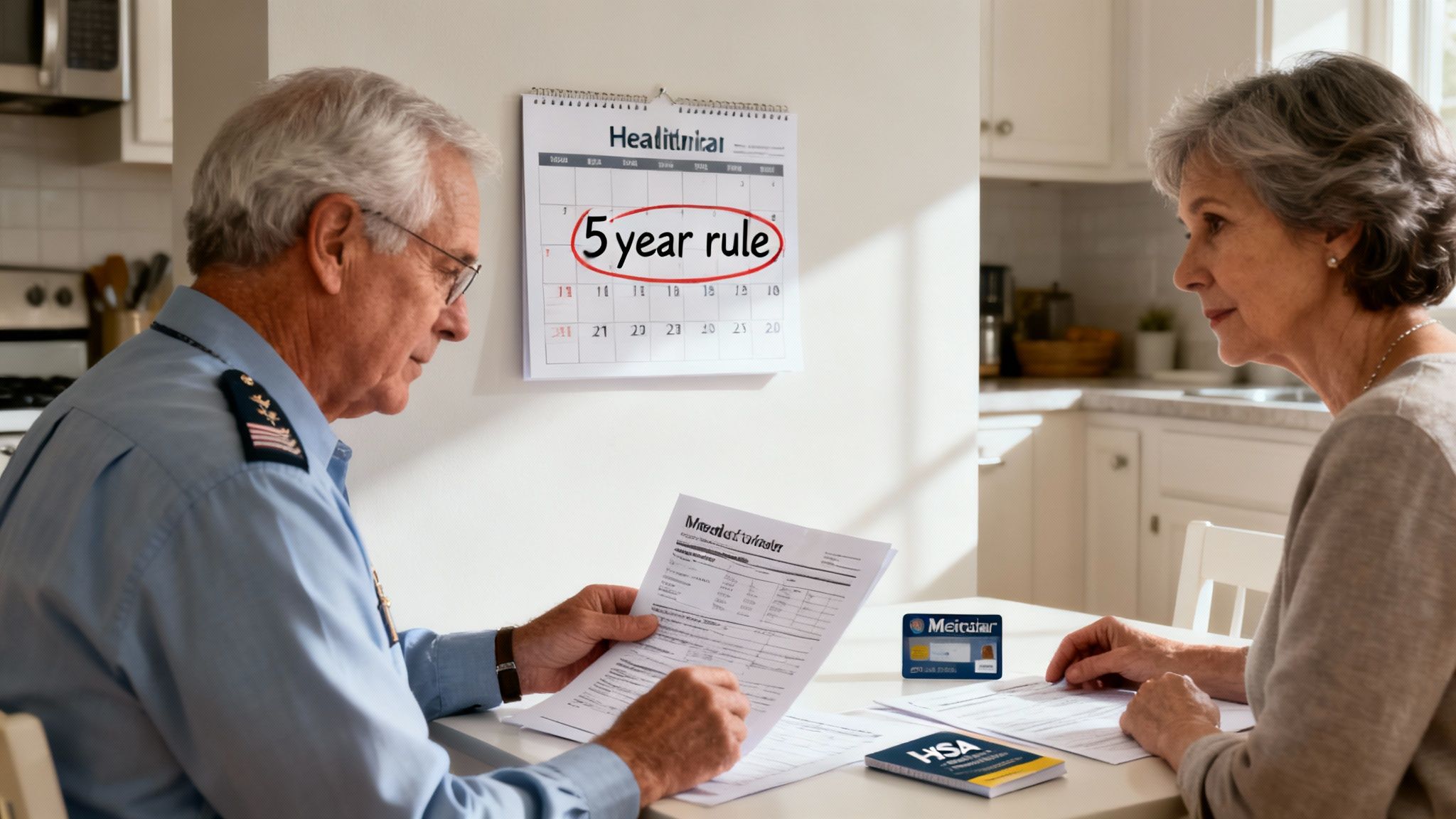
If there’s one thing to burn into your memory, it’s the five-year rule. This rule is absolute, and getting it wrong has permanent consequences. To carry your Federal Employees Health Benefits (FEHB) coverage into retirement, you must have been continuously enrolled in any FEHB plan for the five years immediately before you retire.
You can switch plans during that time, but you can’t have any gaps in coverage.
Think of the five-year rule as your golden ticket. It unlocks the door to keeping your subsidized health insurance for life. If you miss this, you lose your FEHB and the government’s contribution to your premium forever. It's a mistake you simply can’t afford to make.
So, if you’re aiming to retire on January 31, 2028, you must have been covered by an FEHB plan since at least January 31, 2023. If you waived coverage in the past, these final few Open Seasons are your last chance to get enrolled and start that five-year clock ticking.
Strategizing for Medicare Coordination
Once you hit 65 and enroll in Medicare, your whole healthcare picture changes. This is where smart Open Season planning can save you a tremendous amount of money. When you have Medicare Part B, it becomes your primary insurance, and your FEHB plan shifts to a secondary role.
The trick is that some FEHB plans are built to work beautifully with Medicare, offering some incredible perks. These plans often:
- Waive Cost-Sharing: Many plans will eliminate their own deductibles, copays, and coinsurance once Medicare starts paying first. This means fewer out-of-pocket bills for you.
- Provide Part B Reimbursement: Some plans go a step further and actually refund you a portion of your Medicare Part B premium, putting hundreds of dollars back in your pocket each year.
Choosing a plan with these features can dramatically lower your healthcare spending in retirement. Your FEHB plan transforms from your main insurance into a powerful gap-filler that covers what Medicare doesn't. Getting a handle on your options for federal employee health insurance in retirement is the key to making this work.
Using an HSA as a Retirement Tool
Here's another powerful strategy for your final years on the job: consider a High Deductible Health Plan (HDHP) that comes with a Health Savings Account (HSA). An HSA is a retirement game-changer because of its triple tax advantage: contributions are tax-deductible, the money grows tax-free, and you can withdraw it tax-free for qualified medical expenses.
In your last few years of service, you can max out your HSA contributions, building a dedicated, tax-free war chest for future medical needs. The account is yours to keep forever, even after you retire.
While you can’t contribute to an HSA once you enroll in Medicare, you can still spend the money you’ve saved on a wide range of costs, including:
- Medicare premiums (for Part B, D, and Advantage Plans)
- Deductibles and copayments
- Long-term care insurance premiums
This makes an HSA one of the best retirement savings tools out there. By choosing an HDHP in your final Open Seasons, you’re essentially pre-paying for your future healthcare with tax-free dollars, giving you incredible financial flexibility when you need it most.
A Big Change for Postal Workers: Understanding the New PSHB Program
If you’re a postal worker, this isn't your average Open Season. In fact, it's probably the most significant benefits change you'll see in your entire career. The Federal Employees Health Benefits (FEHB) program you've always used is being phased out for you and replaced by the new Postal Service Health Benefits (PSHB) program.
This isn't just a new name on the same old plans. It's a fundamental restructuring of how health insurance works for the entire USPS workforce, mandated by the 2022 Postal Service Reform Act. The idea was to build a system from the ground up that's tailored specifically for USPS employees, retirees, and their families.
When the PSHB program went live in 2025, it was a massive transition. Over 2 million postal employees and annuitants—that’s about a fifth of everyone in the FEHB system—were moved into this new program. Looking ahead to 2026, the PSHB program features 75 plan options from 17 different carriers, with premiums seeing an average jump of 11.3%. For a deeper dive into the launch, you can get more insights from FEDweek.
Why Make Such a Big Change?
So, why the sudden overhaul? It all boils down to one thing: better integration with Medicare for retirees. For a long time, the old system—where FEHB was the primary payer for retirees even if they were on Medicare—was putting serious financial strain on the Postal Service.
The PSHB program was created to fix this. By making sure future postal retirees are enrolled in Medicare Part B, the system is designed to become more financially sound. This coordination helps lower the overall healthcare costs for the USPS, shoring up its finances and making sure your health benefits remain secure for the long haul.
The New Rule You Absolutely Cannot Ignore: Medicare Part B
Pay close attention to this part, because it’s a game-changer. If you're a postal annuitant who retired on or after January 1, 2025, and you're eligible for Medicare Part A, you must enroll in Medicare Part B to continue your PSHB coverage. If you don't, you will lose your postal health insurance. It's that simple.
This is a huge departure from the old rules and requires some real planning. If retirement is on your horizon, signing up for Medicare Part B is no longer optional—it's a mandatory step to keep your health coverage for life.
Think of it this way: Medicare enrollment is now a non-negotiable item on your retirement checklist. You can't have PSHB coverage in retirement without also having Medicare Part B, so you have to factor that premium into your budget.
How to Handle Your First PSHB Open Season
While the PSHB program is new, the actual process of picking a plan during this open season federal health insurance period should feel pretty routine. You'll still compare plans, review doctor networks, and weigh your costs, just like you did under FEHB. The only difference is that you'll be choosing from a curated list of PSHB plans.
Here’s what you need to do during this Open Season:
- Check Your New Plan: You were automatically moved into a PSHB plan, but don't just assume it’s the best one for you. Take the time to confirm it still meets your family’s needs.
- Shop Around: Use this window to explore all the PSHB options available. If you're getting close to retirement, look for a plan that will coordinate smoothly with Medicare.
- Get Ready for Medicare: If you’re still working but plan to retire in the next few years, start learning about the Medicare Part B enrollment process and its costs right now. Don't wait until the last minute.
This is a major adjustment, no doubt about it. But getting a handle on these new rules is the best first step toward making a smart, confident decision about your health coverage.
Common Open Season Mistakes and How to Avoid Them
Every year, the federal health insurance Open Season rolls around, and it's all too easy to just let things ride. But treating it like another routine task can set you up for a year of financial pain. Over the years, I've seen countless federal employees fall into the same handful of traps, turning a chance to optimize their benefits into a source of major regret.

The single biggest mistake? Doing nothing. Letting your plan auto-renew feels easy, but it’s a gamble. You're effectively accepting any changes the insurance carrier has decided to make—and that could mean higher premiums, a shrunken doctor network, or major shifts in your prescription drug coverage.
Focusing Only on the Premium
Picking a health plan based solely on the lowest premium is a classic rookie mistake. It’s like buying a car because the monthly payment is cheap, without ever checking the gas mileage or repair costs. That low bi-weekly deduction might be hiding a massive deductible you have to pay before your insurance kicks in for anything serious.
This kind of tunnel vision leads to nasty financial surprises. A family might save $50 a month on their premium only to get hit with a $5,000 deductible after one trip to the ER. Suddenly, those "savings" are long gone. You have to look at the whole picture: the premiums, deductibles, copays, and especially the out-of-pocket maximum.
A low premium is often a trade-off. You might be paying less upfront, but you're accepting more financial risk if you actually need to use your insurance. The key is finding a balance that protects both your budget and your health.
Overlooking Key Plan Details
The devil is truly in the details. Beyond the big numbers, little things can make a plan a great fit or a total nightmare for your family. Ignoring them is how people end up frustrated and paying for things they thought were covered.
Here are a few common oversights to avoid:
- Ignoring the Provider Network: Never, ever assume your doctor is still in-network. Use the plan’s official online directory to double-check that your primary care physician, any specialists you see, and your preferred hospital are all covered before you commit.
- Forgetting Dental and Vision: This one gets people every year. Your FEHB health plan does not include dental or vision benefits. You have to enroll in a separate FEDVIP plan during Open Season. If you forget, you're paying for cleanings, fillings, glasses, and contacts entirely on your own.
- Neglecting Your FSA: A Flexible Spending Account (FSAFEDS) is a fantastic way to pay for medical costs with pre-tax money, but it never auto-renews. You must actively re-enroll in your FSA every single Open Season. No exceptions.
By consciously avoiding these common slip-ups, you can turn Open Season from a gamble into a strategic move for your financial and physical well-being.
A Few Common Questions About Federal Open Season
Even with a well-thought-out strategy, it’s natural for a few last-minute questions to pop up. Let’s tackle some of the most common ones we hear from federal employees as they get ready to finalize their open season federal health insurance choices.
What Happens If I Just Miss the Deadline?
Don't panic, but don't get too comfortable either. If you miss the Open Season deadline, your current health (FEHB/PSHB) and dental/vision (FEDVIP) plans will simply roll over into the new year. That sounds easy enough, but it also means you’re stuck with any new premium hikes or benefit changes the plan has introduced.
You won't get another chance to switch until the next Open Season unless you experience a Qualifying Life Event (QLE), like getting married, having a child, or losing other health coverage.
Here’s the big one people forget: your Flexible Spending Account (FSAFEDS) does not renew automatically. If you want an FSA, you must sign up for it again every single year. No exceptions.
Can I Also Change My Thrift Savings Plan?
Nope. Your Thrift Savings Plan (TSP) has nothing to do with Open Season. This annual event is strictly for your insurance benefits and FSA.
The good news is you can adjust your TSP anytime you want. You have total freedom to change your contribution amounts or reallocate your investments throughout the year. You’ll just do it through your agency’s payroll system or directly on the TSP website, not the Open Season enrollment portal.
Think of it this way: Open Season is your annual insurance check-up. Your TSP is a long-term investment that you can manage whenever you need to. They run on completely different tracks.
How Do I Make Sure My Doctor Is In-Network?
This is a critical step, and you absolutely want to get it right. Before you commit to a new plan, you have to verify that your doctor is in its network. The most reliable way is to go straight to the source: visit the insurance carrier’s official website and use their provider directory tool. It's usually labeled "Find a Doctor" or something similar.
For extra peace of mind, you can also call the insurance company's member services line. Another great move is to call your doctor’s office directly and ask which specific plans they’ll be accepting next year. Taking a few minutes to confirm this now can save you from a world of headache and surprise out-of-network bills later.
Making sense of your federal benefits is the first step toward a secure retirement. The experts at Federal Benefits Sherpa are here to help you navigate the complexities of Open Season and beyond. Book a free 15-minute benefit review to ensure your choices align with your long-term goals. Learn more and schedule your session at https://www.federalbenefitssherpa.com.

Dedicated to helping Federal employees nationwide.
“Sherpa” - Someone who guides others through complex challenges, helping them navigate difficult decisions and achieve their goals, much like a trusted advisor in the business world.
Email: [email protected]
Phone: (833) 753-1825
© 2024 Federalbenefitssherpa. All rights reserved