
Learning Center
How Are Social Security Credits Calculated? a 2026 Guide
When you compare your work history with your Social Security record, the years may not line up neatly. Part-time jobs, self-employment, time away from work, or federal service under CSRS can all affect whether earnings appear as covered work. A year on your résumé does not automatically mean a year with Social Security credits.
The calculation starts with covered earnings in each calendar year. The annual threshold determines how many credits those earnings earn, up to the yearly maximum. Understanding which jobs and income count is just as important as knowing the threshold.
How Annual Earnings Turn Into Credits
Start with your covered earnings for one calendar year and find the matching row.
| Annual covered earnings (2026) | Credits earned | Notes |
|---|---|---|
| Under $1,890 | 0 | No credit for the year |
| $1,890 to $3,779 | 1 | One credit at the first threshold |
| $3,780 to $5,669 | 2 | Two credits at the second threshold |
| $5,670 to $7,559 | 3 | Three credits at the third threshold |
| $7,560 or more | 4 | Annual maximum; extra earnings add no credits |
Covered earnings means wages and net self-employment income that's subject to Social Security tax. It doesn't mean every dollar you received from every source. Investment income, for example, doesn't create credits, and neither does work where Social Security tax wasn't paid on the earnings.
Why quarters don't mean calendar quarters
The older name causes the most trouble here. The Social Security Administration quarters of coverage page explains that credits, officially called quarters of coverage, are calculated from a worker's total earnings subject to Social Security taxes, and since 1978 the calculation has used annual wages plus covered self-employment income rather than assigning credits to particular calendar quarters.
You don't need to work in January through March to earn a first quarter credit, then April through June for a second. You could earn all your covered income in a few months and still receive credits based on the annual total. The word quarter survives in the terminology, but the counting is yearly.
It works like a loyalty card with only four spaces. You get one punch for each threshold you reach during the year. Once the card is full, more spending that year doesn't add a fifth punch.
One punch per threshold reached, four punches maximum, and the card resets each calendar year.
Two quick examples
Say you earn $4,000 in covered wages in 2026. You've passed the first threshold and the second, but not the third, so you earn two credits.
Say instead you earn $15,000 in covered wages. You've passed all four thresholds, so you earn four credits, and the amount above the top threshold adds nothing for that year. Higher earnings can matter later for the benefit amount formula, which is a separate calculation. If you're working through that next step, our guide on how to calculate Social Security benefits in 2026 walks through how an earnings history becomes a monthly amount.
A worked example with mixed income
Wages and self-employment income combine under the same annual method, as long as both are covered.
- Wages from a job: $5,000 in covered wages for the year
- Side business income: $1,000 of covered self-employment income
- Combined total: $6,000 of covered earnings
Now divide. $6,000 divided by $1,890 is 3.17. You don't round up to the next whole credit, and you don't get a partial credit for the remainder. You earn three credits because you've fully reached three thresholds.
That rounding point trips people up. Earning a little over a threshold doesn't pull the next credit into the current year. The leftover amount doesn't carry into January either. Each calendar year stands on its own, so earnings in December and earnings the following January fall into different annual counts even if the work felt continuous.
The threshold itself isn't fixed for life. It's adjusted over time to track changes in national wage levels, so the dollar amount that earned a credit in an earlier year won't necessarily match the current figure. When you review old years, judge each year by the rules and threshold that applied then, not by today's number.
To check your own history, pull the covered earnings figure for each year from your Social Security record and match it to the right row for that year. Use the current threshold only for the current year. That simple matching exercise tells you whether a low-credit year reflects low covered earnings, or whether something may be missing from the record.
Credits Needed for Each Benefit Type
Credits answer a yes or no question. Are you insured for this type of benefit? They don't set the size of the check.
The Social Security retirement planner credits page states that Social Security credits measure insured-status eligibility, not the dollar amount of a future retirement benefit, and that those born in 1929 or later need 40 credits, normally equivalent to 10 years earning the annual maximum, to qualify for retirement benefits.
| Benefit | Credits generally needed | Timing or age rule |
|---|---|---|
| Retirement | 40 | About 10 years of covered work; most people born 1929 or later |
| Disability, age 31 or older | 20 | Earned in the 10 years before disability begins |
| Disability, age 24 to 30 | About half of the years since age 21 | Counted from age 21 to disability onset |
| Disability, under age 24 | 6 | Earned in the 3 years before disability begins |
| Survivor benefits | Set by age at death | Worker's age at death sets the number; younger workers need fewer |
Retirement is the familiar benchmark
For most readers planning a retirement date, 40 credits is the row that matters. Ten years at the annual maximum gets you there, but the years don't have to be consecutive. A worker can earn credits in their twenties, stop for a period, return later, and keep building on the same record.
Credits remain on your record after you change jobs or go through later years with no earnings. You don't lose earlier credits because you took time out, switched employers, or moved into work that wasn't covered. The total stops growing during years without covered earnings.
Disability adds a timing test
Disability eligibility looks at both how many credits you have and when you earned them. That's why the table splits disability by age. A younger worker hasn't had as many years to build a record, so the required count is lower, but recent work still matters.
This timing element surprises people who assume a lifetime total is enough on its own. Someone can have a long work history and still face a problem if too little of that work falls in the window before disability begins. If disability is the concern in your household, compare your credits against the row for your age, not against the retirement row.
Survivor benefits follow the worker's age
Survivor benefits depend on the deceased worker's record, and the credits needed are tied to the worker's age at death. Younger workers generally need fewer credits for family members to qualify. That sliding approach reflects the same basic fairness idea behind the disability rows. A worker who dies young has had fewer years to accumulate credits.
One caution applies across every row. Reaching the credit count makes a benefit available in principle. It doesn't tell you the monthly amount, which comes from the earnings history formula and other eligibility factors. Keep the two questions separate in your planning. First confirm you're insured. Then look at what the benefit might pay.
Also use the right year's threshold when you reconstruct older eligibility. Because the dollar value of a credit changes over time, applying today's figure to earnings from decades ago can make a record look weaker or stronger than it really was.
How to Check Your Credits on Your Statement
Your own estimate is only as good as the record behind it. The official record sits with the Social Security Administration at ssa.gov, and no independent service can confirm it for you.
Federal Benefits Sherpa is an independent organization and is not affiliated with or endorsed by the Office of Personnel Management, the Social Security Administration, the Federal Retirement Thrift Investment Board (TSP), or any government agency. We can help you understand what you find, but the statement itself comes from SSA.
The visual below summarizes the checking process before you work through it in detail.
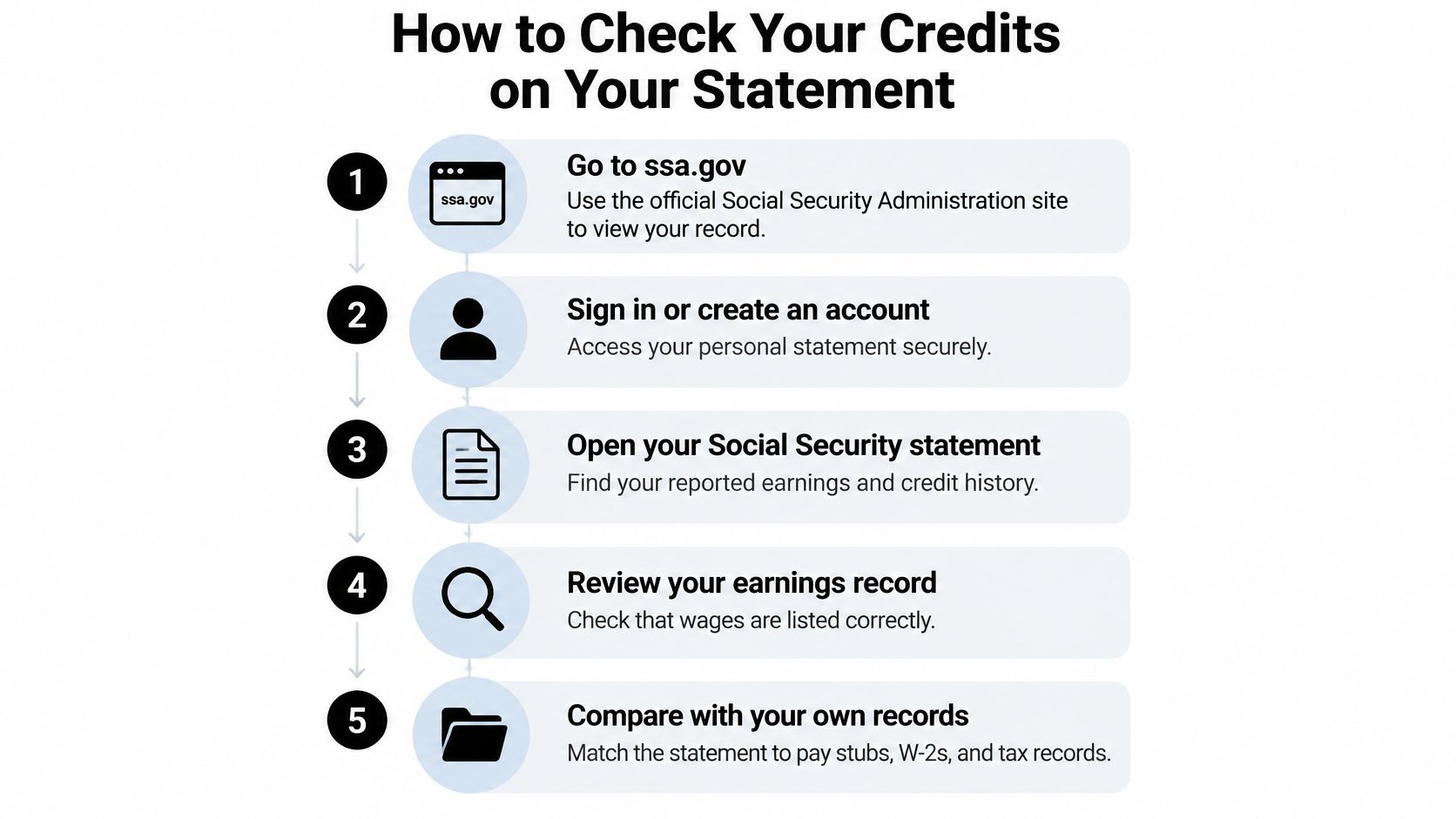
Five steps to verify your record
- Sign in at ssa.gov. Log in to your my Social Security account, or create one if you don't have it yet. This is the secure route to your personal statement.
- Open your statement and find the earnings record. The record lists your covered earnings year by year. Scan for blank years first, since those stand out fastest.
- Convert each year into credits. Compare each year's earnings figure with the threshold for that year to work out that year's credits, remembering the cap of four per year.
- Add the yearly credits together. Compare your total with the benchmark for the benefit you're planning around. For retirement, that's the familiar target most workers need.
- Investigate anything that looks wrong. If a year is missing or too low, pull your W-2 or self-employment tax return for that year and note the exact difference before asking SSA to correct it.
If you'd rather watch the process than read it, the walkthrough below covers the same statement review.
What a problem year usually means
A year showing no earnings isn't automatic proof you didn't work. It can be a reporting gap. An employer may have reported wages under a wrong Social Security number, a name change may not have been matched properly, or self-employment income may not have been filed in the way SSA needs to credit it.
Practical rule: A blank year is a question to investigate, not a conclusion to accept.
Keep your evidence organized by year. A W-2, a final pay stub showing year-to-date Social Security wages, or a filed tax return with self-employment schedules gives SSA something concrete to compare against its record. A vague statement that you definitely worked that year is much harder for anyone to act on.
Fix errors while the paperwork is still within reach. Employers close, payroll providers change, and personal files get lost in moves. A discrepancy you spot at 45 is usually far easier to document than the same discrepancy discovered at 62, weeks before you planned to file.
Special Cases That Change Your Count
The simple division works for ordinary covered wages. It can produce the wrong answer when a special rule governs how the earnings are reported or attributed.
The Social Security publication on how workers earn credits describes these exceptions, including that in 2026 household wages must generally reach $3,000 per employer before they are reported for credit purposes, even though the ordinary credit amount is $1,890, and that self-employed workers calculate credits using net, not gross, earnings and must generally report at least $400 of net earnings.
Keep the review photo in mind as a reminder of the task here. You're not just adding income, you're sorting it by category.

| Situation | Rule that applies | What to check |
|---|---|---|
| Household employee | Credit only when pay from one employer reaches $3,000 in 2026 | Total paid by each household employer |
| Self-employed | Net earnings after deductions; at least $400 net generally reported; optional method in some low-income years | Net profit on your self-employment tax return |
| Nonprofit or religious worker | Coverage depends on whether the organization's coverage applies | Employer coverage status for the job |
| Military service | Military wages can credit under separate rules | Military wage records for the period |
Household work counts employer by employer
Say a caregiver works for two households in one year. Each household pays her $2,500, so she receives $5,000 in total. Under the ordinary division, she'd expect at least two credits.
Neither household reached the per-employer threshold on its own, though. The result can be zero credits for that work, even though her combined pay looks high enough. Nannies, cleaners, and in-home caregivers hit this trap most often because their income is naturally split across families.
Self-employment runs on net earnings
A side business can look healthy on gross receipts and still produce few credits. Deductions for expenses reduce the net earnings figure that Social Security uses. That's legitimate tax planning, but it has a side effect on your credit count that many freelancers don't notice until they review their statement.
In some low-income situations, an optional method may let a self-employed worker report earnings in a way that preserves credits. Whether that helps depends on the type of work and the year's figures, so check the rules for your situation before filing, not after. Once a return is filed and years pass, your options narrow.
Coverage status decides the rest
Nonprofit and religious employment doesn't follow one universal pattern. Whether the job produces credits depends on whether the organization's coverage applies to that work. Two people with similar job titles at different organizations can end up with different credit outcomes.
Military service has its own wage crediting rules as well. If your record includes service years that look light, your military wage records for the period are the documents to compare against the statement.
The pattern across all four rows is the same. The key question isn't merely how much was earned, but which earnings were covered, reported, and attributed under the applicable rule. That distinction also matters for family benefits built on a worker's record, which is why our explainer on how spousal Social Security benefits are calculated starts with the worker's own insured status.
Match your work pattern to a row in the table, then check your record for that category specifically. That's faster and more reliable than re-adding your whole career from scratch.
Federal Service and Social Security Credits
Federal service doesn't automatically mean Social Security credits. That assumption causes real harm when someone discovers the truth a year before retirement.
FERS and CSRS years behave differently
FERS employees pay Social Security tax on their salary. Those years generally produce credits in the normal way, just like covered private sector work. If you're under FERS and your pay stub shows Social Security tax withheld, your federal earnings are building credits.
CSRS employees generally didn't pay Social Security tax on their federal service. Those years usually add no credits at all, no matter how long the service or how high the salary. The service counts toward the CSRS pension, which is a separate benefit with its own rules.
The Social Security tax line on your pay stub is the quickest sign that a federal year is producing credits.
A mixed career example
Say a worker spends 12 years under CSRS, then leaves and spends 15 years in covered private sector jobs. On paper, that's a 27-year career. For Social Security credits, only the covered private years count.
If those private sector years were full years at decent wages, the worker likely reaches the retirement benchmark comfortably. But if the private work was part time, intermittent, or partly self-employed with low net earnings, the worker can fall short despite nearly three decades of total work. Our breakdown of whether federal workers pay into Social Security covers which federal paychecks have that tax withheld and which don't.
A federal pension doesn't replace missing credits. The two systems run side by side. Your pension is based on your federal service, and your Social Security eligibility is based on covered earnings taxed by Social Security. Strong numbers in one don't patch a shortfall in the other.
How to audit your federal years
Look at your statement year by year and mark which years show covered earnings. Then check any suspicious gap against your own paperwork.
- Pay stubs or LES: Look for the Social Security tax withholding line for that year
- SF-50 forms: Confirm your retirement system and service dates for the period in question
- Personnel records: Verify breaks in service, part-time tours, or moves between systems
HR professionals see this pattern regularly with employees who transferred, took breaks, or spent early career years in positions with different coverage. Encouraging employees to pull their statements well before retirement paperwork begins prevents the worst version of this surprise.
Confirm Your Credits Before You Set a Retirement Date
Before setting a retirement date, compare the credits on your Social Security statement with the eligibility requirement for the benefit you expect to claim. If your record is short, you may need more covered work or to correct earnings that are missing.
The decision path
If your credits meet the requirement, you can focus on when to claim and how the timing fits your household plans. You can weigh claiming ages and coordinate with a spouse as you plan around your confirmed credits. You can also compare 2024 retirement months as part of considering how your retirement date fits your income plans.
If your record is short, check whether the gap reflects missing earnings or whether you need additional covered work.
- Work more covered years: Covered earnings can earn up to four credits per year. A shortfall of eight credits takes at least two years of work with enough covered earnings.
- Check for missing earnings: If you did covered work that does not appear on your record, contact Social Security to ask about correcting it.
Credits already on your record remain there through job changes and years without earnings. A shortfall means you need more credits for the benefit you are considering, or need to resolve an earnings-record error.
Turning a credit count into a retirement plan
Confirming eligibility is one part of retirement planning. You also need to understand how your federal benefits and savings may contribute to retirement income. Federal Benefits Sherpa's free Gap Report uses your own service history, salary and elections to show projected income and possible shortfalls.
The process has four steps: learn the basics through the free class or Learning Center, talk with Joe for 15 minutes, get your Gap Report, then decide what to do next. You can call 833-753-1825 or 904-490-6926 to start a conversation.
A retirement date chosen before checking your credits is a guess. Check the record first, then build your plan around what it shows.
Your Social Security statement is the place to check your recorded credits. If its total differs from your own records, look into the discrepancy before relying on either figure.
Pull your statement and compare the credit total with the requirement for the benefit you have in mind. That check can help you see whether your retirement timeline needs to account for additional covered work or a record correction.
If you have questions about how your credits fit with a FERS or CSRS pension, TSP and survivor elections, Federal Benefits Sherpa offers a free Gap Report built from your own service history and salary. Start with the free class or a 15-minute call, then decide what comes next with projected income and possible shortfalls in view. Visit Federal Benefits Sherpa to get started.


Dedicated to helping Federal employees nationwide.
“Sherpa” - Someone who guides others through complex challenges, helping them navigate difficult decisions and achieve their goals, much like a trusted advisor in the business world.
Federal Benefits Sherpa, LLC
12724 Gran Bay Parkway West, Suite 410, Jacksonville, FL 32225
Email: [email protected]
Phone: (833) 753-1825
© 2024 Federalbenefitssherpa. All rights reserved
Federal Benefits Sherpa is an independent organization and is not affiliated with or endorsed by the U.S. government or any federal agency.