Learning Center
FEHB Insurance Plans: Complete Guide for Federal Workers
Could the FEHB plan you choose this year affect your retirement security more than a small change in your monthly premium? Many federal employees compare plans as if they were choosing a phone plan, focusing on today's payroll deduction and overlooking provider access, medical needs, Medicare coordination, and the rules that govern coverage after leaving federal service.
That approach can leave you with a plan that looks affordable but fits poorly when your healthcare needs change. A better decision starts with understanding how FEHB insurance plans work, how enrollment timing affects your options, and which questions matter at each stage of your federal career.
Why Your FEHB Decision Matters More Than You Think
Open Season arrives, and an employee named Daniel does what many federal workers do. He asks a colleague which plan they use, checks whether his current premium changed, and considers keeping the same coverage because switching feels risky. His coworker's recommendation may be sensible for that coworker, but it doesn't necessarily fit Daniel's doctors, prescriptions, family situation, or retirement timeline.
That's the central problem with treating FEHB as a routine checkbox. A plan's value isn't determined by its premium alone. It also depends on how easily you can reach the doctors you trust, what happens when you need hospital care, how prescription coverage works, and how the plan coordinates with Medicare later.
The Federal Employees Health Benefits Program has operated since 1960, after Public Law 86-382 created it in 1959. Today, it covers more than 8.2 million people in the 2024 plan year, including federal employees, annuitants, and family members, according to OPM's FEHB premium information. That scale gives employees many choices, but choice creates responsibility.
The retirement connection
Your FEHB decision doesn't stand alone. It sits alongside your Federal Employees Retirement System or Civil Service Retirement System income, Thrift Savings Plan withdrawals, Social Security decisions, and future Medicare enrollment. A plan that works well during employment may deserve a fresh review as retirement approaches.
Consider an employee who expects to retire soon and assumes the current plan will remain the right choice indefinitely. That employee may be overlooking network changes, prescription needs, the role of Medicare, and the cost of maintaining coverage on a retirement budget. The most useful question isn't, “Which plan is cheapest?” It's, “Which plan structure supports my healthcare and income strategy through the next transition?”
Practical rule: Treat FEHB selection as a recurring financial decision, not an automatic renewal.
Reviewing your coverage doesn't mean changing plans every year. It means confirming that your current choice still matches your providers, medications, expected care, household needs, and retirement path. A deliberate decision can be to stay put. An unexamined decision is the risk.
Understanding What FEHB Covers and How It Works
FEHB insurance plans generally organize coverage around the medical events employees use most often, including preventive services, physician visits, hospital care, emergency treatment, mental health services, and prescription drugs. The exact cost-sharing rules, provider networks, formularies, and exclusions depend on the plan brochure, so two plans can cover similar categories while producing very different bills.
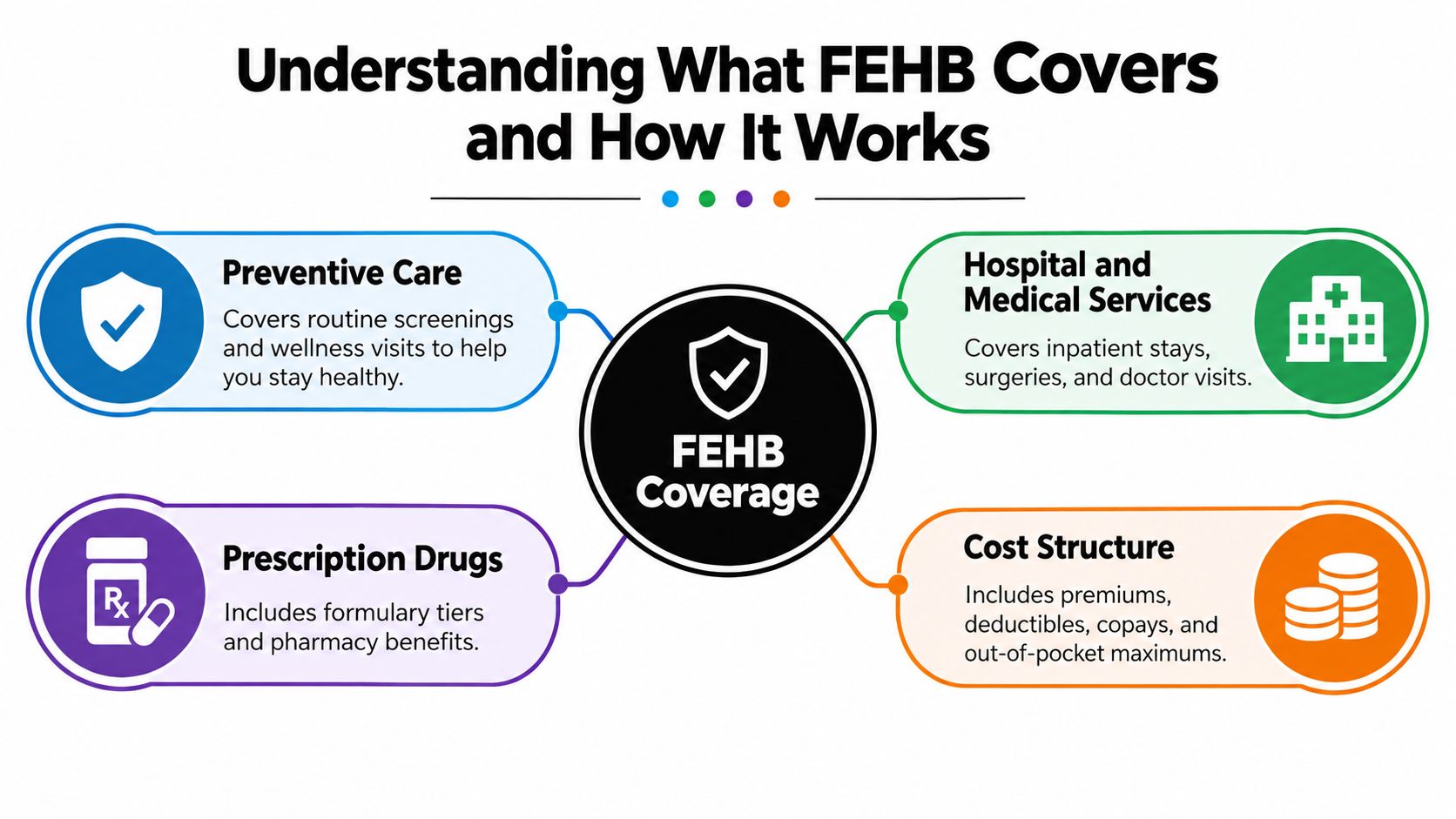
Start with the four parts of the coverage architecture:
- Preventive care: Routine screenings, wellness visits, and other preventive services may be covered differently from treatment for an existing condition.
- Hospital and medical services: Check inpatient rules, surgery costs, specialist access, emergency provisions, and whether prior authorization applies.
- Prescription drugs: Compare the formulary, pharmacy network, mail-order rules, and the tiers used for your regular medications.
- Cost structure: Look beyond the premium. Deductibles, copayments, coinsurance, and the out-of-pocket maximum determine how spending behaves when care becomes more intensive.
How the major designs feel in daily life
A Fee-for-Service plan usually gives you broader flexibility in choosing providers. That can matter if you live in a region with limited networks, travel frequently, or already see specialists who aren't concentrated in one health system. You may still receive better cost-sharing when you use preferred providers, so broad access doesn't mean every provider costs the same.
An HMO typically organizes care around a defined network and coordinated treatment. It may suit an employee whose doctors participate in the system and who values a more managed experience. The tradeoff is that going outside the network or seeing a specialist may require additional steps, depending on the plan.
An HDHP, or high-deductible health plan, combines a qualifying deductible with an HSA or HRA structure. The design shifts more spending toward the beginning of the plan year, while allowing the plan to pass part of the premium into the account under its rules. The result is a direct tradeoff between lower fixed premium exposure and greater first-dollar risk.
Read the plan brochure as a decision document, not as paperwork to file away. Ask how each option handles the services you use, then test the answer against both an ordinary year and a year involving surgery, specialist treatment, or ongoing prescriptions.
FEHB Eligibility and Enrollment Timelines
Eligibility is the first gate. Current federal employees, eligible annuitants, and qualifying family members may participate under the program's rules, but the action required depends on your status and the event that creates your opportunity to enroll or change coverage.
The enrollment sequence
New employees should begin with their agency's benefits office. Confirm the date by which your initial election must be made, review the available plans for your location and enrollee category, and verify when coverage becomes effective. Don't assume that completing onboarding paperwork automatically means your health election is complete.
Current employees generally use the annual Federal Benefits Open Season to review or change coverage. Use that window to compare plan brochures, provider directories, prescription formularies, and premium information. Save confirmation of your election and check your subsequent earnings statement for the expected deduction.
Annuitants manage coverage through the retirement benefits process rather than treating the former agency as the permanent administrator. Keep contact information current with the appropriate retirement services office and review notices carefully during enrollment periods.
When life changes your options
Marriage, divorce, the birth or adoption of a child, and the loss of other qualifying coverage can create a qualifying life event. These events don't give you unlimited flexibility. They trigger specific enrollment rights and documentation requirements, and you must act within the applicable period stated by your agency or retirement administrator.
Missing an enrollment opportunity can limit your ability to add coverage or change plans until another permitted window arrives. It can also create confusion about family eligibility, effective dates, and premium deductions. Contact your agency benefits office before the deadline if you're uncertain, and keep copies of submitted forms, supporting documents, and confirmation numbers.
Before submitting an election: Confirm your eligibility, effective date, enrollee type, family members, plan identifier, and the office responsible for processing the change.
Comparing Major FEHB Plan Types
The best plan type depends on how you use healthcare, where you receive it, and how much uncertainty your budget can absorb. The labels are useful, but they don't tell you whether a particular plan is a good fit. Compare the actual brochure, provider directory, formulary, and account funding terms.
| Plan Type | Network Access | Premium Level | Out-of-Pocket Risk | Best For |
|---|---|---|---|---|
| Fee-for-Service | Broad provider flexibility, with preferred arrangements affecting cost | Varies by option | Can be higher when care is outside preferred arrangements or when services are extensive | Employees who value provider choice, travel, or use multiple specialists |
| HMO | Defined network and coordinated care | Varies by option | Often more predictable inside the network, with restrictions outside it | Employees whose doctors and facilities participate in the HMO |
| High-Deductible Health Plan | Network access depends on the carrier, with account-based cost management | May offer lower fixed premium exposure | Higher early spending risk until the deductible is met | Employees who can fund early medical costs and want an HSA or HRA structure |
Fee-for-Service and HMO decisions
Choose flexibility deliberately. A Fee-for-Service plan may be worth considering if moving between states, consulting specialists, or keeping a particular hospital matters more than tightly coordinated care. An HMO may make more sense when your doctors are in-network and you prefer a system that directs referrals and treatment.
Neither structure is automatically more detailed. The practical question is whether the plan's network and referral rules match the way you receive care. Check every member of your household, not just the person who usually handles enrollment.
The HDHP tradeoff
OPM states that an FEHB HDHP must have at least a $1,350 deductible for Self or $2,700 for Self and Family, with maximum annual out-of-pocket limits of $6,650 for Self and $13,300 for Self and Family. These figures and the account mechanics are described in OPM's high-deductible health plan factsheet.
That structure can work well for someone who has savings available for early medical bills and understands how the HSA or HRA operates. It can be uncomfortable for someone who expects frequent care but hasn't planned for deductible spending. Compare the total pattern, not just the payroll deduction.
For a practical comparison process, use the FEHB plan comparison tool guide alongside the official plan materials. Enter your own providers, medications, location, and enrollee category rather than relying on a coworker's experience.
FEHB and Medicare Coordination for Retirees
At retirement, should you keep the same FEHB insurance plan, change options, or coordinate FEHB with Medicare differently? The answer depends on your enrollment status, how the plan pays alongside Medicare, your expected medical needs, and the premiums your retirement income can support.

Medicare and FEHB remain separate programs. Their payment relationship depends on your circumstances, so changing an FEHB option requires a review of both programs. Part B has its own premium, which means the comparison should include total premiums, cost-sharing, provider access, and expected healthcare use.
OPM explains that FEHB members enrolled in Medicare Part A or Part B can receive Medicare drug benefits through their FEHB plan without an additional cost for the drug benefit. The arrangement also includes the standard Part D-style insulin cap and annual out-of-pocket cap, as described in OPM's Medicare guidance for FEHB members.
The retirement decision that deserves more attention
One retiree might keep a higher-premium FEHB option for medical coverage while using the plan's Medicare drug integration. Another might choose a lower-premium option after Medicare becomes the primary payer. Both decisions can make sense, depending on the plan details and household budget.
Start with the plan's medical coordination rules, provider network, prescription coverage, Part B implications, and projected costs. A lower FEHB premium can create problems if it restricts access to a preferred provider or leaves an important service exposed. A higher premium may offer less value if Medicare coordination reduces the importance of features you would otherwise pay for.
The decision affects many employees planning for retirement. OPM's 2026 guidance describes an aging FEHB and PSHB enrollee population, including a median active-enrollee age of 47 and an overall average age around 60. Those figures make Medicare coordination part of retirement planning for many federal workers, rather than an administrative issue to address at the last moment.
Use the following video as a supplement to your written plan documents. Confirm your circumstances with OPM, your FEHB plan, and Medicare before making an election.
Before the final enrollment decision, identify which program pays first and how your plan handles medical and prescription claims. Add every premium to your retirement-income projection, then compare the result with your expected care. The FEHB and Medicare retiree guide can help organize the review, while your official plan and Medicare materials determine the final choice.
How to Enroll or Change Your FEHB Coverage
Enrollment becomes easier when you treat it as a documented process instead of a last-minute online transaction. The responsible office differs by employment status, so begin by confirming whether your agency's human resources office, benefits center, or OPM retirement services should process the election.
A practical sequence
- Identify the event. Decide whether you're enrolling as a new employee, reviewing coverage during Open Season, or changing coverage after a qualifying life event.
- Confirm the deadline. Ask the responsible office for the exact closing date and effective date. Don't rely on a coworker's timeline because employment status and event type can change the rules.
- Gather household information. Have the names and eligibility details of covered family members, your current plan information, and any documentation connected to the qualifying event.
- Compare official materials. Review the plan brochure, provider directory, drug formulary, premium information, deductible, copayments, account funding, and out-of-pocket limit.
- Submit through the approved channel. New employees and active workers should follow agency instructions. Retirees should use the retirement services process and keep a complete copy of the election.
- Verify completion. Save the confirmation, check the effective date, review the first deduction, and confirm that your identification card and provider records reflect the new coverage.
Don't wait until the final day to discover that a doctor isn't in-network or that a medication has a different formulary tier. If you're changing because of marriage, divorce, a birth, adoption, or loss of other coverage, ask which supporting documents the administrator requires before you submit the request.
For help understanding the election paperwork, review this FEHB health benefits election form guide. The guide can clarify the form's purpose, but the agency or retirement administrator remains the authority for your eligibility, deadline, and submission method.
Common FEHB Misconceptions That Cost Federal Workers
Some FEHB mistakes begin with assumptions that sound reasonable. They become expensive when an employee fails to test them against retirement timing, provider needs, or Medicare coordination.

Misconception one, your current plan will automatically be right in retirement
A plan that works during employment may not be the best fit after retirement. Your doctors may change, your household budget may narrow, and Medicare may alter how the plan's medical and drug benefits provide value. Review the plan before retirement rather than assuming loyalty is always safer.
Misconception two, affordable coverage must be inadequate
FEHB offers different structures, not one universal balance between price and protection. An HMO, Fee-for-Service option, or HDHP can each be sensible for different households. The right comparison considers the premium, network, deductible, expected care, account funding, and ability to absorb an unexpected bill.
Misconception three, Medicare coordination can wait
Waiting until retirement paperwork is underway can leave too little time to understand payment order, Part B decisions, prescription integration, and plan changes. OPM specifically identifies Medicare drug coordination as an important feature for FEHB members who are also enrolled in Medicare. Treat the decision as part of retirement preparation, not as a formality after retirement.
The common thread is a failure to connect separate decisions. FEHB, Medicare, provider access, prescriptions, and retirement income affect one another. Review them together before selecting coverage.
Your FEHB Action Checklist and Next Steps
A sound FEHB decision should be easy to explain. You should know why the plan fits your doctors, prescriptions, expected care, household budget, and retirement path. If you cannot explain that fit, more comparison is needed.
Use this checklist during Open Season, after a qualifying life event, or in the years before retirement:
- Confirm eligibility: Check whether you are enrolling as an active employee, annuitant, or eligible family member.
- Mark the decision window: Record the applicable Open Season or qualifying-event deadline and expected effective date.
- Audit current care: List your doctors, hospitals, prescriptions, recurring treatments, and likely changes in care.
- Check network rules: Confirm that each important provider participates in the specific plan option.
- Read the formulary: Check medication coverage, pharmacy choices, authorization rules, and cost-sharing tiers.
- Model two years: Compare premiums and likely costs in an ordinary year, then test how the deductible and out-of-pocket limit affect a high-use year.
- Review HDHP mechanics: If considering an HDHP, understand HSA or HRA funding, deductible exposure, and account rules before enrolling.
- Coordinate Medicare: If you have Medicare or will soon qualify, identify payment order, Part B implications, and prescription-benefit integration.
- Protect your records: Save plan brochures, election confirmations, supporting documents, and administrator communications.
- Recheck before retirement: A plan that worked during employment may not suit your doctors, budget, or Medicare coordination needs later.
The number of choices makes a focused comparison more practical than reviewing every plan. OPM reported that the 2024 FEHB program offered 157 plan choices through 67 contracts with 52 carriers OPM FEHB Plan Information. Narrow the field by location, providers, medications, enrollee category, risk tolerance, and retirement horizon. This turns a large program into a manageable decision.
A personalized review can help when two plans appear similar but produce different costs or access for your household. Federal Benefits Sherpa offers a free 15-minute benefit review, FEHB comparison support, and gap analysis covering healthcare coverage, Medicare coordination, and retirement income.
Federal Benefits Sherpa helps federal employees compare FEHB choices with their healthcare needs and retirement strategy. Visit Federal Benefits Sherpa to request a personalized benefit review before your next enrollment decision.

Dedicated to helping Federal employees nationwide.
“Sherpa” - Someone who guides others through complex challenges, helping them navigate difficult decisions and achieve their goals, much like a trusted advisor in the business world.
Federal Benefits Sherpa, LLC
12724 Gran Bay Parkway West, Suite 410, Jacksonville, FL 32225
Email: [email protected]
Phone: (833) 753-1825
© 2024 Federalbenefitssherpa. All rights reserved
Federal Benefits Sherpa is an independent organization and is not affiliated with or endorsed by the U.S. government or any federal agency.