
Learning Center
Do Postal Workers Get Social Security in 2026
Most current postal employees covered by FERS do receive Social Security, while employees hired before January 1, 1984, under CSRS generally didn't pay Social Security tax on their federal wages. The advice that postal workers get a pension instead of Social Security is therefore wrong for most employees, but so is assuming every postal retiree qualifies.
Your job title doesn't settle the question. Your retirement coverage on the personnel record, together with your Social Security earnings record, does. A carrier and a clerk can have different answers because they entered different retirement systems, changed coverage, or earned benefits through other jobs.
Who Among Postal Workers Gets Social Security
FERS employees have Social Security-covered postal wages; employees with pure CSRS service generally don't. Newly hired postal employees also have Medicare coverage, but Medicare deductions alone aren't proof that a particular period counts toward Social Security retirement benefits.
Social Security coverage by postal retirement system
The entrance dates and coverage distinctions below come from the USPS retirement-plan notes, which describe CSRS coverage before January 1, 1984, certain dual-coverage hires between that date and January 1, 1987, and general FERS entry beginning on the latter date.
| System | Typical entrance | Social Security tax on USPS pay | Retirement pieces | Benefit from postal work |
|---|---|---|---|---|
| CSRS | Hired before January 1, 1984 | Generally no | Civil-service annuity, not Social Security-integrated | Generally none from pure CSRS wages; other covered work may establish eligibility |
| CSRS Offset or dual coverage | Some hires January 1, 1984 to January 1, 1987 with prior government service | Yes, employee and USPS | Offset annuity plus Social Security | Yes, on covered postal wages, subject to eligibility |
| FERS | Career employees generally from January 1, 1987 | Yes, employee and USPS, subject to the taxable wage cap | Basic annuity, TSP and Social Security | Yes, credits accrue on covered wages |
Use the system, not the craft
A city carrier, rural carrier, window clerk, and mail handler don't have separate Social Security eligibility rules because their duties differ. What matters is whether the wages associated with their service were covered by Social Security.
Under CSRS, the federal pension was the principal retirement benefit for that employment. A worker could spend an entire postal career earning pension service without adding those wages to a Social Security earnings record.
FERS takes a different approach. Social Security is part of the overall retirement package, alongside the federal annuity and Thrift Savings Plan. That doesn't make the programs interchangeable, and it doesn't mean payroll participation guarantees immediate eligibility to collect.
Practical rule: Choose your coverage category from the personnel record, then use the hire or conversion date to check whether the record makes sense.
Give mixed service its own answer
An employee who returned to federal employment, transferred systems, or entered with earlier government service needs more than a hire-date shortcut. CSRS Offset and mixed CSRS/FERS careers deserve their own review, rather than being labeled ordinary CSRS.
For example, an employee might remember starting under a pension-only arrangement but later have Social Security deductions on postal pay. Both memories can be accurate if coverage changed during the career.
Likewise, someone with non-covered postal employment may still qualify through a private-sector job. The postal pension and the outside earnings answer different questions: the pension reflects eligible civil-service employment, while Social Security eligibility follows covered work.
So, do postal workers get Social Security? For modern FERS careers, generally yes once the worker qualifies. For older or mixed careers, the accurate answer requires identifying which employment produced covered earnings.
How FERS Builds a Separate Social Security Benefit
Say a newly hired postal employee sees retirement, Social Security, Medicare, and TSP deductions on a pay statement. It's tempting to treat them as contributions to one retirement account. They aren't.
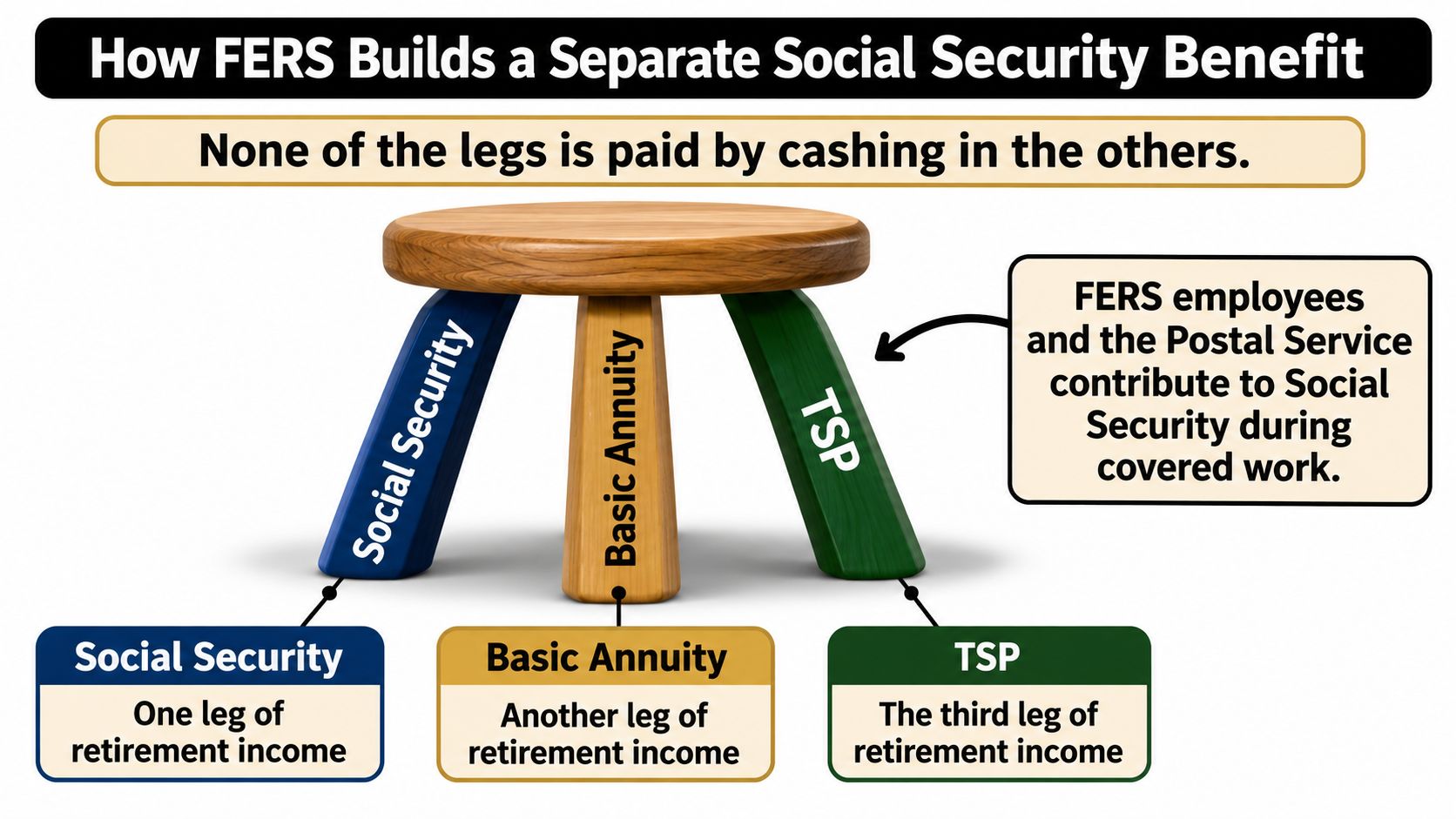
FERS works like a three-legged stool. The basic annuity is the federal pension, Social Security is a separate federal insurance benefit, and the TSP is the employee's retirement savings account. Receiving income from one doesn't require cashing in the others.
From payroll deductions to eligibility
Under the coverage described by the USPS benefits overview, employees generally pay 6.2% of covered wages into Social Security up to the annual taxable wage cap, USPS contributes an additional 6.2%, and retirement eligibility generally requires 40 credits, commonly about 10 years of covered work.
Those contributions support a separate Social Security record. Your annuity contribution doesn't replace them, and the balance in your TSP doesn't determine whether you've earned enough covered-work credits.
A credit is an eligibility measure, not a dollar deposited into a personal Social Security account. For historical context, the Social Security Administration's 2024 Fast Facts states that $1,730 in earnings earned one credit in 2024; don't use that historical threshold as a current-year payroll target.
Once a worker qualifies, the eventual monthly benefit reflects lifetime covered earnings and claiming age. A postal craft designation doesn't set the benefit, nor does the amount of the worker's federal pension.
Separate benefits require separate decisions
For the hypothetical new employee, retirement planning eventually involves distinct actions:
- Federal annuity: Obtain a pension estimate and complete the federal retirement process.
- Social Security: Review the earnings statement and apply through SSA when ready to claim.
- TSP: Decide how savings will support retirement spending and arrange withdrawals through the account's own process.
Filing a USPS retirement application doesn't automatically start Social Security. An employee can leave postal employment and make a separate decision about when to claim that benefit.
The FERS pension and Social Security guide provides additional context for coordinating those decisions without treating the pension as an all-inclusive check.
Medicare coverage accompanies Social Security payroll coverage for new hires, but it serves a different purpose. A Medicare deduction concerns health insurance coverage, not proof that a worker has completed the retirement-benefit eligibility requirements.
How to Tell Which Years Count
Start with documents, not a retirement calculator. The USPS working-benefits page describes retirement coverage for postal employment, but your own personnel and earnings records establish how that coverage applies to your career.
The useful question is specific: Which years produced Social Security-covered wages, and which years contributed only to the civil-service pension? Keep that distinction visible as you review your records.
Check the records in this order
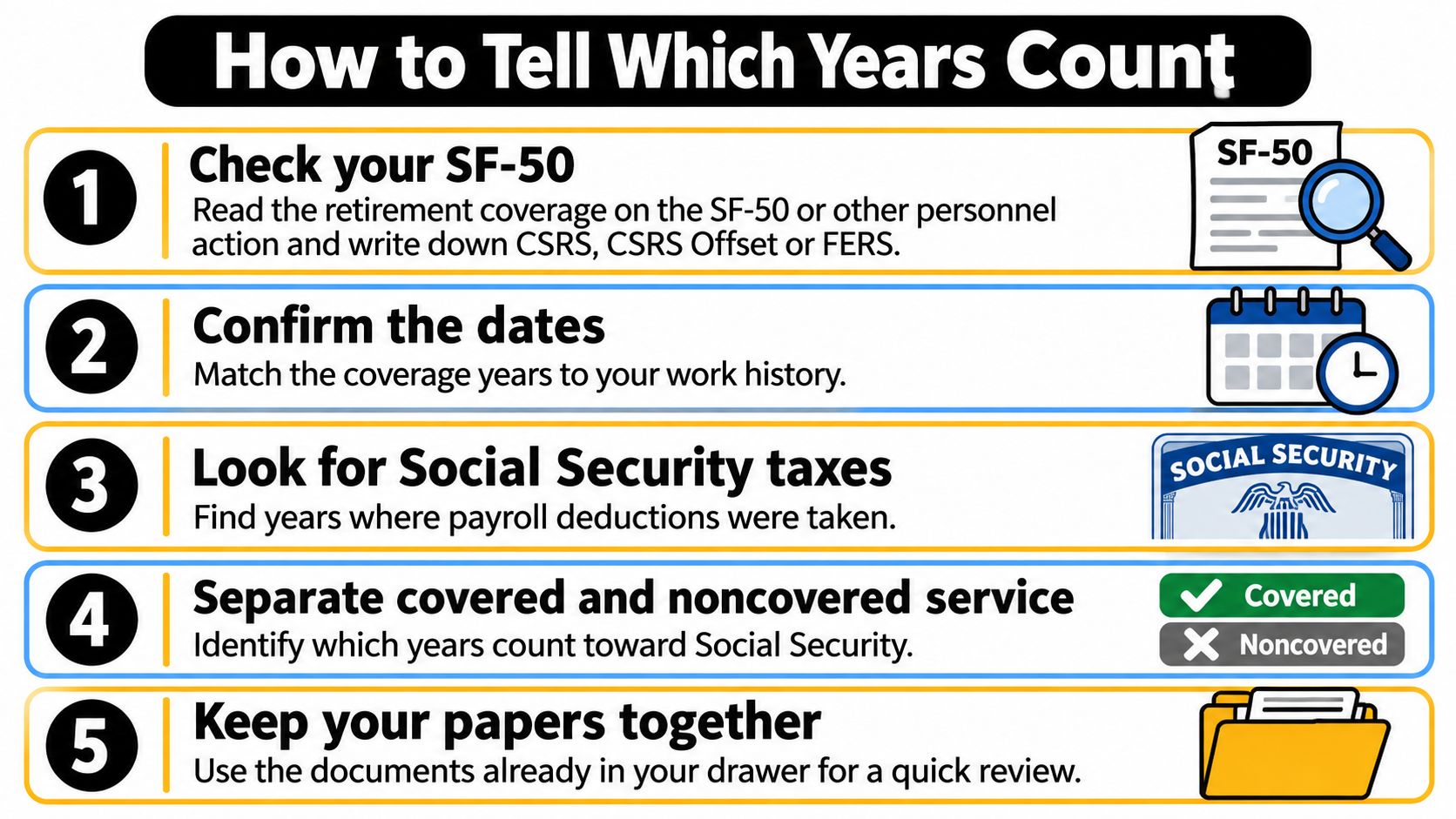
Read the personnel action. Find the retirement coverage on your SF-50 or equivalent personnel document. Write down CSRS, CSRS Offset, or FERS rather than translating a remembered hire date into an assumed system. If the document uses an unfamiliar code, ask the benefits office to identify it.
Inspect payroll deductions. Look for Social Security or OASDI on a recent pay stub or leave-and-earnings statement. Medicare withholding by itself isn't enough. If you expected Social Security deductions and can't find them, ask payroll to explain the coverage before concluding that something is wrong.
Reconstruct coverage changes. Put entrance, separation, rehire, and conversion documents in chronological order. A current FERS designation doesn't necessarily describe every earlier year of service. Mark the point where any change took effect.
Compare the SSA earnings history. Review the calendar years in your Social Security record against your employment history and wage documents. Include covered jobs outside USPS. A blank entry during postal employment needs investigation, but non-covered CSRS wages shouldn't be treated as a missing wage report.
Keep pension service separate. Compare the earnings history with the service shown in your annuity estimate. A FERS period can contribute to both systems; a pure CSRS period generally contributes to the civil-service annuity without producing Social Security-covered earnings.
Investigate before estimating
Create a simple worksheet with columns for employment period, retirement system, pension service, and covered earnings. Attach the supporting document to any entry you're uncertain about.
A blank earnings year is a question to resolve, not an instruction to add wages that weren't Social Security-covered.
If covered wages appear to be missing, gather the relevant pay records and wage statements, then contact USPS payroll and SSA about the discrepancy. Get the reporting issue resolved before relying on an online estimate that assumes the earnings history is complete.
What the 2025 Fairness Act Changed for CSRS
The Social Security Fairness Act, signed on January 5, 2025, repealed the Windfall Elimination Provision (WEP) and Government Pension Offset (GPO) for benefits payable after December 2023, according to the SSA Fairness Act update. That change matters to affected CSRS retirees and families, but it doesn't create eligibility where none exists.
The operational distinction is between qualifying for a benefit and having that benefit reduced. The law removed the specified reductions, not the underlying eligibility requirements.
What repeal of WEP and GPO does and does not do
| Question | What changed | What did not change |
|---|---|---|
| Own retirement benefit reduced by WEP | An affected benefit can be recalculated when the person qualifies and was subject to WEP | No worker retirement benefit is created without sufficient covered credits |
| Spouse or survivor benefit reduced by GPO | The offset is removed within the law's payable window | A CSRS pension is still not a Social Security benefit |
| Retroactive payment | Adjustments can cover eligible months within that window | Earlier months remain outside it |
| FERS retiree who paid Social Security tax | Usually no change if the person wasn't subject to WEP or GPO | The repeal doesn't rewrite the FERS annuity, TSP, or payroll-tax rules |
| SSA record missing covered years | SSA may need corrected wages to establish the proper payment | Repeal doesn't fill non-covered CSRS years with covered earnings |
What an affected retiree should examine
WEP concerned the worker's own Social Security benefit. GPO concerned a Social Security spouse or survivor benefit associated with another person's earnings record. Those are different entitlements, so a notice addressing one doesn't necessarily settle the other.
For example, a CSRS retiree might have qualified for Social Security through earlier private-sector work and then received a WEP-reduced benefit. That person's concern is recalculation of an existing entitlement, not whether postal pension service suddenly earns Social Security credits.
A spouse whose benefit was reduced or eliminated under GPO has a different review. The relevant questions include whether SSA established entitlement, whether an application is needed, and whether the spouse or survivor record reflects the repeal.
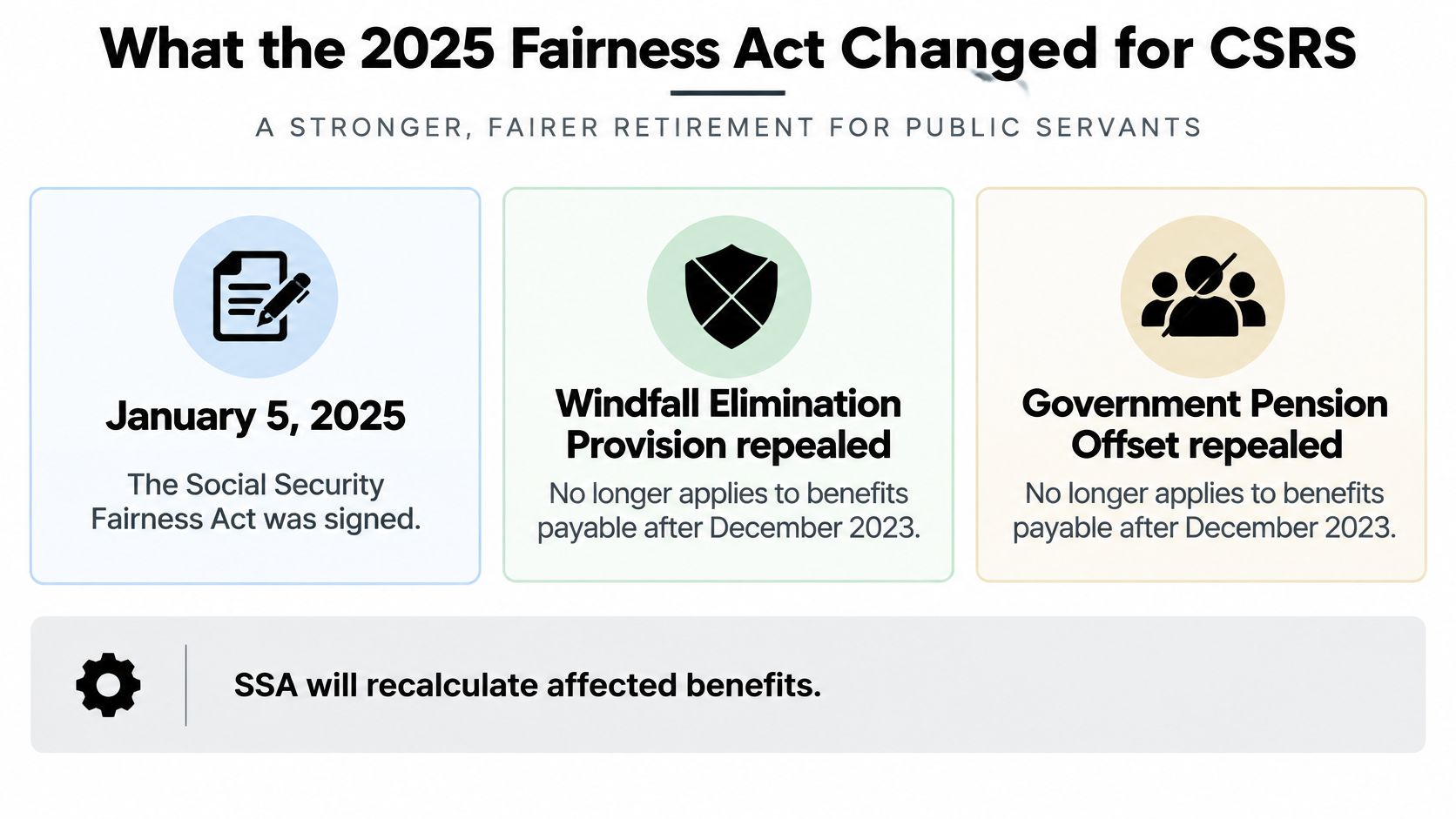
Repeal removes a reduction for someone who qualifies and was subject to the old rules. It doesn't give every postal retiree a Social Security benefit.
Read the notice, not just the deposit
Compare any adjustment notice with your previous benefit determination. Check which benefit SSA adjusted, which months it covered, and whether the notice addresses your own retirement benefit or a family benefit.
The WEP explanation for federal employees can help you understand the terminology in older notices. Don't assume an old explanation of the reduction still describes the amount now payable.
If the notice doesn't resolve your situation, ask SSA specifically about the prior WEP or GPO determination and any spouse or survivor entitlement. Keep eligibility, recalculation, and missing earnings as separate questions.
Four Postal Careers and Their Likely Checks
The SSA guidance for federal employees distinguishes non-covered CSRS employment from Social Security-covered federal employment. The following hypothetical careers show why the right answer follows the employee's records, not the postal job title.
These are examples, not benefit determinations. A different coverage designation, earnings history, or SSA entitlement decision could change the result.

A newer carrier covered by FERS
A city carrier starts a postal career under FERS and sees Social Security deductions on each pay statement. If the worker completes the applicable eligibility requirements, the expected retirement-income picture includes a federal annuity, TSP withdrawals, and a separately claimed Social Security benefit.
The SF-50 and payroll statement establish coverage; the SSA earnings record confirms reported wages. A missing earnings entry would call for a reporting review, not an assumption that carriers don't receive Social Security.
A longtime clerk with outside employment
A window clerk spends a postal career under pure CSRS but worked in a Social Security-covered private-sector job beforehand. The expected postal benefit is the civil-service annuity, while any Social Security retirement benefit must rest on the covered earnings.
The clerk should check the SSA statement, not infer eligibility from the length of postal service. If SSA previously applied WEP to an independently earned benefit, the old notice also belongs in the review.
A returning employee under CSRS Offset
A carrier enters postal employment after earlier government service and has CSRS Offset coverage. Social Security deductions appear on postal wages, but the annuity isn't an ordinary CSRS pension added without adjustment to Social Security.
Under CSRS Offset, the civil-service annuity is reduced under a formula tied to the Social Security benefit attributable to offset-covered service. The worker needs the coverage record and an offset-aware annuity estimate, because the pension amount alone doesn't describe the combined income.
A personnel record showing FERS rather than CSRS Offset would change the analysis. A familiar hire-date pattern isn't enough to override that document.
A surviving spouse reviewing an old GPO decision
A surviving spouse finds an SSA notice showing that GPO reduced or eliminated a benefit. The useful next step is to establish what SSA decided about entitlement and whether the affected benefit has been updated.
The SSA determination and subsequent adjustment notices settle that question. The deceased employee's postal pension statement, by itself, doesn't establish a Social Security survivor entitlement.
- For the employee: Verify the system and the wages associated with it.
- For the spouse: Verify the family-benefit entitlement and any prior offset.
- For either: Let the records override the closest-sounding example.
Where Social Security Sits in the Retirement Estimate
Once eligibility is clear, build an income estimate that shows each payment separately. Don't enter a single total labeled federal retirement and lose track of what starts when.
For a FERS employee, the worksheet should distinguish the basic annuity, a planned TSP withdrawal, and Social Security at the intended claiming age. Add them only for months when each payment is expected to be available.
Build a dated income worksheet
| Income line | Document to use | Planning question |
|---|---|---|
| Federal annuity | Current annuity estimate | What pension is payable under the intended retirement choice? |
| TSP withdrawals | TSP statement and withdrawal plan | What draw supports spending without treating savings as guaranteed pension income? |
| Social Security | SSA statement and claiming estimate | What benefit is expected at the intended claiming age? |
Changing the Social Security claiming date changes the Social Security projection. It doesn't substitute for a pension eligibility review or establish the start date of the federal annuity.
Likewise, being eligible to leave USPS with a retirement benefit doesn't, by itself, settle Social Security eligibility. Someone may satisfy the requirements of one program without satisfying those of the other.
For a pure CSRS retiree, start with the annuity and include Social Security only when there's an established entitlement. For a mixed-service employee, use an estimate that reflects the actual coverage history rather than a generic pension calculator.
Keep coordination separate from assumptions
Avoid treating the FERS annuity as if it already contains the Social Security payment. Also avoid adding a spouse or survivor benefit to the household budget merely because the employee expects to receive Social Security.
The post office retirement benefits guide offers context for fitting postal benefits into the broader retirement decision. Beyond benefit eligibility, My Money Mentor Plus's personal finance strategies for greater independence can help frame spending, savings, and household priorities around the income you've verified.
Confirm the pension amount and the Social Security estimate from their respective documents before choosing dates. Then test whether the household can cover the period between leaving work and starting every planned income source.
Confirm Your Coverage Before You Claim
The immediate decision isn't always when to claim. It may be whether the estimate in front of you rests on the correct coverage and earnings history.
If your record shows CSRS, CSRS Offset, or a conversion between systems, resolve the Social Security portion before building a budget around it. If an earnings entry appears missing, determine whether it represents non-covered employment or an actual reporting error.
Match the problem to the remedy
- Uncertain coverage: Ask the benefits office to confirm the retirement system and effective coverage periods.
- Missing covered wages: Pursue a wage-record correction with USPS and SSA.
- Prior WEP or GPO reduction: Ask SSA whether the affected entitlement and any family-benefit record reflect repeal.
- Confirmed benefits: Compare claiming choices using the verified pension and earnings information.
At Federal Benefits Sherpa, we use clients' SF-50, recent pay stub or LES, TSP statement, and Social Security statement to make the free Gap Report most accurate. The report organizes expected benefits from the employee's own records and identifies gaps that need attention.
We're independent and aren't affiliated with or endorsed by OPM, SSA, the Federal Retirement Thrift Investment Board, or any government agency. Our material is educational, not a government benefit determination.
Keep the next action specific. A coverage question needs a personnel answer, a missing wage needs a records correction, and a claiming decision needs a timing comparison.
Federal Benefits Sherpa offers a free Gap Report to help you see how your postal pension, TSP income, and Social Security timing fit together. Visit Federal Benefits Sherpa to request a review, and have your personnel, payroll, TSP, and Social Security records ready so the discussion starts with your actual coverage.


Dedicated to helping Federal employees nationwide.
“Sherpa” - Someone who guides others through complex challenges, helping them navigate difficult decisions and achieve their goals, much like a trusted advisor in the business world.
Federal Benefits Sherpa, LLC
12724 Gran Bay Parkway West, Suite 410, Jacksonville, FL 32225
Email: [email protected]
Phone: (833) 753-1825
© 2024 Federalbenefitssherpa. All rights reserved
Federal Benefits Sherpa is an independent organization and is not affiliated with or endorsed by the U.S. government or any federal agency.