Post Office Retirement Benefits Explained
When you work for the U.S. Postal Service, your retirement isn't just a single account—it's a powerful combination of three different income sources. Think of it as a three-legged stool: you have your FERS Basic Annuity pension, Social Security, and your personal Thrift Savings Plan (TSP). For a secure retirement, you need all three legs to be strong.
Successfully navigating these benefits is the key to financial stability after you hang up your mailbag for the last time.
Understanding Your USPS Retirement Benefits
Let’s be honest, figuring out your USPS retirement benefits can feel overwhelming. With so many moving parts, it’s easy to get lost in the details. But it doesn’t have to be that complicated.
This guide will give you a clear roadmap to your post office retirement benefits. We'll break down how each piece works on its own and, more importantly, how they all fit together to support you financially.
The Three Pillars of Your Retirement
Your retirement income is a mix of guaranteed government benefits and your own personal savings. Getting a handle on each one is the first step to making a solid plan.
FERS Basic Annuity: This is your traditional pension. It’s a guaranteed monthly check for the rest of your life, calculated based on how long you worked and how much you earned.
Social Security: As a USPS employee under the Federal Employees Retirement System (FERS), you pay into Social Security just like someone in the private sector. You’ll be eligible for those benefits, too.
Thrift Savings Plan (TSP): This is the federal government’s version of a 401(k). It’s your personal retirement savings account, and the USPS even gives you a generous match on your contributions.
These benefits are a huge part of what makes a career with the Postal Service so valuable. The numbers prove it. For fiscal year 2023, the USPS reported that retirement expenses accounted for about 11.7% of its $85.4 billion in total operating costs.
Those costs are only going up, with projections showing that combined expenses for retirement and health benefits could hit nearly $18 billion a year by 2032. You can read more about the USPS's financial outlook to see the full picture. It just goes to show how significant these benefits are—and why it’s so important to understand what you’re earning.
Decoding the Three Pillars of Your FERS Plan
If you were hired at the post office anytime after 1983, your retirement security is built on a system called FERS—the Federal Employees Retirement System. The best way to think about FERS isn't as a single benefit, but as a sturdy, three-legged stool. Each leg provides a different stream of income, and all three work together to keep you balanced and stable financially throughout your retirement.
Getting a handle on how these three pillars support each other is the first real step toward mapping out a solid financial future. Let's break down each one so you can see exactly how your post office retirement benefits create such a powerful foundation.

Pillar 1: The FERS Basic Benefit Annuity
The first leg of the stool is your Basic Benefit, which is a traditional defined-benefit pension. This is the government’s promise to you: a guaranteed monthly check for the rest of your life as a thank-you for a career of dedicated service. It’s the bedrock of your retirement income.
How much you get isn't a random number. It’s calculated with a specific formula that hinges on two key things: how many years of creditable service you have and your "high-3" average salary. Your high-3 is simply the average of your highest basic pay over any 36 consecutive months of service. For most people, that ends up being their final three years on the job.
The standard formula is pretty straightforward:
High-3 Average Salary x Years of Service x 1% = Annual Pension
Here's a pro tip: if you work until at least age 62 and have 20 or more years of service, that multiplier gets a permanent 10% boost, jumping from 1% to 1.1%. That may not sound like much, but it makes a real difference over a lifetime.
Let's walk through a quick example. Picture a postal worker named Sarah retiring at 62 with 30 years of service. Her high-3 average salary is $70,000.
Calculation: $70,000 (High-3) x 30 (Years) x 1.1% (Boosted Multiplier)
Annual Pension: $23,100
Monthly Pension: $1,925
That $1,925 every month is the stable base she can count on, no matter what the stock market is doing.
Pillar 2: Your Social Security Benefits
The second leg of the FERS stool is Social Security. This is a key difference from the older CSRS system. FERS was specifically designed to work hand-in-hand with Social Security. As you’ve worked your postal route or sorted mail, you’ve been paying Social Security taxes just like someone in the private sector.
That means you’re earning credits toward Social Security retirement benefits, which you can start drawing on as early as age 62. This provides another lifelong income stream that stacks right on top of your FERS pension. For a lot of retirees, it’s a major slice of their monthly cash flow.
It's smart to keep an eye on the bigger picture, though. The 2025 Trustees Report pointed out a significant financial shortfall for the Social Security trust fund down the road, which could lead to benefit changes if Congress doesn't act. You can discover more about the Social Security financial outlook to get a better sense of the long-term projections.
For FERS employees who retire before 62, there's a neat feature called the FERS Annuity Supplement. Think of it as a "bridge" payment. It approximates the Social Security benefit you earned during your postal career and helps fill the income gap until you officially hit 62. Once you're eligible for actual Social Security, the supplement stops.
Pillar 3: The Thrift Savings Plan (TSP)
The third and final pillar is the Thrift Savings Plan, or TSP. This is the federal government’s version of a 401(k), and it's your personal wealth-building engine. While your pension and Social Security create a reliable income floor, the TSP is where you have the most control to grow a really substantial nest egg.
Contributing to your TSP is one of the smartest financial moves you can make, thanks to two huge advantages:
Automatic Contributions: The USPS automatically deposits 1% of your basic pay into your TSP. This happens even if you don't put in a single penny yourself. It’s free money.
Generous Matching: This is where it gets really good. The USPS will match your contributions dollar-for-dollar on the first 3% you put in. Then, they'll add another 50 cents on the dollar for the next 2%.
All you have to do is contribute 5% of your own salary to get the full 5% match from the government. If you don't, you're literally turning down a 100% return on your money. Over a 30-year career, that free money, combined with decades of compound growth, can turn your TSP into a massive asset—often the largest of the three FERS pillars.
How to Squeeze Every Last Drop Out of Your Thrift Savings Plan
Think of your FERS pension and Social Security as the solid foundation of your retirement house. They provide a reliable income floor. But the Thrift Savings Plan (TSP)? That's the engine in the garage—it's the most powerful tool you have to really build wealth and turbocharge your retirement.
Getting the most out of your TSP isn't just about stashing money away. It’s about making your money work as hard for you as you do for the USPS. Let's move past the basics and get into real-world strategies that will help you build a nest egg big enough to fund the comfortable future you’ve earned.

The Unbeatable Power of the USPS Match
If you remember only one thing from this entire guide, make it this: contribute at least 5% of your pay to the TSP. Not doing so is literally turning down free money. It’s a guaranteed 100% return on your investment, a deal you will never, ever find anywhere else.
The matching program is incredibly generous. Here's a simple look at how it works:
The Free 1%: The USPS automatically deposits 1% of your basic pay into your TSP, even if you don’t contribute a single dime yourself.
The Full Match: They match your contributions dollar-for-dollar on the first 3% you put in.
The Half Match: For the next 2% you contribute, they'll add another 50 cents on the dollar.
Put it all together, and when you contribute 5%, the USPS adds another 5% (the 1% automatic plus the 4% match). You're only taking 5% out of your paycheck, but a full 10% is landing in your account. This free money, supercharged by decades of compound interest, is the single fastest way to grow your retirement savings.
Understanding Your TSP Investment Funds
Your TSP contributions don't just pile up in a cash account; they get invested in different funds that you choose. Figuring out these options is crucial for matching your investments to your personal timeline and how much risk you're comfortable with.
Think of them as different tools for different jobs. There are five core individual funds:
G Fund (Government Securities): The safest bet. It invests in special U.S. Treasury securities that are guaranteed by the government. Your principal will never go down, but your growth potential is also the lowest.
F Fund (Fixed Income Index): A bond fund. It's still considered low-risk but offers a little more potential for return (and a bit more risk) than the G Fund.
C Fund (Common Stock Index): This fund mirrors the S&P 500, which means you're investing in 500 of the largest, most established U.S. companies. It has high growth potential but comes with the ups and downs of the stock market.
S Fund (Small Cap Stock Index): This fund tracks small and medium-sized U.S. companies that aren't in the C Fund. It's more aggressive, offering even higher potential returns and, you guessed it, higher risk.
I Fund (International Stock Index): Your ticket to the global market. This fund invests in companies across numerous developed countries, giving you diversification outside the U.S. It carries both market risk and currency risk.
If picking and choosing feels overwhelming, there are also the Lifecycle (L) Funds. These are "target date" funds designed to be a "set it and forget it" option. You just pick the fund with the date closest to when you plan to retire, and it automatically adjusts its mix, becoming more conservative as you get closer to that date.
The Great Debate: Roth vs. Traditional TSP
One of the most important decisions you'll face is whether to use the Traditional TSP, the Roth TSP, or a mix of both. The entire choice boils down to a simple question: Do you want to pay taxes now or pay them later?
Traditional TSP: Your contributions are made with pre-tax dollars. This lowers your taxable income today, giving you an immediate tax break. Your money grows tax-deferred, but you'll owe income tax on every dollar you withdraw in retirement.
Roth TSP: Your contributions are made with after-tax dollars, meaning no tax break now. But here's the magic: your qualified withdrawals in retirement—both your original contributions and all the earnings—are 100% tax-free.
So, which one is right for you? It really depends on where you are in your career and what you expect your financial picture to look like down the road.
Let's walk through a couple of examples.
Scenario 1: Sarah, the Early-Career Letter Carrier. Sarah is 25 and in a relatively low tax bracket. She fully expects her income and tax bracket to climb over her 30-year career. For her, the Roth TSP is a fantastic choice. She pays the taxes now while her rate is low, letting decades of investment growth happen completely tax-free for her future, higher-tax self.
Scenario 2: David, the Supervisor Nearing Retirement. David is 55, at his peak earning potential, and in a high tax bracket. He expects to be in a lower tax bracket once he retires. The Traditional TSP likely makes more sense for him. He gets a valuable tax deduction now when he needs it most and will pay the taxes on his withdrawals later when his income and tax rate are lower.
For a lot of folks, a hybrid strategy is the sweet spot. You can contribute to both! Maybe you put enough in the Traditional TSP to lower your current tax bill a bit, then direct the rest to the Roth TSP for that sweet tax-free growth. The TSP gives you the flexibility to build a tax-diversified retirement, which can be a huge advantage when it's time to start living off your savings.
What Happens to Your Health and Life Insurance When You Retire?
A comfortable retirement isn't just about the size of your pension check. Honestly, some of your biggest expenses down the road will be for things like healthcare, so you need a solid plan for that, too. Thankfully, two of the most valuable benefits you have as a postal employee are the options to keep your health and life insurance after you retire.
But here's the critical part: you have to know the rules before you hand in your retirement papers. A simple mistake here can lead to a permanent loss of coverage, and that's a mistake you can't afford to make when you and your family will need it most.
Keeping Your Health Insurance: The 5-Year Rule You Can't Ignore
The Federal Employees Health Benefits (FEHB) program is, frankly, one of the best health insurance setups out there. The great news is you can take it with you into retirement and continue paying the same premiums as active employees. But there’s one big catch.
It’s known as the “5-year rule,” and it is set in stone. To be eligible to keep your FEHB coverage for the rest of your life, you must have been continuously enrolled in any FEHB plan for the five full years leading right up to your retirement date.
Let’s break that down, because the details matter:
You can switch plans. Maybe you had Blue Cross for three years and then moved to a local HMO for the last two. That’s perfectly fine. As long as there wasn't a single day of lapsed FEHB coverage, you’ve met the requirement.
The clock starts on your effective date. Your five-year window doesn't start the day you fill out the form, but on the first day of the first full pay period after your enrollment is processed.
There are no second chances. If you retire with four years and 11 months of coverage, you lose the chance to keep FEHB for life. It’s that strict.
This rule is a perfect example of why planning ahead is so important. Every year, thousands of federal and postal employees face these same decisions. In fact, the Office of Personnel Management processed 112,679 retirements in fiscal year 2025 alone. You can dig into more OPM data by checking out their public reports on trends in federal employee retirement.
How FEHB and Medicare Work Together
When you hit age 65, your healthcare puzzle gets a new piece: Medicare. It’s natural to wonder how it fits with your FEHB plan. The best way to think about it is that they aren't competing—they're partners.
For nearly all postal retirees, here’s how it works:
Medicare Steps Up as Primary: Once you're 65, Medicare becomes your primary insurance. This just means that whenever you see a doctor or go to the hospital, they bill Medicare first.
FEHB Becomes Your Secondary: After Medicare pays its portion of the bill, the rest is sent over to your FEHB plan. Your FEHB plan then picks up most, if not all, of the remaining cost, depending on the plan you have.
This teamwork is exactly why it's almost always a no-brainer to sign up for Medicare Part B (which covers your doctor visits and outpatient stuff) as soon as you're eligible. If you decide not to, your FEHB plan will still pay its benefits as if Medicare had already paid its share. That leaves you on the hook for a much, much bigger chunk of the bill.
Making Sense of Your FEGLI Life Insurance Options
Your Federal Employees' Group Life Insurance (FEGLI) is another great benefit you can carry into retirement, but you need to pay close attention here because both its structure and cost can change in a big way. Just like with your health insurance, you must have been enrolled in FEGLI for the five years right before retirement to keep it.
The single most important thing to wrap your head around is that FEGLI, especially the optional parts, gets much more expensive as you get older.
Basic Insurance: This is worth your final salary rounded up to the next thousand, plus an extra $2,000. When you retire, you get to choose how this benefit reduces over time. Letting it reduce makes the premiums much cheaper—and eventually free after you turn 65.
Option B (Multiples of Salary): This is where the real cost can hit. The premiums for Option B are based on your age and jump up every five years. Many retirees find that by the time they reach their 70s or 80s, the cost of keeping Option B is just too high.
It's absolutely essential to sit down and review your FEGLI choices as retirement gets closer. You might find it makes more sense to reduce your coverage or even look into a private life insurance policy that offers a more predictable, level premium for the long haul.
Your Step-by-Step Retirement Application Guide
After decades of service, the finish line is in sight. But navigating the final stretch—the actual retirement application—can feel like its own full-time job. It’s a process loaded with forms, deadlines, and important decisions.
The secret to a stress-free transition isn't just knowing what to do, but when to do it. Think of it less like a sprint and more like a well-paced marathon. Starting early, as much as two years before your last day, is the single best thing you can do to avoid last-minute headaches and costly mistakes.
Kicking Off Your Retirement Countdown
Your journey to retirement doesn't start the day you hand in your notice. It begins with careful planning long before you even think about cleaning out your locker.
About 18 to 24 months before you plan to retire, your first move should be to request a preliminary retirement estimate. This isn't just a ballpark guess; it's a detailed projection of your future annuity based on your current record. It's an essential tool for realistic financial planning.
Getting this estimate from your agency's Human Resources Shared Service Center (HRSSC) also serves as a crucial check-up. It allows you to confirm your service computation date is accurate and that every single year you've worked is accounted for.
Once you’re within the six to twelve-month window, things get more concrete. It's time to request your official retirement application package. This packet will have all the specific forms you'll need, like the SF 3107 for FERS employees.
This is your cue to start treasure hunting for documents. Gather everything you might need: marriage certificates, divorce decrees if applicable, and especially your military service records (like the DD 214). Getting all this paperwork organized now will save you from a frantic search later on.
The timeline below gives you a bird's-eye view of some of these benefit milestones, especially how your health coverage evolves over time.
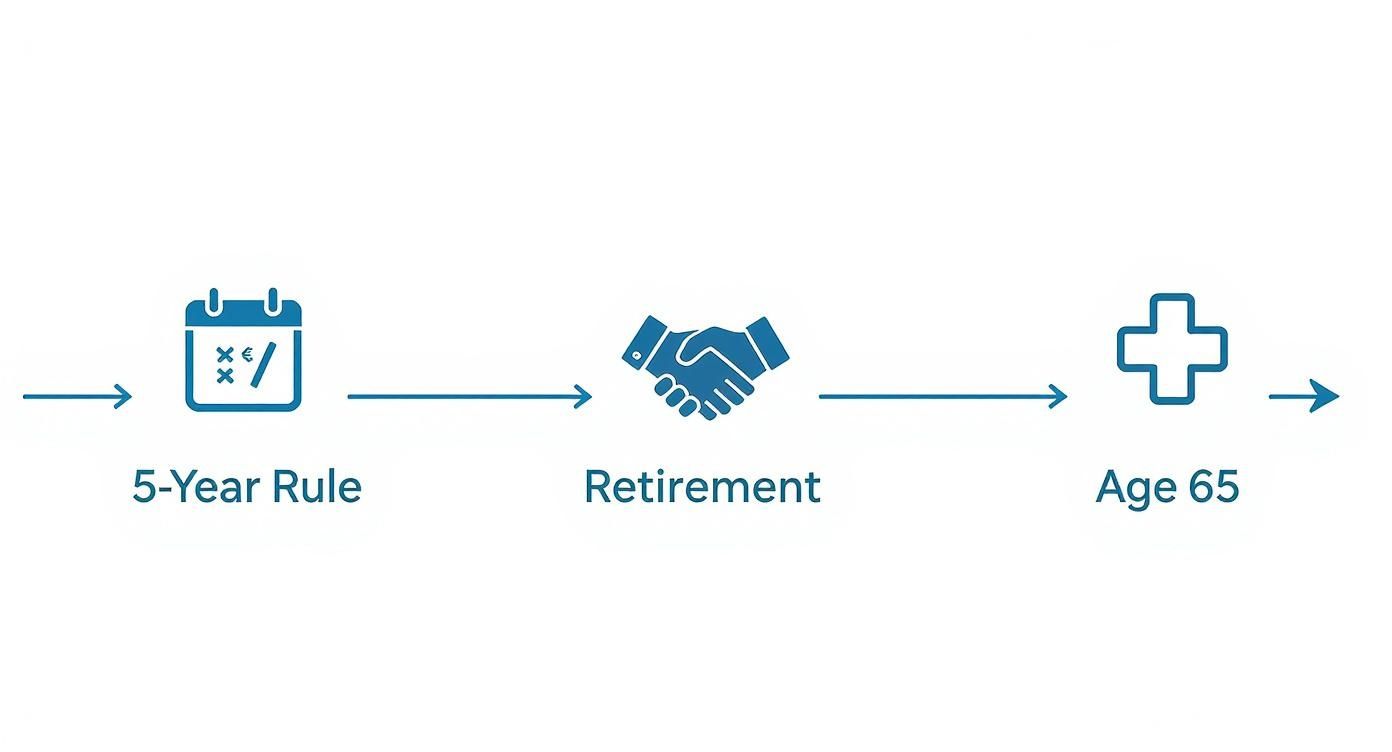
As you can see, the decisions you make during your career have a direct line to your health and financial security in retirement.
Submitting Your Application and What Comes Next
You've done the prep work, and now it's go-time. Aim to submit your completed application to the HRSSC about 60 to 90 days before your retirement date. This buffer gives them plenty of time to review your file, spot any issues, and get it over to the Office of Personnel Management (OPM) for final processing without a mad rush.
Now, a heads-up: your first retirement check won't be for the full amount. You'll start by receiving interim pay. Here’s what that looks like:
Interim Payments Begin: Soon after you retire, OPM will put you on an estimated "interim" payment schedule. Think of it as a partial payment—typically a percentage of your final annuity—to ensure you have income while they finalize everything.
Application Adjudication: While you're getting interim pay, OPM is meticulously verifying every detail of your career. This official review process is called adjudication, and honestly, it can take several months.
Finalization and First Full Payment: Once OPM gives the final sign-off, you'll receive your first full annuity payment. They'll also send you a retroactive lump-sum payment to cover the difference between what you received in interim pay and what you were actually owed for those months.
This waiting period requires a bit of patience, as OPM processing times can vary. For example, things can slow down during government shutdowns, but once you're in the system, your payments will continue.
To make this all a bit easier to track, here's a simple checklist to guide you through the major milestones.
Retirement Application Timeline Checklist
This checklist breaks down the key actions you need to take and why they're important as you approach your retirement date.
Timeframe Before RetirementKey Action ItemPurpose18-24 MonthsRequest a preliminary retirement annuity estimate from HRSSC.To get a realistic projection of your income and verify your service computation date is correct.6-12 MonthsRequest your official retirement application package.To get the necessary forms (like SF 3107) and begin gathering required personal documents.6-12 MonthsGather all supporting documents (marriage/divorce records, DD 214).To have everything ready and avoid delays when you're ready to submit your application.60-90 DaysComplete and submit your retirement application to HRSSC.To allow ample time for initial review and processing before forwarding to OPM.1 Day After RetirementYour retirement is official. Your annuity begins to accrue.This marks the official start of your retirement, even though the first payment is still pending.4-8 Weeks AfterExpect your first interim payment from OPM.To provide a partial, estimated income while your case is being finalized.Several Months AfterReceive your first full annuity payment and retroactive pay.This indicates OPM has completed the adjudication process and your benefits are fully calculated.
By following this timeline, you're not just filling out forms—you're taking control of the process. A little planning goes a long way in ensuring the transition into the retirement you've worked so hard for is as smooth as possible.
Common Questions About Post Office Retirement
Even after you've done your homework, some specific questions always seem to come up as retirement gets closer. It's one thing to know the general rules, but it’s the unique, real-life situations that often leave you scratching your head.
Let's dig into some of the most common questions we hear from postal employees. We’ll give you straight, clear answers to help you navigate these tricky spots with confidence.
What Happens to My Unused Sick Leave When I Retire?
Think of your sick leave balance as more than just a rainy-day fund for when you're under the weather. When you retire, it becomes a genuine financial asset. Under the FERS system, every hour of sick leave you've saved gets converted directly into extra creditable service.
This new, higher service time is then plugged right into your pension formula, which means a bigger monthly annuity check for the rest of your life.
For every 2,087 hours of unused sick leave you have when you retire, you get credited with one full year of service. Even smaller amounts add up—1,044 hours will tack on six months to your service time, giving your pension a permanent boost.
It’s a fantastic reward for staying healthy and using your sick leave wisely throughout your career. That saved time literally turns into more retirement income.
Can I Take a Loan from My TSP After I Retire?
In short, no. The TSP loan program is a perk strictly for active federal and postal employees. The moment you separate from service and officially retire, the door to new loans closes.
It's also crucial to handle any existing loans before you walk out the door for the last time.
If you have an outstanding TSP loan when you retire, the remaining balance will be treated as a taxable distribution. Not only will you owe income tax on that amount, but you could also get hit with a hefty 10% early withdrawal penalty if you're under age 59½. Once you're retired, your options for getting money from your TSP switch over to withdrawals, like taking a lump sum, setting up monthly payments, or buying an annuity.
What Is the FERS Special Retirement Supplement?
The FERS Special Retirement Supplement (often called the SRS) is a real game-changer for many FERS employees. It's essentially a financial bridge, designed specifically for those who retire before they're old enough to claim Social Security benefits at age 62.
The SRS payment is calculated to be about what your Social Security benefit would be based on your years of FERS service. It gives you a temporary income stream to help fill that gap until your actual Social Security can kick in.
Keep in mind, though, that the SRS automatically stops the month you turn 62, regardless of when you decide to start taking your Social Security. It’s also subject to an earnings test, which means if you get another job after retiring from the post office, that income can reduce or even eliminate your supplement payment entirely.
What Is the Difference Between CSRS and FERS?
The biggest difference boils down to your hire date and the fundamental structure of your retirement plan. CSRS, the Civil Service Retirement System, is the old-school plan for employees hired before 1984. It’s known for its generous pension, but it doesn't include Social Security.
FERS, the Federal Employees Retirement System, covers everyone hired since 1984. It was built to be a more modern, flexible "three-legged stool":
A FERS Basic Benefit (your pension)
Social Security
The Thrift Savings Plan (TSP)
Under FERS, there’s a much bigger emphasis on what you contribute to your own TSP account. While the CSRS pension is larger on its own, the FERS system’s three pillars work together to provide a powerful and well-rounded foundation for a secure retirement.
Trying to piece all this together can feel overwhelming, but you don't have to do it alone. At Federal Benefits Sherpa, we specialize in helping postal employees understand their benefits to build a retirement plan they can feel great about. To get a personalized look at your situation, schedule your free 15-minute consultation at https://www.federalbenefitssherpa.com.
