
Blogs

Blog title place here
We understand that every federal employee's situation is unique. Our solutions are designed to fit your specific needs.

Blog title place here
We understand that every federal employee's situation is unique. Our solutions are designed to fit your specific needs.

Blog title place here
We understand that every federal employee's situation is unique. Our solutions are designed to fit your specific needs.
Civil Service Pension Rates: A Clear Guide for 2026
Maria, a GS-12 analyst at the Department of Labor, is two years from her Minimum Retirement Age and has just opened her first OPM estimate letter. The projected annuity looks lower than she expected, and she isn't sure whether the problem is the formula, her high-3 average, the cost-of-living assumption, or a survivor election she hasn't chosen yet.
That confusion is common because civil service pension rates aren't a single flat percentage. Your retirement system, creditable service, high-3 average salary, retirement age, special coverage, and survivor choice can all affect the result. The size of the federal system also matters. In 2022–23, the Civil Service Pension Scheme's current service cost was £15.4 billion, equal to 79.9% of pensionable pay, while contributions received were £6.3 billion, up from £3.9 billion in 2018–19. Those UK figures illustrate the broader point: pension rates reflect actuarial valuations and policy decisions, not just a number printed on a pay statement. (Civil Superannuation Annual Report and Account 2022–23)
The examples below use Maria's profile to make the math concrete, then place a parallel FERS employee beside her. You'll see how the multiplier, high-3 pay, COLA, and survivor election change the income that reaches a retiree and, eventually, a surviving spouse.
What Civil Service Pension Rates Mean for Your Retirement
A pension rate is best understood as the percentage of your high-3 salary that your service earns under a specific retirement formula. The high-3 is the largest average of your basic pay over any three consecutive years of creditable service, usually the final three years for someone who has had a steady federal career.
Maria's estimate can therefore be reduced to a simple question: what percentage of her high-3 does her service produce? That percentage comes from the retirement system and the applicable multiplier. A multiplier is the rate applied to each year of creditable service. A survivor election can then reduce the starting annuity in exchange for continuing income for an eligible survivor.
Practical rule: Don't judge an estimate by its headline annuity alone. Check the service years, high-3 pay, retirement system, retirement date, COLA treatment, and survivor election separately.
For a CSRS employee, the formula uses several service tiers. For a regular FERS employee, the formula generally uses a flat multiplier, with a higher rate available only for a particular age and service combination. FERS also coordinates with the Thrift Savings Plan and Social Security, so its smaller basic annuity isn't the entire retirement-income picture.
Four levers deserve attention:
- The multiplier: This determines how much of high-3 pay each year of service produces.
- The high-3 average: A higher counted salary raises the base to which the multiplier applies.
- COLA rules: A cost-of-living adjustment can increase an annuity after retirement, but the rules differ between CSRS and FERS.
- The survivor trade-off: More protection for a surviving spouse means a lower annuity while both spouses are alive.
Maria's OPM letter won't become easier to evaluate until each lever is separated. Once the figures are isolated, the estimate can be rebuilt with a calculator and checked against personnel records.
CSRS vs FERS Multipliers and the High-3 Average
CSRS, the Civil Service Retirement System, is the older federal system. FERS, the Federal Employees Retirement System, covers most employees hired after 1987 and combines a basic annuity with Social Security and the TSP.
The two systems don't use the same multiplier schedule. CSRS applies progressively higher rates as service length increases. FERS generally applies 1% for each year of service, with 1.1% available when the employee reaches age 62 with at least 20 years of service. The FERS age-and-service rule isn't merely triggered by reaching the Minimum Retirement Age.
The high-3 pay base
The high-3 isn't your highest single salary. It uses the largest average basic pay over three consecutive years. Counted pay can include basic pay, locality pay, special-rate adjustments, night differential, and within-grade step increases when those amounts qualify as basic pay for retirement purposes.
Overtime, bonuses, and lump-sum awards generally don't enter the high-3 calculation. That distinction explains why an employee's annual earnings can look higher than the salary used in an OPM estimate.
The formulas are:
- CSRS: Add the applicable tiered percentages for each service period, then multiply the total by high-3.
- FERS: Multiply years of service by 1%, then multiply by high-3. Use 1.1% only when the age-and-service requirement is met.
| Service Bracket | CSRS Multiplier | FERS Multiplier |
|---|---|---|
| First 5 years | 1.5% | 1% |
| Next 5 years | 1.75% | 1% |
| Service beyond 10 years | 2% | 1% |
| Age 62 with at least 20 years | Special CSRS rules may apply | 1.1% |
These are starting points, not a complete retirement determination. Special-category employees, disability retirements, postponed benefits, deposits, redeposits, and unused sick leave can change the calculation. The difference between CSRS and FERS matters before you enter any numbers into a worksheet because the same salary and service history can produce different annuities.
Worked Examples for CSRS and FERS Annuities
Maria's profile gives us a clean CSRS example: 25 years of creditable service, a $110,000 high-3 salary, and retirement at age 57. The calculation starts by applying each CSRS tier to the relevant service.
The first five years produce 1.5% times five, or 7.5%. The next five produce 1.75% times five, or 8.75%. The remaining 15 years produce 2% times 15, or 30%. Together, those tiers equal 46.25% of high-3 pay.
Multiplying 46.25% by $110,000 produces $50,875 per year before checking the special 20-and-out enhancement. Maria has at least 20 years and is older than 55, so the example applies a 2.5% enhancement to the first 20 years. That adds 2.5% times 20, or 50%, to the calculation. Her resulting annual annuity is $55,000, or approximately $4,583 per month, before any survivor election or other adjustment.
Ben is a parallel FERS employee with 30 years of service, a $110,000 high-3, and the same general retirement context. Applying the regular 1% FERS multiplier gives 1% times 30, or 30%. Thirty percent of $110,000 is $33,000 per year, or approximately $2,750 per month.
| Step | Maria, CSRS, 25 years | Ben, FERS, 30 years |
|---|---|---|
| High-3 salary | $110,000 | $110,000 |
| First service tier | 1.5% × 5 = 7.5% | 1% × 30 = 30% total |
| Second service tier | 1.75% × 5 = 8.75% | Not applicable |
| Remaining service | 2% × 15 = 30% | Not applicable |
| Base percentage | 46.25% | 30% |
| Base annual annuity | $50,875 | $33,000 |
| Enhancement used in example | 2.5% × 20 = 50% | None |
| Example annual annuity | $55,000 | $33,000 |
| Approximate monthly amount | $4,583 | $2,750 |
The visible difference is about $22,000 a year in this simplified illustration. FERS employees may also receive a retirement supplement when eligible, plus Social Security and TSP income, so the basic annuity isn't a complete comparison of retirement resources.
COLA Rules and the FERS Retirement Supplement
A COLA, or cost-of-living adjustment, changes an annuity after retirement to help address inflation. The adjustment is tied to the Consumer Price Index for Urban Wage Earners and Clerical Workers, commonly called CPI-W, and it typically takes effect in January.
CSRS generally receives the full applicable COLA. FERS uses a different age-based scale. A FERS retiree under 62 generally receives 1%, a retiree who is 62 with at least 20 years receives 2%, and other eligible FERS retirees receive 1% under the scale described in the planning assumptions.
| Retiree Age | CSRS COLA | FERS COLA |
|---|---|---|
| Under 62 | Full applicable adjustment | 1% |
| Age 62 with at least 20 years | Full applicable adjustment | 2% |
| Other eligible ages | Full applicable adjustment | 1% |
Use a simple illustration to see why timing matters. If a FERS annuity begins at $40,000, a 1% adjustment would make it $40,400. A later 2% adjustment on a $40,000 base would make it $40,800. These are illustrations of the stated rates, not forecasts of a particular year's inflation adjustment.
The FERS Retirement Supplement is separate from the basic annuity. It can approximate the Social Security benefit earned during federal service for an employee who retires at the applicable minimum age with at least 30 years of service. An earnings test can reduce the supplement when the retiree has earnings above the permitted threshold, so early retirement income should be modeled rather than assumed.
For a current illustration of how federal public-service pension increases can differ by system and country, the 2026 public service pensions increase notice reports a 3.8% increase in UK public service pensions in payment from 6 April 2026. It also helps show why a headline COLA doesn't answer the whole planning question. The starting annuity, retirement age, service history, and system rules still determine how much income the adjustment produces.
More detail on the supplement's assumptions and calculation is available in this FERS annuity supplement guide.
Special Rates for Law Enforcement and Air Traffic Controllers
Certain federal occupations receive enhanced retirement treatment because the work can involve unusual physical demands, mandatory separation rules, or public-safety responsibilities. Law enforcement officers, firefighters, and air traffic controllers shouldn't automatically use the regular FERS multiplier for every year of covered service.
For covered FERS service, the enhanced multiplier is 1.7%. The employee generally needs 20 years of covered service to use the special retirement provision. The minimum retirement age is also earlier, commonly 50 for many law enforcement and firefighter employees and 57 for air traffic controllers. Coverage limits usually apply, with generally 20 years of enhanced coverage for law enforcement officers and firefighters and 25 years for controllers.
The dollar effect is clear with an $80,000 high-3 and 20 years of covered service. Under the special FERS rate, 1.7% times 20 equals 34%, and 34% of $80,000 produces $27,200 annually. Under the standard 1% multiplier, the same salary and service would produce 20% of $80,000, or $16,000 annually.
| Coverage | FERS Multiplier | Years to Max Benefit | Earliest Retirement |
|---|---|---|---|
| Regular FERS | 1% | No special-category cap | Standard FERS rules |
| Law enforcement officer | 1.7% | Generally 20 covered years | Generally age 50 |
| Firefighter | 1.7% | Generally 20 covered years | Generally age 50 |
| Air traffic controller | 1.7% | Generally 25 covered years | Generally age 57 |
CSRS had its own enhanced treatment for covered employees, including a 2.5% rate for qualifying special-category service, subject to the applicable cap. The employee's personnel records must confirm whether each year counts as covered service. A title alone isn't enough because the legal coverage designation, appointment, and service history control the result.
Air traffic controllers also face rules that don't map neatly onto a regular employee's retirement timeline. The air traffic controller retirement guide can help organize the specific questions, but an agency HR office or OPM must verify the official coverage record.
Survivor Annuity Options and Trade-Offs
A survivor annuity is an election that continues income to an eligible survivor after the retiree dies. The choice affects the retiree's starting payment, so it belongs in the initial retirement calculation rather than being treated as an afterthought.
The maximum election generally provides 55% of the unreduced annuity to the survivor. The retiree's annuity is reduced by 2.5% under CSRS or 10% under FERS. A partial election provides 50% of the selected base to the survivor with a smaller reduction. Choosing no survivor benefit avoids that reduction but leaves no continuing survivor annuity under that election.
Using a $40,000 FERS annuity as the base, the maximum election reduces the retiree's payment to $36,000. The survivor would then receive $22,000 for life, representing 55% of the unreduced $40,000 base. The calculation demonstrates the trade-off, but the correct decision depends on household income, health coverage, savings, Social Security, and the survivor's own retirement resources.
| Election | Retiree Annuity | Survivor Annuity |
|---|---|---|
| Maximum | FERS example: $36,000 from a $40,000 base | 55% of unreduced base, $22,000 in example |
| Partial | Smaller reduction than maximum | 50% of the selected base |
| None | No survivor-election reduction | No continuing survivor annuity |
Survivor annuities generally receive the applicable COLA treatment after they begin. An insurable interest election may be available when the beneficiary isn't a spouse but has a financial interest in the retiree's continued life. That option has its own eligibility and proof requirements.
Marriage timing also matters. A marriage after retirement can create a limited opportunity to elect coverage, subject to the applicable nine-month marriage rule and other requirements. The retiree generally has a one-time election opportunity within two years of the marriage. A deferred retirement situation can follow different rules from an immediate retirement, so someone who marries after leaving federal service shouldn't rely on a form designed for a current retiree without checking the instructions.
Getting an Exact Estimate and Planning Your Next Move
A personal estimate should begin with official records, not a generic pension calculator. Use the OPM Retirement Services online estimator where available, then compare its output with the official annuity calculation worksheets on OPM.gov. The calculator can produce a useful projection, but it can only be as accurate as the service history and pay data entered.
Start by assembling the documents that establish the inputs:
- Pull your SF-50 history: Confirm appointments, retirement coverage, promotions, locality changes, and special-category designations.
- Request an official earnings statement: Verify the pay history used to build your high-3 and identify periods that may require additional review.
- Review service credit: Check deposits, redeposits, military service, part-time service, temporary service, and any break in service.
- Run an OPM estimate: Compare immediate, postponed, and delayed retirement dates when those choices are available.
- Test the household plan: Model COLA treatment, the FERS supplement, Social Security timing, TSP withdrawals, and survivor elections together.
Employee Express and your agency's HR office can help you locate payroll and service information, while OPM's worksheets let you follow the formula manually. Your HR office should confirm whether the records support the retirement system and service years shown in the estimate.
A personalized Federal Benefits Sherpa review is another option for comparing early versus delayed retirement, projecting a FERS supplement, and testing survivor choices against actual personnel records. That kind of review doesn't replace OPM's official determination. It gives you a way to identify questions before you file.
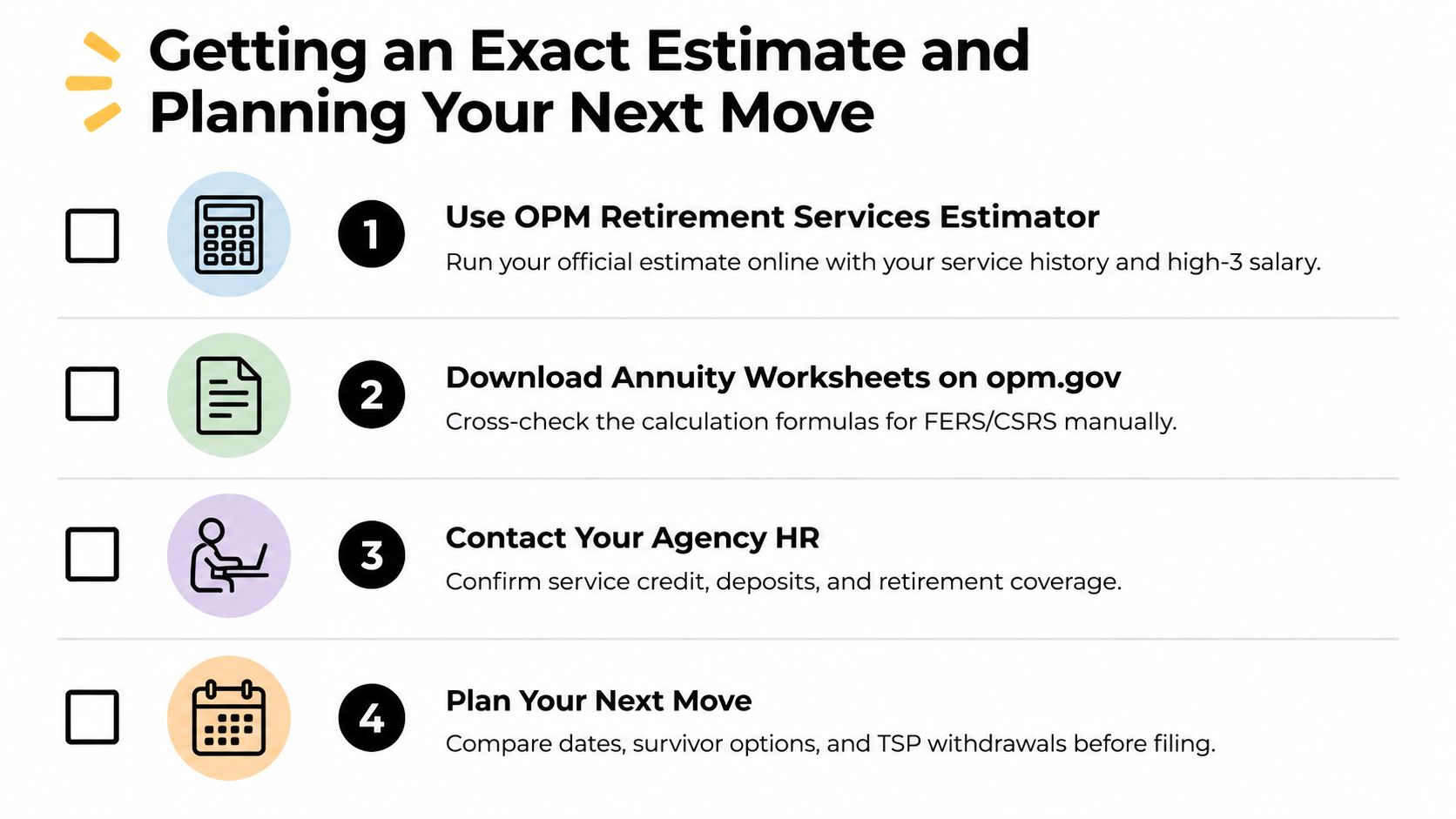
For Maria, the next move is practical. She should compare the $110,000 high-3 assumption with her pay records, verify her 25 years of creditable service, confirm her CSRS coverage, and request estimates that show both the unreduced annuity and each survivor option. Ben should perform the same review using the FERS formula, then add the supplement and TSP assumptions separately rather than treating the $33,000 basic annuity as his entire retirement income.
The official process and the personal planning process answer different questions. OPM determines the benefit under the governing rules. A carefully organized review helps you decide when to retire, which income sources to start, and how much survivor protection your household needs.
Federal Benefits Sherpa can help you organize your service history, compare retirement dates, estimate FERS supplement income, and evaluate survivor choices alongside your TSP and other benefits. If you're ready to turn your civil service pension rates into a personalized retirement decision, visit Federal Benefits Sherpa to review your options.


Dedicated to helping Federal employees nationwide.
“Sherpa” - Someone who guides others through complex challenges, helping them navigate difficult decisions and achieve their goals, much like a trusted advisor in the business world.
Federal Benefits Sherpa, LLC
12724 Gran Bay Parkway West, Suite 410, Jacksonville, FL 32225
Email: [email protected]
Phone: (833) 753-1825
© 2024 Federalbenefitssherpa. All rights reserved
Federal Benefits Sherpa is an independent organization and is not affiliated with or endorsed by the U.S. government or any federal agency.