Unlock 2024 tsp contribution limits to maximize your federal retirement savings
As a federal employee, staying on top of the annual changes to your Thrift Savings Plan (TSP) is one of the smartest things you can do for your financial future. For 2024, the IRS has officially bumped up the contribution limits, giving you a fresh opportunity to supercharge your retirement savings.
The big news is that the main contribution limit, known as the elective deferral limit, is now $23,000. If you're age 50 or over, you can tack on an extra $7,500 in catch-up contributions, bringing your potential total to a whopping $30,500.
Decoding the 2024 TSP Contribution Limit Changes

Each year, the IRS takes a look at the cost of living and adjusts these retirement plan limits accordingly. It’s their way of making sure your ability to save keeps up with inflation. For us federal employees, these aren't just numbers on a government form; they're a direct lever we can pull to build long-term wealth.
Think of it like this: your TSP is your retirement vehicle. These limits define how much fuel you can put in the tank each year. The more you add, especially early on, the further you'll go, all thanks to the incredible power of compound growth.
A Look at This Year's Key Figures
The most important change for 2024 is the increase in the general contribution limit. The TSP elective deferral limit climbed to $23,000, which is a nice $500 bump from the 2023 limit of $22,500.
For those of you 50 and older, the extra catch-up contribution limit remains a solid $7,500. This means your total potential contribution for the year is now $30,500. For official details, you can always check out documents like the 2024 TSP contribution notice from the Defense Logistics Agency.
To make it even clearer, here’s a quick side-by-side comparison.
TSP Contribution Limits at a Glance
This table breaks down exactly what's changed from last year to this year.
| Contribution Type | For Employees Under Age 50 | For Employees Age 50+ | 2023 vs 2024 Change |
|---|---|---|---|
| Elective Deferral Limit | $22,500 (2023) → $23,000 (2024) | $22,500 (2023) → $23,000 (2024) | +$500 |
| Catch-Up Contribution | Not Applicable | $7,500 (2023) → $7,500 (2024) | No Change |
| Combined Maximum | $22,500 (2023) → $23,000 (2024) | $30,000 (2023) → $30,500 (2024) | +$500 |
As you can see, that $500 increase might seem small, but over time, it's a meaningful boost that helps your savings outpace the rising cost of living. Every little bit helps.
How Catch-Up Contributions Work Now
Good news for employees age 50 and over: making catch-up contributions is now completely seamless. The TSP has fully adopted what's called the "spillover method."
The Spillover Method in a Nutshell:
Once your regular bi-weekly contributions hit the $23,000 annual limit, any money you contribute after that automatically "spills over" and starts counting toward your $7,500 catch-up limit. There's no separate election or form to fill out.
This is a fantastic quality-of-life improvement. You no longer have to micromanage your contributions or worry about making a separate election mid-year. Just set your contribution percentage, and the system handles the rest. It’s designed to be a "set it and forget it" process, letting you focus on your retirement goals instead of the paperwork.
Understanding How Your TSP Gets Funded
To really get a handle on the 2024 TSP contribution limits, you first need to understand how money actually gets into your account. It's not just about what you put in. Think of it as a partnership—what you contribute is one piece of the puzzle, and what your agency contributes is the other.
The money you put in from your paycheck is known as your elective deferral. It’s the amount you "elect," or choose, to defer from your salary into your TSP. You set the percentage, and it’s pulled from your pay automatically.
Then you have the government's side of the deal. These are called agency contributions, and they're a key part of your benefits package. They come in two flavors, and you'll want to make sure you're getting both.
The Starting Point: The 1% Automatic Contribution
If you're a FERS employee, your agency gives you a head start, no matter what you do. This is the 1% Automatic Agency Contribution.
Every pay period, the government automatically deposits an amount equal to 1% of your basic pay into your TSP. You get this even if you contribute zero yourself. It’s a nice perk, but relying on this alone is a massive mistake.
Think of it as the foundation. It's solid, but you wouldn't build a house with just the foundation, right? The real power comes from what you build on top of it by unlocking the agency match.
Unlocking Free Money with Agency Matching
This is where your own savings habits pay off—literally. The government provides Agency Matching Contributions based on what you put in, up to the first 5% of your basic pay. Honestly, it's one of the best deals in any retirement plan out there.
Here’s the breakdown of how the match works:
- For your first 3%: Your agency matches you dollar-for-dollar. You put in 3%, they put in 3%. Simple as that.
- For your next 2%: They match you fifty cents on the dollar. So, to get the full match, you need to contribute that extra 2% (bringing your total to 5%).
Let's put it all together. When you contribute 5% of your pay, you get the full 4% agency match. Add in the 1% automatic contribution, and suddenly your 5% contribution has turned into a total of 10% of your salary going into your TSP.
Not contributing at least 5% is like saying "no, thanks" to a guaranteed 100% return on your money before it even has a chance to grow. It is, without a doubt, the single biggest financial misstep a federal employee can make. You’re just leaving free money on the table year after year.
Remember, these matching funds don't count toward your personal 2024 TSP contribution limits. They are a completely separate, and incredibly powerful, benefit.
Using Catch-Up Contributions to Supercharge Your Savings
If you’re a federal employee age 50 or over, you have a powerful tool at your disposal for beefing up your retirement savings: catch-up contributions. Think of it as an express lane for your TSP account, letting you put away a lot more money during your peak earning years.
The best part? It's incredibly straightforward. If you're 50—or will be turning 50 this year—you're in. For 2024, this means you can add an extra $7,500 on top of the standard $23,000 limit. That brings your total potential contribution for the year to a hefty $30,500. No special forms, no hoops to jump through. Your age is your ticket.
The Magic of the Spillover Method
It used to be a bit of a hassle to make catch-up contributions. You had to make a separate election and keep a close eye on your totals. Thankfully, those days are over, all thanks to the spillover method.
Here’s a simple way to picture it: Imagine you have two buckets to fill with your TSP savings. The first, big bucket holds your regular $23,000 contributions. Once you've filled that to the brim, any extra money you contribute automatically spills over into the second bucket, which is reserved for your $7,500 in catch-up savings.
This automated system is a game-changer. You don't have to micromanage your contributions or worry about filing new paperwork mid-year. Just set your payroll deduction high enough to pass the regular limit, and the TSP system takes care of the rest. For a more detailed breakdown, check out our comprehensive TSP catch-up contributions guide.
The chart below shows how all the pieces—your contributions and the agency’s—fit together to build your retirement fund.
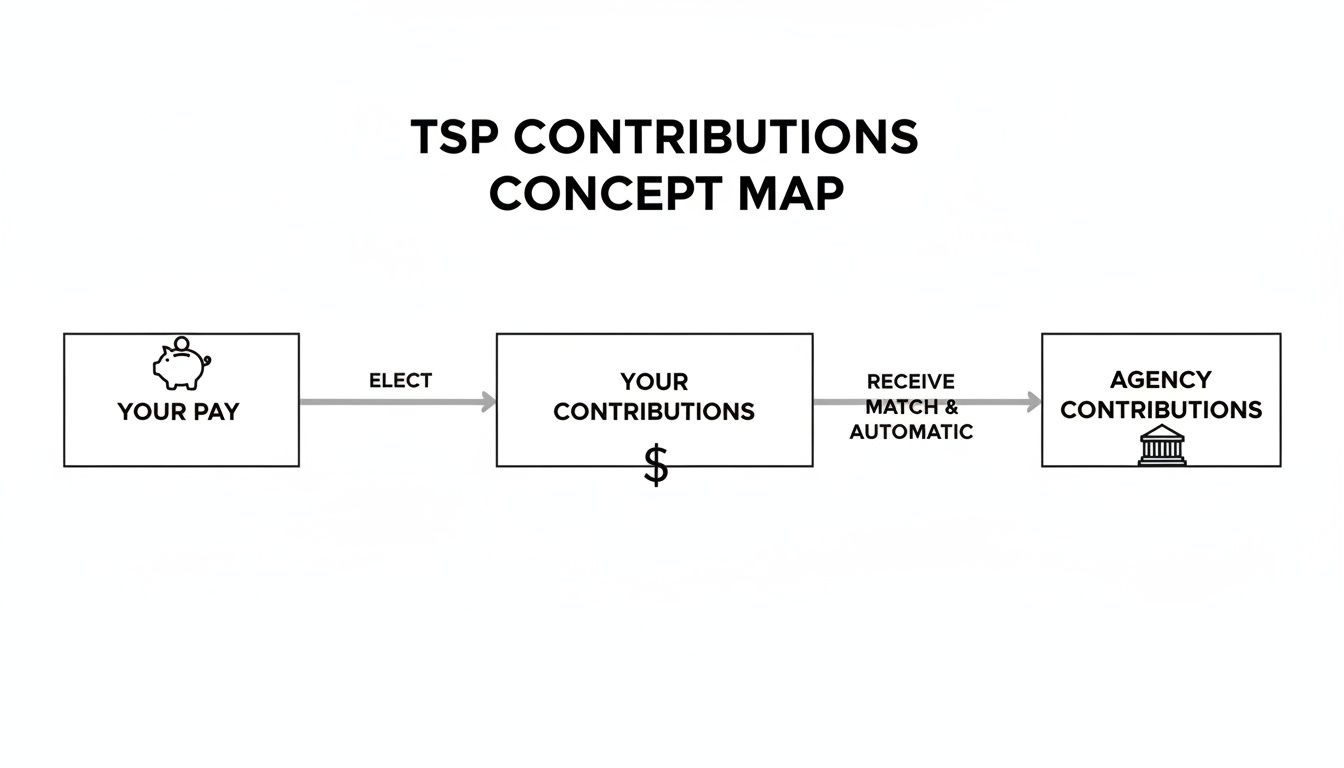
As you can see, your TSP grows from both what you put in and what your agency adds on your behalf. It’s a team effort.
Do Catch-Up Contributions Affect My Agency Match?
This is a question I hear all the time, and it’s a great one. The short answer is no, they don't. You can breathe a sigh of relief.
Here's why: your agency matching funds are based on the first 5% of your basic pay that you contribute each pay period. It’s a percentage, not a flat dollar amount. As long as you’re contributing at least that 5%, you’ll get the full match. It doesn't matter if your contributions eventually "spill over" into the catch-up category.
Key Takeaway: The spillover method won't mess with your agency match. Feel free to max out both your regular and catch-up limits—you'll still collect every penny of the government match you've earned.
The system is designed to reward aggressive savers, not penalize them. Your personal contributions and the agency match work side-by-side, so you can maximize both at the same time.
What About the Special Catch-Up Rule?
Now, there is another, much rarer type of catch-up contribution called the "Special Catch-Up Contribution." This was created for certain employees who couldn't contribute to the TSP in the past because of specific situations, like being deployed in a uniformed service.
Frankly, this provision is not something most federal employees will ever use. It comes with a very specific and strict set of eligibility rules. For almost everyone, the standard, age-based catch-up contribution is the way to go. The rules are clear: you can’t use both types of catch-up in the same year, and you must use whichever one allows you to contribute more. For the vast majority of people, that will be the standard $7,500 catch-up allowance.
Calculating Your Contributions to Max Out Your TSP

Knowing the 2024 TSP contribution limits is one thing, but figuring out how to actually hit that number from your paycheck is where the rubber meets the road. This is where we move from theory to action, translating that big annual goal into a simple payroll deduction percentage.
The math is actually pretty straightforward. Since most federal employees get paid bi-weekly, you’ll receive 26 paychecks over the course of a year. To hit your target, you just need to spread your total contribution goal evenly across those paychecks.
The Simple Formula to Max Out Your TSP:
Annual Contribution Goal ÷ 26 Pay Periods = Your Bi-Weekly Contribution
If you're under 50 and shooting for the $23,000 max, your target is $884.62 per paycheck. For those 50 and older aiming for the full $30,500 (with catch-up contributions), that number climbs to $1,173.08 every two weeks.
Putting the Numbers Into Action
Let's walk through a couple of quick examples to see how this works for feds with different salaries.
Example 1: Employee Under Age 50
- Annual Salary: $85,000
- Bi-Weekly Gross Pay: $3,269.23 (that's just $85,000 ÷ 26)
- Target Bi-Weekly Contribution: $884.62
- Required Contribution Percentage: ($884.62 ÷ $3,269.23) = 27%
So, if this is you, setting your TSP contribution to 27% will get you right to the $23,000 limit by the end of the year.
Example 2: Employee Age 50 or Over
- Annual Salary: $120,000
- Bi-Weekly Gross Pay: $4,615.38 ($120,000 ÷ 26)
- Target Bi-Weekly Contribution: $1,173.08
- Required Contribution Percentage: ($1,173.08 ÷ $4,615.38) = 25.4%
In this case, setting your contribution to 26% (it’s always smart to round up) will ensure you max out both your regular and catch-up contributions. And remember, before you even think about maxing out, make sure you're getting your full government match. You can find everything you need to know about that here: https://federalbenefitssherpa.com/post/maximizing-your-government-matching-tsp-contributions.
Hitting the contribution limit is a huge win, but it's just one piece of the puzzle. It's always wise to look at the bigger picture and explore proven strategies for growth to maximize retirement savings.
Sample Bi-Weekly TSP Contributions to Max Out
To make things even easier, here's a quick-reference table. It shows the percentage of your bi-weekly pay you'd need to contribute to hit the $23,000 annual limit at different salary levels.
| Annual Salary | Bi-Weekly Gross Pay | Bi-Weekly Contribution ($) | Required Contribution (%) |
|---|---|---|---|
| $60,000 | $2,307.69 | $884.62 | 38% |
| $75,000 | $2,884.62 | $884.62 | 31% |
| $90,000 | $3,461.54 | $884.62 | 26% |
| $110,000 | $4,230.77 | $884.62 | 21% |
| $130,000 | $5,000.00 | $884.62 | 18% |
Note: Percentages are rounded to the nearest whole number.
As you can see, the percentage needed drops as your salary increases. This table gives you a great starting point for figuring out your own number.
How to Change Your Contribution Election
Once you've landed on your target percentage, the last step is making it official in your agency's payroll system. It's usually a quick and painless process.
- Log into your payroll portal. For most civilian feds, this is MyPay. Military members or employees at other agencies might use a different system, like Employee Express.
- Navigate to the Thrift Savings Plan section. It should be clearly labeled as "TSP Contributions" or something very similar.
- Enter your new contribution percentage. You'll have the option to allocate your contribution between Traditional and Roth TSP accounts.
- Review and confirm your changes. Always take a second to double-check the numbers before you hit that submit button.
The change should kick in on your next paycheck or the one after. I always recommend checking your first Leave and Earnings Statement (LES) after making a change just to confirm everything was processed correctly.
Choosing Between Your Traditional and Roth TSP Options
Once you've wrapped your head around the 2024 TSP contribution limits, you’ve got another big decision to make: where should that money actually go? The Thrift Savings Plan gives you two fantastic choices for your own contributions—Traditional and Roth. This isn't a small detail; it fundamentally changes when and how your retirement savings get taxed.
The entire debate really comes down to a single question: Would you rather pay taxes now or pay them later? How you answer that will directly impact how much money you actually get to spend in retirement.
The Traditional TSP: A Pay-Taxes-Later Approach
The Traditional TSP is the classic, time-tested way to save. When you contribute, the money comes out of your paycheck before federal and state income taxes are calculated. That's why you'll often hear it called a "pre-tax" contribution.
The immediate payoff is pretty sweet: it lowers your taxable income for the year. For example, if you put $10,000 into your Traditional TSP, your taxable income drops by that same amount. This can lead to some very real savings when you file your taxes.
But, as we all know, there's no free lunch with the IRS. The trade-off comes in retirement. Every dollar you withdraw—your original contributions plus all the earnings they've racked up over the years—is taxed as ordinary income.
The Roth TSP: A Pay-Taxes-Now Approach
The Roth TSP completely flips the script. With a Roth contribution, the money is taken from your paycheck after taxes have already been paid. Since you're using "post-tax" dollars, you don't get that immediate tax break.
So why would anyone choose this? The advantage is enormous. In retirement, every qualified withdrawal is 100% tax-free. That includes everything you put in and, crucially, all the growth your investments achieved over decades. Imagine taking out a hefty sum from your account and owing Uncle Sam absolutely nothing on it. That’s the real power of the Roth.
This tax-free withdrawal feature is a game-changer for long-term planning. It gives you incredible certainty about your retirement income because you won't have to worry or guess what tax rates might look like in 10, 20, or 30 years.
Which Option Is Right for You?
The Traditional vs. Roth decision often hinges on where you are in your career and what you predict your finances will look like down the road.
Here's a simple framework to help you think it through:
- You might lean toward the Roth TSP if: You're early in your career and in a relatively low tax bracket. You're essentially betting that your income—and your tax bracket—will be much higher by the time you retire. Paying taxes now at your current, lower rate could be a brilliant long-term financial move.
- You might prefer the Traditional TSP if: You're in your peak earning years and sitting in a high tax bracket. The immediate tax deduction provides significant value right now. It’s also possible your income and tax rate will be lower in retirement, making the tax hit less painful then.
Of course, you don't have to pick just one! Many savvy federal employees contribute to both. This strategy gives you tax diversification in retirement, letting you pull from different tax buckets as needed. To go even deeper, check out our guide on what a Roth TSP is and how it works for federal employees.
One final, critical point: your agency’s contributions have their own set of rules. No matter what you choose, all agency automatic (1%) and matching contributions always go into your Traditional TSP balance. This means that even if you contribute 100% to your Roth TSP, you'll still build a Traditional balance from the government's contributions.
Building Your TSP Strategy Into a Secure Retirement
Hitting the 2024 TSP contribution limits is a huge win, and you should be proud of that accomplishment. But it’s really just the first step in a bigger journey. To build a truly secure financial future, you have to think of your TSP as more than just a savings account—it’s the cornerstone of your entire retirement structure.
The classic analogy for a solid federal retirement is a three-legged stool. It’s a bit old-fashioned, but it perfectly illustrates the need for stability from multiple income sources. Your TSP is just one of those legs.
The other two are your FERS Basic Benefit Annuity (your pension) and your Social Security benefits. When all three are working together, they form a rock-solid foundation for the life you want after you stop working. This mindset shifts your goal from just hitting a savings target to building a cohesive income plan.
Moving Beyond Contribution Limits
Once you’ve got a handle on maxing out your annual contributions, the next layer of strategy is deciding how to invest that money inside your TSP. This is your asset allocation—the mix of funds you choose.
Your investment choices shouldn’t be random; they need to be a direct reflection of who you are and where you are in your career.
- How much risk can you stomach? Are you okay with the market's ups and downs, or does volatility make you nervous?
- When do you plan to retire? Is it decades away, or just around the corner?
The TSP gives you a solid range of options, from the ultra-safe G Fund to the stock-based C, S, and I Funds. Of course, you also have the L Funds, which are designed to automatically get more conservative as you get closer to your target retirement date. An employee in their 20s can afford to be aggressive to chase growth, while someone five years from retirement is likely more focused on protecting what they’ve built.
A smart TSP strategy does two things at once: it maximizes what you put in and optimizes how that money is invested based on your personal goals. It’s not just about how much you save, but how you put that money to work.
Crafting a Holistic Retirement Plan
It's critical to see your TSP as the engine of your retirement plan, not the entire vehicle. It provides the growth and power, but it needs the stability of your pension and Social Security to get you to your destination safely. To truly optimize your federal benefits, you need to integrate broader wealth building strategies into your financial picture.
This is often where getting a second opinion from an expert can make all the difference. A financial professional who understands federal benefits can help you map out all three income streams—TSP, FERS, and Social Security—to build one unified plan. They can help you see what your future income might look like, spot any potential gaps, and adjust your TSP strategy to ensure every piece of your benefits package is working in harmony to secure the retirement you've earned.
Your Top TSP Contribution Questions Answered
When you start digging into the details of the 2024 TSP contribution limits, a few questions almost always pop up. It's completely normal. Let's walk through some of the most common ones I hear from federal employees so you can feel confident you're on the right track.
What Happens If I Accidentally Contribute Too Much?
This is a great question, and fortunately, it's not something you usually have to worry about. Your agency's payroll system is designed to automatically stop your contributions once you hit the annual limit. It's a built-in safety net.
In the rare event that a clerical error pushes you over the limit, the TSP has a straightforward fix. They'll simply return the excess contribution to you, along with any earnings that money made. Just keep in mind that those earnings will be considered taxable income in the year you get them back.
Can I Adjust My Contribution Rate During the Year?
Absolutely, and you should! You have complete control to change your contribution percentage whenever you want. Life happens—maybe you get a promotion and want to max out, or perhaps you need to dial it back for a few months to cover an unexpected expense.
Key Insight: You can start, stop, or change your contribution election at any point. This flexibility is a powerful tool, letting you fine-tune your savings strategy as your financial picture changes.
Making the change is easy. You just need to log into your agency’s payroll interface, like MyPay, and update your election. The new rate usually kicks in within one or two pay periods.
Does the Government Match Count Against My Limit?
This is probably the most important thing to get straight: No, it does not. The money your agency puts into your account is completely separate from your personal contribution limit.
Think of it like this: there are two buckets filling up your TSP.
- Your Bucket: This is the money you personally contribute from your paycheck, up to the $23,000 limit (or $30,500 if you're eligible for catch-up).
- The Government's Bucket: This includes the 1% Automatic Agency Contribution and the up to 4% in matching funds. This is bonus money that sits on top of your own contributions.
This is a huge advantage for federal employees. It means the total amount going into your TSP each year can be significantly higher than your personal limit, putting your retirement savings on the fast track.
At Federal Benefits Sherpa, our goal is to help you untangle these rules and build a clear path to retirement. If you want to make sure you're getting every dollar you're entitled to, schedule your free 15-minute benefits review with our team.