TSP L Income Fund The Complete Guide for Retirees
If you're already retired or just a few steps away from it, your investment mindset has likely shifted. It's no longer about chasing aggressive growth; it's about protecting what you've built. This is precisely where the TSP L Income Fund comes into play. It’s the most conservative of all the Lifecycle (L) Funds, designed specifically for federal employees who have started taking money out of their TSP account.
Think of it as the anchor of the L Fund fleet—the final, stable harbor where the other, more growth-oriented L Funds eventually dock.
Your Guide to Retirement Income with the L Income Fund

Figuring out how to turn your nest egg into a reliable "paycheck" in retirement can feel like a huge puzzle. The Thrift Savings Plan created the L Income Fund to be a key piece of that puzzle. This guide will walk you through what makes this fund unique, who it's really for, and how it can help you build a more secure financial future.
This isn't just another investment option. For many federal retirees, the L Income Fund becomes the bedrock of their income strategy. It’s built for those who have moved past the accumulation phase and are now focused on making their savings last.
Understanding Its Core Purpose
The L Income Fund is fundamentally different from the other L Funds. While options like the L 2050 or L 2045 are on a glide path, automatically becoming more conservative each year, the L Income Fund has already arrived. Its asset allocation is fixed and doesn't change.
Its mission is clear and focused on three primary goals:
Capital Preservation: The top priority is to safeguard your principal from major market swings.
Modest Growth: It aims for just enough growth to help your money outpace inflation over the long haul.
Income Generation: It's designed to be a stable source of funds for you to draw upon for your living expenses.
For a retiree, the twin threats are taxes and inflation slowly eroding the buying power of your savings. The L Income Fund tries to strike a careful balance—keeping a small allocation in stocks for inflation protection while heavily favoring the stability of bonds.
To give you a quick snapshot, here’s a breakdown of the L Income Fund’s key characteristics.
TSP L Income Fund At a Glance
FeatureDescriptionPrimary GoalCapital preservation and generating monthly income for retirees.Risk ProfileVery low; the most conservative of all TSP L Funds.Asset AllocationFixed; does not change over time.Target AudienceFederal employees who are already in retirement and making withdrawals.Stock AllocationApproximately 22%.Bond/G Fund AllocationApproximately 78%.
This fixed allocation is what makes the fund a dependable, albeit slow-growing, option for those in their withdrawal years.
The Fund's Fixed Allocation
What truly sets the TSP L Income Fund apart is its static mix of investments. It is permanently allocated to hold approximately:
72% in the G Fund (Government Securities)
6% in the F Fund (Fixed Income Index)
11% in the C Fund (Common Stock Index)
3% in the S Fund (Small Cap Stock Index)
8% in the I Fund (International Stock Index)
This composition means about 78% of your money is in the relative safety of government securities and high-quality bonds, with only 22% exposed to the stock market's volatility.
Of course, generating income from investments is a broad topic, and the L Income Fund is just one approach. For a wider perspective, you can explore other proven strategies for earning passive income from stocks to see how they might complement your overall retirement plan.
What's Really Inside the L Income Fund?
To get a real feel for the TSP L Income Fund, you have to pop the hood and see how it’s built. It's not one single thing; think of it more like a finished recipe made from five core ingredients: the G, F, C, S, and I Funds. Each one has a specific job, and the way they're mixed is what gives the L Income Fund its signature stability and potential for a little bit of growth.
This fund’s allocation isn't just a random mix. It’s a carefully planned strategy designed to protect your capital. While other L Funds are on a "glide path" gradually getting more conservative, the L Income Fund has already arrived at its final destination. Its mix is fixed, giving retirees a steady and predictable financial base to draw from.
The Fund's Financial Recipe
The L Income Fund is what’s known as a "fund of funds." That just means its performance is entirely based on the five individual TSP funds it holds. The secret sauce is in the percentages, which are set up to keep risk extremely low.
Here’s the exact breakdown of what you're invested in:
The G Fund (Government Securities): This is the foundation, making up about 72% of the entire fund. The G Fund is unique to the TSP and is backed by the full faith and credit of the U.S. government, so your principal can't be lost. Its main purpose? To provide rock-solid stability.
The F Fund (Fixed Income Index): At around 6%, this adds another layer of security. It tracks an index of high-quality U.S. bonds, generally offering a slightly better return than the G Fund with very little extra risk. It helps generate some income for the portfolio.
The C, S, and I Funds (Stocks): These three stock funds are the growth engine, but they make up a relatively small portion, totaling about 22%. This slice is there to help your money grow faster than inflation over time.
What does this all mean? It means a whopping 78% of your money is in the safety of government securities and bonds, with only 22% exposed to the ups and downs of the stock market. This tilt toward preservation is precisely why the L Income Fund is the most conservative fund in the entire Lifecycle series.
Why Each Ingredient Matters
Let's break down the "why" behind this specific mix. The G Fund is the bedrock. It’s the reason retirees can take withdrawals with confidence, knowing the bulk of their money is shielded from market crashes.
The F Fund provides a small but welcome return boost over the G Fund, while still sticking to the theme of safety. Think of it as a way to add a little more interest income to the pot without rocking the boat.
Finally, you have the stock funds (C, S, and I). A 22% allocation might not sound like much, but it’s doing a crucial job. This exposure to U.S. and international stocks is your main defense against inflation—the silent wealth killer. Without it, your balance would be safe, but your purchasing power would slowly shrink over a 20- or 30-year retirement. The goal here isn't to get rich quick, but to ensure your money lasts as long as you do.
This deliberate blend of safety-first assets with a small dose of growth is what makes the tsp l income fund such a specialized tool for federal employees in or near retirement.
Comparing The L Income Fund To Other TSP Options
To really get a handle on what the L Income Fund brings to the table, it helps to see how it stacks up against the other options in the Thrift Savings Plan. The TSP isn’t a one-size-fits-all program; it’s more like a toolbox, with each fund designed for a specific job.
You wouldn’t grab a sledgehammer to hang a picture frame, right? In the same way, the L Income Fund is a specialized tool built to protect your principal, while other funds are built for growth. Let's put them side-by-side to see where each one shines.
L Income vs. The Other L Funds
One of the biggest points of confusion for federal employees is the difference between the L Income Fund and its siblings, the target-date L Funds (like the L 2045, L 2055, etc.). The easiest way to think about it is motion versus stillness.
The other L Funds are all on a dynamic "glide path." This just means their investment mix automatically gets more conservative as you get closer to your target retirement date. For example, a young employee in the L 2065 fund starts out almost entirely in stocks (nearly 99%) and, over the next few decades, that mix will gradually shift more into bonds.
The L Income Fund, on the other hand, is static. It has already arrived at its final, most conservative destination. Its allocation is fixed and doesn't change over time.
Target-Date L Funds: These are built for the accumulation phase of your career, automatically reducing risk as you age.
L Income Fund: This is built for the decumulation (or withdrawal) phase, providing a stable, fixed allocation for retirement income.
Here's the key takeaway: All the other L Funds are designed to eventually roll into the L Income Fund after they pass their target date. Think of the L Income Fund as the final stop for the entire Lifecycle fund series—it's purpose-built for people who are already taking money out.
This chart shows you exactly what that final, static allocation looks like.
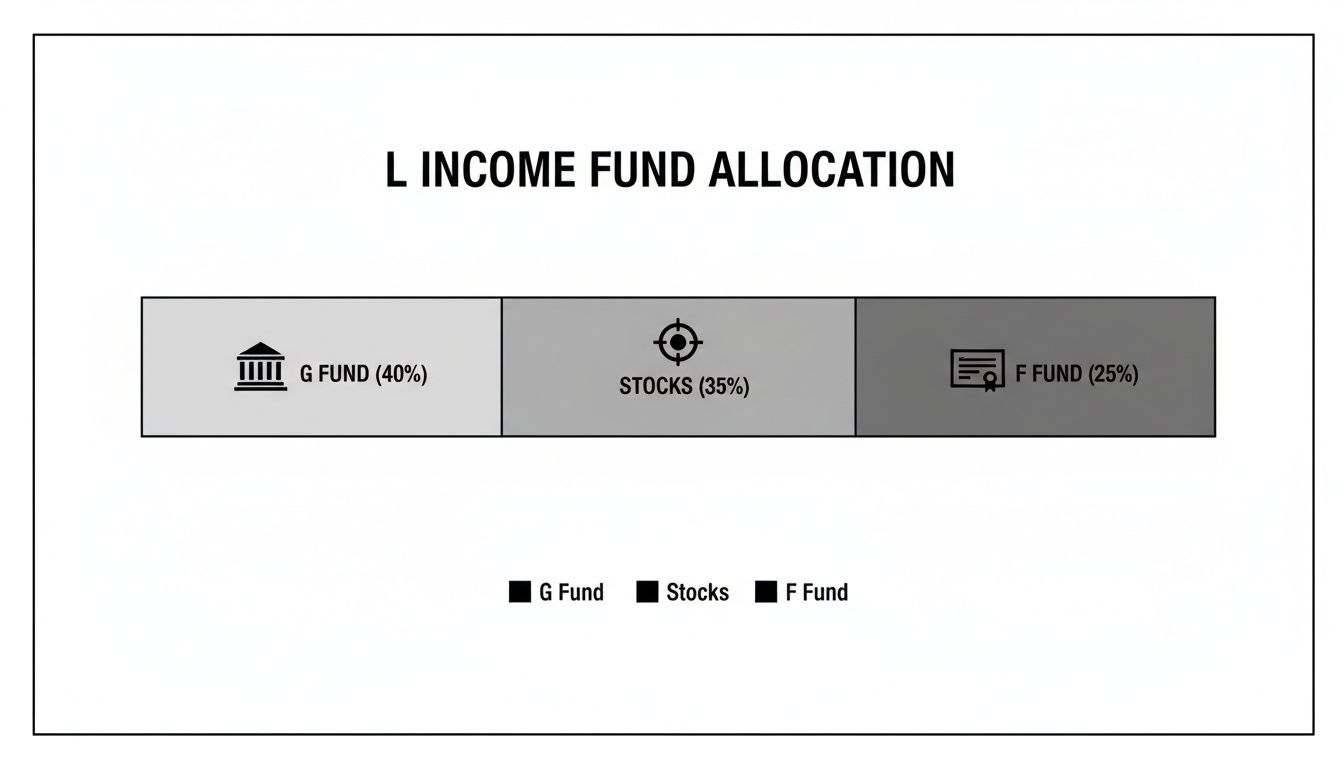
As you can see, the fund is overwhelmingly weighted toward government securities in the G Fund, which perfectly aligns with its mission to preserve your capital.
L Income vs. The Individual Core Funds
It’s also helpful to compare the L Income Fund to the five individual "core" funds: G, F, C, S, and I. Doing this really highlights the classic trade-off every investor faces between risk and potential reward.
The C, S, and I funds are 100% stock funds. They offer the greatest potential for long-term growth, but they also come with the highest risk of short-term market swings. A sudden downturn can take a big bite out of your account balance, a risk many retirees simply can't afford with the money they need to live on.
At the other end of the spectrum is the G Fund, which is 100% government securities and has zero risk of losing principal. It’s the safest place for your money in the TSP, but its low returns often struggle to keep up with inflation over a long retirement.
The L Income Fund carves out a middle ground, though it leans heavily toward safety. It's essentially a pre-mixed, conservative cocktail of the individual funds. You get the rock-solid stability of a massive G Fund position (around 72%) blended with a small dose of stocks (about 22%) to give your money a fighting chance to grow and outpace inflation.
L Income Fund vs Other TSP Funds
To make this even clearer, here's a table that boils down the key differences between the L Income Fund and other popular TSP choices. It's a quick cheat sheet to help you see where each fund fits in the grand scheme of things.
FundPrimary ObjectiveRisk LevelTypical InvestorL IncomeCapital Preservation & IncomeVery LowRetirees or those within 5 years of retirement.L 2030-2065Growth (shifting to preservation)Moderate to HighEmployees accumulating savings, with a long time horizon.G FundExtreme Capital PreservationLowestExtremely risk-averse investors; a "safe harbor" holding.C, S, I FundsMaximum Long-Term GrowthHighYounger employees or those with a high tolerance for risk.
This comparison highlights that the L Income Fund isn’t meant to compete with the high-growth stock funds. It's designed for a completely different phase of your financial life.
Of course, you don't have to use a pre-mixed L Fund. Many federal employees prefer to create their own allocation from the core funds. If you want to dive deeper into building a custom portfolio, our guide on the top TSP investment strategies for federal employees is a great place to start.
Ultimately, the right choice comes down to your personal timeline, comfort with risk, and what you need your money to do for you in retirement. The L Income Fund has one job and it does it well: provide a stable pool of money for retirees to draw from, without the gut-wrenching volatility of the stock market.
Is the TSP L Income Fund Right for You?

Figuring out the right investment strategy is a deeply personal decision. There's simply no one-size-fits-all answer for every federal employee. The TSP L Income Fund is a specialized tool, really built for a specific chapter in your financial life.
To see if it fits your story, let's walk through a few common scenarios. Think of these as financial portraits. By seeing how different people use—or avoid—the L Income Fund, you can get a much clearer picture of where it might fit into your own retirement plan.
The Ideal Candidate: The Immediate Retiree
Meet Sarah. She just wrapped up a 30-year career in federal service and needs to start drawing from her TSP right away. This money will supplement her FERS annuity and Social Security, and her primary goal has shifted from growth to capital preservation.
For Sarah, the very thought of a major stock market correction is terrifying. She simply can't afford to watch her TSP balance drop by 20% at the exact moment she needs to live on it. This is a classic case of "sequence of returns risk," a real danger where a market downturn in early retirement can do lasting damage to a portfolio.
The L Income Fund is practically tailor-made for someone in Sarah's shoes. Its heavy weighting in the G and F funds (nearly 80%) delivers the stability she needs. The small slice of stocks offers a little protection against inflation without exposing her to the kind of volatility that keeps retirees up at night. For her, it's all about peace of mind.
The Cautious Planner: The Conservative Near-Retiree
Now, let’s look at David. He’s five years out from his target retirement date. While he’s still in accumulation mode, his appetite for risk has dropped off a cliff. He’s no longer trying to hit home runs; he’s just focused on not losing the game in the final inning.
After watching his TSP grow for decades, David wants to lock in those hard-earned gains. He makes a proactive choice to move a large chunk of his TSP balance into the L Income Fund before he retires. It's a defensive play, shielding his capital from a potential market slide just before he needs it. He might keep a smaller amount in a more aggressive fund for one last growth push, but the L Income Fund has become his safe harbor.
This strategy is all about de-risking. For conservative near-retirees, the L Income Fund serves as a powerful tool to transition from a growth-oriented mindset to a preservation-focused one, ensuring the money they've saved will be there when they need it.
When the L Income Fund Is Not the Right Fit
Just as important as knowing when to use this fund is knowing when not to. Its conservative design makes it a poor choice for certain people.
Here are two examples where using the L Income Fund would likely be a mistake:
The Young Accumulator: Maria is 35 and has at least 25 years until she retires. Her number one financial priority should be long-term growth. Parking her money in the L Income Fund would be a major strategic blunder. Its tiny stock allocation would severely hamstring her money's ability to grow over the next few decades, leaving a massive amount of potential gains on the table.
The Growth-Focused Retiree: Frank is 65 and newly retired. But here's the key: he has a solid FERS pension and other assets, so he only needs to pull a small amount from his TSP each year. Because his core income is secure, he can afford to keep his TSP invested for growth in funds like the C and S. His goal is to keep the portfolio growing to leave a larger legacy. For Frank, the L Income Fund is far too conservative and doesn't match his goals.
For some retirees, the best move might be moving funds out of the TSP altogether. If you’re looking for more investment choices or withdrawal flexibility, you might want to explore how to rollover a TSP to an IRA in our complete guide.
Ultimately, the decision boils down to your personal timeline, your comfort with risk, and your overall financial picture. The L Income Fund does one job, and it does it well: protecting capital for those who need to start making withdrawals now or in the very near future.
Weaving the L Income Fund into Your Retirement Plan

Getting a handle on what the L Income Fund is is one thing. Knowing how to actually use it as part of your overall financial life is where the real magic happens. A solid retirement plan isn't about picking one "perfect" fund; it's about making all your different income sources work together to create a reliable cash flow you can live on.
Think of it like the classic three-legged stool of federal retirement. For most of us, those legs are our FERS annuity, Social Security, and the TSP. The TSP L Income Fund is all about making that third leg—your TSP—as sturdy and dependable as possible.
Creating Your Retirement "Paycheck"
The main job for the L Income Fund in retirement is to be your go-to "safe bucket" for regular withdrawals. It's the pool of money you can dip into for your monthly bills without losing sleep over what the stock market did that day. Since it’s so heavily invested in the G and F funds, its value doesn't swing wildly.
That stability is what lets you build a predictable income stream. You can, for instance, set up automatic monthly payments from your TSP, confident that the core of that money is insulated from market volatility. This simple strategy brings incredible peace of mind and makes budgeting for your non-negotiable living expenses a whole lot easier.
Think of the L Income Fund as a financial shock absorber. By drawing your immediate living expenses from this conservative fund, you can leave your other, more aggressive investments alone, giving them time to grow and recover from any market bumps.
The "Bucket Strategy" in Action
A really effective way I've seen clients visualize this is with a "bucket" approach. Picture your retirement savings split into three different buckets:
Bucket 1 (Short-Term): This is your cash for the next 1-3 years of living expenses. A big chunk of your L Income Fund balance would live here, ready for you to draw from systematically.
Bucket 2 (Mid-Term): This bucket is for expenses you see coming in the next 4-10 years. It might hold a more balanced mix of stocks and bonds—something that looks a lot like a moderate L Fund allocation.
Bucket 3 (Long-Term): This is your growth engine, holding the money you won't touch for a decade or more. This is where you'd keep your C and S fund investments, positioned to outpace inflation over the long haul.
With this setup, you periodically refill Bucket 1 from your other buckets, ideally when the market is doing well. The L Income Fund is the perfect container for that first bucket, giving you the safety and easy access you need for your near-term spending.
Navigating Withdrawals and Taxes
When it's time to start taking money out of your TSP, you've got options. You can take partial withdrawals as needed, set up those recurring monthly payments we talked about, or even buy an annuity. The L Income Fund's stability makes it a great source for both planned income and unexpected lump-sum needs.
But let's not forget about taxes—they're a huge piece of this puzzle. Unless you've been saving into a Roth TSP, every dollar you pull from your traditional TSP balance is taxed as ordinary income. That can really change your financial picture in retirement.
It's so important to plan your withdrawal strategy with an eye on your tax bill. A single large withdrawal could easily bump you into a higher tax bracket for the year. To get a handle on all the possibilities, you can explore our complete guide to your TSP withdrawal options in retirement.
Securing Your Financial Future
Properly using the L Income Fund is a major step toward real financial security. When you pair its stability with your other income from FERS and Social Security, you're building a resilient foundation designed to support you for the long run. Of course, as you build this plan, it's also smart to think about protecting your retirement savings from financial scams.
At the end of the day, this fund isn't about chasing huge returns. It’s about creating dependable income so you can actually enjoy the retirement you worked so hard for. And for many federal retirees, that kind of predictability is priceless.
Frequently Asked Questions About the L Income Fund
Once your TSP becomes a primary source of income, the nitty-gritty details suddenly matter a lot more. It's completely normal to have practical questions, and getting clear answers can give you the confidence you need to make smart decisions.
Let's walk through some of the most common questions federal employees ask about the TSP L Income Fund. Think of this as a final check-in to make sure you understand how this fund could fit into your retirement.
Can I Lose Money in the L Income Fund?
This is probably the most important question for anyone relying on their investments, and the straightforward answer is yes, it's possible. But it's highly unlikely to be a significant loss.
While the L Income Fund is the most conservative of all the Lifecycle funds, it isn't completely risk-free like the G Fund. Roughly 22% of the fund is invested in the C, S, and I stock funds. That small slice is exposed to the ups and downs of the stock market and can lose value.
However, the other 78% is anchored in the super-stable G Fund and the F Fund (bonds). This heavy allocation to government securities is there for one reason: to minimize volatility. So, while you might see a small dip during a major market correction, the fund’s main job is to preserve your capital, making it far more stable than any stock-heavy alternative.
Does the L Income Fund's Allocation Ever Change?
Nope. And that’s a really important feature. The L Income Fund’s asset allocation is static, which just means it's fixed. The percentages invested across the G, F, C, S, and I funds are designed to stay put.
This is what makes it different from all the other L Funds (like the L 2040 or L 2050). Those funds are on a "glide path," automatically shifting to a more conservative mix as they approach their target date. They are built for your accumulation years.
The L Income Fund is built for your distribution years—the time when you're taking money out. It has already reached its final, most conservative allocation because it's designed for retirees who need a consistent and predictable investment mix to draw from.
When I Retire, Should I Put My Entire TSP in the L Income Fund?
Not necessarily. In fact, for many people, putting all their eggs in this one basket might not be the best move. The right strategy for you depends on your entire financial picture—your FERS annuity, Social Security, other savings, your comfort level with risk, and your long-term goals.
Going "all-in" on the L Income Fund offers maximum stability, and it's a perfectly good choice if you're extremely risk-averse.
But most federal retirees have a long life ahead of them. You have to think about a couple of things:
Longevity: It's not uncommon for retirees today to live for 20-30 years or more. A portfolio with very little growth potential might have trouble keeping up with inflation over that long of a timeline.
Your Actual Needs: If your FERS pension and Social Security cover your essential bills, you may not need to pull large amounts from your TSP right away. That gives your TSP balance more time and opportunity to grow.
Because of this, many retirees opt for a "bucket" strategy. They might keep a portion of their TSP in the L Income Fund to cover near-term living expenses while leaving another portion in funds like the C or S Fund for long-term growth. A personalized plan is always the best way to go.
How Does the L Income Fund Actually Generate "Income"?
This is a really common source of confusion. The word "income" in the fund's name points to its intended purpose, not a mechanical function like a dividend payment. The L Income Fund is designed to be a stable pot of money from which you create an income stream through your own withdrawals.
It doesn't "pay" you an income directly. The income you get is simply the money you decide to take out.
The fund is built to support this process. The small stock portion aims for just enough growth to help fight inflation, while the G Fund and bond portions provide stability and interest. This blend is designed to preserve your principal, helping your balance last as long as possible while you make those regular withdrawals.
Making these decisions is a huge step in securing the retirement you've worked so hard for. If you're not sure how to structure your TSP or how it fits in with your other federal benefits, getting personalized guidance can make all the difference. The experts at Federal Benefits Sherpa are here to help you build a clear and confident retirement plan.
Book your free 15-minute retirement benefits review today at https://www.federalbenefitssherpa.com
