TRICARE and FEHB: A Dual-Eligible Decision Guide
You're a federal employee with military service, a military retiree with a civilian federal spouse, or a National Guard member who just became eligible for federal civilian benefits. Two cards sit in your wallet, but the decision isn't about choosing the plan with the lower premium. The wrong move can create unexpected bills, disrupt Reserve coverage, or leave both carriers waiting for the other to process a claim.
The right comparison starts with three questions: Which program are you eligible for? Which plan pays first? What will your household spend over a full year, including deductibles, cost sharing, prescriptions, and provider-access trade-offs? Keep your employment status, military status, family enrollment, Medicare status, and recent qualifying events nearby as you work through the answers. A general free blog health monitor can help you keep related benefits content and reminders organized, but it can't replace a carrier or agency eligibility confirmation.
Why the TRICARE and FEHB Decision Matters
If you're comparing TRICARE and FEHB, you're probably facing a decision tied to a hire, retirement, marriage, Medicare enrollment, activation, or a change in family coverage. Those events can alter not only your premium but also your eligibility, claims order, provider access, and ability to preserve coverage for a spouse or survivor.
TRICARE is a military health benefit. FEHB is a federal civilian employee benefit. Having access to both doesn't always mean you can freely stack or swap them. For some Reserve households, becoming FEHB-eligible can affect TRICARE Reserve Select eligibility even when the member doesn't enroll in FEHB. For retirees, changing coverage without checking enrollment rules can create a gap or eliminate an option that would have been valuable later.
My practical rule: Never cancel or decline one program until you know whether the action changes eligibility for the other.
Start with a short fact sheet:
- Military status: active duty, retired, Selected Reserve, Retired Reserve, or survivor.
- Civilian status: current federal employee, annuitant, spouse, or dependent.
- Age and Medicare: whether anyone is Medicare-eligible.
- Household enrollment: who is covered under which enrollment.
- Provider needs: specialists, hospitals, prescriptions, and locations that matter.
- Timing: retirement date, hire date, activation, open season, or another qualifying event.
By the end of the comparison, you should be able to identify the available program, understand who pays first, estimate total annual cost, and document the action needed with your agency, Defense Enrollment Eligibility Reporting System, and insurance carriers. That is a much safer process than selecting the card with the lowest visible price.
What Each Program Is
TRICARE is the U.S. Military Health System's health benefit for eligible service members, retirees, and families. Its modern form dates to 1995, and TRICARE Prime was created by law in 1994 as an outgrowth of the Civilian Health and Medical Program of the Uniformed Services. The final implementing rule appeared in the Federal Register in October 1995. The Military Health System describes TRICARE's beneficiary scale and structure.
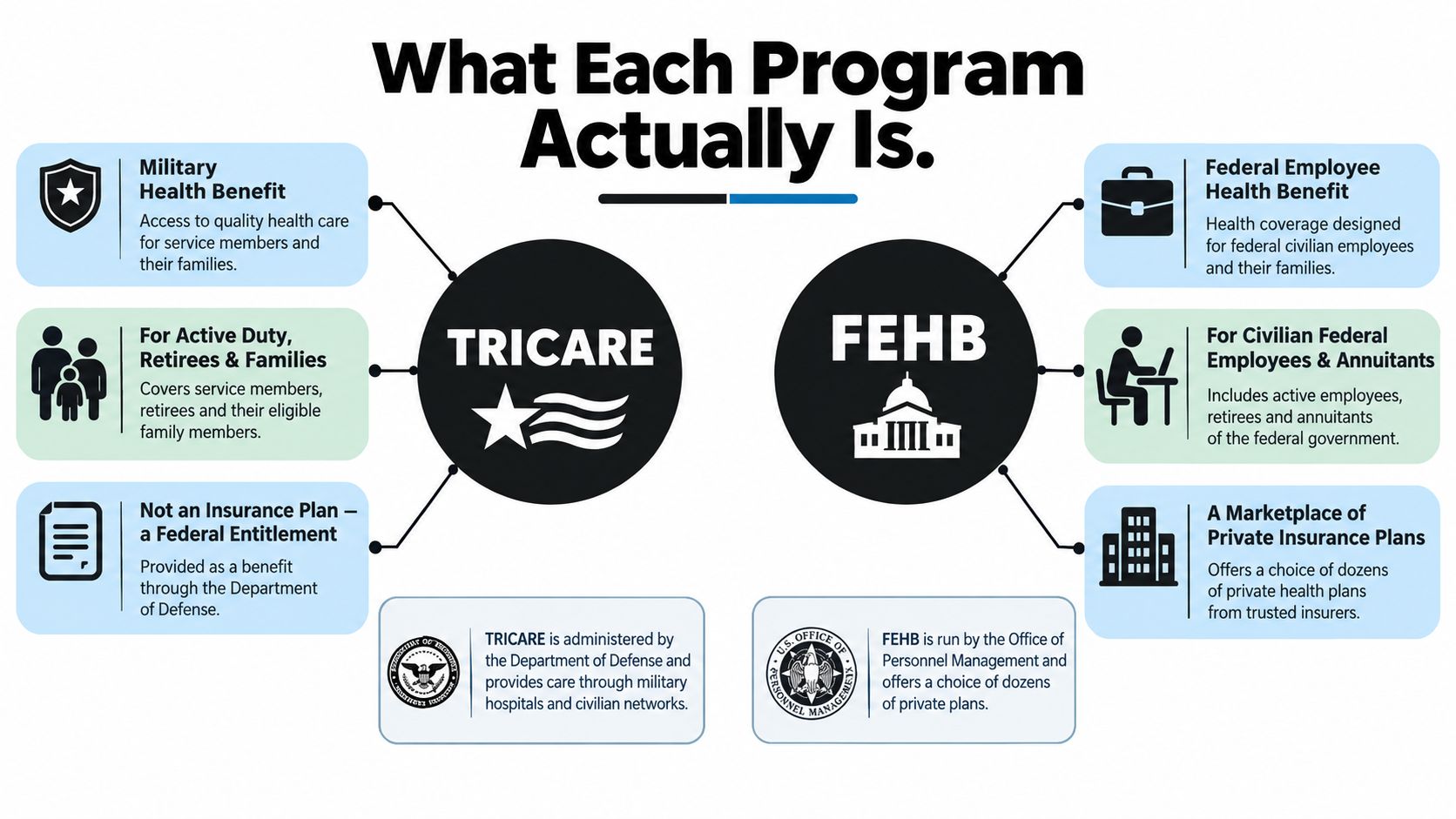
TRICARE is a family of programs, not one uniform product. Prime, Select, Reserve Select, Retired Reserve, and TRICARE for Life each serve different eligibility groups and use different access and cost rules. Military hospitals and clinics matter in some arrangements, while civilian networks and referral requirements matter in others.
The program served roughly 9.1 million eligible beneficiaries in fiscal year 2007, including Prime enrollees, TRICARE for Life beneficiaries, non-enrolled users, and TRICARE Reserve Select participants. The Military Health System later reported roughly 9.6 million beneficiaries in fiscal year 2022, and in 2024 it reported about 9.4 million people eligible, with 6,180,903 non-service-member beneficiaries generating 90,357,451 recorded medical encounters. The beneficiary analysis from the Military Health System also shows that adults age 65 and older make up a large share of the people using care.
FEHB, established in 1960, is the Federal Employees Health Benefits Program run by the Office of Personnel Management. OPM describes it as the largest employer-sponsored health benefits program in the United States, covering about 8.2 million federal civilian employees, annuitants, family members, and certain Tribal employees and their families. OPM's FEHB program materials explain how the program is organized within federal benefits.
FEHB works like a marketplace of private carrier plans. The government negotiates with carriers, and employees choose among plan designs with different premiums, networks, deductibles, prescriptions, and out-of-pocket limits. A practical guide to the Federal Employees Health Benefits Program helps with the civilian-program terminology, but the answer depends on the exact plan available to you.
Side-by-Side Comparison of the Two Programs
Compare the specific coverage option, not just the program name. TRICARE Prime and TRICARE Select impose different access and cost-sharing rules, while FEHB premiums and benefits vary by carrier, enrollment category, network, and expected use.
| Dimension | TRICARE | FEHB |
|---|---|---|
| Eligibility source | Military service, retirement, Reserve status, family relationship, or survivor status | Federal civilian employment, annuitant status, family relationship, or qualifying Tribal employment |
| Program structure | Multiple military health options, including Prime, Select, Reserve Select, Retired Reserve, and TRICARE for Life | A marketplace of private carrier plans under the OPM program |
| Cost structure | Enrollment fees, deductibles, copayments, and other cost sharing vary by option and beneficiary category | Employee premiums plus the selected plan's deductible, copayments, coinsurance, and out-of-pocket maximum |
| Provider access | May use military facilities, designated networks, referrals, or self-directed civilian access depending on option | Plan-specific provider networks and rules, with access varying significantly by carrier and option |
| Prescription coverage | Tied to the selected TRICARE arrangement and military pharmacy structure | Tied to the selected FEHB carrier's formulary and pharmacy benefits |
| Medicare coordination | TRICARE for Life coordinates with Medicare for eligible beneficiaries | FEHB can coordinate with Medicare, but the result depends on the FEHB plan and enrollment choices |
| Retirement and survivor considerations | Eligibility follows military status and applicable family or survivor rules | Retirement continuation depends on federal annuitant eligibility and enrollment requirements |
| Primary payer in a dual-plan situation | Generally secondary when FEHB is active and applicable | Primary when the enrollee or dependent also has TRICARE |
For retirees under 65, TRICARE Prime generally limits point-of-service exposure in exchange for more structured access. Select offers broader self-directed access, but its $150 individual or $300 family deductible creates an added cost risk that Prime enrollees avoid. Choose Prime when predictable costs and military-network access fit your household. Choose Select when civilian provider choice matters more.
FEHB requires a plan-by-plan review. OPM's 2026 FEHB comparison data show displayed biweekly Self Only premiums from $81.62 to $188.32, Self Plus One premiums from $175.47 to $410.88, and Self and Family premiums from $215.63 to $457.66 across the listed options. “The FEHB premium” is therefore not a useful comparison until you identify the carrier and enrollment tier.
TRICARE's 2026 retiree fees also depend on beneficiary category. Group A Prime charges an annual enrollment fee of $381.96 for an individual or $765 for a family, with no annual deductible. Group A Select charges $186.96 for an individual or $375 for a family, with a $150 individual or $300 family deductible. The 2026 TRICARE costs and fees document lists the corresponding Group B fees and cost-sharing details.
For a dual-eligible household, compare annual premiums, enrollment fees, deductibles, expected visits, prescriptions, provider access, and the maximum likely out-of-pocket exposure. That total gives you a sounder answer than comparing monthly payroll deductions alone.
How Coordination of Benefits Works in Practice
At the doctor's office, tell the staff that the patient carries both plans and confirm that FEHB pays first and TRICARE pays second when both policies cover the person and service. OPM's guidance identifies FEHB as primary, while TRICARE coordinates as secondary. Combined payments should not exceed the claim's full allowed amount, but the process depends on accurate coverage information and correctly submitted claims.
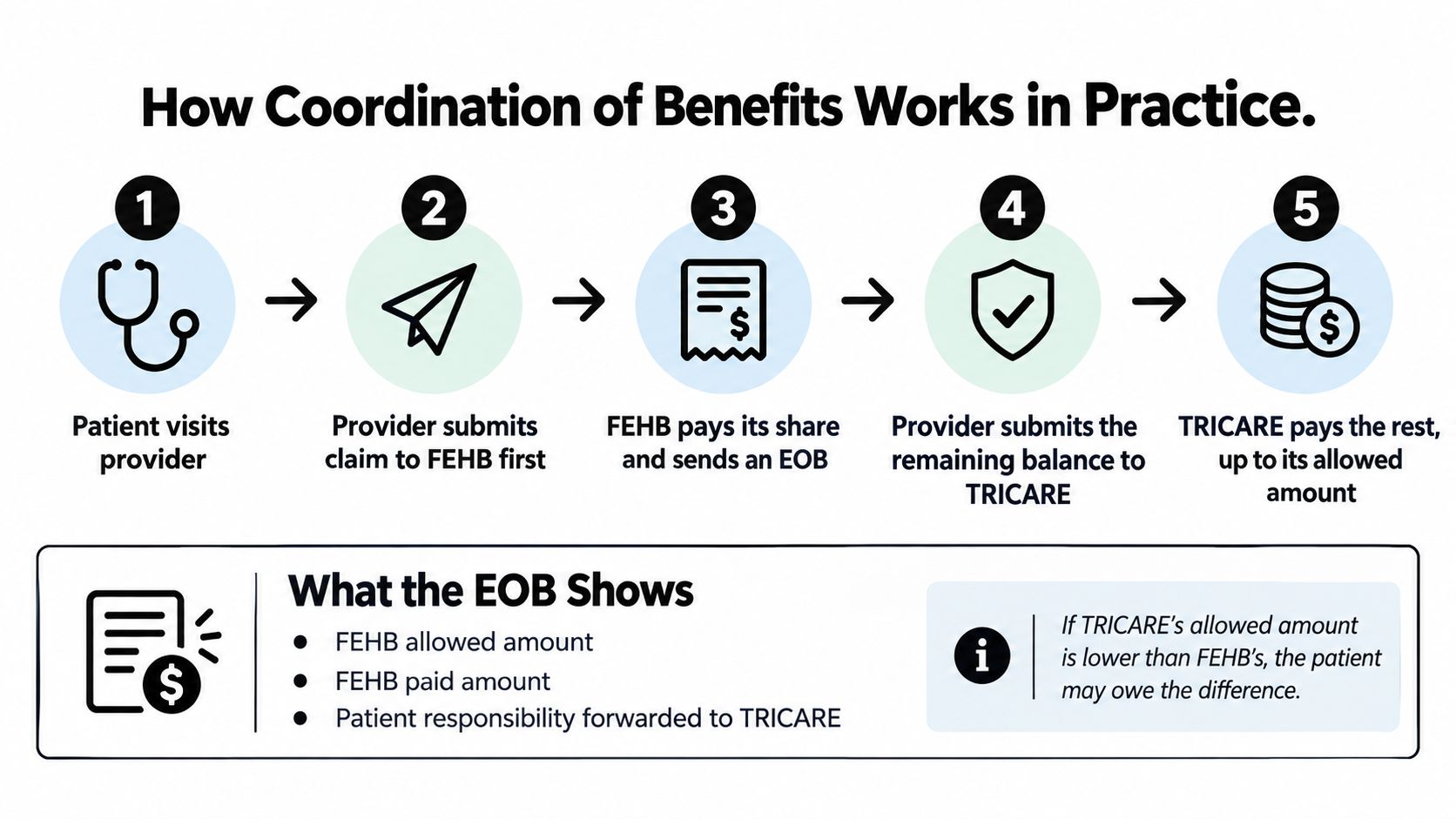
Consider a routine outpatient visit. Give the provider both insurance cards at registration and ask the billing office to submit FEHB first. FEHB then processes the claim and issues an explanation of benefits, or EOB, showing the allowed amount, its payment, and the remaining patient responsibility.
The provider submits the applicable balance to TRICARE, usually with the FEHB EOB. TRICARE applies its own coverage rules and allowed amounts, then pays only what its policy supports. Compare TRICARE's EOB with the provider's final bill before paying anything.
What to do when the claim goes wrong
If the office bills TRICARE first, contact its billing department and request corrected payer order. Provide current FEHB and TRICARE details, and ask the office to resubmit the claim rather than paying the disputed balance immediately.
A denied FEHB claim needs a reason. Missing referrals, authorization failures, excluded services, and network restrictions can all prevent TRICARE from covering the remaining amount. Secondary coverage does not turn an excluded service into a covered one. For how Medicare changes the payment order, see this federal retiree's guide to FEHB and Medicare.
Use this checklist after an unexpected bill:
- Read both EOBs: Check the allowed amount, each payment, denial reason, and stated balance.
- Confirm payer order: FEHB should generally process first in this arrangement.
- Call the provider: Ask whether both claims were submitted with the correct member information.
- Verify authorization: TRICARE may apply its own referral and prior-authorization requirements.
- Appeal carefully: Keep the original claim, both EOBs, medical records, and provider notes together.
A second plan adds limited protection when the service is excluded, the provider falls outside applicable network rules, or required authorization was never obtained. Two insurance cards do not guarantee a zero balance.
The Reserve and National Guard Eligibility Trap
Reserve and National Guard households face a rule that can change the decision before anyone compares premiums. Under the applicable rule, FEHB eligibility can make a Selected Reserve member ineligible for TRICARE Reserve Select, even if the member declines to enroll in FEHB.
The GAO review found that approximately 103,080 Selected Reserve members, roughly 12% of those examined, were FEHB-eligible and therefore ineligible for TRICARE Reserve Select. GAO's review of Reserve health-benefit eligibility shows why this isn't a niche administrative issue.
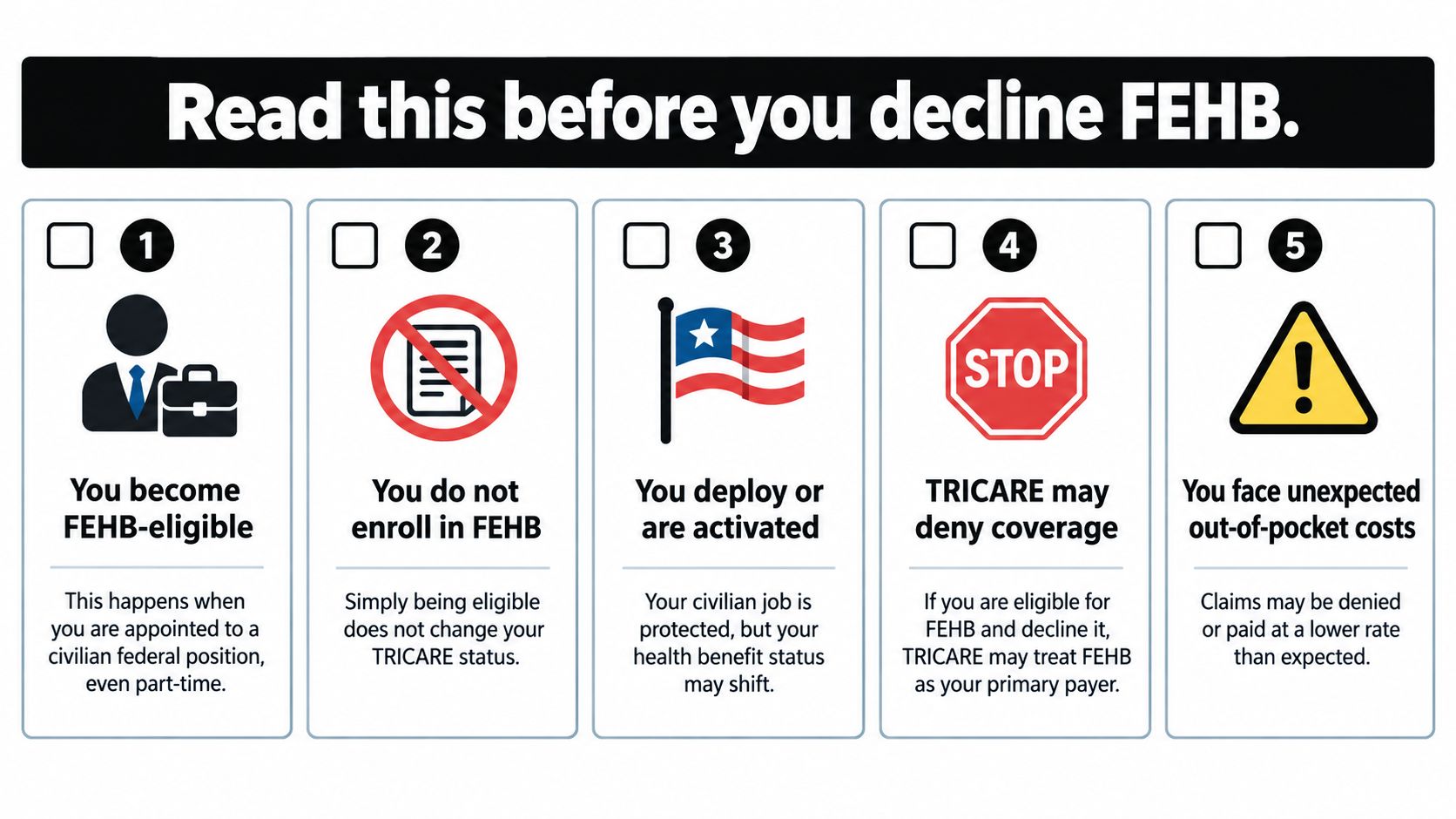
The decision tree needs precision:
- Are you eligible for FEHB? A civilian federal appointment can create FEHB eligibility.
- Are you enrolled in FEHB? Eligibility and enrollment aren't the same fact.
- Which TRICARE program covers you? Reserve Select and Retired Reserve have their own rules.
- Has your status been reported correctly? Military systems, not only your civilian agency, can affect the eligibility record.
- What happens to your family and survivor coverage? Don't assume every dependent's status changes identically.
TRICARE guidance says a sponsor who becomes eligible for or enrolls in FEHB must contact the regional contractor to disenroll from TRICARE Reserve Select or TRICARE Retired Reserve. The guidance also indicates that FEHB eligibility doesn't affect survivor coverage. That distinction matters, but you shouldn't rely on a verbal explanation from a payroll office alone.
Before declining FEHB: Ask the civilian HR office to confirm eligibility in writing, contact the TRICARE regional contractor, review the DEERS record, and document the effective dates.
If a record is wrong, ask which office can correct it and how claims submitted during the disputed period will be handled. Keep proof of premium payments, enrollment elections, disenrollment requests, and family eligibility. A delayed correction can turn a simple status change into a claims problem.
Three Household Scenarios That Change the Answer
The active-duty family with a federal civilian spouse
An active-duty household may have TRICARE through the military sponsor while the spouse works for the federal government and can elect FEHB. I would keep TRICARE for the family unless FEHB solves a specific problem, such as a needed provider network, prescription coverage, or an employment requirement that makes the premium worthwhile.
Do not add FEHB by default. First confirm what it would pay, whether it would become primary for particular claims, and whether enrollment affects any family member's eligibility. If both plans remain active, give both insurance records to each provider and confirm that FEHB is billed first when required.
The recently retired service member under 65
Retirement changes the comparison. The household should compare TRICARE Prime or Select with the exact FEHB plan available through the retiree's civilian employment or an eligible spouse. For 2026, Group A Prime and Select have different enrollment fees and deductible structures, while Group B retirees generally pay higher annual fees. Use the applicable TRICARE fee category when calculating the household's cost.
My default is TRICARE Select when provider freedom is the priority. I favor Prime when predictable military-system access and lower point-of-service exposure matter more. I would choose FEHB only if its network, benefits, or total annual cost addresses a documented household need.
The premium is only the starting point. Add enrollment fees, deductibles, copayments, prescription costs, travel, and likely out-of-network spending before deciding.
Retirees must reenroll within 90 days after retirement to avoid losing continuous TRICARE coverage. Put that deadline on the retirement checklist and complete it before other coverage decisions distract from it.
The Medicare-eligible retiree
Once Medicare eligibility begins, the analysis changes. TRICARE for Life coordinates with Medicare, so a lower FEHB premium alone does not settle the question. Compare Medicare coordination, FEHB benefits, prescriptions, provider access, and the long-term value of keeping or suspending FEHB under applicable federal rules.
I would preserve flexibility until the household confirms its future options. Do not cancel FEHB before verifying whether suspension, continuation, or later reentry is available. Before changing enrollment, ask both carriers how claims will be processed and who pays first. That answer matters more than a brochure comparison.
Choosing the Right Plan and Locking It In
| Household situation | Starting recommendation | Option that commonly loses |
|---|---|---|
| Active-duty family | Use the applicable TRICARE option unless FEHB solves a specific access or coverage need | Paying for FEHB without a defined purpose |
| Recently retired under 65 | Compare TRICARE Prime and Select with the exact FEHB plan, then prioritize provider access and total cost | Choosing only by the visible premium |
| Medicare-eligible retiree | Evaluate TRICARE for Life with Medicare before changing FEHB | Treating FEHB and TRICARE for Life as interchangeable |
| Reserve or National Guard member | Confirm FEHB eligibility before selecting or declining TRICARE Reserve Select | Assuming FEHB is merely an optional alternative |
| Dual-employed household | Coordinate both plans and verify payer order | Letting each provider guess which plan pays first |
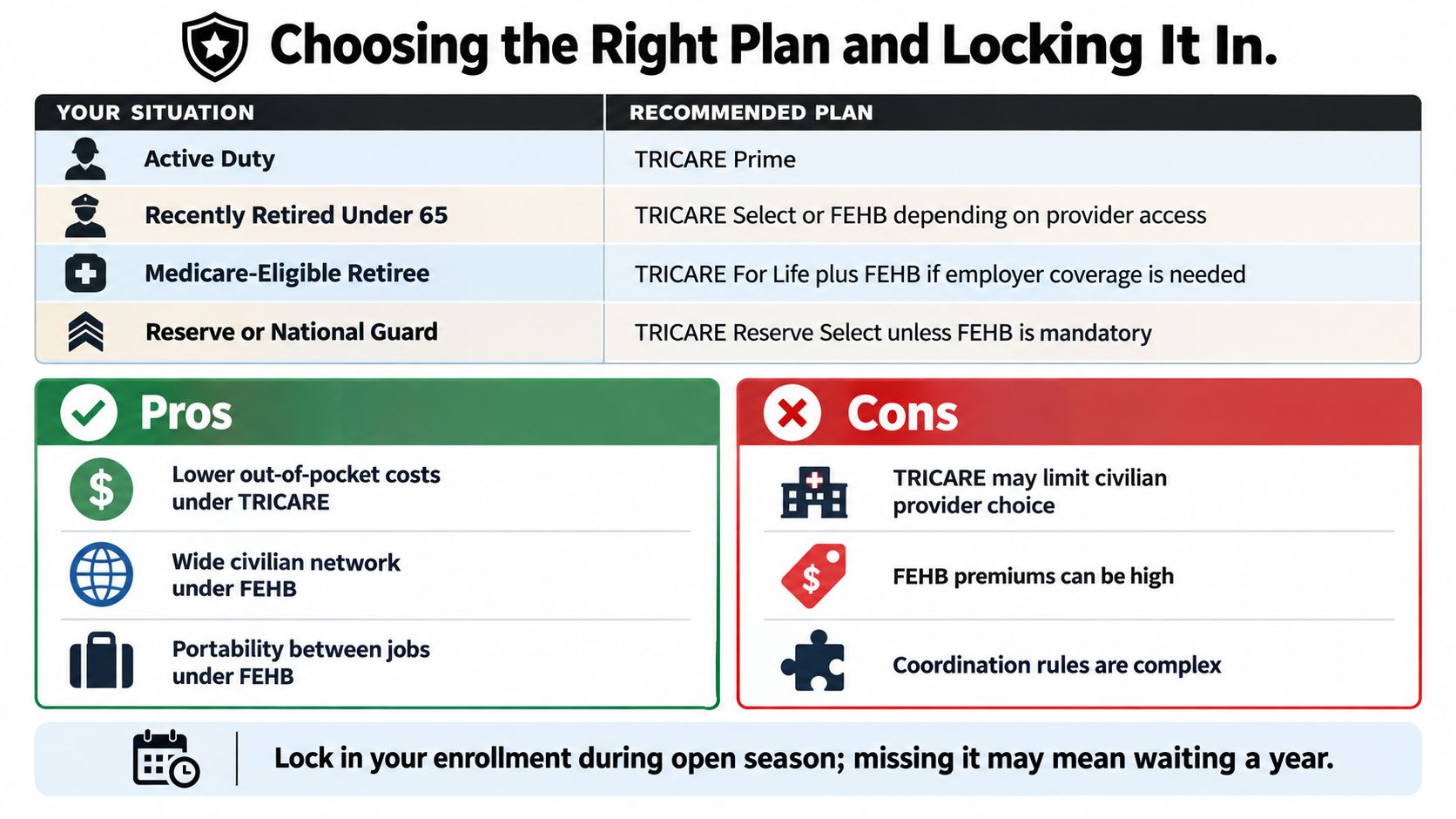
The decision becomes manageable when you lock down five operational points.
- Confirm eligibility with both systems. Ask civilian HR about FEHB eligibility and enrollment. Check DEERS and contact the appropriate TRICARE contractor about the military program. Don't rely on a stale ID card.
- Build a total annual cost. Add annualized employee premiums, TRICARE enrollment fees, deductibles, expected copayments, coinsurance, prescriptions, travel, and likely specialist use. Then run a high-utilization scenario.
- Separate eligibility from enrollment. This is essential for Reserve households. Becoming eligible for FEHB can matter even when no FEHB election is made.
- Respect the enrollment window. Retirees need to address TRICARE enrollment within the applicable 90-day post-retirement period, while FEHB changes generally follow open season or a qualifying life event.
- Update both carriers. Give each plan the other plan's information, and tell every regular provider which coverage is primary.
For a structured civilian-plan comparison, the FEHB plan comparison tool guide is a useful planning resource. Federal Benefits Sherpa also offers benefits reviews, retirement planning, and gap analysis reports for federal employees evaluating healthcare alongside broader retirement decisions.
Frequently Asked Questions for Dual-Eligible Households
Can my federal employer reimburse my FEHB premium?
Don't assume it can. FEHB is generally handled through the program's employee and employer contribution structure, not an informal reimbursement arrangement. Ask your agency's benefits office how your enrollment is processed and whether any special employment category applies.
How do I switch coverage at retirement without creating a gap?
Start before the retirement date. Confirm the final active-employee coverage date, the effective date of retiree coverage, and the deadline for enrolling in the TRICARE option you want. Request written confirmation from the agency and TRICARE contractor, then keep copies of every election and confirmation.
What happens to TRICARE after the sponsor dies?
Survivor eligibility depends on the survivor's relationship, military status, and applicable program rules. Don't cancel a survivor's coverage based on an assumption that the sponsor's enrollment automatically transfers. Contact TRICARE, verify the survivor's DEERS record, and ask specifically about the applicable survivor arrangement.
How does Medicare change the decision?
Medicare changes who processes the claim first and makes TRICARE for Life a different comparison from Prime or Select. Review Medicare enrollment, TRICARE for Life eligibility, FEHB coordination, prescriptions, and provider participation together. The right answer depends on the full combination, not on one premium.
Can I suspend FEHB instead of canceling it?
Eligible annuitants may be able to suspend FEHB when they have qualifying alternative coverage, including TRICARE or TRICARE for Life. Suspension and cancellation are not the same. Confirm the reentry rules with OPM before acting, because preserving a future option can be more valuable than permanently ending enrollment.
Federal Benefits Sherpa helps federal employees and retirees review FEHB, TRICARE coordination, retirement timing, and coverage gaps through personalized benefits reviews and planning resources. Visit Federal Benefits Sherpa to arrange a benefits review before you decline, switch, or cancel either program.
