Thrift Savings Plan Government Match Explained
A FERS employee who contributes 5% of basic pay each pay period receives a 4% agency match plus a separate 1% automatic contribution, for 5% of basic pay from the agency. That means your own 5% doesn't sit alone in your account. When you meet the full threshold in a pay period, the agency side can equal the amount you put in, turning a single election on your paycheck into two streams of deposits.
The catch is timing. The Thrift Savings Plan government match isn't an annual reward based on your average saving rate, and it doesn't keep rising if you save far above 5%. It's a capped, pay period incentive. Miss the threshold in one period and you can't recover that period's unused match by saving extra later, even though the automatic 1% keeps coming.
What Five Percent Buys From the Agency
Say you're a standard FERS employee with a steady paycheck and you elect 5% of basic pay for the TSP. You aren't buying a vague bonus. You're filling the match formula completely, so the agency adds its match plus its automatic contribution beside your money each period.
Think of it as a capped raise reserved for retirement. It tops out once you reach 5%, rather than growing every time you save another dollar. Saving 8% or 12% still builds your account faster, but the agency piece stops at its ceiling.
Basic pay is the only pay that counts
Basic pay is the slice the formula uses. For most federal employees, locality pay is part of basic pay, while overtime, awards, and most bonuses aren't. That's the number to check on your Leave and Earnings Statement, often called your LES, before you run any math.
This distinction trips people up after a busy season. A paycheck padded with overtime looks bigger, so a 5% election can seem larger than the formula will produce. Work from basic pay for that period, not from the gross total at the bottom of the stub. If you're new to the account itself, our simple guide to how the TSP works walks through where those deposits land and how the balances are tracked.
At a 0% election you're not getting nothing. You're getting only the floor, which is why the automatic deposit can hide a missed match.
That floor explains a common misunderstanding. FERS employees receive the automatic 1% even if they contribute nothing, so an agency deposit on a statement doesn't prove you're getting the full benefit. It proves the first piece posted. The matching piece requires your own election.
Private sector plans work on a similar idea, though each employer writes its own formula and cap. If you're comparing a spouse's plan or a job outside federal service, Peak Transport's guide to 401(k) matching is a useful plain language comparison for how caps and percentages work there.
This section speaks to standard FERS as the default case. CSRS employees and some military members follow different agency rules, so they shouldn't assume this 5% benchmark applies to them. For FERS readers, the practical question is simple: what does each election level, from 0% up through 6% and beyond, buy from the agency? The rate table answers that without any extra math.
FERS Match Rates From Zero to Five Percent
The TSP page on contribution types describes the FERS match in two tiers, with a dollar-for-dollar match on the first 3% of basic pay contributed each pay period and 50 cents per dollar on the next 2%. On top of that, FERS employees receive an automatic agency contribution of 1% of basic pay, whether or not they contribute personally.
FERS agency deposits by employee contribution rate
| Employee rate | Dollar-for-dollar match | 50% match tier | Automatic 1% | Total from agency |
|---|---|---|---|---|
| 0% | 0% | 0% | 1% | 1% |
| 1% | 1% | 0% | 1% | 2% |
| 2% | 2% | 0% | 1% | 3% |
| 3% | 3% | 0% | 1% | 4% |
| 4% | 3% | 0.5% | 1% | 4.5% |
| 5% | 3% | 1% | 1% | 5% |
| Above 5% | 3% | 1% | 1% | 5% |
Read one row at a time and the table gets less mysterious. The first three employee percentage points are the richest, because each dollar there draws a full dollar back. At 1% you collect 1% in matching, at 2% you collect 2%, and at 3% you've filled the entire first tier at 3%.
The return changes at 4%. That fourth point only draws half a point of agency matching, because you're now in the second tier. At 5%, both extra points are counted at 50 cents per dollar, worth 1% together. Add the first tier's 3%, the second tier's 1%, and the automatic 1%, and the agency total reaches 5% of basic pay.
The $60,000 illustration
Percentages stay abstract until you attach a salary. Take $60,000 in annual basic pay and a steady 5% election held all year. Your own contributions total $3,000, the agency match equals $2,400, and the automatic contribution adds $600.
That produces $6,000 in combined deposits for the year before any investment earnings. Your $3,000 is matched by $3,000 from the agency when both agency pieces are counted. Notice what's doing the work here. It isn't a special fund choice or market timing. It's reaching the election level where every available tier pays.
Contributions above 5% still matter for your future balance. They raise your own saving, they stay invested under your fund choices, and they can compound over time. They just don't add more agency money under the standard FERS formula, which is why the row above 5% stays flat at a 5% agency total.
These percentages apply to that pay period's basic pay, not to a year-end average you calculate in December. There's no year-end true-up described in the standard formula that sweeps in later to fix a low period. A flat 5% election is therefore the minimum that fills the match, provided you keep it in place pay period after pay period.
Practical rule: Count the first 3% as dollar-for-dollar territory, the next 2% as half-dollar territory, and anything above 5% as your own extra saving.
Why Each Pay Period Has Its Own Match
The agency doesn't wait until year-end and ask what you averaged. It looks at one paycheck, checks your basic pay and contribution rate for that period, and calculates one match for that period. The flow below shows how narrow that window is.
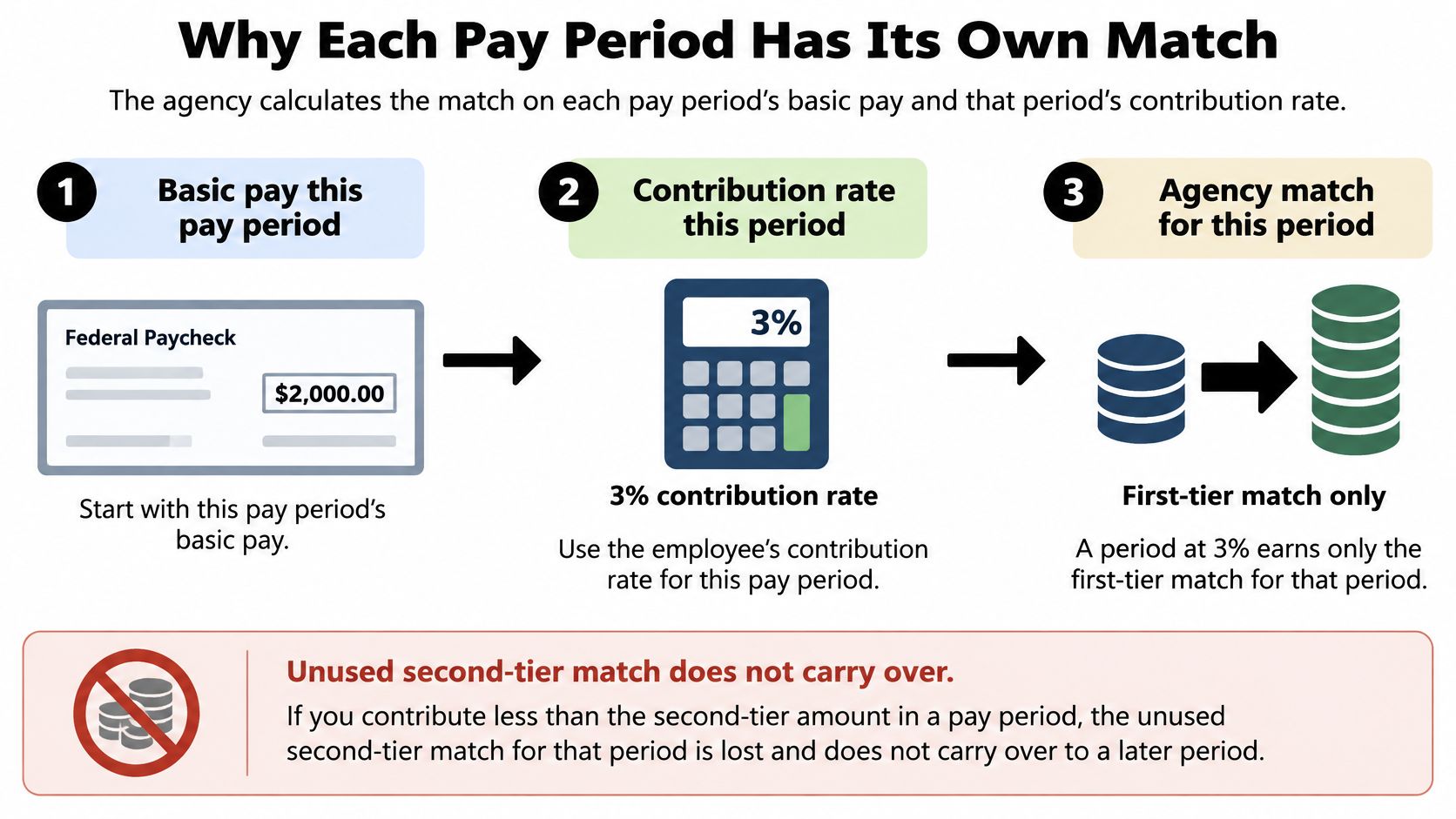
That's why a period at 3% earns only the first-tier match for that period. The unused second-tier opportunity isn't banked for next month, and contributing 7% later does not activate it retroactively. In 2024, the TSP page on growing with the TSP stated that participants receive the full government match only when they contribute at least 5% of basic pay each pay period.
The front-loading miss
Consider an employee who wants to get serious in January. She elects a high percentage, fills her elective deferral limit early, and her employee contributions stop well before December. For the remaining periods her election effectively becomes 0%.
During those zero periods, the automatic 1% still posts. The match doesn't. She can truthfully say she saved a lot that year and still have left match dollars behind, because the agency only matches periods where she contributed. This isn't a penalty for saving. It's the calendar built into the formula.
A level 5% election avoids the trap because something matchable comes out of every paycheck. Steady, smaller deposits across all periods also have a pacing value many savers recognize from regular investing schedules. For readers who want that concept explained in general terms, investing insights from Finzer covers why spreading purchases over time behaves differently than putting everything in at once.
Agency contributions are excluded from the elective deferral limit, so the match itself doesn't consume your personal cap. Your own contributions are what run into the limit. Stopping those contributions is what shuts off the match, not receiving agency money. Spillover and catch-up provisions matter here only for one reason: they can help eligible employees keep some traditional or Roth election in force through the last pay period instead of hitting a wall early.
The short video below is a helpful pause point if the pay period idea still feels slippery, because it ties the election to what appears on an actual paycheck cycle.
Check the LES, not the average
- Open the latest LES: Confirm that an employee TSP deduction posted for that specific period.
- Find both agency amounts: Look for the automatic contribution and the matching contribution as separate pieces.
- Ignore the annual average: A year-to-date rate near 5% can hide several zero periods.
- Keep the election alive: Hold at least 5% through the final pay period of the year.
Say it plainly: the standard formula has no year-end true-up. A pay period's unused match isn't recovered later, so your annual average isn't the test. Each paycheck passes or fails on its own.
CSRS and Military Rules That Change the Match
The same TSP contribution can bring agency money under one retirement system and none under another. Check your system first, then interpret the contribution rules in the chart and table.
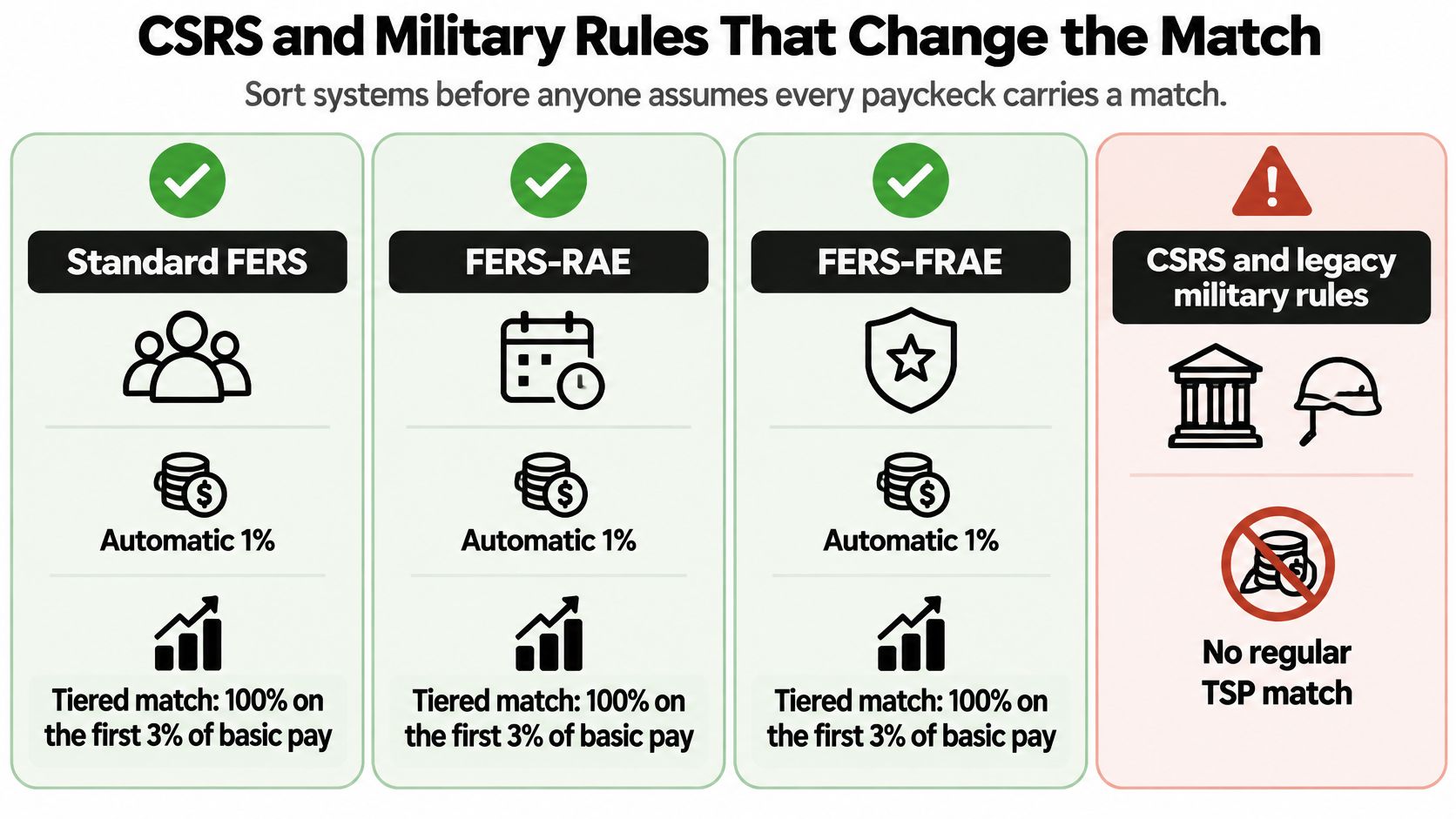
Who receives TSP agency contributions
| System | Own TSP contributions | Automatic 1% | Tiered match | Timing note |
|---|---|---|---|---|
| FERS, FERS-RAE, FERS-FRAE | Yes | Yes | Yes, up to 4% | Each pay period on basic pay |
| CSRS | Yes, elective | No | No | Larger pension, no FERS agency formula |
| CSRS Offset | Yes, elective | No | No | Same agency rule as CSRS for TSP |
| Military BRS | Yes | Yes | Yes, up to 4% | Auto after 60 days; match after 2 years |
| Legacy military retirement | Yes, elective | No | No | No BRS agency match |
FERS, FERS-RAE, and FERS-FRAE have different pension contribution histories, but the same agency contribution structure: an automatic contribution and a tiered match. If you're unsure which system applies to you, this comparison of CSRS and FERS can help you identify it before changing your TSP election.
Why CSRS sits outside the formula
FERS, created in the 1980s, pairs an automatic 1% agency contribution with a tiered match on employee savings. Under the current formula, the agency matches dollar for dollar on the first 3% of basic pay you contribute, then adds 50 cents per dollar on the next 2%. The TSP contribution types explain how these agency contributions work.
CSRS and CSRS Offset employees can contribute their own money to the TSP, but they don't receive the FERS automatic contribution or matching schedule. Their retirement system relies more heavily on the pension, so a TSP election does not produce the same agency deposits.
Eligible members of the Blended Retirement System (BRS) use the same tiered match, but their agency contributions have different start dates. The automatic contribution generally begins after 60 days of service, while matching generally begins after two years. Legacy military members can contribute to the TSP, but don't receive a BRS agency match.
For CSRS and legacy military employees, TSP contributions are personal savings, not a way to earn agency deposits. BRS members should check their service records for the applicable start dates before including matching contributions in a budget or projection.
Dollar Examples at Common Federal Salaries
Dollars make the cost of a low election easier to see than percentages. The TSP explanation of what a contribution is gives the $80,000 case directly: at 5%, an employee receives $3,200 in matching contributions plus $800 in automatic contributions annually, before investment returns.
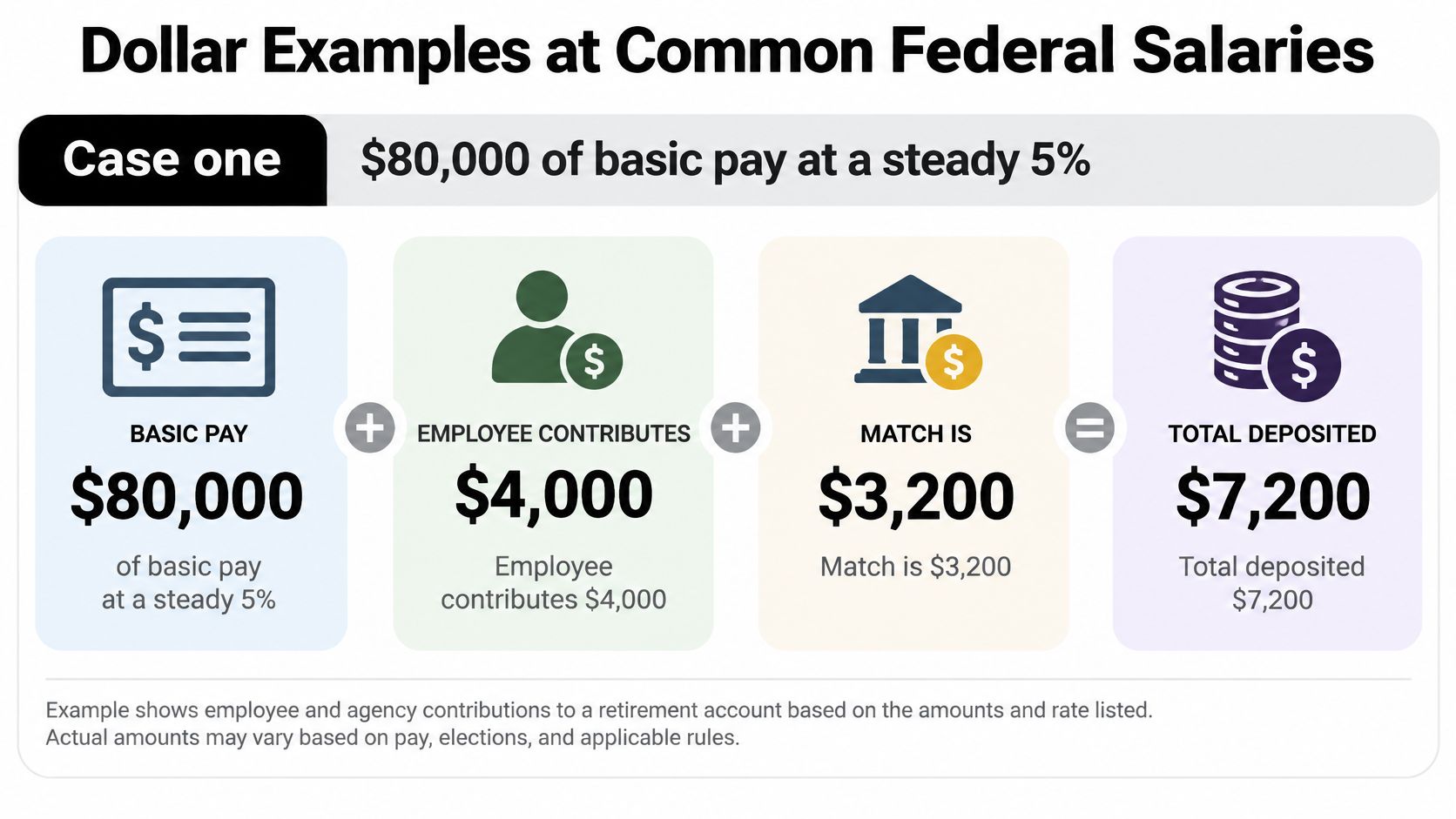
Case one at a steady 5%
Start with $80,000 of basic pay and a 5% election held in every period. You contribute $4,000 of your own pay over the year. The match adds $3,200 and the automatic 1% adds $800, so the agency total is $4,000.
Combined deposits reach $8,000 before investment returns. This is the clean benchmark case, because your contribution and the agency total are the same size. Remember the shortcut behind it: at a steady 5%, total agency deposits equal 5% of annual basic pay, and the match portion alone equals 4%.
Case two at a steady 3%
Now keep the same $80,000 salary and lower the election to 3%. You contribute $2,400, and the first-tier match returns the full $2,400. The automatic $800 still arrives, bringing the agency total to $3,200.
Compared with the 5% case, you've left $800 of match behind for the year. That $800 is the unpaid second tier, the half-dollar match on the fourth and fifth percentage points you didn't contribute. Nothing about your salary changed. Only the election changed, and the agency total fell by exactly that tier.
A 3% election isn't half-hearted saving. It's full payment on the first tier and zero payment on the second.
Case three at zero, plus one uneven year
Drop the election to 0% on the same $80,000 and the picture gets stark. You contribute nothing, the match is $0, and only the $800 automatic deposit posts. The account still receives money, which is worth knowing, but $3,200 of potential matching never appears.
Uneven saving creates a quieter version of the same loss. Say a year has 26 pay periods, with six periods at a 10% election and twenty at 0%. Match dollars appear only in the six active periods, while the automatic 1% can continue across all 26. The high early rate doesn't rescue the twenty empty periods, because each period's match stops at its own cap.
When you run your own numbers, multiply basic pay from the LES, not gross pay swollen by overtime, awards, or bonuses. Then test three versions of yourself: the 5% case, the 3% case, and the zero case. The gap between the first two tells you exactly what raising your election by two points buys.
Set the 5% Election Before the Next Pay Period
You've got the formula, the exceptions, and the dollar stakes. What remains is a payroll change, made soon enough to count for the next period rather than the one after. Use the checklist as your order of operations.
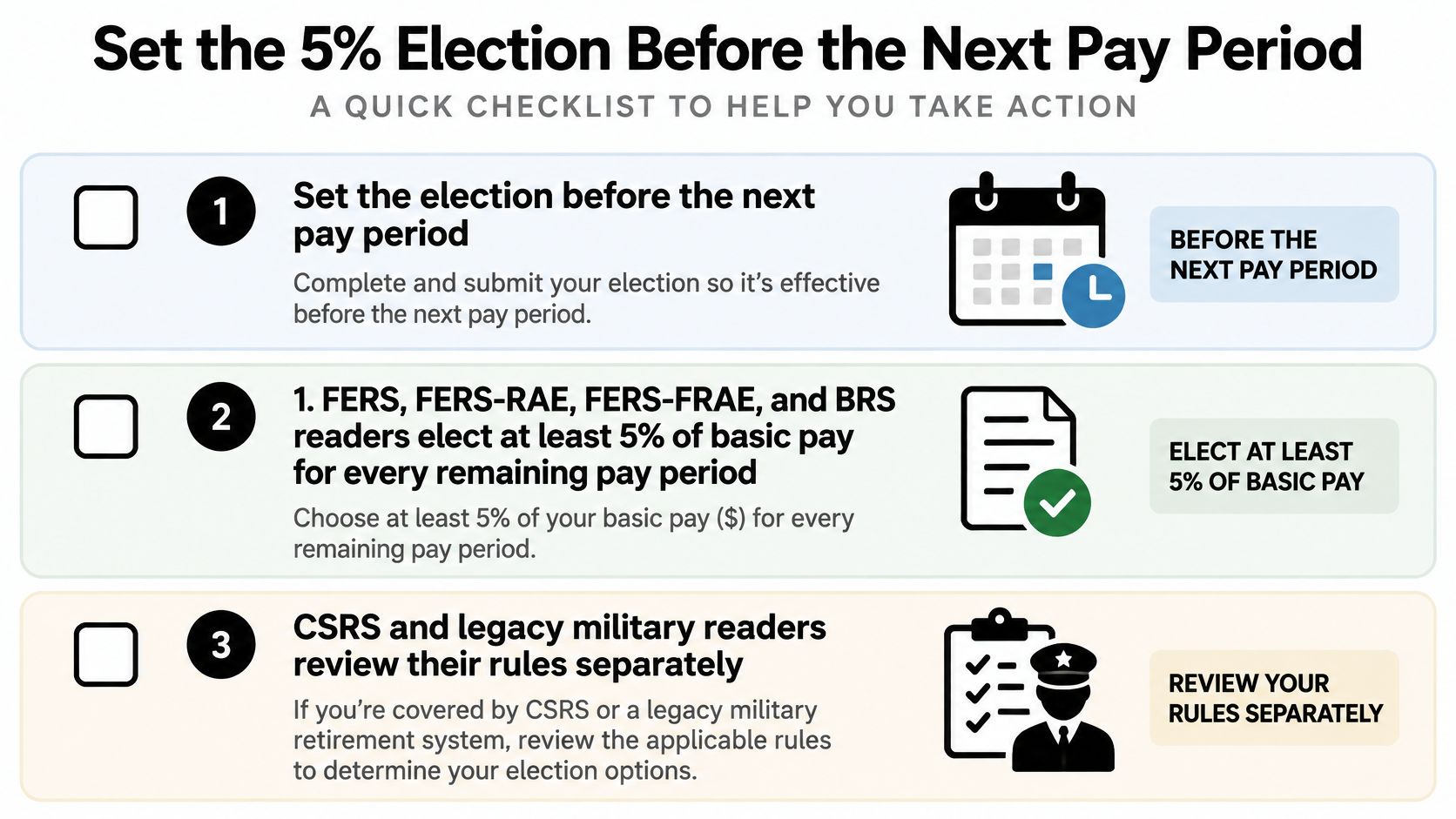
Six steps to set and hold the election
- Elect at least 5% if you're covered: FERS, FERS-RAE, FERS-FRAE, and eligible BRS readers should set at least 5% of basic pay for every remaining pay period. CSRS and legacy military readers skip the match target and size their deferral against the pension they already have.
- Split traditional and Roth as you like: Your 5% can be all traditional, all Roth, or a mix, and the match calculation follows the total. Agency matching and the automatic 1% always post to the traditional balance, so don't expect agency dollars to show up on the Roth side.
- Hold the rate through the last pay period: Resist sprinting to a dollar cap early in the year. A contribution that stops in October takes the match with it, so spread your intended annual amount so an election is still active in December.
- Raise it in 1% steps if 5% isn't affordable yet: Moving from 0% to 3% buys a full agency dollar for each employee dollar. Moving from 3% to 5% buys 50 cents per dollar, which is still an immediate return on those specific dollars before any market movement.
- Treat catch-up as extra saving, not extra match: Catch-up contributions for employees age 50 and older are additional employee deferrals. They don't extend the match, which still stops once you've contributed 5% in a period.
- Verify the next LES: Check that both your employee deduction and the agency amounts posted for that period. If one side is missing, follow up with payroll while the period is still recent and easy to trace.
If you need the mechanics of making the change in your payroll system, our guide to changing your TSP contribution covers where the election lives and how to confirm it took effect. The election is made through your agency or service payroll channel, not by moving money between TSP funds.
One limit check belongs in step three. The 2024 TSP bulletin on contribution limits reported an elective deferral limit of $23,000 and an annual additions limit of $69,000, with agency matching contributions excluded from the elective deferral limit. Those are 2024 figures, so check the current year's numbers before you set a high dollar election, and make sure your pace leaves room to contribute in the final period.
Where the match fits in a retirement decision
For readers close to retirement, the match is only one moving part. Your pension amount, any FERS supplement, Social Security timing, and your TSP withdrawal plan all interact, and a contribution change this year is easier to judge when you can see those pieces together. That's the point where education beyond a single formula starts to help.
We offer free resources, including a class, a Learning Center, and a 15-minute conversation, and those free resources carry no cost and no obligation. Use them after you've made the 5% election or consciously decided against it, so the conversation starts from a decision rather than a guess.
Two disclosures belong here so expectations stay clear. Federal Benefits Sherpa is an independent organization and is not affiliated with or endorsed by the Office of Personnel Management, the Social Security Administration, the Federal Retirement Thrift Investment Board (TSP), or any government agency. We also don't provide investment advisory services, so fund selection and personal investment advice stay outside what we do.
Before the next pay period: Set the election, then prove it worked on the LES that follows. A planned 5% earns nothing until payroll actually takes it.
If you want help seeing how your TSP match fits alongside your pension, supplement, and Social Security timing, visit Federal Benefits Sherpa to explore the free class, Learning Center, and a short introductory conversation. Bring your latest LES and TSP statement if you have them, and we'll help you turn the 5% decision into a clearer picture of your retirement income.
