Social Security Suspension Your Guide to Maximizing Benefits
Think of your Social Security benefits as a faucet you've earned the right to turn on after a long career. A voluntary Social Security suspension is simply choosing to keep that faucet turned off for a little while after you’ve reached your Full Retirement Age (FRA).
It’s not a penalty or something forced on you. Instead, it’s a strategic decision to pause your payments. Why would anyone do that? Because for every year you wait between your FRA and age 70, the Social Security Administration (SSA) rewards you with delayed retirement credits. These credits permanently boost your future monthly checks by up to 8% per year.
What Social Security Suspension Really Means for You

It’s easy to get bogged down in the jargon, but the concept is straightforward. Imagine you have a choice: take a smaller, steady paycheck starting now, or wait a few years for a much larger one that will last the rest of your life. That’s the core of a suspension decision.
This isn’t about losing money you’re entitled to. It’s a calculated trade-off. You're forgoing payments today in exchange for a bigger, inflation-protected income stream down the road.
For federal employees, this strategy can be particularly effective. Your retirement income already has multiple pillars—your FERS or CSRS pension and your Thrift Savings Plan (TSP). Suspending Social Security adds a powerful layer of control, allowing you to optimize all three sources for a stronger financial future.
To put it all in perspective, here’s a quick summary of what voluntary suspension involves.
Social Security Suspension At A Glance
| Aspect | Description | Key Takeaway for Federal Employees |
|---|---|---|
| Eligibility | You must be at or past your Full Retirement Age (FRA) to request a voluntary suspension. | This is a post-retirement tool, not an early retirement option. Perfect for those who can live on their pension/TSP for a few years first. |
| The Benefit | Your future monthly payment increases by a set rate for each month of suspension, up to age 70. | This is a guaranteed, risk-free way to increase a core component of your retirement income. |
| How It Works | You proactively request the SSA to stop your payments. They will automatically restart at age 70 if not requested sooner. | You are in complete control. You can unsuspend at any time if your financial situation changes. |
| Impact on Others | While your benefits are suspended, anyone receiving benefits on your record (like a spouse) cannot receive them. | This is a critical point for married couples to discuss. It requires careful coordination and planning. |
Ultimately, suspension gives you the power to consciously build a bigger safety net for your later years, ensuring you have more income when you might need it most.
A Smart Move for Federal Retirees
For a federal employee, this isn't a decision made in a vacuum. It’s a chess move that affects the entire board. Maybe you retire at 62 with a solid FERS pension and a healthy TSP balance. You could live comfortably on those two income sources for a few years.
While you do, your Social Security benefit is sitting in the background, quietly growing. By letting it mature until you’re 70, you essentially create a supercharged income stream that kicks in later in life, providing powerful protection against inflation and longevity risk.
Key Insight: By voluntarily suspending benefits at your FRA, you aren't losing anything. You're investing in a higher future payout. This decision can be a cornerstone of a robust retirement income plan, especially when coordinated with your FERS/CSRS pension and TSP.
This guide will walk you through exactly how suspension works. We’ll get past the confusing government-speak to uncover the "what," the "how," and, most importantly, the strategic "why" for federal employees like you. You'll see how this simple pause can become one of the most effective tools in your retirement planning toolkit.
Why Your Social Security Payments Might Stop
You might choose to pause your own Social Security benefits, but sometimes the government stops them for you. This is called an involuntary social security suspension, and it’s a whole different ballgame. It’s not a strategic move to grow your future payments; it's a mandatory pause triggered by specific life events or rules the Social Security Administration (SSA) has to enforce.
Think of it like this: a voluntary suspension is you deciding to let your investment mature a bit longer for a bigger payout. An involuntary one feels more like your bank putting a temporary hold on your account due to a regulatory flag. The result is the same—no money coming in for a while—but the reasons couldn't be more different.
Getting a handle on what can trigger these suspensions is your best defense against a sudden, unwelcome surprise in your bank account.
Earning Too Much Before Full Retirement Age
This is probably the most common reason people see their checks stop unexpectedly. If you start collecting Social Security before your Full Retirement Age (FRA) and then decide to go back to work, you’ll run into the SSA's annual earnings limit.
It’s not a punishment, but it’s a hard and fast rule. Here’s how it works:
- For every $2 you earn over the annual limit, the SSA will hold back $1 of your benefits.
- The rules are a bit more generous in the year you actually hit your FRA. During those months, they’ll only hold back $1 for every $3 you earn above a much higher limit.
The good news is that this money isn't gone forever. Once you reach your FRA, the SSA recalculates your benefit and gives you credit for the months your payments were withheld. It’s a temporary pause, not a permanent loss.
Let's look at an example: Sarah, a retired federal employee, starts drawing Social Security at 63. She picks up a consulting gig that brings in $40,000 a year, putting her way over the earnings limit. The SSA will suspend her checks until the amount they've "overpaid" her (based on her earnings) is covered by the withheld benefits.
Other Reasons Your Payments Could Be Halted
The earnings test is a big one, but a few other situations can also put a stop to your Social Security payments. They’re less common, but every federal employee and retiree should know about them.
Changes in Disability Status If you're on Social Security Disability Insurance (SSDI), your benefits depend on your medical condition preventing you from working. The SSA conducts periodic reviews, and if they determine your health has improved enough for you to return to the workforce, they can suspend or even terminate your benefits.
Incarceration By law, Social Security retirement and disability benefits are suspended if you are incarcerated for more than 30 consecutive days following a criminal conviction. The payments stop while you are confined and can only be started again the month after you are released.
Returning to Federal Service This one is crucial for anyone under the FERS system. If you're retired and receiving the FERS Annuity Supplement (often called the "Social Security bridge"), that payment will stop dead in its tracks if you return to a federal job. It's not technically your Social Security being suspended, but since that supplement is designed to tide you over until you're eligible for Social Security, the financial impact feels exactly the same.
Knowing these rules ahead of time helps you plan properly and ensures you’re never caught off guard by a change in your income.
Unlocking Extra Income with Voluntary Suspension

So far, we've talked about suspension as something that happens to you. But what if you could use it as a powerful financial tool? That's exactly what voluntary suspension is. This is where you shift from reacting to the system's rules to proactively using them to your advantage—a strategic decision to build greater wealth for your later years.
Once you reach your Full Retirement Age (FRA), you unlock a special ability: you can tell Social Security to pause your benefit payments. This isn't a penalty; it's a reward for your patience. By choosing to suspend, you start earning what are known as delayed retirement credits.
These credits are incredibly valuable. For every single year you keep your benefits on hold, your future monthly check grows by a guaranteed 8%. This powerful growth continues all the way until you turn 70, at which point the accrual stops and your newly maximized benefits kick in automatically.
The Power of the Pause in Numbers
Let's make this real. Imagine your Social Security benefit at your FRA of 67 is a solid $2,000 per month. You've retired from your federal job, and your FERS pension and TSP distributions are comfortably covering your expenses.
Instead of taking that $2,000, you decide to suspend your benefits. You wait three years until you turn 70. While your payments are paused, your benefit is growing by 8% each year on the back end.
- Year 1 (Age 68): Your benefit potential grows by $160/month ($2,000 x 8%).
- Year 2 (Age 69): It grows by another $160/month.
- Year 3 (Age 70): It grows by a final $160/month.
When you hit 70 and flip the switch back on, your new monthly benefit isn't $2,000. It's now $2,640 ($2,000 + $480 from the total 24% increase). That’s an extra $7,680 per year, for the rest of your life. And just as important, this higher amount becomes the new baseline for all future cost-of-living adjustments (COLAs).
A Key Distinction: One of the smartest plays for federal retirees is voluntarily suspending benefits right at FRA. For anyone born in 1960 or later, your FRA is 67. Suspending at that point lets your monthly checks grow by 8% annually up to age 70, and you don't have to repay anything you've already received. This is a completely different move than withdrawing an application within the first year, which forces you to pay everything back.
Suspension vs. Delaying Your Claim
You might be thinking, "Isn't this the same thing as just waiting until 70 to claim my benefits in the first place?" Not quite. Voluntary suspension offers a unique flexibility that simply delaying your initial claim doesn't.
Think about a federal employee who claims benefits early at 62 but then decides to go back to work a few years later. Once they reach their FRA, they can suspend their benefits. This stops their current (and permanently reduced) payments but allows them to start earning those valuable 8% delayed retirement credits from that point forward.
It’s like getting a second chance to boost your benefit, even if you claimed early. Simply waiting to file from the start doesn't give you that kind of mid-stream option to adjust your strategy.
Reframing the 'Lost' Income
The biggest mental hurdle for most people is the idea of "losing" several years of payments. It's so important to reframe this thinking. You aren't losing income; you're making a strategic investment in a much more financially secure future.
Think of it as purchasing a personal pension with a guaranteed 8% annual return—an investment you simply can't find anywhere else. For federal employees with a stable FERS pension and TSP income, this trade-off is often a brilliant move. You use your other retirement pillars to bridge the financial gap while your Social Security benefit compounds into a much larger, lifelong income stream. You can learn more about how all these pieces fit together by exploring our guide on how to maximize Social Security benefits for your retirement.
This approach turns your Social Security from a simple check into a dynamic part of your overall retirement portfolio, one that perfectly complements your federal pension and TSP savings. By pausing for just a few years, you create a stronger financial foundation that provides incredible peace of mind for decades to come.
How GPO and WEP Affect Your Suspension Strategy
If you’re a federal employee, especially one under the old Civil Service Retirement System (CSRS), you’ve got two extra hurdles to think about with your Social Security: the Government Pension Offset (GPO) and the Windfall Elimination Provision (WEP). These rules can take a real bite out of your benefits, which naturally leads to a big question.
Does it still make sense to suspend your Social Security to get that sweet 8% annual boost if GPO or WEP is just going to slash the final amount anyway? It’s a fair question, and the answer isn't always straightforward.
Think of GPO and WEP as fixed deductions that get taken out after all your benefit calculations are done, but right before the check is cut. Suspending your benefits is all about making that initial, pre-deduction number as big as possible. So, understanding how these deductions play out is key to making the right call.
A Quick Refresher on GPO and WEP
Before we get into strategy, let's quickly break down what these two provisions actually do. In short, they’re designed to prevent folks who get a government pension from work where they didn't pay Social Security taxes (like CSRS) from also collecting a full Social Security benefit.
- Government Pension Offset (GPO): This one targets spousal or survivor benefits. The rule is simple but harsh: it reduces your Social Security spousal benefit by two-thirds of your government pension amount. So, if your CSRS pension is $3,000 a month, the GPO will chop $2,000 right off your spousal benefit. Ouch.
- Windfall Elimination Provision (WEP): This one hits your own Social Security retirement or disability checks. It forces the Social Security Administration to use a less generous formula to calculate your benefits, which means a smaller monthly payment. The maximum reduction changes each year. For a full breakdown, check out our guide on the Windfall Elimination Provision explained for federal employees.
While these rules primarily affect CSRS retirees, FERS employees who have a CSRS component in their background or other non-covered pension income need to pay attention, too.
Calculating the Real-World Impact on Suspension
Now for the most important part, a detail that many people miss: The 8% delayed retirement credits you earn by suspending are calculated on your Social Security benefit before the WEP reduction is applied. This is a game-changer.
Let's walk through an example to see this in action.
Scenario: Meet John, a CSRS retiree who also has enough credits from private-sector work to qualify for Social Security. His Full Retirement Age (FRA) is 67, and his Social Security benefit, based on his earnings, should be $1,200 a month. But because of WEP, his benefit is hit with a $500 reduction, bringing his actual payment down to $700 a month.
John gets to his 67th birthday and has a decision to make:
- Claim Now: Start collecting his $700 per month immediately.
- Suspend and Wait: Put his benefits on hold until he turns 70.
If John chooses to suspend, those 8% annual credits are applied to his original, pre-WEP benefit of $1,200.
- Annual increase from credits: $1,200 x 8% = $96
- Total increase over 3 years (from 67 to 70): $96 x 3 = $288
At age 70, his new base benefit is $1,488 ($1,200 + $288). Now the SSA applies the $500 WEP reduction.
John's new benefit at age 70: $1,488 - $500 = $988 per month.
By waiting, John boosted his lifelong monthly payment from $700 to $988. That’s a 41% increase over what he would have gotten at 67. The WEP is still there, but the suspension strategy made his final check significantly larger.
So, Is Suspension Still the Right Move?
As John's story shows, the powerful math behind suspending your benefits doesn't just disappear because of GPO or WEP. The strategy can still pack a serious punch and deliver a higher lifetime income, even for federal retirees affected by these rules.
But it does make the decision more personal. You're starting with a smaller base benefit, which means your "break-even" point—the age at which you recoup the payments you skipped—will be further down the road. For some, the smaller net gain might not feel worth the wait, especially if cash flow is a concern. For others who have longevity on their side and other solid retirement income, it’s still one of the smartest plays you can make to squeeze every last dollar out of the system.
A Practical Guide to Pausing and Restarting Your Benefits
Understanding how to navigate the Social Security system gives you a powerful tool. Whether you're making a strategic choice to pause your payments or need to fix an unexpected stoppage, the whole process is much less intimidating when you know the ropes.
It all starts with keeping a close eye on your own account. The best way to do that is through your personal "my Social Security" online portal. Think of it as your command center for everything from checking your earnings history to seeing your current benefit status. If something changes or you get a notice in the mail, that portal is your first and best place to look for answers.
How to Request a Voluntary Suspension
So, you've reached your Full Retirement Age (FRA) and have decided that pausing your benefits is the right financial move for you. Good news—telling the Social Security Administration (SSA) is pretty simple. You can make the request over the phone, send them a letter, or just stop by a local Social Security office.
When you do, have your Social Security number handy and be crystal clear that you want to suspend your retirement benefits. The suspension can kick in as early as the month right after your request. Just keep in mind, this decision also freezes any spousal or child benefits that are paid out based on your work record.
Dealing with an Involuntary Suspension
Getting a letter saying your benefits have been stopped can definitely be a shock, but don't panic. There's always a way forward. The very first thing to do is read that SSA notice from top to bottom. It will tell you exactly why your payments were suspended and what you need to do to fix it.
Usually, it comes down to a few common reasons:
- You earned more than the earnings limit allows while still under your FRA.
- Your disability status changed if you're on SSDI.
- There was an administrative overpayment that the SSA needs to sort out.
To get things moving again, you'll likely need to send them some updated information—maybe recent pay stubs or medical records. The key is to respond quickly. The faster you give them what they need, the faster you'll get your payments back on track.
Honestly, the best defense is a good offense. Keeping the SSA in the loop about any changes in your life—your job, your marital status, where you live—can head off most of these involuntary suspensions before they even happen.
This diagram helps visualize how an outside pension can shrink your final Social Security payment.
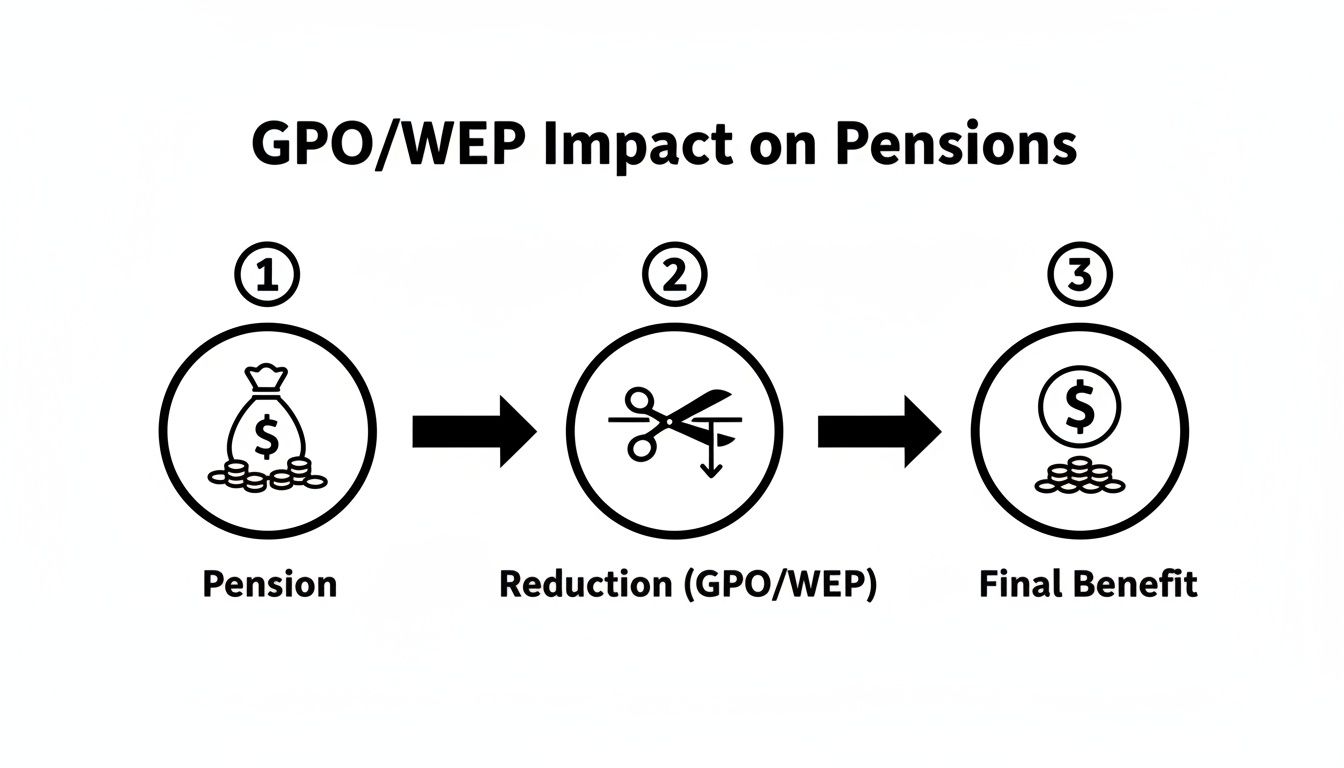
As you can see, your starting pension amount gets hit with a reduction before you end up with your final, smaller benefit.
How to Restart Your Social Security Payments
Getting your benefits flowing again is just as crucial as knowing how to pause them. The steps you'll take depend on why they were stopped in the first place.
If you chose to suspend your benefits yourself, you're in complete control. Your payments will automatically fire back up at the highest possible amount once you hit age 70. But what if your plans change before then? No problem. You don't have to wait. You can contact the SSA anytime and ask them to turn the faucet back on. Your payments will usually resume the very next month.
Interestingly, this idea of adjusting benefits to keep the system healthy isn't unique to the U.S. As a federal retiree, it's worth noting that many countries are exploring similar reforms. For example, some planned global social security reforms and their key updates for 2026 in places like South Korea and Portugal involve tweaking contributions to strengthen their national pension systems. The U.S. voluntary suspension is a powerful tool in that same vein, letting anyone who’s reached their FRA (which is 67 for those born after 1960) stop their benefits to earn an 8% annual credit until age 70, all without having to repay a dime.
If your benefits were stopped involuntarily, they are usually reinstated automatically once you've cleared up the problem. For instance, once you hit your FRA, the earnings limit vanishes. At that point, any benefits that were held back because you earned too much will be recalculated and paid back to you.
When to Get Expert Help with Your Retirement Plan
You've got the basics down on how Social Security suspension works and its power to give your retirement income a serious lift. But there's a world of difference between knowing the rules and applying them perfectly to your specific situation as a federal employee.
Deciding when—or if—to hit pause on your benefits is a huge decision. It's a delicate balance between your health, how long you expect to live, and how your other income sources like your FERS pension and TSP fit into the picture. A small misstep here can have big financial ripples for years to come.
Signs You Might Need an Expert Opinion
While some feds can confidently chart their own course, certain complexities are giant red flags telling you it’s time to call in a pro. Federal retirement is an intricate system, and it’s easy to get tangled up.
If any of these sound familiar, it's probably a good time to get a second opinion:
- You're dealing with GPO or WEP: These two provisions completely change the retirement math. An expert can run the numbers to show you exactly how they’ll affect your suspension strategy and find your real break-even point.
- You're coordinating with a spouse: Your decision to suspend doesn’t just affect you; it impacts your household's entire financial future. A professional can model various timing scenarios to help you maximize your combined lifetime benefits.
- Your financial picture is complicated: Juggling multiple income streams, investments, and a hefty TSP? Integrating your Social Security strategy into that mix is critical, and it's where expert guidance really shines.
For truly thorny issues, like navigating disability claims or dealing with disputes, understanding why hiring a lawyer for a Social Security claim can be beneficial can offer a path forward to securing the benefits you're owed.
The Value of a Professional Analysis
Think of a federal benefits expert as the architect of your retirement plan. They don't just look at one room—they see the entire blueprint. Their job is to analyze how your Social Security, pension, TSP, and healthcare all work together to create a single, solid structure. This holistic view helps you avoid costly mistakes, like not realizing how suspending your benefits could impact your spouse's future income.
A professional analysis cuts through the confusion. It turns complex regulations and dense calculations into a clear, actionable roadmap designed just for you, ensuring every piece of your federal retirement puzzle fits together perfectly.
Here at Federal Benefits Sherpa, this is what we do. We help federal employees move from theory to a concrete plan of action, making sure your choices are grounded in solid math and a real understanding of the system.
For feds who want to squeeze every drop of value out of their hard-earned benefits, finding the right guide is the most important first step. You can learn more by reading our guide on choosing the right employee benefits advisors for your unique needs. Your goal is a stress-free retirement, and getting the right help is how you get there.
Got Questions? We've Got Answers.
When it comes to suspending your Social Security, it's natural to have a few questions. The rules can seem a bit tangled, but once you break them down, they make a lot of sense. Let's tackle some of the most common questions federal employees ask about this powerful retirement tool.
Can I Still Work If My Social Security Is Suspended?
Yes, absolutely. If you voluntarily suspend your benefits once you hit your Full Retirement Age (FRA), you can earn as much as you want without penalty. There's no limit. This is a fantastic strategy for people who decide to keep working and want to supercharge their future Social Security checks, letting them grow by a guaranteed 8% each year they wait.
Now, if your benefits were suspended before your FRA because you were earning too much, that's a different story. In that case, the suspension usually stays in place until you either reach your FRA or your income drops below the yearly earnings limit.
How Does Suspending My Benefits Impact My Spouse?
This is a big one, and something every married couple needs to talk through. When you suspend your own retirement benefits, any spousal or dependent benefits that are being paid out based on your work record are also put on hold.
Key Takeaway: Suspending your benefits isn't just a "you" decision; it's a "we" decision. Your spouse's income will be directly affected, so make sure you're both on the same page about the financial plan. Once you turn your benefits back on, theirs can typically resume as well.
What's the Difference Between Suspending Benefits and Withdrawing My Application?
They might sound similar, but they're two completely different moves with very different outcomes. Mixing them up can be a costly mistake, so let's clear it up.
Withdrawing an Application: This is like hitting the undo button on your entire Social Security claim. You can only do this within 12 months of when you first started receiving payments, and there’s a huge string attached: you have to pay back every penny you and your family have received.
Voluntary Suspension: Think of this more like hitting pause. It’s a strategic move you can only make at or after your Full Retirement Age. You don't have to repay anything, and your future benefit amount actually gets bigger while it's paused.
Do I Have to Wait Until I'm 70 to Start My Benefits Again?
Nope, not at all. While your benefits will automatically kick back on at age 70 (giving you the highest possible payment), you're still in the driver's seat. If life throws you a curveball and you need the income sooner, you can simply contact the Social Security Administration and ask them to restart your payments at any time.
Making sense of these moving parts is what Federal Benefits Sherpa is all about. We help federal employees gain the confidence to make smart retirement decisions. If you're ready to build a personalized plan that coordinates your FERS pension, TSP, and Social Security, let's talk. Schedule your free 15-minute consultation today by visiting us at https://www.federalbenefitssherpa.com.
