Social Security Offset FERS: What Retirees Need to Know
You planned around a federal disability annuity replacing part of your salary. Then the Social Security Disability Insurance decision arrives, and the amount from the Office of Personnel Management is lower than you expected. That's a jarring moment, especially when you're already managing a health change and a new income picture.
The phrase Social Security offset FERS can refer to different rules, and mixing them up leads to bad projections. The central questions are practical: Which benefit can be reduced? How does the calculation work? What can you check before the rules catch you off guard? The answers differ for a disabled retiree, a surviving spouse, and children receiving benefits.
FERS employees pay Social Security taxes, so their federal retirement coverage is coordinated with Social Security in some circumstances, as OPM explains in its overview of related federal benefits. That coordination isn't a general cut to every FERS pension. It's a set of specific rules tied to benefit type, service history, and whether payments overlap. If you're also sorting out how benefits work while living outside the United States, this guide to Social Security benefits living abroad can help clarify a separate set of practical questions.
A Federal Retiree's First Surprise With Social Security
A federal employee leaves work because a medical condition makes continuing impossible. The employee files for FERS disability retirement and, as required, applies for SSDI. When both benefits are approved, the OPM annuity statement doesn't match the unreduced amount the employee had penciled into a household budget.
That doesn't mean OPM has taken away the employee's entire federal pension. It means the disability-retirement formula coordinates the FERS payment with SSDI during months when both are payable. The coordination can still feel like a penalty: one agency approves a benefit, and the other reduces its payment. But the rule is not a blanket subtraction from every FERS retiree's Social Security or retirement income.
The first question to ask isn't “How much Social Security will I get?” It's “Which benefit rule applies to my service and my situation?”
FERS employees pay Social Security taxes, unlike employees in some older federal retirement arrangements who may have had non-covered federal service. That coverage is part of why the programs interact, but it doesn't mean every FERS annuity is automatically reduced. The disability offset, survivor-related eligibility rules, and rules connected to non-covered CSRS service are distinct issues.
This distinction matters because a retiree may hear the word “offset” and assume the same rule applies to a regular retirement annuity, a disability annuity, and a survivor benefit. It doesn't. A sound estimate identifies the benefit being reduced, the months in which both benefits are payable, and any past service that changes the analysis.
The advice I give clients is simple: don't build a retirement-income plan from a single headline number. Get the benefit type and service history right first. Then compare the actual OPM calculation with the Social Security determination.
Understanding the Key Concepts Behind Federal Offsets
Federal employees often hear WEP, GPO, and FERS disability offset used as if they describe one rule. They don't. Treat them as separate mechanisms with different triggers and different benefits in their sights.
The first distinction is whether the federal service was covered by Social Security. FERS employees pay Social Security taxes. Some workers with CSRS service may have federal earnings that weren't covered in the same way. That service history can matter when Social Security and a federal benefit are coordinated.
Three rules, three different questions
WEP, or the Windfall Elimination Provision, is associated with Social Security retirement benefits when a worker also receives a pension based on work that wasn't covered by Social Security. GPO, or the Government Pension Offset, concerns certain Social Security benefits received as a spouse or surviving spouse when the person also has a pension from non-covered government work. These are not names for the FERS disability formula.
The FERS disability offset is a separate calculation. It coordinates a FERS disability annuity with SSDI for concurrent months when the retiree qualifies for both. The formula is explained below, but the key idea is that it targets the disability annuity, not every FERS retirement payment.
| Mechanism | Who it affects | Benefit reduced | Typical trigger |
|---|---|---|---|
| WEP | People with a pension based on non-covered work who also qualify for Social Security retirement | Social Security retirement benefit | Social Security-covered work plus a pension from non-covered employment |
| GPO | Some people with a non-covered government pension who qualify for Social Security through a spouse or former spouse | Certain Social Security spouse or survivor benefits | A pension from non-covered government work |
| FERS disability offset | Eligible FERS disability retirees receiving SSDI for the same period | FERS disability annuity | Concurrent entitlement to FERS disability and SSDI |
A $2,000 Social Security payment doesn't tell you which mechanism applies or whether a particular federal benefit will be reduced. The payment's source, your federal service record, and the type of benefit matter more than the amount by itself.
Don't let a conversation about WEP or GPO substitute for an audit of your own record. The rule's label matters less than whether your earnings were covered and what benefit you're claiming.
How the FERS Disability Offset Works
A FERS disability retiree under age 62 faces two different offset stages. During the first twelve months, the starting annuity is 60% of high-3 average salary, reduced by 100% of SSDI received for the same month. After that, the starting annuity generally becomes 40% of high-3, reduced by 60% of SSDI. OPM outlines this calculation in its information on related federal benefits.
For a retiree with an $80,000 high-3, the initial base is $48,000 annually, or $4,000 monthly, before the SSDI reduction. After the first year, the base is $32,000 annually, or about $2,666.67 monthly, before the 60% offset.
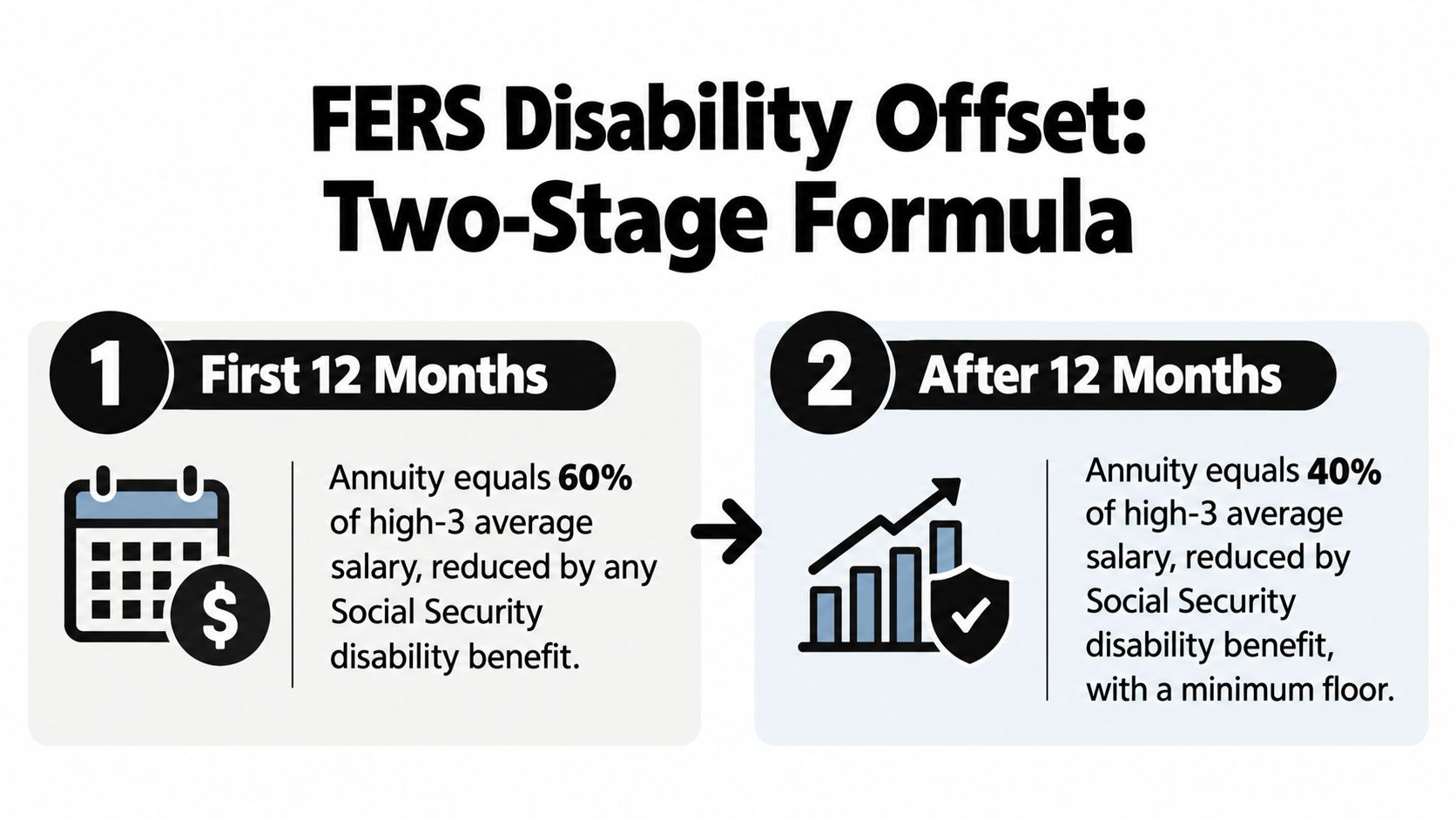
Apply the percentage to SSDI, not to the high-3
The reduction is calculated from the SSDI payment for the same month. For example, if the retiree receives $1,000 in SSDI for a month, the initial 100% reduction leaves $3,000 from the $4,000 starting amount. After the first year, the 60% reduction subtracts $600 from the approximately $2,666.67 starting amount, leaving about $2,066.67.
These examples show the formula, not a personal payment forecast. The offset applies only for months when the retiree is entitled to both benefits. If the earned FERS annuity is higher than the amount produced by the formula, the retiree remains entitled to that earned annuity.
Age 62 changes the calculation. A former FERS disability annuitant with the required Social Security-covered work history may qualify for Social Security retirement benefits, which can partly make up for a lower FERS annuity. Get a personal projection before relying on those benefits to replace a reduction.
For eligibility details and planning considerations, review this FERS disability retirement guide. Confirm your high-3, the SSDI amount for each overlapping month, and the period OPM uses to calculate the offset.
The Mandatory SSDI Application and OPM Coordination
Applying for SSDI isn't an optional tactic for a FERS disability-retirement claim. OPM requires the applicant to apply for Social Security disability benefits and provide documentation of the application or its outcome. The Social Security Administration's guidance on FERS disability coordination describes the relationship between the programs and the service-history issues that can affect an offset.
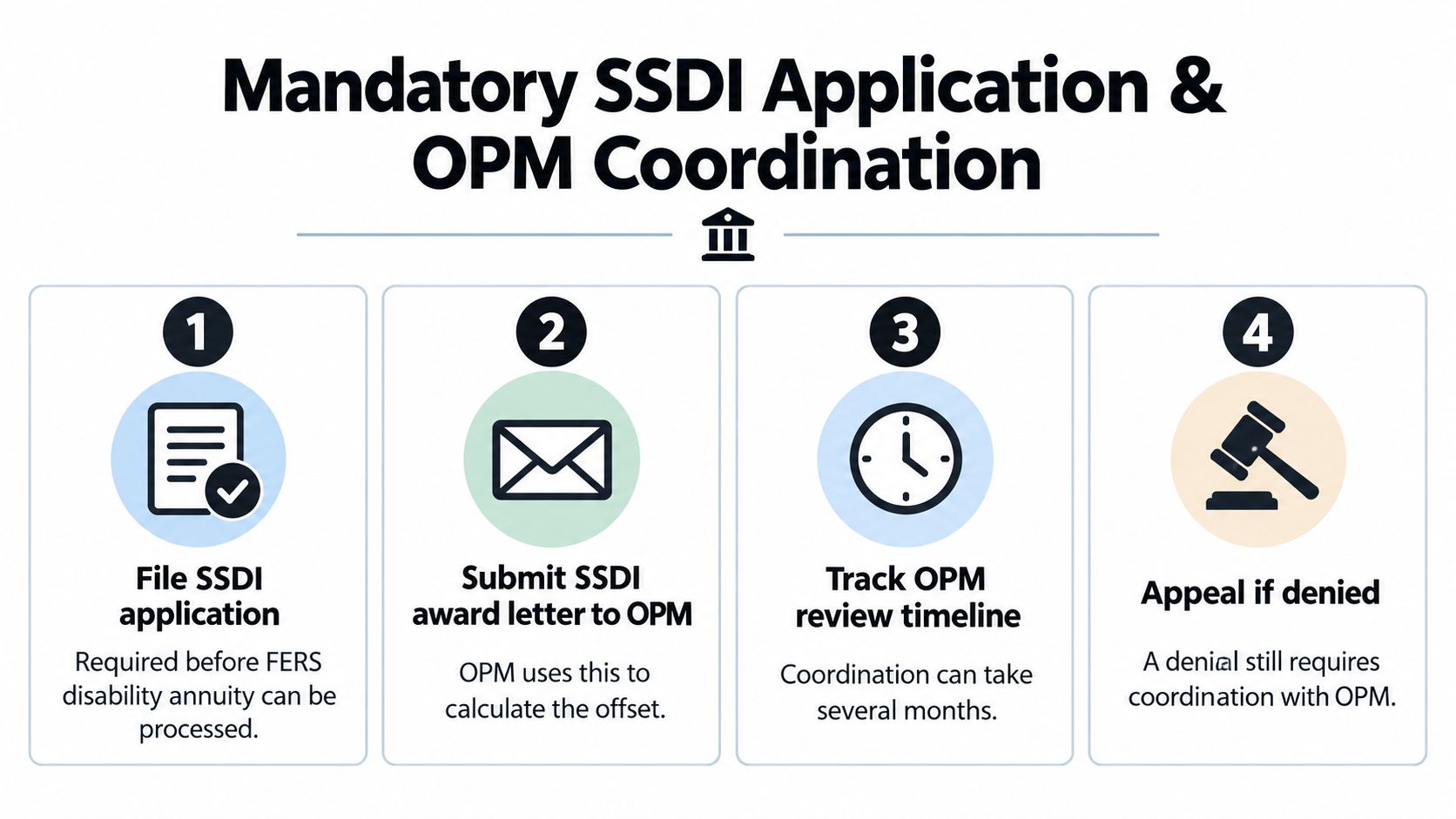
Treat documentation as part of the claim
The OPM retirement package must include the SSDI application receipt or an SSA award notice. OPM can't fully process the FERS disability claim without that evidence. If SSA denies the application, keep the notice and provide it as required. A denial doesn't erase the need to document the SSDI claim and its disposition.
Approval creates another timing issue. If SSDI is approved, OPM applies the FERS reduction retroactively to the SSDI eligibility date. That can mean a balance due for amounts paid before OPM completed its calculation. Don't spend a payment increase or back payment before understanding how the agencies may reconcile the overlapping period.
A withdrawn SSDI application is especially risky. OPM may dismiss the FERS disability application if the applicant withdraws the Social Security claim. Before withdrawing or changing an application, ask how that decision affects both files and get clear guidance from the agencies or a qualified benefits professional.
Practical rule: Keep copies of every SSA receipt, decision, and notice you send to OPM. Record when you sent each document and follow up if the claim file doesn't reflect it.
When the Offset Hits the Survivor and the Family
A family can face several different coordination rules after a federal employee dies. The surviving spouse may receive both a FERS survivor annuity and Social Security, but eligibility for certain FERS survivor supplements can be affected if the survivor qualifies for Social Security mother, father, or disability benefits on the deceased worker's record. That's an eligibility issue, not a simple rule that every survivor payment is reduced by the same amount.
Children's benefits require a separate calculation. OPM says the total FERS benefits payable to children are reduced by Social Security benefits payable to all children, and Social Security can eliminate the FERS child benefit entirely. The household can therefore receive Social Security payments for children while the FERS child payment falls or disappears. Don't assume the two programs add together.
Compare the household, not just one check
| Household situation | What to examine |
|---|---|
| Surviving spouse alone | Whether the spouse qualifies for a FERS survivor annuity and Social Security, and whether any FERS supplement has a separate eligibility restriction |
| Spouse with dependent children | How Social Security payable to the children affects the total FERS benefits payable to them |
| Survivor receiving disability benefits | Whether Social Security disability benefits based on the deceased worker's record affect eligibility for a particular FERS survivor supplement |
A survivor's own Social Security record may also interact with benefits based on a deceased spouse's record under the applicable Social Security rules. Don't assume every payment continues unchanged just because the surviving spouse qualifies for more than one program. The right review lists each payment by recipient and program, then identifies whether it is offset, affects eligibility, or continues independently.
OPM's survivor annuity and Social Security guidance addresses these interactions. For help reviewing election choices and family protections, see this guide to federal employee survivor benefits.
The practical consequence is clear: a survivor election shouldn't be judged only by the retiree's current monthly income. Life insurance, emergency savings, and the number of family members relying on benefits all belong in the same conversation.
This video offers a visual overview to accompany your review of survivor benefits.
Planning Strategies That Actually Reduce the Offset
Federal employees aren't powerless, but the useful move is often to correct the record or plan around the rules, not to search for a loophole. Start with the service history. SSA guidance says FERS disability benefits generally aren't offsettable when the person's entire federal career consisted of FERS-covered employment; special offset rules can arise when the record includes non-covered CSRS service.
That makes an earnings-record and service-history audit more valuable than guessing from a job title or an old estimate. Identify which periods were FERS-covered and whether the record includes non-covered CSRS service. If it does, ask a benefits professional to assess how that history affects the applicable rule before you rely on a projection.
Put planning effort where it can change a decision
- Verify the record first. Compare your federal service history with your Social Security earnings record. Resolve mismatches before building a retirement-income estimate.
- Model disability scenarios. If disability retirement is a possibility, compare the FERS formula with potential SSDI outcomes and account for the fact that approval may affect earlier months.
- Review survivor elections as a household choice. Consider what the spouse and children may receive, and distinguish benefits that are reduced from benefits whose eligibility may change.
- Coordinate claim timing carefully. Social Security timing can affect household cash flow, but don't assume a claim-date choice will remove a FERS offset. Model the actual benefits and rules that apply to you.
- Don't count on converting service without verification. Ask OPM whether any service-credit or deposit option is available for your circumstances and what it changes. A payment or election should never be treated as a fix for a non-covered-service issue until the agencies confirm the result.
A Social Security claiming strategies guide for federal employees can help frame the timing conversation. Federal Benefits Sherpa also offers retirement planning and gap analysis reports that consider Social Security timing and federal benefits. Use any planning tool to test your own service record, not to substitute a generic estimate for an agency determination.
Your Personal Federal Benefits Action Plan
Use a staged checklist, but anchor every task to your actual record. The point isn't to predict every future decision. It's to catch mismatches and eligibility questions while you still have time to respond.
- About five years before retirement: Audit your Social Security earnings and federal service history. Flag any non-covered CSRS service, and review survivor elections alongside your family's expected benefits.
- About three years before retirement: If disability retirement is a realistic concern, ask for a scenario review of the FERS calculation and SSDI coordination. Confirm whether any service-credit question needs an answer from OPM.
- About one year before retirement: Gather service and benefit documents, confirm any required SSDI filing steps, and plan how you'll handle OPM and SSA notices. Review Social Security timing and TSP withdrawals together, rather than treating them as separate income decisions.
A personalized plan should show which benefit may be reduced, who receives each payment, and which agency needs which document. Federal Benefits Sherpa offers a free 15-minute benefit review that can help start a discussion about your own federal benefits and retirement-income picture.
Federal Benefits Sherpa offers personalized retirement planning, benefit reviews, and gap analysis reports to help federal employees assess Social Security timing alongside FERS and other income sources. Visit Federal Benefits Sherpa to request a free 15-minute benefit review and bring your service history, estimates, and family-benefit questions.
