Minimum Retirement Age Rules for Federal Employees
What if reaching your Minimum Retirement Age doesn't mean you should retire, or even that you can afford to? Many federal employees treat that birthday as a finish line. In practice, it's a threshold that opens a set of choices, and the value of those choices depends on your service record, your retirement system, and when you start your annuity. Understanding that distinction early can prevent a permanent benefit reduction that you didn't need to accept.
What Minimum Retirement Age Really Means
Consider a federal employee who is months away from reaching Minimum Retirement Age, often shortened to MRA. She's circled the date on her calendar, told her family she may retire then, and assumed monthly retirement income will begin. Then she checks her service record and discovers the harder questions. Has she completed enough creditable service for the pathway she expects? Will starting an annuity immediately reduce it? Could she leave federal service and start benefits later instead?
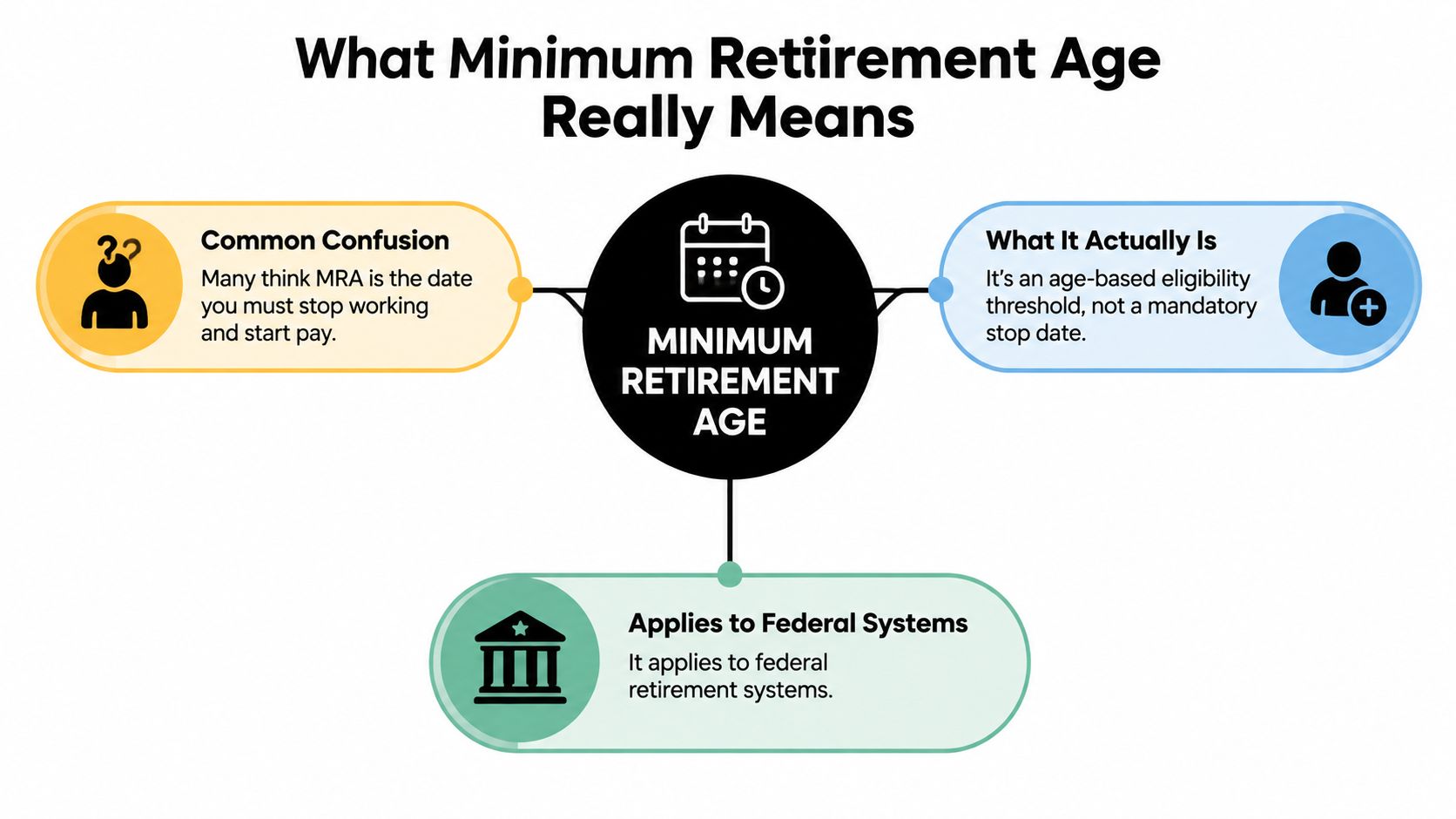
That surprise is common because the phrase sounds like an instruction. It isn't a date when you must stop working, and it doesn't by itself guarantee an unreduced benefit. For FERS employees, MRA is mainly an age based eligibility threshold. It helps determine whether certain retirement options are available, but service years and the annuity start date determine how those options pay.
Three Separate Decisions Readers Often Merge
It's easier to plan when you separate three events that don't have to happen on the same day.
- Becoming eligible: You've met an age and service combination that makes a retirement pathway available.
- Separating from service: You leave federal employment, which is an employment decision as well as a benefits decision.
- Starting the annuity: Monthly payments begin, and the timing can affect whether a reduction applies.
This is why a birth year lookup is only the first step. Two employees with the same MRA can face different outcomes if one has a long service history and the other doesn't. One may qualify for an immediate unreduced annuity, while the other may need to compare a reduced immediate annuity, a later start date, or working longer.
MRA tells you when a door may open. It doesn't tell you whether walking through it immediately is the right financial move.
Before you treat MRA as a retirement date, verify your system, your service computation, and your expected income at more than one possible start date. That simple check turns a single birthday into a practical decision.
Core Federal Retirement Concepts Made Clear
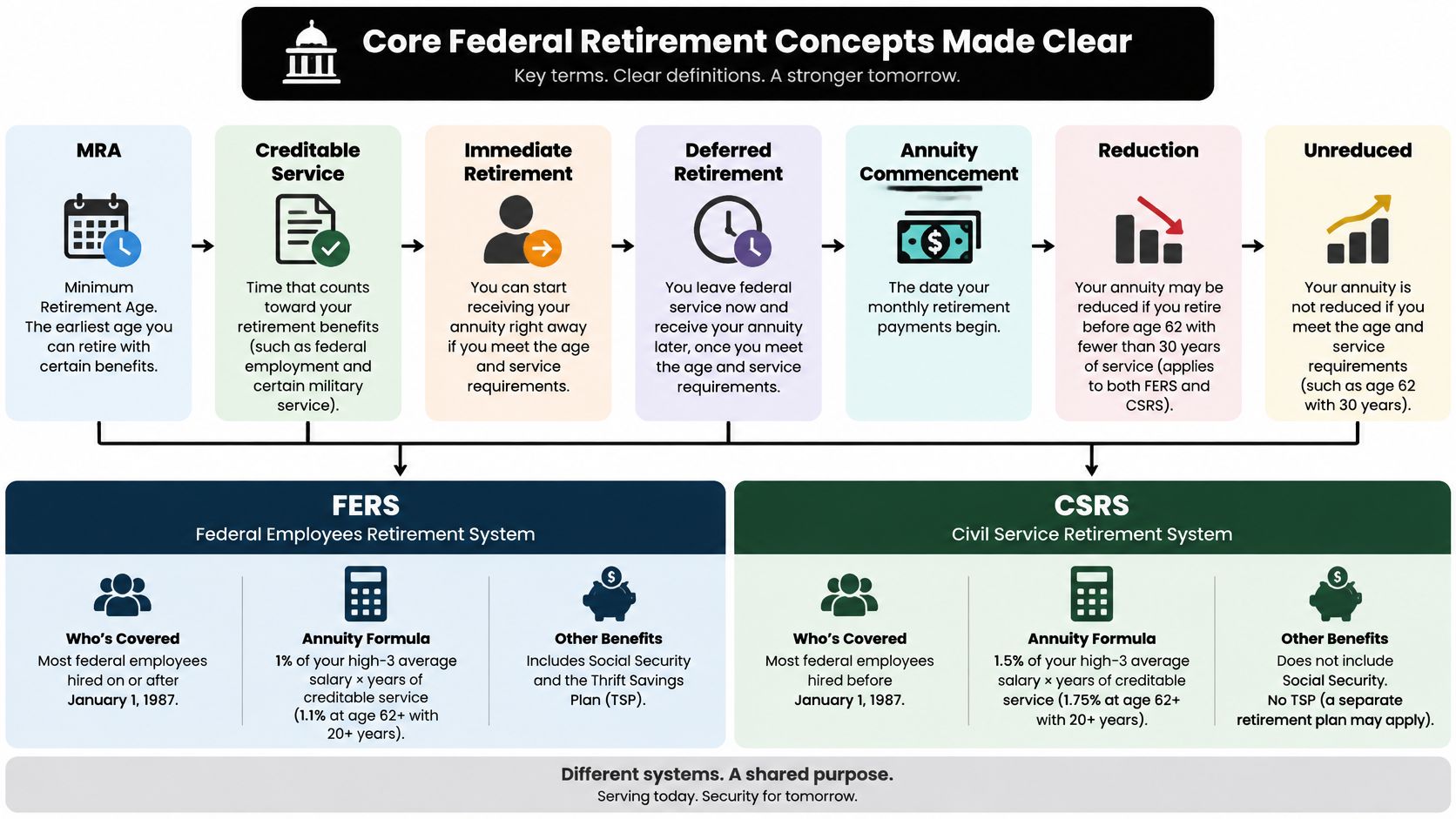
Federal retirement language feels technical because several terms describe different parts of the same process. Think of MRA as a doorway. Reaching it may get you into the room, but creditable service is a second lock, and the date your annuity begins determines what you find inside. If you skip any one of those pieces, you'll misread your options.
Creditable service is the service that counts toward retirement eligibility under your system's rules. It isn't always identical to the time you've spent in a federal job, which is why your official record matters. Breaks in service, part time work, deposits, and other record issues can change the picture, so you shouldn't rely on memory or a start date alone.
Eligibility, Separation, and Commencement
An immediate retirement generally means your annuity begins close to separation because you've met the applicable age and service requirements. A deferred retirement is different. You leave federal service before you're eligible for an immediate annuity, then apply for benefits later when you meet the requirements for that deferred benefit. Annuity commencement is the point when payments start, and it's the date that can matter greatly for reductions.
A reduced annuity starts under a pathway that applies a permanent age based reduction. An unreduced annuity starts under a pathway that avoids that particular reduction. Those labels don't describe whether the amount is large or small, because service length and salary history also affect the calculation. They describe how the timing rules treat your benefit.
- Start with age: Confirm the threshold that applies to your birth year and system.
- Then check service: Confirm how much service is creditable for eligibility.
- Then model timing: Compare starting immediately with postponing benefits or working longer.
If you're building broader context on how pensions fit into household income, retirement planning with Fintrack can help you connect pension basics with the federal rules you're reviewing here. For federal employees, though, the core lesson is specific. Don't ask only what your minimum retirement age is. Ask what service you have, when you'd separate, and when you'd want the annuity to begin.
FERS and CSRS Rules Compared
Your first filter is your retirement system. FERS and CSRS don't use identical structures, so an explanation written for one system can mislead an employee covered by the other. That's especially important when colleagues share advice based on their own careers. Their age and service pathway may be correct for them and wrong for you.
Under FERS, the Minimum Retirement Age ranges from 55 to 57 depending on birth year, and employees born before 1948 have an MRA of 55, those born from 1953 through 1964 have an MRA of 56, and employees born in 1970 or later have an MRA of 57, as shown in the OPM guidance on FERS eligibility and Minimum Retirement Age by birth year. The age rises gradually for some birth years between those anchors, so you need your exact birth year rather than a rounded estimate.
CSRS employees should apply CSRS provisions to their own records and shouldn't import FERS labels or formulas. If you're unsure which system covers you, or you have service that may involve both, start with a clear explanation of the difference between CSRS and FERS for federal employees before you estimate anything.
Federal Retirement Systems at a Glance
| System | MRA framework | Service based retirement focus | Planning issue |
|---|---|---|---|
| FERS | Birth year based MRA | Different age and service combinations lead to different annuity treatment | Separating eligibility from an unreduced start date |
| CSRS | Governed by CSRS provisions | Service and the applicable CSRS retirement rules drive the analysis | Avoiding FERS formulas that don't apply to the record |
Why FERS Labels Include Service Numbers
FERS planning often uses shorthand such as MRA+10 and MRA+30. Those labels combine the age threshold with a service level. They aren't separate retirement ages. They're reminders that reaching MRA is only half of the test.
An employee who reaches MRA with a shorter qualifying service history may have an immediate option that carries a reduction. An employee who reaches MRA with much longer service may qualify under a pathway that avoids that reduction. The age on the calendar is the same, but the retirement outcome isn't.
Practical rule: Identify your system first, your birth year second, and your creditable service third. Only then should you estimate income.
That order prevents the most common comparison error. You aren't choosing between FERS and CSRS as products. You're reading the rules that already govern your record, then deciding how to time separation and benefit commencement within them.
How Service Years Change the Retirement Outcome
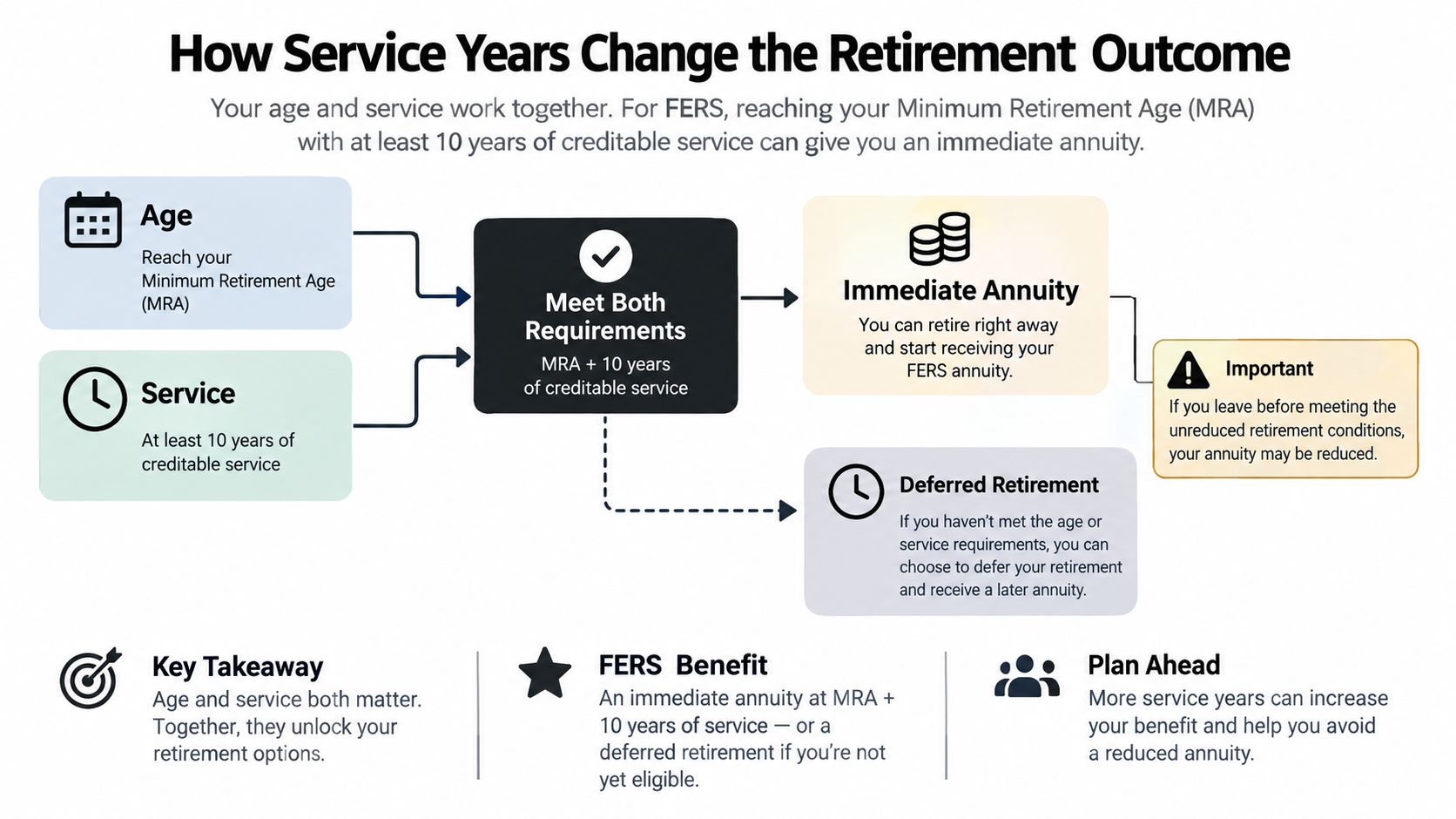
Service is where minimum retirement age becomes financially concrete. An employee can reach MRA and still face a choice between income now at a reduced level, income later with less or no age reduction, and continued federal employment until a stronger eligibility point. Those aren't minor administrative differences. They shape monthly cash flow for the rest of retirement.
Start by verifying the record behind the calculation. A careful review of your service computation date and what it means for retirement eligibility can reveal whether the service you think you have matches the service that will count. If there's an error or an unresolved deposit issue, finding it before you choose a separation date gives you more options.
The MRA+10 Reduction
Under the FERS MRA+10 pathway, an employee who has reached MRA with at least 10 years of creditable service can generally claim an immediate annuity, but that annuity is reduced by 5% for each year under age 62, calculated as 5/12 of 1% for each month, according to the OPM overview of FERS retirement types and the MRA+10 reduction. The monthly calculation matters because even a partial year under the threshold affects the result.
Think through the logic without needing a personal estimate. If you start several years before the unreduced reference age in that formula, the reduction is applied across that full gap. If you postpone commencement and move closer to that age, the portion of the gap subject to the formula shrinks. Postponing doesn't create income during the waiting period, though, so you need a plan for living expenses and health coverage during any gap.
The key question isn't only whether you can start. It's what you give up, permanently, by starting at the first available date.
Pathways That Avoid That Reduction
The same OPM overview distinguishes MRA+10 from pathways such as reaching MRA with 30 years of service, reaching age 60 with 20 years, or reaching age 62 with five years, which can avoid the MRA+10 age reduction when the applicable requirements are met. That's why service milestones can be more important than a birthday by itself. An employee who is close to a longer service threshold may change the treatment of the annuity by staying longer, while an employee far from that threshold may focus instead on postponement.
Use three variables for every comparison:
- Age at separation: When you stop federal employment.
- Creditable service at separation: Which pathway you qualify under.
- Annuity commencement age: When payments begin and whether the reduction formula still applies.
Deferred benefits add another layer for employees who leave before claiming. Don't assume deferred retirement and an immediate MRA+10 retirement produce the same result, because eligibility, timing, and related benefit access can differ. Model both the separation date and the commencement date before you decide. A few months can matter when a formula is calculated month by month, and a service threshold can matter even more.
For a practical timeline, write down your earliest eligible date, the next service milestone, and the date when an unreduced pathway could become available. Then estimate income at each point with your agency or a qualified professional using your verified record.
Birth-Year and Service Examples
Examples help because they show how the same rules produce different decisions. The scenarios below illustrate timing only. They aren't personal benefit estimates, and they don't replace an official calculation based on your salary history and verified service record.
The image below reflects the kind of calendar based conversation many employees have with a colleague, HR specialist, or adviser when they move from a target birthday to a workable date.

Example One and Example Two
Example one is an employee in the earliest FERS birth year group, with an MRA at the low end of the range covered earlier and a service record that only reaches the MRA+10 level. She can consider an immediate annuity, but starting well before the reduction reference age means the monthly formula has a long period to work across. Her central question isn't eligibility. It's whether immediate income is worth accepting the reduction, or whether postponing commencement produces a better long term fit if she can fund the interim period.
Example two is an employee whose birth year places MRA in the middle of the range and who reaches that age with a much longer service record that meets the MRA+30 concept. His planning conversation is different because the service component changes the annuity treatment. He still needs to review health benefits, taxes, survivor choices, and other income timing, but he isn't weighing the same MRA+10 reduction question.
The short video below gives you another way to hear the timing issues explained before you compare the remaining scenario.
Example Three and What It Teaches
Example three is an employee in the later birth year group who separates at MRA with enough service for MRA+10 but postpones the annuity instead of starting it immediately. She may use savings, other household income, or part time work during the gap. In exchange, moving commencement closer to the age used in the reduction formula can reduce or eliminate that specific reduction, subject to the applicable rules. She must also check how postponement affects related benefits, because delaying payments isn't a purely mathematical choice.
Two employees with the same birth year can therefore reach opposite conclusions. One may value leaving federal service as soon as possible and accept a reduced annuity. Another may stay until a service milestone changes the pathway. A third may leave work but delay payments.
What these examples can establish is the structure of the decision. What they can't establish is your best date, because your health coverage needs, household income, taxes, survivor needs, and verified service record may point in a different direction.
Compare MRA, 60, 62, and 67
Federal employees often hear four ages in the same conversation and treat them as competing answers to one question. They're better understood as separate milestones on one timeline. MRA is a federal system threshold. Age 60 matters because it pairs with a specific FERS service pathway covered earlier. Age 62 matters both in the MRA+10 reduction formula and as an early Social Security milestone. Age 67 belongs to Social Security's full benefit rules for a particular birth year group.
Social Security retirement benefits may begin as early as age 62, while full retirement age varies by birth year and reaches 67 for people born in 1960 or later, according to the Social Security Administration fast facts on retirement benefit claiming ages. That doesn't make 62 a full benefit age. It makes 62 an earliest claiming point, with a different benefit treatment from waiting until full retirement age.
- MRA: Ask whether a FERS immediate pathway is available and what service accompanies it.
- Age 60: Ask whether your service record aligns with the specific FERS pathway tied to that age.
- Age 62: Ask how it affects the federal reduction comparison and whether early Social Security fits your household plan.
- Age 67: Ask how Social Security full retirement age affects the value of delaying that benefit.
Why These Ages Are Not Interchangeable
United States policy history shows why labels matter. Social Security's full retirement age was 65 when the program was established in the 1930s, and the Social Security Amendments of 1983 legislated a gradual increase to 67, phased in by birth year beginning with workers born in 1938, as detailed in the Congressional Research Service history of Social Security full retirement age changes. Early benefits could still begin before full retirement age, but with a permanent reduction.
International comparisons reinforce the same planning point without giving you a personal target. The OECD reported that in 2022 the average normal retirement age was 63.6 for women and 64.4 for men, with a general range of 62 to 67 across OECD countries excluding Türkiye under specific conditions, in its OECD Pensions at a Glance 2023 comparison of normal retirement ages. Normal, early, and full benefit ages are separate concepts in those systems too.
Build a cash flow timeline rather than searching for one universal best age. Mark when federal income could start, when it could start without the MRA+10 reduction, and when Social Security choices change. The right sequence depends on the years between those marks.
Plan the Transition Between Benefits
Once you know your milestones, the planning task is sequencing. You may leave federal service at one age, start a FERS annuity at another, claim Social Security later, and draw from the Thrift Savings Plan across the gap. If those dates don't line up, the issue isn't only total lifetime income. It's whether monthly cash flow works in each year of the transition.
Start with the bridge period between FERS eligibility and Social Security full retirement age. During that period, you might rely on a reduced or unreduced annuity, savings, TSP withdrawals, a spouse's income, or other work. Each source has tax and longevity implications, so you shouldn't choose a claiming date only because it is the earliest available. For employees who may qualify for a bridge related benefit, review how the Social Security supplement for federal employees works fits with your own eligibility record and timing.
A Short Pre Decision Checklist
- Verify records: Confirm your system, birth year based MRA, creditable service, and service computation information.
- Model at least three dates: Compare earliest commencement, a postponed start, and an unreduced pathway.
- Map the income bridge: Identify which source pays each year before Social Security reaches the age you prefer.
- Check health coverage: Confirm how separation, immediate retirement, deferred benefits, or postponement affects continuation.
- Review household items: Include taxes, survivor needs, housing costs, and any state specific relief that applies to you.
Housing costs deserve a separate line in that review because property taxes don't retire when you do. Texas homeowners, for example, may want to understand freezes and deferrals for Texas seniors as one part of a broader cash flow check, while employees elsewhere should look for the rules in their own state.
Some employees can run this comparison with agency estimates and a spreadsheet. Others have breaks in service, military deposits, part time work, divorce related orders, survivor concerns, or complex health coverage questions. Federal Benefits Sherpa is one option for a benefits review and retirement gap analysis, and your agency HR office and OPM resources can also help verify official eligibility details. Use individualized guidance before you submit paperwork, not after a reduced commencement date is already locked in.
If you're approaching your minimum retirement age and want your FERS or CSRS eligibility, service record, annuity timing, TSP, health coverage, and Social Security sequence reviewed together, Federal Benefits Sherpa offers personalized benefit reviews, retirement planning, and gap analysis reports for federal employees. Visit Federal Benefits Sherpa to request a review and turn your earliest eligible date into a retirement plan you can test before you separate.
