How Early Can I Retire? a Federal Employee Guide
You've run the numbers, checked your service history, and started asking the question that matters most: how early can I retire from federal service without creating a financial or healthcare crisis? The answer isn't one universal age. It depends on whether you're covered by FERS or CSRS, your creditable service, your retirement category, the reduction you're willing to accept, and how you'll pay for life before Social Security and Medicare become available.
Eligibility is only the first checkpoint. A retirement date can be legally available yet financially impractical if your annuity is reduced, your TSP withdrawals are poorly timed, or you leave without a healthcare bridge. The most reliable way to evaluate early retirement is to treat it as a sequence of decisions, not a single age milestone.
Determining Your Federal Retirement Eligibility
A federal employee often starts with a simple question. Someone might be 52, have more than two decades of service, and assume that means they can leave immediately with an unreduced pension. Another employee may have fewer years but qualify for a different route through their Minimum Retirement Age. Both may ask, “How early can I retire?” and receive different answers.
The first task is identifying the retirement system. FERS and CSRS don't use the same eligibility framework, and your agency's benefits office or official retirement records should confirm which system covers you. A practical overview of the foundational requirements is available in this federal retirement eligibility guide.
Start with the retirement system
FERS generally combines a basic annuity, Social Security, and the Thrift Savings Plan. That combination gives employees several income sources, but it also creates timing issues. Leaving federal service before Social Security or Medicare begins means the annuity and personal assets must carry more of the early-retirement load.
CSRS follows an older pension-centered design. Employees covered by CSRS shouldn't assume that FERS pathways automatically apply to them. The relevant age and service rules, refund decisions, survivor elections, and coordination with other benefits require a separate review.
Separate eligibility from affordability
A benefits counselor will usually ask for more than your age. You'll need a verified service history, including any military service you're claiming, periods of part-time work, prior federal employment, refunded service, and the retirement coverage attached to each period. A service year that appears on a personnel record may not produce the result you expect until the agency confirms how it counts for retirement.
For FERS employees, OPM identifies immediate early-retirement paths at age 50 with 20 years of creditable service, or at any age with 25 years of creditable service. OPM also recognizes an MRA+10 route for an employee with at least 10 years of service who reaches the applicable Minimum Retirement Age. That route carries a permanent reduction if the annuity begins before age 62 unless it's deferred or postponed. These rules apply only when the separation circumstances and other requirements fit the applicable retirement category.
Practical rule: Don't circle a retirement date until you've verified both the eligibility route and the income plan that supports the date.
Your earliest lawful departure may not be your earliest sustainable departure. The difference usually comes from the bridge years, especially the period before Social Security and Medicare.
Comparing FERS and CSRS Early Retirement Paths
FERS offers early-retirement doors that many employees associate with federal service, but those doors aren't interchangeable with every retirement system or every separation scenario. The key is to compare the age and service combination with the benefit consequences.
For FERS employees, OPM lists the standard immediate retirement paths as age 50 with 20 years of creditable service or any age with 25 years. OPM also describes MRA+10, which applies when an employee has at least 10 years but fewer than 30 years at separation, reaches their MRA, and accepts a reduction of 5% for each year under age 62 if the annuity begins immediately. The official FERS retirement types guidance should control any final decision.
The milestones side by side
| System | Earliest Standard Age | Required Service Years | Key Distinction |
|---|---|---|---|
| FERS | 50 | 20 | Immediate early retirement may be available when the applicable separation and agency conditions are satisfied |
| FERS | Any age | 25 | Service length can open an early path without a stated minimum age, subject to the applicable rules |
| FERS | Minimum Retirement Age | 10 | MRA+10 can provide an immediate annuity, but starting before 62 creates a permanent reduction |
| CSRS | Varies by applicable provision | Varies by applicable provision | CSRS employees must use CSRS-specific age, service, and separation rules rather than assuming FERS milestones apply |
The table shows why an age-only answer fails. A FERS employee with 25 years may be evaluating a different route from an employee with 20 years who is approaching age 50. An employee with 10 years may have an MRA+10 option, but the immediate benefit reduction can make postponement more sensible.
Read the conditions, not just the headline
The age and service numbers are only part of the analysis. Some FERS early retirements depend on an involuntary separation, a major reorganization, or an approved early-out authority. OPM states that early retirement is generally limited to specific separation situations rather than being an unrestricted choice available to anyone who reaches a preferred age. The agency's FERS eligibility information explains why the same employee profile can produce different outcomes depending on how separation occurs.
CSRS employees face their own framework, and the comparison shouldn't be treated as a shortcut. Your retirement estimate should identify the system, retirement type, separation reason, service credit, annuity reduction, survivor election, and benefit start dates. Without all of those inputs, “I can retire at 50” may describe eligibility in theory but not a complete retirement plan.
Navigating the MRA Plus 10 Rule
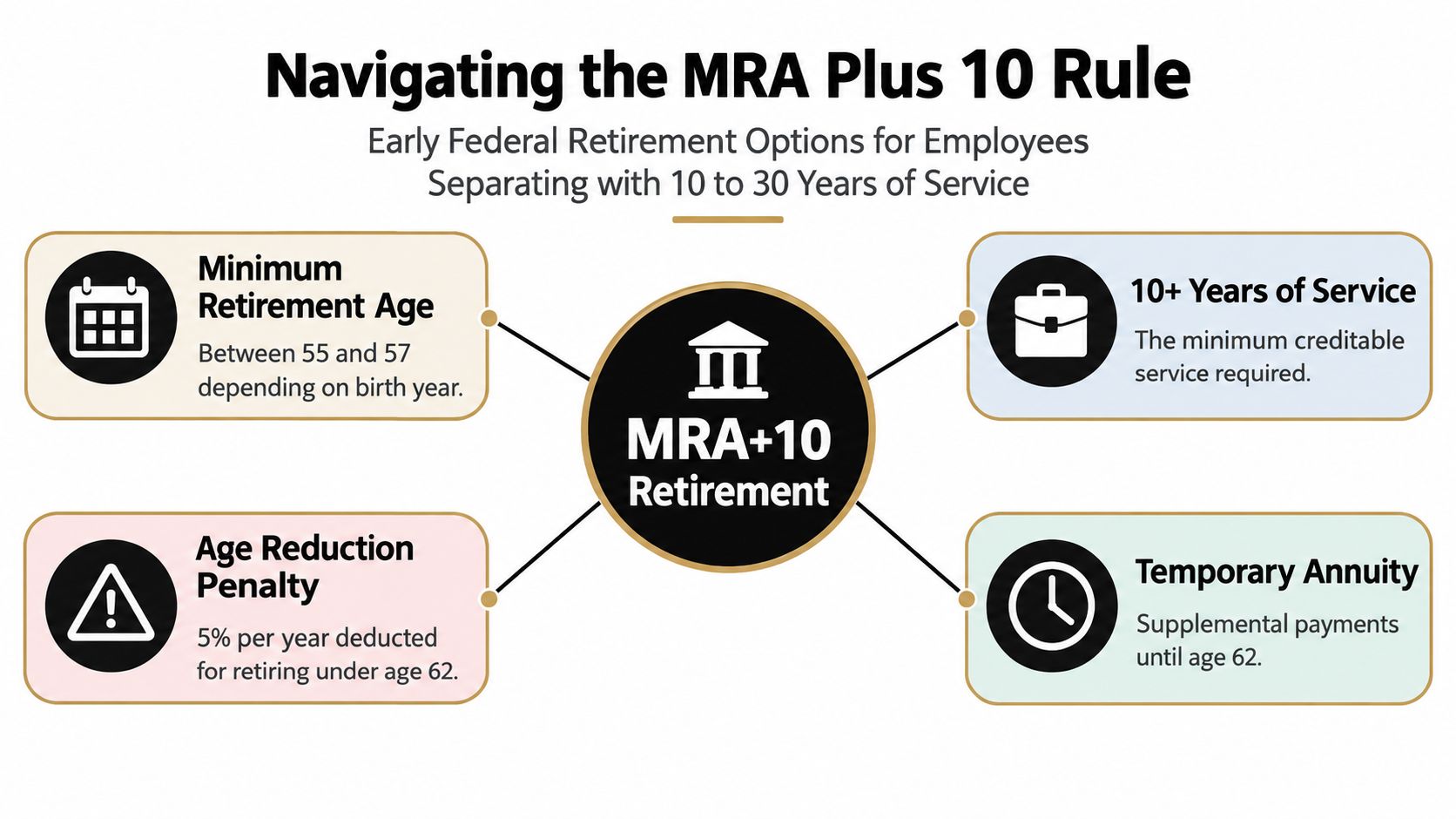
MRA+10 is often the option employees discover when they don't qualify for an earlier FERS route. It can allow an employee with at least 10 years of service to receive an annuity after reaching the applicable Minimum Retirement Age, but the immediate payment may be permanently reduced when it begins before age 62.
The reduction is 5% for each year under age 62, according to OPM's FERS retirement rules. That reduction isn't a temporary inconvenience. It changes the amount of the annuity for the rest of the payment period unless the employee chooses to defer or postpone the annuity instead.
Immediate payment versus postponed income
Suppose an employee reaches MRA with 10 or more years of service and wants to leave immediately. Starting the annuity may provide income right away, but the employee accepts the age-based reduction. Postponing the annuity can avoid or reduce that particular cost, but it also means the employee must fund the period between separation and the annuity start date.
That creates a decision with two separate questions:
- Cash-flow need: Can your TSP, savings, part-time income, or household income cover the delay?
- Lifetime income: Is immediate access worth accepting a lower annuity for the long term?
An employee with substantial liquid assets may prefer postponement. Someone leaving an unhealthy workplace with limited alternatives may value immediate income even after the reduction. Neither choice is automatically correct.
Check the calculation before choosing the date
The reduction should be modeled against your expected spending, survivor benefit election, taxes, and other income. A reduction that looks manageable on a benefits estimate may become difficult when paired with health insurance premiums, dependent coverage, housing costs, and irregular expenses.
MRA+10 also shouldn't be confused with an unreduced retirement. Reaching MRA doesn't erase the age reduction. The practical question is whether you're buying additional freedom at a cost your later budget can absorb.
The right comparison isn't “retire now or work forever.” It's “start the annuity now, postpone it, or use another income source while preserving more guaranteed income.”
Review the estimate under each scenario. Ask your agency or a qualified federal benefits professional to verify the service record and the start-date assumptions before you file.
Special Rules for Safety and Law Enforcement
Employees in law enforcement, firefighting, air traffic control, and other covered special categories may have retirement rules that differ sharply from regular FERS provisions. The job title alone isn't enough. Coverage depends on the position, duties, appointment, retirement deductions, and agency documentation.
A common mistake is assuming that performing physically demanding work automatically creates special retirement eligibility. It doesn't. Your official position history and retirement coverage must support the category.
Confirm the position before planning around it
Start by checking the position description, personnel records, and retirement deductions. Ask the agency retirement counselor to confirm whether the position is covered as a special category and whether all periods of service qualify. A transfer into a regular position can change the analysis, particularly when the employee assumes that earlier special-category service guarantees the same retirement treatment after separation.
The next step is to distinguish an immediate annuity from a deferred benefit. Special-category rules may permit earlier retirement, but the result can depend on whether the employee meets the required age and service combination at separation. Leaving before the required milestone can produce a different benefit or eliminate access to the special formula.
Watch the timing
Safety-sensitive employees should also review the consequences of leaving before the qualifying window. The pension may be only one part of the decision. TSP access, Social Security timing, survivor benefits, insurance continuation, and any special supplement must be evaluated together.
Use a written checklist:
- Verify coverage: Confirm the official special-category designation.
- Count qualifying service: Separate special-category service from regular civilian or military service.
- Confirm the separation route: Determine whether the planned departure qualifies for an immediate benefit.
- Model the income bridge: Calculate how the household will pay expenses before other benefits begin.
- Review insurance: Confirm how health and life insurance continue after separation.
The advantage of special-category coverage is real only when the employee satisfies the precise rule. A benefits estimate based on an incorrect job classification can send a retirement plan in the wrong direction.
Funding Your Early Years With the TSP
A FERS annuity can provide a foundation, but early retirement usually requires more than one income source. The TSP often becomes the flexible account that funds the years between federal separation and later Social Security or Medicare milestones.
That flexibility creates responsibility. A withdrawal plan must account for market volatility, taxes, inflation, healthcare costs, and the possibility that the bridge lasts longer than expected. Treating the TSP as an unlimited paycheck can force larger withdrawals during a market decline and leave less capital for later life.

Build the bridge around spending
Begin with the expenses that won't disappear when your paycheck does. Housing, food, utilities, insurance, taxes, debt payments, and family support belong in the first version of the plan. Then identify expenses that may rise after retirement, especially travel, medical care, or support for dependents.
Next, divide income into three layers:
- Guaranteed income: Your FERS annuity and any other predictable household income.
- Flexible portfolio income: TSP withdrawals and taxable savings used to fill the spending gap.
- Later benefits: Social Security and Medicare, each with its own start date and eligibility rules.
This structure prevents a common error, using the TSP to replace the entire working paycheck when the annuity already covers part of the need. It also helps you decide whether to claim Social Security early or preserve the account for a longer bridge.
For broader account coordination, employees may also browse wealth management IRAs as part of a review of retirement assets outside the TSP. The account type matters less than the withdrawal sequence, tax treatment, investment allocation, and role each account plays.
A practical TSP withdrawal plan should specify which account supplies income, how often distributions occur, and what happens if markets fall. It should also leave room for taxes. Gross withdrawals aren't the same as spendable income.
This guide to using the TSP can help organize the account decisions, but your personal withdrawal strategy should reflect your retirement date and household budget.
Before making a distribution decision, review the account mechanics and your tax situation with a qualified professional. This video may help frame the discussion about TSP planning:
A bridge works when it has an end point, a spending limit, and a fallback plan. “I'll take what I need from the TSP” isn't a retirement strategy until those details are written down.
Managing Healthcare During the Gap
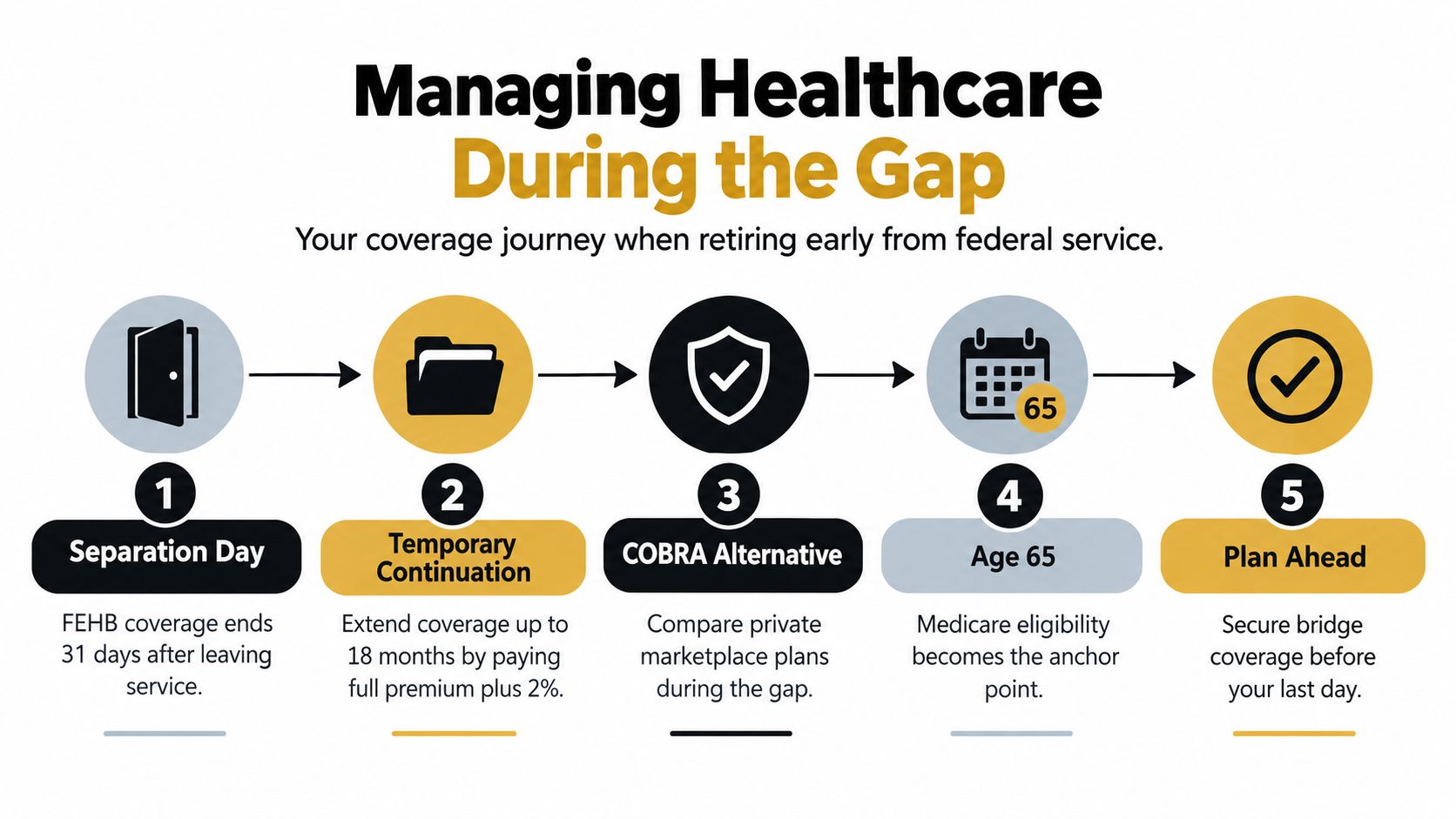
Leaving federal service doesn't automatically solve healthcare. If you retire before Medicare eligibility, you need coverage for the period between your separation and age 65, when Medicare generally becomes the central healthcare milestone. That gap can be more financially disruptive than the pension decision itself.
Your options may include continuing employer-sponsored coverage temporarily, enrolling through a spouse, using an ACA Marketplace plan, or evaluating Medicaid eligibility where applicable. Each option has different enrollment rules, provider networks, premiums, deductibles, and income effects. Compare them before your final day rather than waiting until coverage has already ended.
Protect the transition
Ask the benefits office for written confirmation of when active coverage ends and which continuation options apply. Temporary continuation can be expensive because the retiree may pay the full premium plus an administrative charge. It may still be useful for a short bridge, especially when maintaining an established provider network matters.
The Marketplace can offer another route after a qualifying loss of employer coverage. A spouse's plan may also be practical if the spouse remains employed and the plan permits enrollment. Don't assume the cheapest monthly premium produces the lowest total cost. A plan with a narrow network or high out-of-pocket exposure may be unsuitable for a household managing ongoing treatment.
The FEHB and Medicare guide for federal retirees provides a useful framework for reviewing how the programs interact.
Put healthcare into the retirement budget
Healthcare planning should include more than the premium. List prescriptions, specialist visits, dental and vision needs, deductibles, coinsurance, and travel requirements. Then test the budget against different income levels, because taxable TSP withdrawals and other income can affect Marketplace assistance.
The OECD reports that retirement ages are moving higher in many developed markets, with projections for people entering the labor market at age 22 in 2022 reaching average normal retirement ages of 65.8 for women and 66.3 for men across member countries. That policy direction reinforces the need to plan for a longer period between leaving work and receiving later-life benefits. See the OECD public pensions overview for the organization's retirement-age benchmarks and projections.
Never set a federal retirement date without a written healthcare plan for every person on your coverage.
Calculating Your Personal Retirement Date
Your earliest realistic date is the first date when four pieces work together: the retirement system and eligibility route, verified creditable service, a sustainable income bridge, and healthcare coverage.
Use this checklist:
- Confirm your MRA and retirement system. Identify whether FERS, CSRS, or a special category applies.
- Verify service credit. Review civilian, military, part-time, refunded, and transferred service with your agency.
- Compare annuity starts. Model immediate, postponed, and deferred options, including any age reduction.
- Map TSP income. Decide how withdrawals will support spending before later benefits begin.
- Close the healthcare gap. Arrange coverage before separation and account for Medicare eligibility at 65.
For broader retirement-planning context, you can also review these 2026 retirement planning tips, while recognizing that federal benefits rules require a U.S.-specific analysis.
Federal Benefits Sherpa offers personalized benefit reviews, retirement planning, gap analysis reports, and education on TSP, healthcare, and Social Security decisions. If you're weighing an early FERS retirement, visit Federal Benefits Sherpa with your service history and estimated retirement date so you can test eligibility, income, and healthcare together.
