FERS Disability Retirement Process: A Step-by-Step Guide
Your doctor says you need to stop working, your supervisor is waiting on HR, and HR is waiting on medical paperwork. Meanwhile, you're trying to understand whether leaving federal service will protect your health or create a benefits problem you can't undo.
The FERS disability retirement process requires coordination, but you shouldn't let someone else's unfinished attachment control your filing. The practical task is to build clear medical and employment evidence, identify what's missing, and protect your filing deadline while the remaining records are collected.
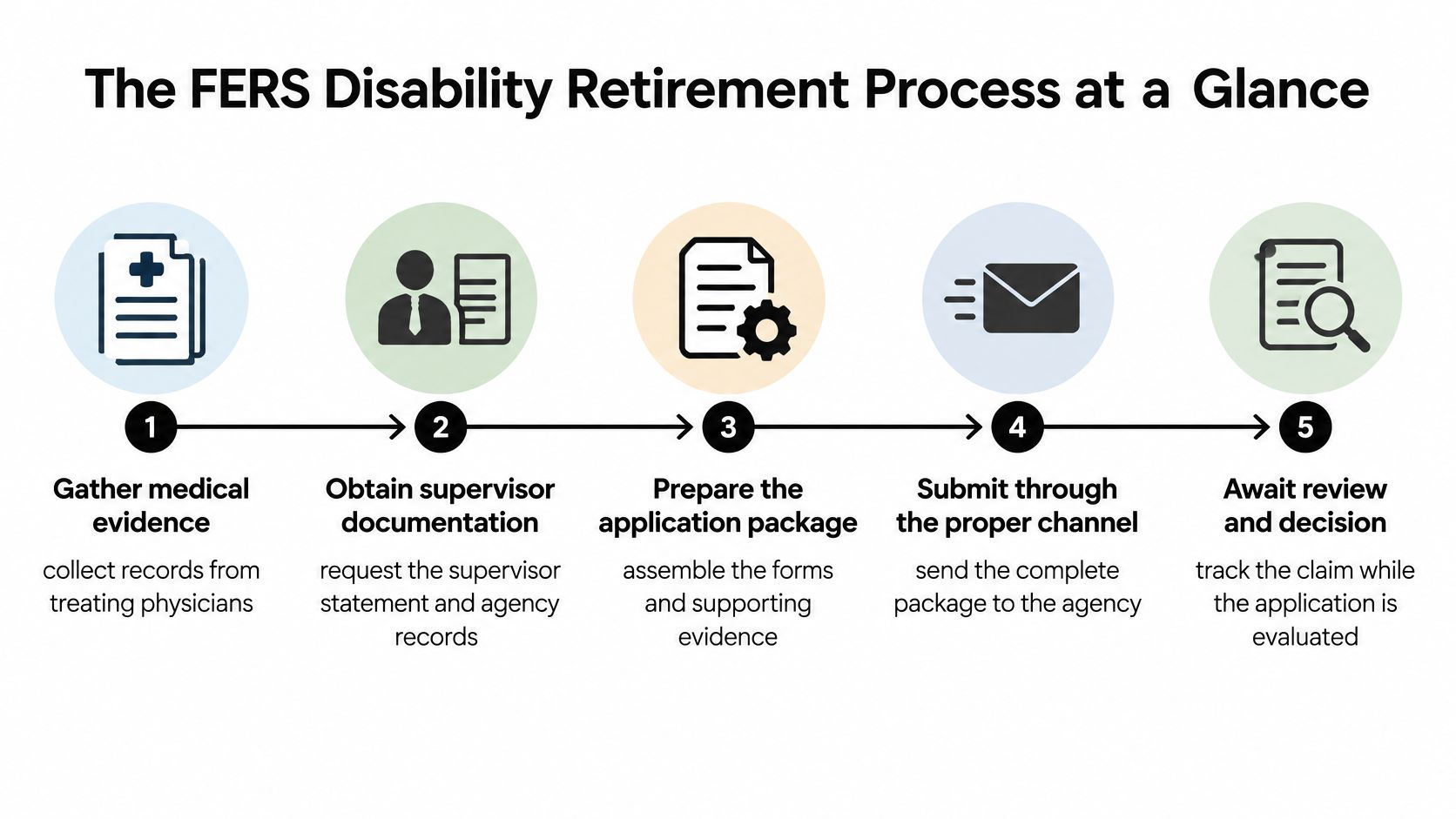
The FERS Disability Retirement Process at a Glance
The route starts with your records, not with OPM's review. You gather medical evidence, request agency documentation, prepare the retirement application, submit it through the appropriate channel, and respond to OPM's requests until it issues a decision.
A denial can lead to reconsideration and, if necessary, an appeal to the Merit Systems Protection Board, or MSPB. Those are separate stages with their own instructions, not reasons to postpone preparing a strong initial application.
Use this visual to understand the sequence, then confirm the correct submission route for your employment status.
Separate your work from other people's work
Your physician supplies the medical explanation. Your supervisor describes your duties and employment difficulties. HR documents accommodation and reassignment efforts and helps assemble the agency's records.
You control your applicant statement, requests for documents, follow-up log, and copies of what you submit. You don't control how quickly a physician signs a report or an agency completes its certification.
FERS disability retirement phases, actors and timing
| Phase | Who Acts | Typical Timing |
|---|---|---|
| Gather medical evidence | You and your physicians | Start months before separation |
| Agency certification | Supervisor and HR | Request before separation when possible |
| File application with OPM | You, with agency involvement when appropriate | Before the separation-based filing deadline |
| Initial OPM decision | OPM | After receipt and any necessary evidence development |
Treat these as planning stages, not guaranteed turnaround commitments. Medical offices may need your position description before preparing a useful report, and HR may need to retrieve accommodation correspondence before completing its certification.
Start a tracking sheet with columns for the document, responsible person, request date, promised response, and next action. Keep your actual separation record with it so you're planning from the official personnel action rather than an anticipated last day at work.
Practical rule: Request records in parallel. Don't wait for your physician's report before asking your supervisor and HR for their portions.
Plan for review without assuming a payment date
Submitting an application and establishing entitlement are different events. OPM may need clarification about medical restrictions, job duties, or the agency's efforts before it can decide the case.
For household budgeting, separate application preparation from agency handling and OPM adjudication. The guide to OPM retirement processing delays can help you organize those stages without treating a general processing benchmark as a disability-case promise.
Begin with medical records and official service history. Those documents let you identify missing evidence early, while you still have time to request corrections.
Eligibility Rules You Must Meet First
A diagnosis alone doesn't establish eligibility. The central question is whether disease or injury prevents you from providing useful and efficient service in your current position, supported by medical evidence and the agency's employment analysis.
The OPM FERS retirement eligibility guidance sets a minimum of 18 months of creditable federal civilian service and requires a disabling condition expected to last at least one year. It also establishes the accommodation, reassignment, Social Security application, and filing requirements summarized below.
FERS disability eligibility requirements and evidence
| Requirement | Rule | Evidence to Gather |
|---|---|---|
| Creditable service | At least 18 months of creditable federal civilian service under FERS | Official service history and SF 50 records |
| Medical inability | Unable, because of disease or injury, to provide useful and efficient service in the current position | Treating physician statements and medical records |
| Duration | Disabling condition expected to last at least one year | Physician prognosis addressing expected duration |
| Agency accommodation | Agency certifies it cannot reasonably accommodate the condition in the current job | SF 3112D agency certification |
| Reassignment | Agency considers vacant positions at the same grade or pay level, in the same commuting area, for which you qualify | Documented HR reassignment review |
| Social Security | Must apply for SSDI; withdrawing that application can lead OPM to dismiss the FERS case | SSA application receipt or award letter |
Prove the connection between the condition and the job
Give your treating physician the position description, but also explain what you do. A description that mentions inventory management may not adequately explain the walking, lifting, bending, or sustained concentration your assignment requires.
Ask for an accurate medical explanation of the restrictions, their clinical basis, treatment history, and prognosis. Don't ask the physician to copy legal phrases without explaining how the condition affects your work.
Check your service record rather than assuming every period of federal employment counts identically. Missing personnel actions and unexplained gaps deserve attention before you rely on a service total.
Accommodation and reassignment need separate answers
Say a warehouse supervisor develops a back condition that prevents required lifting and prolonged standing. If the agency identifies a vacant position at the same grade within the commuting area, the important questions include whether the employee qualifies and whether the work is medically suitable.
The existence of a lighter-duty job doesn't automatically settle the case. Neither does a general statement that no accommodation is available. The record should describe the actual duties, restrictions, accommodation efforts, and reassignment review.
Keep proof of your SSDI application, and don't withdraw it just because you're pursuing FERS disability retirement. These are separate applications with a procedural connection.
Timely filing is also an eligibility issue. OPM's guidance generally requires receipt within the separation-based filing window, with only limited waiver circumstances involving mental incompetence. Don't assume missing records, an unresponsive supervisor, or a difficult medical recovery will excuse late filing.
Age and career length alone won't establish entitlement. The application must document why the medical and employment requirements fit your situation.
How to File Your Application Step by Step
Build the file around the deadline, not around the slowest person supplying an attachment. Under the OPM SF 3112 instructions, the application generally must reach OPM within one year after separation; employees separated for more than 31 days should submit directly because the former agency may no longer have the records needed to assemble it.
Those instructions also provide a critical safeguard: if the full package isn't ready, submit the completed SF 3107 and SF 3112A before the deadline and identify the people responsible for outstanding agency documents. Filing those forms doesn't eliminate the need for supporting evidence, but waiting for a perfect package can create a worse problem.
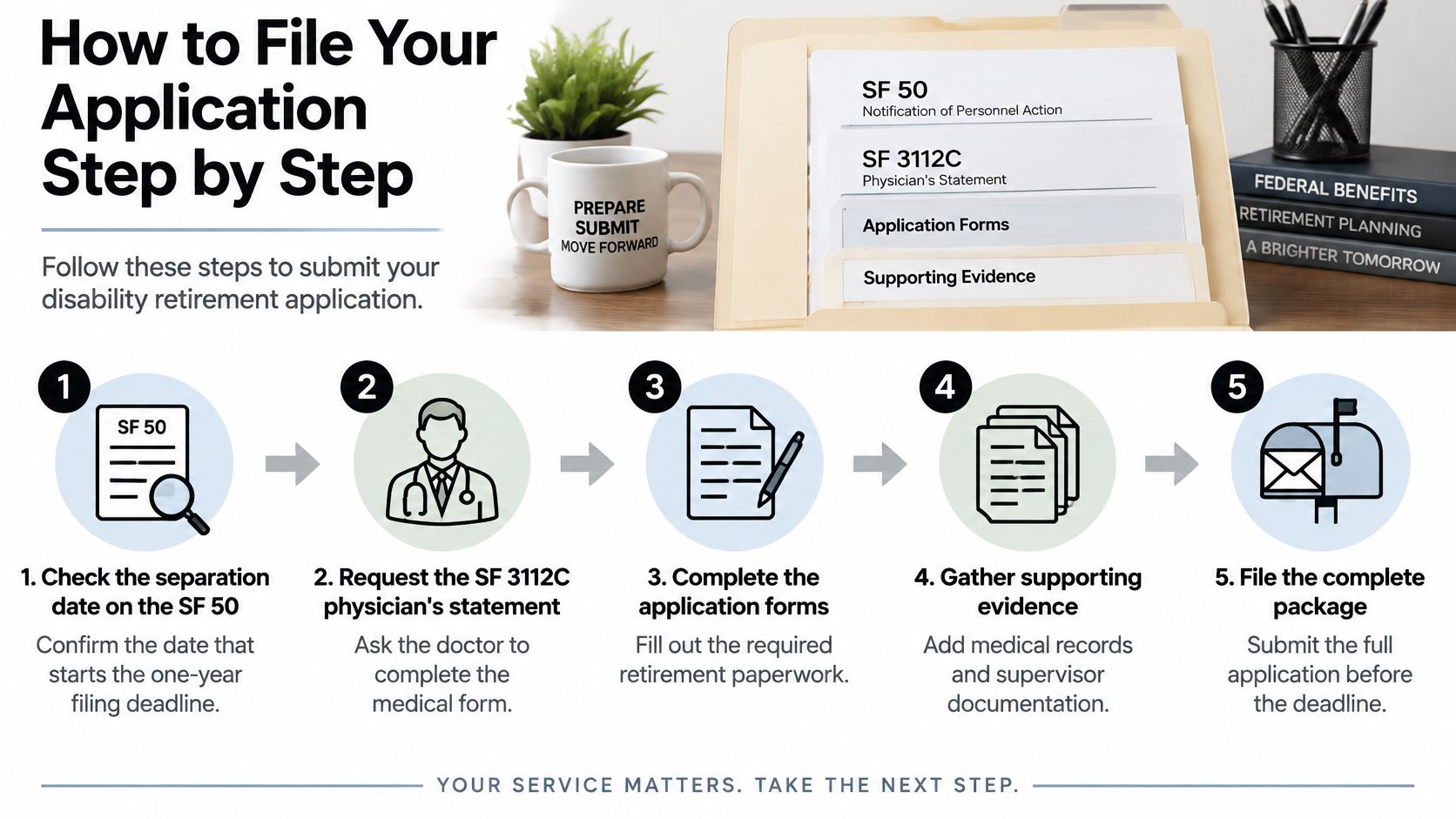
Use this filing sequence as a working checklist, while following the submission instructions that apply to your employment status.
Build and send the application
Confirm the separation date on your SF 50. Put the filing deadline on your calendar and set earlier reminders for follow-up. If the personnel action appears incorrect, ask HR to address it without putting your application on hold.
Request SF 3112C from your treating physician. Include your position description and a concise list of duties affected by your condition. Ask the physician to explain restrictions and expected duration using medical findings, not just a diagnosis.
Request SF 3112B from your supervisor. The statement should accurately address duties, attendance, performance difficulties, and relevant accommodation efforts. Send the request in writing so you can track who received it.
Ask HR for SF 3112D. Request the agency's accommodation and reassignment certification, along with relevant supporting correspondence. Identify the HR contact responsible for completing it.
Complete SF 3107 and SF 3112A. SF 3107 is the Application for Immediate Retirement used in the FERS disability application. In your applicant statement, explain the relationship between your condition and your duties without exaggerating or contradicting the medical record.
Reconcile the file against SF 3112E. Use a working copy to identify missing items, while coordinating the agency checklist with HR. Apply for SSDI and retain confirmation for the retirement file.
Submit through the proper channel and retain delivery proof. Current employees should coordinate with agency HR. Former employees using direct submission should follow OPM's current address and delivery instructions, keep a complete copy, and identify outstanding items and their responsible contacts.
The forms and paperwork resource can help you organize the personnel and retirement documents you'll need.
SF 3112 forms and who completes them
| Form | Completed By | Purpose | Filing Note |
|---|---|---|---|
| SF 3107 | You | Retirement application used for disability retirement | Submit even if supporting attachments remain outstanding |
| SF 3112A | You | Applicant statement | Submit with SF 3107 |
| SF 3112B | Supervisor | Duties, attendance, and accommodation information | Name the responsible person if missing |
| SF 3112C | Your physician | Medical findings, work restrictions, and prognosis | Request early |
| SF 3112D | HR and agency | Accommodation and reassignment certification | Name the responsible person if missing |
| SF 3112E | Agency, coordinated with you | Disability retirement application checklist | Check your copy against the file and identify the agency contact |
Make missing items visible
Include a cover sheet listing enclosed documents and outstanding attachments. Name the responsible supervisor or HR representative, include contact information, and record your follow-up requests.
A timely application with clearly identified outstanding documents is different from an unexplained stack of incomplete paperwork.
Before sending, check signatures, dates, readable scans, and consistent identifying information. Add a concise evidence summary connecting each affected duty to the relevant medical report.
For a companion overview of the filing process, use the video below.
Appeals and Reconsideration After a Denial
A denial calls for a targeted response, not another copy of the same packet. Read the decision letter for the precise reason OPM found the evidence insufficient, then distinguish an eligibility problem from a documentation problem.
A report that establishes a diagnosis may still fail to explain work limitations. A strong medical record may not resolve an incomplete accommodation certification. Each problem needs its own response.
Turn the decision into an evidence plan
Make a short issue list using the decision's actual findings. Beside each finding, identify the document that could address it and the person who can supply that document.
| Issue raised in the decision | Targeted response |
|---|---|
| Medical report doesn't connect symptoms to duties | Physician explanation addressing specific job functions |
| Prognosis is unclear | Updated medical opinion explaining expected duration |
| Reassignment review is incomplete | Agency clarification and supporting vacancy-review records |
| SSDI filing isn't documented | Application confirmation or other appropriate SSA documentation |
Say a physician's note describes severe back pain but doesn't explain what the employee can't do. A useful supplement would discuss lifting restrictions, sitting tolerance, examination findings, treatment response, and prognosis.
The physician should provide an independent medical opinion. Don't supply invented restrictions or ask the physician to endorse limitations that the clinical record doesn't support.
Follow the review path deliberately
- Record the controlling deadline. Use the decision letter's instructions to identify when and where to request reconsideration. Preserve the letter and delivery information.
- Submit a focused written request. Explain which findings you challenge, identify the supporting evidence, and clearly label attachments.
- Track pending evidence. Don't assume an agency's delay extends your deadline. Follow the applicable procedures for identifying or supplementing outstanding material.
- Evaluate an MSPB appeal after reconsideration. If OPM issues an adverse reconsideration decision, follow its appeal-rights instructions and consider legal representation.
- Prepare an organized record. Keep exhibits, correspondence, medical updates, and a timeline of job limitations ready for any further proceedings.
Response strategy: Match each disputed finding to evidence. A longer personal statement won't substitute for a missing medical explanation.
Benefits education and legal representation serve different purposes. An advisor can help organize benefits questions, while a qualified attorney can assess disputed legal issues and representation needs.
Federal Benefits Sherpa is an independent organization and is not affiliated with or endorsed by the Office of Personnel Management, the Social Security Administration, the Federal Retirement Thrift Investment Board (TSP), or any government agency. OPM decides the retirement claim; outside assistance doesn't change that authority.
Annuity Amounts, Offsets and Ongoing Reviews
An approval doesn't tell you, by itself, how much money you'll have available to spend. Before making an irreversible employment or household-budget decision, obtain an estimate that addresses your circumstances and distinguishes the gross annuity from the net payment.
Don't treat FERS disability retirement as a regular pension with a universally guaranteed floor. The applicable calculation and Social Security coordination need individual review, and you shouldn't assume a later recalculation occurs because you reach minimum retirement age.
Ask for an explanation, not just a total
A useful estimate should identify the salary and service information used, the applicable disability calculation, and how Social Security disability benefits affect the result. Keep the SSA award notice and any later changes with your retirement records.
If the estimate changes, ask what changed. A different service record, salary input, Social Security award, or deduction can produce a different payment for a different reason.
- Verify the inputs. Compare the service and pay information against your personnel and payroll records.
- Separate gross from net. Identify insurance premiums, withholding, and other applicable deductions rather than budgeting from the headline amount.
- Clarify Social Security coordination. Ask how an SSDI award, including a retroactive award, would affect the retirement calculation and whether an adjustment could be necessary.
- Document later changes. Request an explanation of any future recalculation and the event that triggers it.
- Plan for an uncertain start. Avoid committing every available dollar while adjudication and payment arrangements remain unresolved.
Keep written estimates and official determinations together. An informal worksheet can help you plan, but OPM's official determination governs.
Treat ongoing eligibility as an administrative responsibility
Retain treatment records after approval. If OPM requests updated medical information, answer the specific request and preserve proof of your response rather than assuming the original application remains sufficient forever.
Work plans deserve the same care. Before accepting federal employment, private employment, or self-employment, confirm how the proposed duties and earnings could affect your particular benefit.
Ask about both the work and the income. A job title may say little about whether the actual duties are consistent with your documented restrictions.
| Keep this record | Why it helps |
|---|---|
| Medical reports and treatment updates | Supports responses to medical information requests |
| Earnings and self-employment records | Supports accurate reporting and benefit review |
| Job descriptions and offer letters | Documents proposed duties and compensation |
| OPM and SSA notices | Explains benefit decisions and adjustments |
Don't assume that improved health, a return to work, or a stopped payment automatically produces a particular restoration or reemployment outcome. Get the applicable conditions in writing before relying on them.
The practical objective is a sustainable income plan supported by accurate records, not the largest preliminary estimate.
Decide Whether to Get Help Before You File
Choose help based on the unresolved issues in your file, not on how intimidating the form numbers look. A well-documented condition, responsive supervisor, complete service history, and clear accommodation record may leave you comfortable organizing the application yourself.
Conflicting physician statements, an incomplete agency certification, or an adverse decision create a different task. Those problems require someone to identify what's missing and explain how to address it, not merely assemble a cleaner binder.
Match the professional to the problem
Benefits planning focuses on how a potential retirement fits your pension, insurance, savings, and Social Security decisions. Legal representation focuses on legal standards, disputes, procedural rights, and advocacy.
If you're unsure whether an issue calls for a lawyer, HeyAtty's guide to which legal specialty fits your situation offers a starting point. For a contested federal disability retirement matter, ask specifically about experience with OPM disability cases and MSPB proceedings.
Use these questions when deciding whom to engage:
- What will you review? Ask whether the work includes medical-duty connections, agency documentation, benefits planning, or legal representation.
- What remains my responsibility? Clarify who requests records, follows up, submits documents, and tracks deadlines.
- What will I receive? Look for a defined explanation or deliverable rather than a general promise of approval.
- Who communicates with the agency? Don't assume an educational appointment includes representation before OPM.
Compare your available retirement paths before choosing one solely because it appears easier. The guide to disability retirement versus regular retirement can help you frame that decision around eligibility and consequences rather than labels.
Don't wait for a complete folder to seek guidance
At Federal Benefits Sherpa, our process is to learn the basics through the free class or Learning Center, talk with Joe for 15 minutes, get your Gap Report, and then decide what's next. If you don't have every document, you can still book; we'll work with what you have.
For the appointment, identify your most urgent question and bring the records already available. A clear list of missing documents is useful too, particularly when it names the physician, supervisor, or HR contact responsible.
Your immediate actions are straightforward: confirm the official separation record, calendar the filing deadline, send outstanding documentation requests, and decide whether you need benefits guidance or legal assistance. Keep the appointment process separate from the filing process so scheduling doesn't become another reason to delay.
The first action is the deadline calendar, not the advisor.
Federal Benefits Sherpa offers independent benefits education and retirement planning to help you understand how a potential FERS disability retirement fits your broader income and insurance decisions. Visit Federal Benefits Sherpa or call (833) 753-1825 to discuss your next steps, even if some documents are still missing.
