How to Compare Federal Employee Health Plans and Choose Wisely
When you start comparing federal employee health plans, you'll quickly realize it boils down to a fundamental tradeoff: pay less now in premiums and more later if you need care, or pay more upfront for the peace of mind of lower out-of-pocket costs. This decision is at the heart of your total healthcare spending for the year, making Open Season the most critical time to dig into the details.
Why Comparing FEHB Plans Is Critical for Your Finances

The Federal Employees Health Benefits (FEHB) program is, frankly, massive. It's one of the largest employer-sponsored health insurance programs in the world, covering over 8.2 million federal employees, retirees, and their families. Because of its sheer scale, you have a dizzying array of choices—everything from traditional fee-for-service plans to local HMOs and high-deductible options. You can read more about the scope of the FEHB program and its national role on kffhealthnews.org.
Picking the right plan isn't just about healthcare; it's a major financial decision. Getting it wrong can easily cost you thousands of extra dollars over the year, either through premiums that are too high for your needs or unexpected bills that wreck your budget.
Understanding Your Total Healthcare Costs
To do a real, apples-to-apples comparison of FEHB plans, you have to look past that bi-weekly premium deduction. Your actual cost is a mix of several moving parts.
| Cost Component | What It Covers | Key Consideration |
|---|---|---|
| Premiums | The fixed, predictable amount taken from your paycheck. | This is your guaranteed, recurring health expense. |
| Deductibles | The amount you have to pay yourself before the plan kicks in. | Plans with lower premiums almost always have higher deductibles. |
| Copayments & Coinsurance | Your share of the bill for a doctor visit, procedure, or prescription. | These can vary wildly from one plan to the next. |
| Out-of-Pocket Max | The absolute most you'll pay for covered care in a plan year. | This is your financial safety net against a worst-case scenario. |
Fixating on premiums is the most common trap people fall into. A plan with a rock-bottom premium might look like a great deal, but a high deductible can leave you with a huge bill if you have an unexpected injury or illness.
A lower premium isn't always a better deal. The true value of a plan is revealed when you calculate your potential total annual cost, including premiums, deductibles, and anticipated medical expenses.
Why Annual Re-evaluation Matters
Life happens. Your health needs change, and so do the plans. Every single year, insurers can tweak benefits, shrink provider networks, and change which prescription drugs are covered. With premiums on the rise in recent years, just rolling over your current plan without a second thought could be a very expensive mistake.
Think of the annual Open Season as your dedicated time to do a financial and health check-up. It's your chance to:
- Account for any new health conditions for you or your family.
- Double-check that your trusted doctors and local hospital are still in-network.
- See what's new or what's changed with other plans available to you.
This yearly review is the only way to ensure your plan still works for your wallet and your well-being.
Understanding the Core FEHB Plan Types
Before you can really start comparing federal health plans, you have to get a handle on the three main ways they're built. Each type works differently, and that affects everything from which doctors you can see to what you'll actually pay. Think of it like this: they're all roads to getting healthcare, but the route you take—and the tolls you pay along the way—can be wildly different.
The main flavors in the FEHB program are Fee-for-Service (FFS) plans, Health Maintenance Organizations (HMOs), and High Deductible Health Plans (HDHPs). Getting to know how each one operates is the absolute first step to making a smart choice during Open Season. This is the foundation for any real comparison.
Fee-for-Service Plans: Freedom and Flexibility
Fee-for-Service (FFS) plans are what most people think of as traditional health insurance. Their biggest selling point is maximum flexibility. With an FFS plan, you’re generally free to see any licensed doctor or go to any hospital you want, anywhere in the country.
This setup is perfect if you travel a lot, have kids away at college in another state, or have a long-standing relationship with a specialist you don't want to give up. You also don't typically need a referral from a primary care doctor to see a specialist, which means you get direct access when you need it.
Of course, that freedom isn’t free. FFS plans usually come with higher premiums. You might also have to pay for your care upfront and then file a claim to get reimbursed. They also make a big distinction between "in-network" and "out-of-network" providers. Sticking with in-network doctors saves you a ton of money, but going out-of-network means you’ll face higher coinsurance and a separate, often much larger, deductible.
Health Maintenance Organizations: Coordinated and Cost-Effective Care
On the other end of the spectrum are Health Maintenance Organizations (HMOs). These plans are built around a local network of doctors and hospitals, focusing on coordinated care within a specific geographic area. When you join an HMO, you pick a Primary Care Physician (PCP) from their list, and that doctor becomes the quarterback for your healthcare.
Your PCP is your gatekeeper. Need to see a cardiologist or a dermatologist? You'll need a referral from your PCP first. The whole system is designed to keep care efficient and control costs, which usually means you get lower premiums and predictable, flat-fee copayments for your visits.
The core trade-off with an HMO is simple: you sacrifice some choice for lower costs and predictability. If you get care outside the HMO's network, it's generally not covered at all, unless it's a true life-threatening emergency.
This model is a great fit for people who like having a single doctor manage their health and are happy with the providers available in the local network.
High Deductible Health Plans: Savings and Responsibility
High Deductible Health Plans (HDHPs) take a completely different tack. Just like the name says, these plans have a much higher deductible you have to pay out-of-pocket before the insurance starts covering most costs. The upside? Your monthly premiums are significantly lower.
The real magic of an HDHP, though, is its partnership with a Health Savings Account (HSA). This is a tax-advantaged savings account you can use to pay for medical expenses. Many FEHB plans will even kick in a portion of the premium savings right into your HSA, giving you a nice head start.
- Triple Tax Advantage: The money you put in is tax-deductible, it grows tax-free, and you can withdraw it for qualified medical expenses completely tax-free.
- You Own It: The money in your HSA is yours forever. It rolls over every year and you take it with you even if you change jobs or retire.
HDHPs are an excellent choice for federal employees who are generally healthy, don't anticipate needing a lot of medical care, and want to build a tax-free nest egg for future health costs. They do, however, require you to be more hands-on with your finances and cover more costs upfront.
For a deeper look into the program's structure, check out our complete guide to the Federal Employees Health Benefits program.
A Detailed Comparison of Key Plan Features and Costs
When you’re trying to compare federal employee health plans, it’s easy to get fixated on the bi-weekly premium. But to see the whole financial picture, you have to look deeper. The real cost of your healthcare is a combination of that premium, your deductible, the out-of-pocket maximum, and what you’ll pay for prescriptions.
Each plan type—FFS, HMO, and HDHP—strikes a different balance between these costs. This creates unique pros and cons that depend entirely on your health, your family's needs, and your financial situation.
Diving into these numbers is more important than ever. While the government’s contribution helps, it doesn’t shield us from rising costs. Premiums for federal employees have been climbing steeply—the average enrollee share went up by 7.7% in 2024, is set to jump by 13.5% for 2025, and is projected to increase by another 12.3% in 2026.
This chart gives you a quick visual breakdown of the three main plan types you’ll be choosing from.
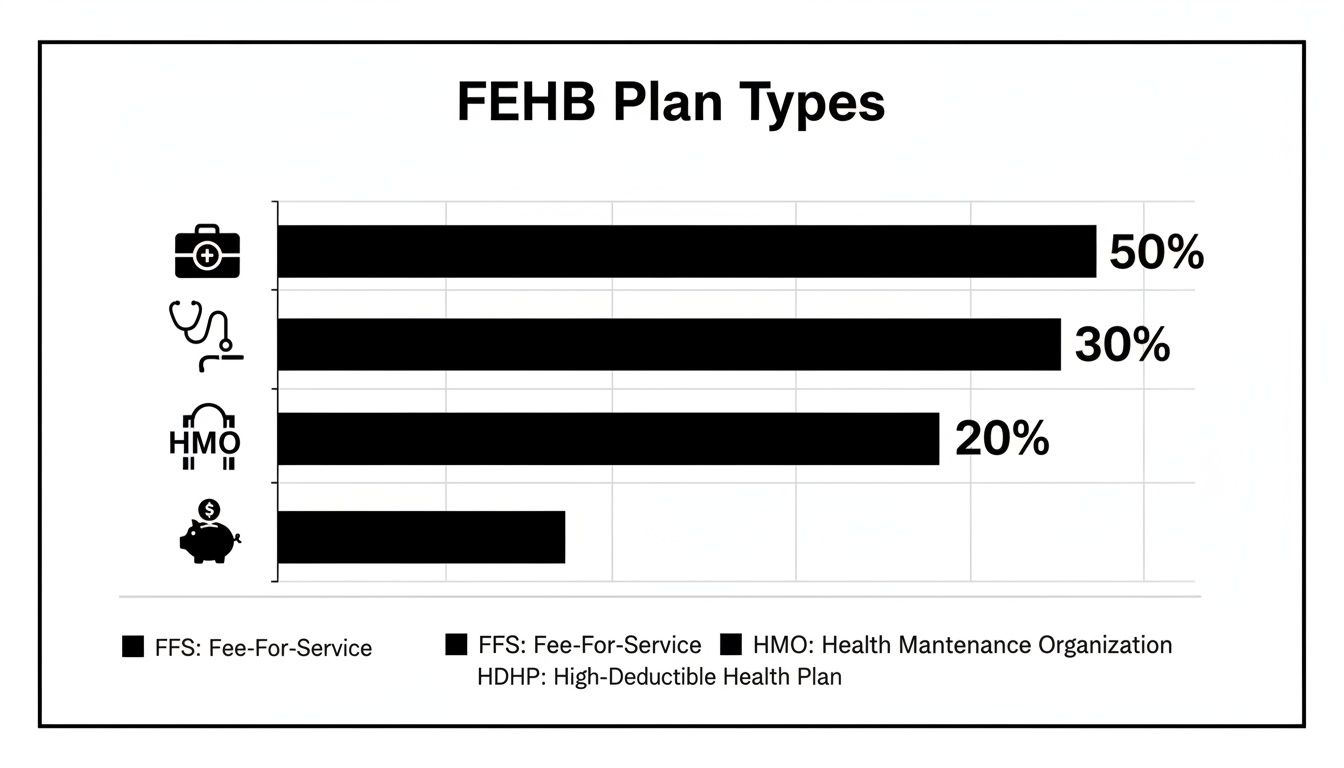
As you can see, each is built around a different philosophy: FFS plans prioritize provider choice, HMOs focus on coordinated care through a network, and HDHPs are designed around a savings-first approach.
The table below provides a side-by-side look at how these plan types handle key features and costs.
FEHB Plan Type Feature Comparison
| Feature | FFS Plan (e.g., BCBS Standard) | HMO Plan (e.g., Kaiser Permanente) | HDHP Plan (e.g., GEHA HDHP) |
|---|---|---|---|
| Typical Premium | Higher | Moderate to High | Lowest |
| Provider Choice | Widest choice; see any doctor, in or out of network (with cost differences). | Must stay within the plan's network; requires referrals for specialists. | Wide network, similar to FFS, but out-of-network costs are much higher. |
| Deductible | Generally low to moderate for in-network care. | Often very low or zero for in-network services. | Highest; must be met before most plan benefits (except preventive) kick in. |
| Out-of-Pocket Max | Moderate to High | Typically Lower | High, but HSA funds can be used to meet it. |
| Best For | Those who want maximum flexibility, see specific specialists, or live in rural areas. | Individuals and families who prefer predictable costs and a coordinated care model. | Healthy individuals or families who want to save for future medical costs via an HSA. |
This comparison highlights the fundamental trade-offs you'll need to weigh based on your personal circumstances.
Deconstructing Premiums and Deductibles
The core trade-off in any health plan is the relationship between your premium and your deductible. Think of it as a seesaw: when one goes down, the other usually goes up.
- Low Premium, High Deductible (HDHP): You'll pay less out of every paycheck, which feels great. The catch is that you’re on the hook for a larger chunk of your initial medical bills before the plan’s main coverage starts. This is a great fit for people who are generally healthy and want to bank savings for the future.
- High Premium, Low Deductible (FFS/HMO): You commit to a higher payment each pay period. In return, you get more predictable, lower costs when you actually need to see a doctor or get a prescription. This route offers peace of mind for those who anticipate more frequent medical care.
Imagine this scenario: one fed chooses an HDHP with a low $150 bi-weekly premium but a $3,500 deductible. Another picks an FFS plan with a $250 bi-weekly premium but just a $700 deductible. The HDHP user saves on premiums all year, but if they need an unexpected surgery, they face a big bill before their insurance takes over.
The secret weapon of the HDHP is the government's contribution to your Health Savings Account (HSA). This is "free money" that goes directly into your account and can be used to pay that high deductible. It dramatically lowers your financial risk while you enjoy those lower premiums.
If an HDHP sounds appealing, our complete guide to the GEHA Health Savings Account breaks down exactly how these powerful accounts work.
Understanding the Out-of-Pocket Maximum
The out-of-pocket maximum is your ultimate financial safety net. This number is the absolute most you will have to pay for covered, in-network medical care in a year. Once you hit that ceiling, your plan pays 100% of covered costs for the remainder of the year.
For anyone managing a chronic illness, planning for a major surgery, or expecting a baby, this number is arguably more critical than the deductible. A plan with a lower out-of-pocket max offers far better protection against worst-case scenarios, even if it comes with a higher premium.
Comparing Prescription Drug Formularies
Don't just assume your medications will be covered. Prescription drugs are a huge cost driver, and how they’re covered varies wildly between plans. Every plan uses a formulary—its official list of covered drugs—which is usually sorted into tiers.
- Tier 1: Generic drugs. These will have your lowest copay.
- Tier 2: Preferred brand-name drugs. The copay is higher.
- Tier 3: Non-preferred brand-name drugs. Costs start getting significantly higher here.
- Tier 4/Specialty Tier: These are for very expensive drugs used to treat complex conditions like cancer or MS. The costs can be substantial.
If you or a family member relies on a specific medication, checking its tier on a plan’s formulary is an absolute must. A drug that’s a cheap generic on one plan might be a costly non-preferred brand on another, potentially costing you hundreds more each month.
Coverage for Mental Health and Specialized Therapies
Finally, make sure you look past the big-ticket items and check the details on services you know you'll need. Things like mental health care, physical therapy, and even maternity care can have very different coverage levels from one plan to the next.
For example, one plan might offer unlimited physical therapy sessions with a small copay, while another limits you to 20 visits per year. Mental health benefits can also differ, affecting your access to therapists and what you’ll pay for in-person versus telehealth appointments.
Always, always check the official plan brochure (look for Section 5, "Benefits") for the specific services your family depends on. This is the only way to avoid surprises and ensure the plan you pick truly matches your real-world health needs.
How to Match a Health Plan to Your Life Stage
Picking the right federal health plan isn't just about crunching numbers on a spreadsheet. The best plan for you is deeply personal, and it hinges almost entirely on where you are in life. A plan that’s a perfect fit for a young, single fed is likely a terrible choice for a growing family or someone mapping out their retirement.
Your real goal is to find that sweet spot where your monthly premiums, potential out-of-pocket spending, and actual coverage needs all click into place. Let's walk through a few common life stages to see how different plan types stack up in the real world.
For Young and Healthy Federal Employees
If you’re just starting your federal career, are in good health, and don’t have any dependents, your main goal is probably keeping fixed costs as low as possible. You need a solid safety net for emergencies, but you aren’t planning on a lot of doctor visits or prescriptions.
In this scenario, a High Deductible Health Plan (HDHP) is often the most powerful financial tool you can choose.
- Low Premiums: HDHPs come with the lowest monthly premiums, which frees up a significant chunk of your paycheck for other goals, like smashing student loan debt or building your savings.
- HSA Contributions: The government’s contribution to your Health Savings Account (HSA) is a game-changer. It’s basically free money you can use to cover your deductible if something comes up.
- Long-Term Savings: Any money left in your HSA at the end of the year rolls over and keeps growing tax-free. This account isn't just for healthcare; it becomes a portable investment vehicle for your future.
The trade-off, of course, is that high deductible. But for a healthy person, the risk of hitting it is often small compared to the immediate savings on premiums and the incredible triple-tax advantage of the HSA.
For Federal Employees with Growing Families
Once you start or expand your family, your healthcare priorities do a complete 180. Predictability is suddenly king. You need robust coverage for everything from maternity and pediatric care to those inevitable late-night trips to urgent care for a sick kid.
This is where a traditional HMO or a comprehensive Fee-for-Service (FFS) plan usually shines.
For families, the out-of-pocket maximum is arguably more important than the deductible. It represents your absolute worst-case financial exposure in a year filled with specialist visits, potential hospital stays, and frequent check-ups.
An HMO can be a fantastic value if you're comfortable with its network of pediatricians and specialists. You'll get predictable, low copays for all those well-child visits, vaccinations, and sick appointments that can really add up.
On the other hand, a national FFS plan gives you much more flexibility. This is huge if you need access to a specific pediatric specialist or if your family members live in different areas. The premiums are higher, no doubt, but the lower deductible and comprehensive coverage provide priceless peace of mind during these expensive years.
For Employees Managing a Chronic Condition
If you or someone in your family is living with a chronic condition like diabetes, asthma, or heart disease, your calculus is completely different. You know you'll have regular, ongoing medical expenses, from specialist appointments to pricey prescription drugs.
For this situation, a low-deductible FFS plan or a well-regarded HMO is almost always the most financially sound choice. Think of the higher premiums as a predictable, budgeted expense that shields you from truly crippling out-of-pocket bills.
Here’s what you need to laser-focus on:
- Prescription Formulary: This is non-negotiable. Before you even think about enrolling, you must confirm your specific maintenance medications are on the plan's list of covered drugs (the formulary), and ideally in a low-cost tier.
- Specialist Network: Make absolutely sure your trusted specialists are in-network. Going out-of-network can lead to massive, unexpected bills.
- Low Out-of-Pocket Maximum: Your total annual costs will likely get close to this number, so a lower max provides a much stronger financial safety net.
An HDHP is generally a poor fit here. You'd likely blow through the high deductible very early in the year, which completely wipes out any savings you might have seen from the lower premiums.
For Federal Employees Approaching Retirement
As retirement gets closer, your focus naturally shifts to long-term health planning and how your FEHB plan will play with Medicare. This is a critical time to make sure your coverage is built to last.
Many pre-retirees stick with a trusted FFS plan, like Blue Cross Blue Shield Standard, because of its nationwide network and seamless ability to coordinate with Medicare once they turn 65. The freedom to see almost any doctor who accepts Medicare becomes a massive advantage.
But don't count out HDHPs just yet. If you're still relatively healthy, the years right before you retire are your last chance to aggressively pump money into your HSA. That tax-free account can be an incredibly powerful tool for paying Medicare Part B premiums and other medical costs once you've stopped working.
Understanding how these two massive programs work together is essential. To get into the weeds on this, you can check out our deep dive on how FEHB and Medicare work together for federal retirees. Knowing the rules today will help you make a choice that sets you up for a financially secure and healthy retirement tomorrow.
Mastering the OPM Plan Comparison Tool
When you’re staring down the dozens of health plans available to federal employees, the official OPM Plan Comparison Tool is your best friend. It’s packed with information, but let's be honest, it can feel a bit clunky at first. Let's walk through how to use it effectively, so you can turn that long list of options into a confident decision.
The first step is simple. You'll plug in your zip code, pay frequency, and who you need to cover—just yourself (Self), you and one other person (Self Plus One), or your whole family (Self and Family). This immediately filters out any plans not available where you live, giving you a customized starting point.
Filtering Down to What Matters
With your initial list loaded, it's time to get specific. This is where you can really narrow the field based on what you and your family actually need. The filters let you zero in on a plan type (HMO, FFS, HDHP), look for specific insurance carriers, or even find only those plans that work with a Health Savings Account (HSA). This is how you cut through the noise.
One of the most powerful features is the provider and prescription drug search. Don't skip this. You can type in the names of your doctors and the exact medications you take to see which plans cover them. This simple check can save you from the major headache of accidentally enrolling in a plan that doesn’t include your trusted physician or a critical prescription.
The tool will then display a list of every plan available to you based on your search criteria.
This gives you a great overview, but the real magic happens when you select up to three plans for a direct, side-by-side comparison.
Comparing Your Top Choices Side-by-Side
Once you've whittled down your options to two or three top contenders, check their boxes and hit "Compare." This is where you get a detailed, apples-to-apples breakdown that makes the differences crystal clear.
- Estimated Yearly Cost: This is arguably the most important number the tool calculates. It doesn't just show you the premium; it adds your likely out-of-pocket costs for healthcare and prescriptions to give you a much more realistic picture of what you’ll actually spend in a year.
- Plan Details: Here, you can quickly scan and compare the nuts and bolts: deductibles, out-of-pocket maximums, and what you’ll pay for a primary care visit versus a specialist or an emergency room trip.
- Provider and Rx Check: The comparison screen will re-confirm if the doctors and medications you entered earlier are covered by each specific plan you selected.
The OPM tool is an excellent guide, but it shouldn't be your only source. Always call your doctor's office to confirm they are still in-network for the plan you're considering. Provider networks can change, and the tool's data isn't always updated in real-time.
Finally, the tool gives you a direct link to each plan's official brochure (also known as the "plan contract"). This is the legally binding document that details everything the plan covers—and what it doesn't. Always cross-reference the brochure with the tool's summary to make sure you have the most accurate information before you lock in your choice during Open Season.
Avoiding Common Mistakes When Choosing Your Plan

You've done the hard work of narrowing down your choices. Now comes the final decision, and it’s surprisingly easy to stumble at the finish line. Even with the best research, a few common slip-ups can lead to major headaches and unexpected bills later on.
The number one mistake I see federal employees make is premium fixation. It’s tempting to gravitate toward the plan with the lowest bi-weekly deduction from your paycheck, but that number is only a small part of the story. A rock-bottom premium can often hide a sky-high deductible or a very narrow provider network, which could end up costing you a fortune if you actually need medical care.
To make a smart comparison, you have to look at your total potential cost. That means getting past the premium and digging into the out-of-pocket maximum, prescription copays, and coinsurance for the services you know you'll need.
Calculating Your True Annual Cost
A little back-of-the-napkin math can make your decision crystal clear. For your top two or three contenders, sketch out a quick estimate of what you'll really spend over the course of a year. This helps you compare apples to apples.
Here's a simple way to do it:
- Calculate Annual Premiums: Take your bi-weekly premium and multiply it by 26. This is your guaranteed, baseline cost for the year.
- Estimate Medical Usage: Add up the copays for any doctor visits, specialist appointments, or therapies you anticipate needing.
- Add Prescription Costs: Figure out the monthly copays for all your family's regular medications, then multiply that total by 12.
- Factor in the Deductible: If you know you have a surgery coming up or are managing a chronic condition, you should probably add the plan's deductible into your total estimate.
When you add all this up, you get a much more realistic picture of what each plan will actually cost you. It shifts the focus from the sticker price to your true financial exposure.
Before you hit "enroll," make one final, crucial check: call your doctors' offices directly. Ask the billing department, "Do you participate with [Plan Name and Option] for 2026?" Don't just ask if they "take" the insurance—network participation can be incredibly specific.
The Most Important Habit to Build
The most dangerous mistake of all? Inertia. Just letting your plan roll over year after year without a second thought. Your health, your family's needs, and the plans themselves change annually. The perfect plan from last year might be a terrible fit this year because of provider network changes or benefit adjustments.
Think of Open Season as your annual financial and health check-up. Every November, take the time to actively re-evaluate your choice. This simple yearly habit is the best way to make sure your health plan is still working for you, protecting both your health and your wallet.
Common Questions About Your FEHB Plan
Choosing and managing your federal health benefits can bring up a lot of questions, especially when life throws you a curveball. Here are straightforward answers to some of the most common things federal employees ask when navigating their FEHB options.
Can I Change My FEHB Plan Outside of Open Season?
Typically, you can only make changes during the annual Open Season. However, life doesn't always wait for a specific time of year.
Certain major life events, known as Qualifying Life Events (QLEs), trigger a special enrollment period. These include things like getting married, having a baby, adopting a child, or even moving to a new area where your current plan's network isn't available. A QLE gives you a window—usually from 31 days before to 60 days after the event—to adjust your coverage. If you miss that window, you’ll have to wait for the next Open Season.
What Happens to My FEHB Coverage When I Retire?
You can absolutely keep your FEHB coverage into retirement, which is one of the best perks of federal service. The key is to meet the eligibility rules.
To carry your health benefits into your post-career life, you must have been continuously enrolled in any FEHB plan for the five years immediately before you retire. Your premiums and benefits stay largely the same, but instead of coming out of your paycheck, your share will be deducted from your retirement annuity.
Don't overlook the "five-year rule." It's non-negotiable. Making sure you meet this requirement is absolutely critical if you want to secure that healthcare safety net for the long haul.
How Does the New Postal Service Health Benefits Program Affect Me?
Starting in 2025, the government is rolling out the Postal Service Health Benefits (PSHB) Program. This creates a separate insurance system specifically for Postal Service employees, retirees, and their families.
If you're a non-postal federal employee, this change won't directly impact your FEHB plan choices. It's a significant shift in the federal benefits world, as it carves out a massive group of people into their own insurance pool, but your FEHB options will remain the same.
Making sense of it all is a lot easier when you have an expert in your corner. Federal Benefits Sherpa provides personalized retirement planning and gap analysis reports to help you maximize every benefit you've earned. Take the first step toward securing your financial future by scheduling your free benefits review at https://www.federalbenefitssherpa.com.