Federal Retiree Health Insurance Open Season Guide
It's late fall, and you're looking at your FEHB plan documents with a familiar question: should you keep the coverage you have, switch plans, change the enrollment type, or cancel? If you're also enrolled in Medicare, the decision can feel even less clear because your federal coverage and Medicare may work together rather than replace one another.
For federal retirees and other annuitants, federal retiree health insurance open season is a once-a-year decision window. It isn't an informal opportunity created by an employer, and retirement itself doesn't give you a separate chance to switch plans whenever you want. The U.S. Office of Personnel Management, or OPM, establishes the period for eligible annuitants across the federal government.
This guide follows the decision in practical order. You'll learn what Open Season allows, who can act, how the election deadline relates to the later effective date, which options you can choose, how to consider FEHB alongside Medicare, and how to submit your election through OPM's approved channels.
If you're approaching retirement, already retired, or helping a family member manage federal benefits, the goal is simple: finish the season knowing what you elected, when it will take effect, and how you documented the transaction. OPM's Federal Benefits Open Season guidance for retirees and other annuitants is also a useful reference for checking the official process.
Key concept: Open Season is a fixed government-wide window. You make the election during the window, but the resulting coverage generally begins on January 1 of the following year.
Introduction to Federal Retiree Health Insurance Open Season
A retiree named James might spend the first part of November reviewing his mail, checking whether his doctors still participate in his plan, and asking whether Medicare changes the answer. His spouse's coverage needs may have changed, too. James knows that doing nothing may leave his current arrangement in place, but he doesn't want to treat a once-a-year decision as an automatic renewal without reviewing it.
That situation is common in principle, even when each household's details differ. Retirees must make choices within a specific period, and a missed deadline can leave them waiting for another annual opportunity unless an exception applies. The decision deserves attention because the next chance isn't available whenever a retiree changes their mind.
Active federal employees and annuitants may both encounter Open Season, but retirees face a particularly firm planning constraint. An annuitant can't switch plans merely because they retired, and OPM says retirees generally can change FEHB enrollment only during Open Season. That means the transition into retirement should include a deliberate review of health coverage rather than an assumption that retirement will create a new enrollment event.
Why the calendar matters
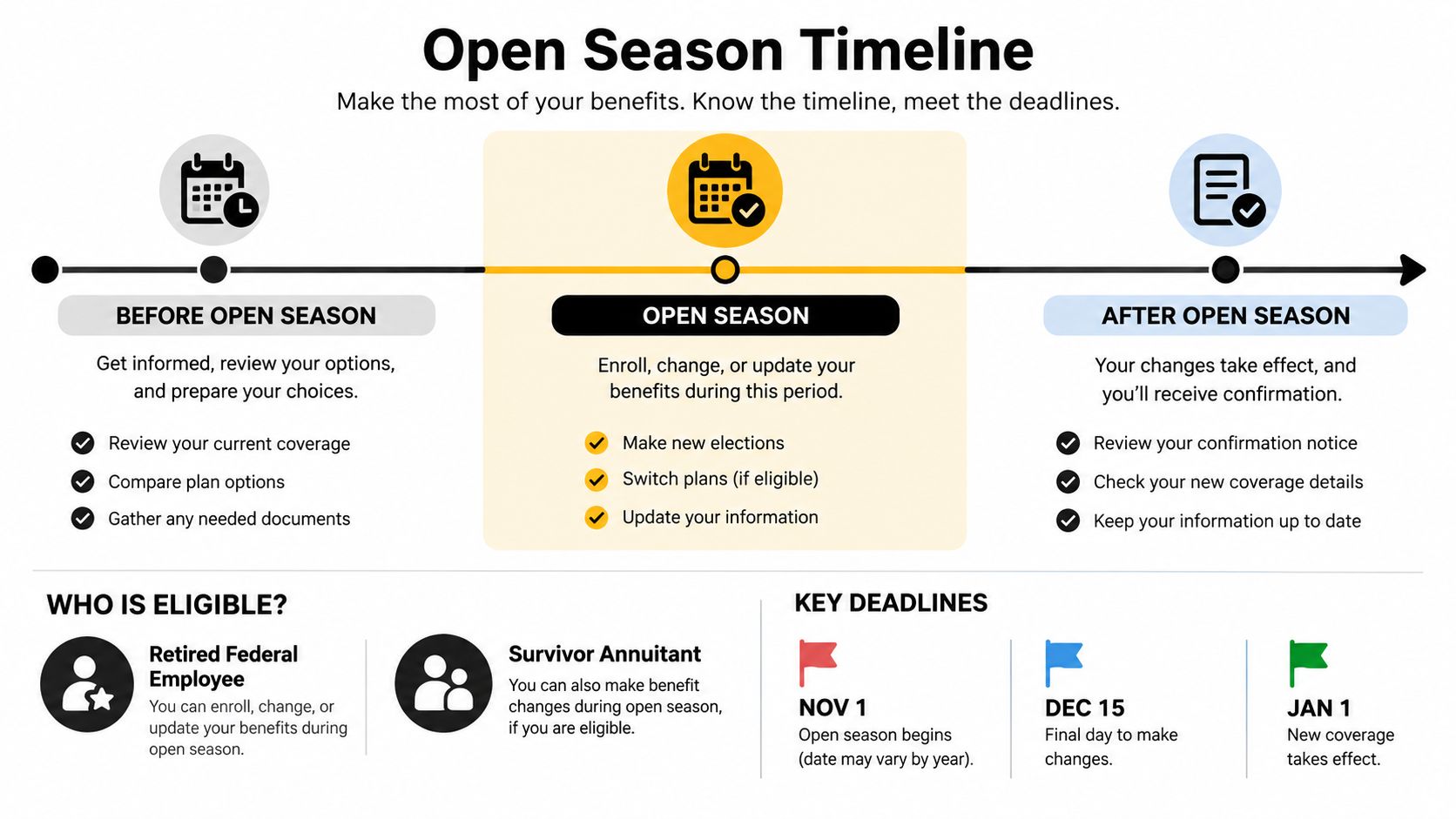
OPM says the annual Federal Benefits Open Season runs from the Monday of the second full workweek in November through the Monday of the second full workweek in December. For the 2026 plan year, OPM set the period as November 10 through December 8, 2025, with retiree elections generally taking effect on January 1 of the following year. These dates come from OPM's official retiree Open Season information.
The timing creates two separate points to track. First, you submit an election before the Open Season window closes. Later, the approved change generally becomes effective on January 1. The coverage doesn't change the moment you submit the form or complete the online transaction.
What confident action looks like
A sound decision doesn't require guessing about every future medical need. It requires comparing the available plan information with your doctors, prescriptions, household enrollment needs, Medicare status, and tolerance for changes in cost sharing or provider access.
By the end of this process, you should be able to answer four questions:
- What coverage do I have now?
- What, if anything, do I want to change?
- Which OPM channel will I use to submit the election?
- How will I confirm that OPM recorded it?
What Federal Retiree Health Insurance Open Season Really Means
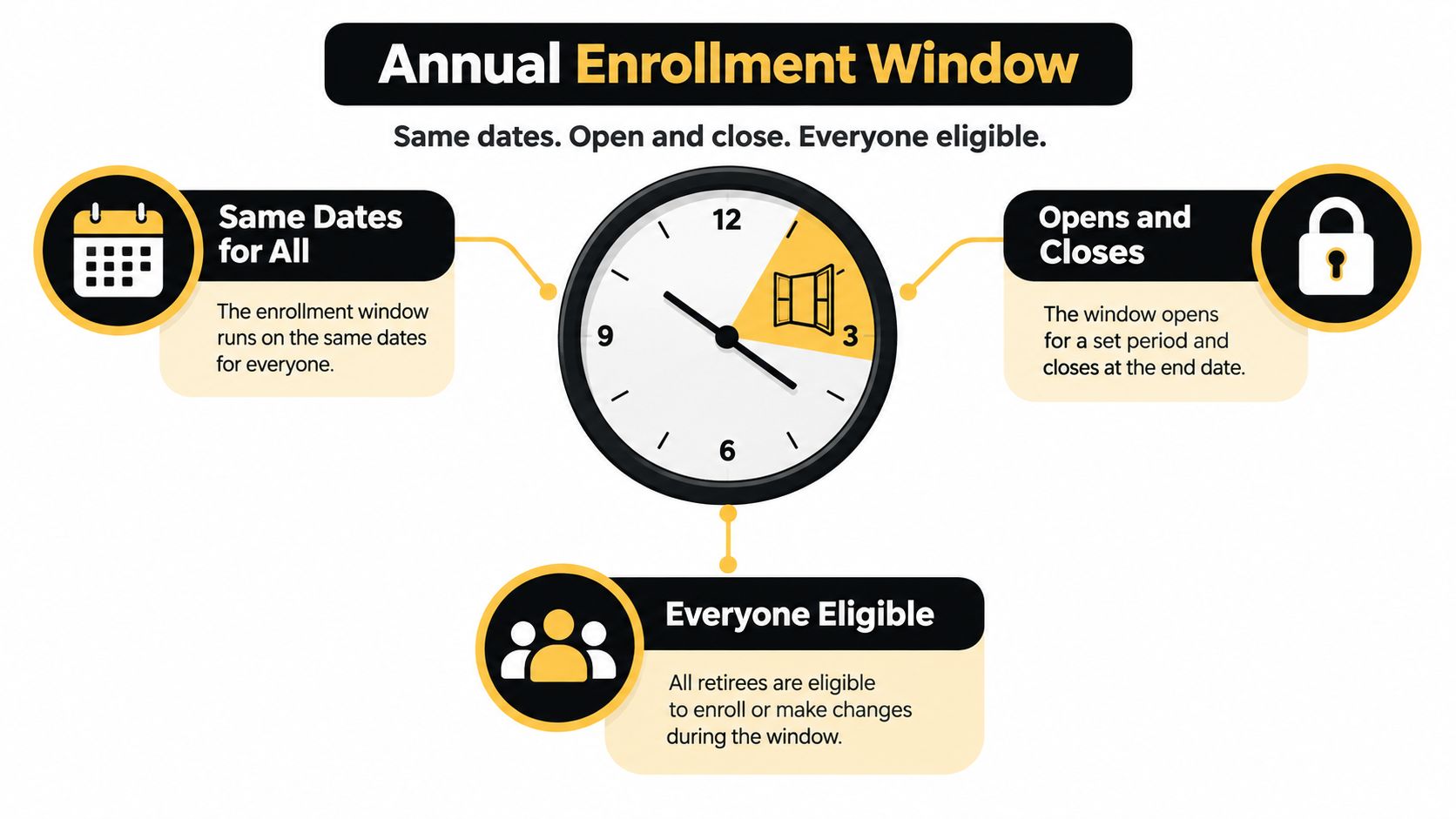
Suppose your doctors, prescriptions, or household coverage needs have changed during the year. Open Season gives you one scheduled opportunity to adjust FEHB coverage, rather than a year-round window for ordinary plan changes. The period opens and closes on the government-wide calendar, so the deadline matters as much as the decision itself.
For annuitants, this is FEHB Open Season, administered through the federal benefits system rather than offered as a temporary promotion by a private carrier. The election and its effective date are separate. You make the choice during Open Season, while the approved change generally begins the following January.
Four actions fit inside the window
OPM permits several types of FEHB changes during Open Season:
- Enroll in FEHB coverage, if you qualify to make that election under the applicable rules.
- Switch from one FEHB plan to another.
- Change the enrollment type, such as moving among Self Only, Self Plus One, and Self and Family when the circumstances support that choice.
- Cancel FEHB coverage.
These choices affect different parts of your coverage. Switching plans changes the carrier or plan option. Changing the enrollment type changes who is covered. Canceling ends the FEHB election, and returning can be difficult. A retiree who drops coverage generally must wait until the next Open Season to re-enroll unless an exception applies. OPM's Open Season overview explains the available retiree channels and the restrictions that may apply after cancellation.
Why the system is synchronized
A shared schedule gives annuitants a defined review period and gives OPM a consistent way to process elections. Treat the closing date as firm. A late phone call, delayed form, or change of mind does not normally create another plan-change opportunity.
Use three separate checkpoints:
- Review: compare your current FEHB plan with your doctors, prescriptions, household needs, and Medicare status.
- Submit: send the election through an OPM-approved channel before the window closes.
- Confirm: check that OPM recorded the election and keep the confirmation for your records.
The coverage should continue under your existing election until the approved change takes effect. This timing helps retirees coordinate FEHB with Medicare without creating a gap because a new election was submitted. The annual window is the decision point, while January 1 generally marks the start of the new choice.
Practical rule: Make the election during Open Season, then verify both the recorded choice and its effective date.
Who Can Participate and When Key Deadlines Apply
Eligibility and timing answer separate questions. As an annuitant, you may be able to make a permitted FEHB change during Open Season. The annual window, however, determines when OPM will accept and process that election. Retirement itself doesn't create a separate opportunity to switch plans, so retiring outside Open Season does not ordinarily let you choose a new plan immediately.
For the 2026 plan year, the window and January 1 effective date follow the schedule stated in OPM's health care coverage FAQ for retirees. The recurring schedule runs from the Monday of the second full workweek in November through the Monday of the second full workweek in December.
One decision window, two dates
Open Season works like a scheduled departure. You choose your change while the window is open, but the new election generally starts with the next plan year. Your current coverage normally remains in place while OPM processes the election, rather than ending on the day you submit it.
That separation helps retirees coordinate FEHB with Medicare. Submitting a plan change does not by itself create a same-day coverage gap. The deadline still matters: if OPM receives the election after the window closes, the ordinary annual change opportunity may have passed. A late phone call, delayed form, or postmarked application may not be processed for the upcoming plan year.
Three ways to submit an election
OPM provides three administrative channels for annuitants:
- Open Season Online: Use OPM's online service to submit the election electronically.
- Open Season Express: Call 1-800-332-9798 to make an Open Season change by phone, as described in OPM's annuitant enrollment instructions.
- Mailed forms: Send the required election form to OPM's processing center in Lawrence, Kansas. The form must be postmarked no later than the final day of Open Season.
Choose the channel you can complete accurately and document. For an online or phone election, save the confirmation details and submission date. For a mailed form, keep a copy and proof of the postmark. These records give you a clear way to check what you submitted if OPM's recorded election does not match your intent.
A simple sequence helps: review the deadline, submit through one approved channel, then verify the recorded election and its effective date.
Your Enrollment and Change Options During Open Season
Once you know that Open Season is the decision window, the next question is what kind of decision fits your household. Keeping the current plan can make sense if your doctors, prescriptions, service area, and coverage priorities remain suitable. Switching may be appropriate if the plan's network, benefits, or cost-sharing structure no longer matches your needs.
Enrollment type deserves separate attention. A retiree who once chose Self Only may now need coverage for a spouse. Another household may no longer need the broader enrollment category it selected previously. The right choice depends on who needs FEHB coverage, not only on what was selected in the past.
| Election Action | What It Changes | Best When |
|---|---|---|
| Keep the current plan | Leaves the existing FEHB plan election in place | Your providers, prescriptions, service area, and coverage priorities still fit |
| Switch plans | Changes the FEHB plan or carrier for the next plan year | Your current network, benefits, or cost-sharing approach no longer meets your needs |
| Change enrollment type | Changes who is covered under the FEHB enrollment | Your household's coverage needs have changed |
| Cancel coverage | Ends your FEHB enrollment for the applicable future coverage period | You've carefully reviewed replacement coverage and understand the limits on re-enrollment |
Compare more than the premium
A lower premium doesn't automatically make a plan a better fit. Review the plan brochure and compare the features that affect how you use care:
- Provider access: Confirm that the doctors, hospitals, and specialists you rely on participate.
- Prescription coverage: Check whether your medications are covered under the plan's formulary and review applicable requirements.
- Cost sharing: Compare deductibles, copayments, coinsurance, and out-of-pocket responsibilities in the situations most relevant to you.
- Geographic service area: Make sure the plan works where you live and where you regularly receive care.
- Household enrollment: Match Self Only, Self Plus One, or Self and Family to the people who need coverage.
You can use the FEHB Health Benefits Election Form guide to understand the form and the information involved in documenting a change.
Treat cancellation as a final decision unless an exception applies
Canceling isn't the same as choosing a less expensive plan. It removes the FEHB election, and OPM says a retiree who wants to re-enroll generally must wait until the next Open Season unless an exception applies. Before canceling, identify the replacement coverage, confirm when it begins, and consider how it coordinates with Medicare.
A retiree who wants different benefits may have a safer path through a plan change rather than cancellation. The choice should reflect a verified coverage strategy, not frustration with a confusing notice.
How FEHB Works Alongside Medicare for Retirees
FEHB and Medicare can occupy different roles in a retiree's coverage strategy. FEHB is the federal employer-sponsored health benefits program, while Medicare provides federal health insurance for eligible individuals. The two programs may coordinate, but the details depend on which parts of Medicare you have, the FEHB plan's rules, and the care you receive.
A retiree with FEHB and Medicare Part A may have hospital coverage through Medicare alongside the broader FEHB arrangement. A retiree with FEHB and Medicare Part B adds medical coverage through Medicare, while the FEHB plan may continue to provide benefits that Medicare doesn't cover or may coordinate claims according to the plan's terms.
Three situations that require careful comparison
FEHB plus Medicare Part A and Part B can provide layered coverage, but you still need to understand how the selected FEHB plan processes claims, what services each program covers, and which costs remain your responsibility. Don't assume that having both programs makes every service free or that every FEHB plan coordinates in exactly the same way.
FEHB plus Medicare Advantage creates a different arrangement. Medicare Advantage plans generally deliver Medicare-covered benefits through a private plan, while FEHB remains a separate source of coverage subject to its own terms. Review provider networks, referral rules, prescription coverage, and coordination provisions before treating this combination as interchangeable with Original Medicare and FEHB.
FEHB without Medicare Part B may reduce the number of overlapping premiums for some retirees, but it can also leave medical coverage structured differently. If you're considering delaying Part B, examine your FEHB plan's coordination rules and your expected use of outpatient medical services. This is an area where a general explanation can't replace a review of your own plan documents.
Use Open Season to align the pieces
The Open Season decision shouldn't be made by looking only at the FEHB name or premium. Ask how the plan fits with your Medicare status for the coming year:
- Do your doctors accept both the coverage arrangements you're considering?
- Does your FEHB plan coordinate with Medicare in a way you understand?
- Are prescription benefits duplicated, coordinated, or subject to different rules?
- Would a change in FEHB enrollment type affect the people who rely on your coverage?
- Are you comparing the full coverage structure rather than one isolated benefit?
The FEHB and Medicare guide for federal retirees can help organize those questions. Use official plan materials for the final decision, especially where provider participation, claims coordination, or Medicare Advantage terms are involved.
Medicare coordination is a fit question, not a simple either-or choice. Review how the programs interact before you submit an FEHB election.
Decision Checklist and Common Pitfalls to Avoid
You submit an Open Season election once, but its consequences continue into the next coverage year. Before acting, place your current plan materials, Medicare details, provider list, prescription list, and household enrollment information together. This turns the review into a records check rather than a decision based on memory.
A practical pre-submission review
- Read the plan information. Check changes to doctors, hospitals, prescriptions, referrals, cost sharing, and service area. Use the plan brochure and comparison materials, not just the plan name.
- Confirm the enrollment type. Make sure Self Only, Self Plus One, or Self and Family matches the people who need FEHB coverage.
- Review Medicare coordination. Identify whether Part A, Part B, Medicare Advantage, or another arrangement affects how claims may be handled. Confirm that your doctors and prescriptions fit the arrangement you are considering.
- Use the submission channel described above. Choose the option that gives you a record you can preserve and retrieve.
- Check the confirmation record. Verify your name, plan name, enrollment type, submission date, and any confirmation number. Save screenshots, written phone details, copies of forms, and mailing evidence with your benefits records.
The confirmation is your administrative receipt. Compare it with your intended election while the details are still easy to correct. OPM's plan comparison and brochure materials provide the documents needed to check plan features before submission.
Mistakes that can disrupt the plan
Retirement itself does not create an immediate opportunity to change plans outside Open Season. If retirement occurs at another time, review the applicable exception rules before assuming a new election is available.
Mailed forms require careful timing. Keep a copy, obtain the required postmark by the final day of Open Season, and retain mailing evidence. For online or phone submissions, record when you acted and store the confirmation details where your benefits records can be found.
A second risk is treating the election record as paperwork with no follow-up. Review later enrollment notices against the confirmation you saved. If the plan, enrollment type, or covered household members do not match, contact the appropriate benefits office promptly and keep notes of the response.
Next Steps to Make Your Open Season Election With Confidence
Treat the annual review as a deliberate maintenance task for retirement coverage. Start with your current FEHB plan, then compare the upcoming options against your actual providers, medications, household enrollment, Medicare status, and expected travel or care needs. You don't need to predict every medical event. You do need to understand the trade-offs before submitting a change.
Use January 1 as the planning anchor. Because the election happens during Open Season while the change generally takes effect later, arrange your records around both dates. Note what you elected, the plan name and enrollment type, the submission method, and the confirmation or mailing evidence.
A calm process for the final review
First, open the current plan materials and mark anything that could affect your household. Then check the alternative plan information and write down the practical differences, rather than relying on memory. If Medicare is part of your coverage, review the coordination language for the FEHB plan you're considering.
Next, select the OPM channel you'll use. Open Season Online may provide an immediate electronic record. Open Season Express offers a phone route at 1-800-332-9798. A mailed form can work as well, but OPM requires the form to be postmarked no later than the final day of Open Season and sent to its processing center in Lawrence, Kansas.
After submission, keep your proof in your retirement benefits file. Check later materials for evidence that the election was recorded and review the effective date. If the recorded information doesn't match what you submitted, contact the appropriate OPM resource promptly and keep notes about the conversation.
The most useful habit is simple: verify the election instead of assuming it was processed. That small step helps catch an incorrect enrollment type, an unexpected plan selection, or a missing transaction before the new coverage period begins.
Federal Benefits Sherpa offers personalized benefit reviews, retirement planning, and gap analysis reports that can help you organize FEHB, Medicare, and other federal retirement decisions. Visit Federal Benefits Sherpa to explore a benefits review and prepare for your next Open Season election.
